Arrange the following in order of magnitude of work done by the system / on the system at constant temperature :
(a) |wreversible|$|\mathrm{w}_{\mathrm{reversible}}|$ for expansion in infinite stage.
(b) |wirreversible|$|\mathrm{w}_{\mathrm{irreversible}}|$ for expansion in single stage.
(c) |wreversible|$|\mathrm{w}_{\mathrm{reversible}}|$ for compression in infinite stage.
(d) |wirreversible|$|\mathrm{w}_{\mathrm{irreversible}}|$ for compression in single stage.
Choose the correct answer from the options given below:
A.a > b > c > d$a > b > c > d$
B.d > c = a > b$\mathrm{d} > \mathrm{c} = \mathrm{a} > \mathrm{b}$
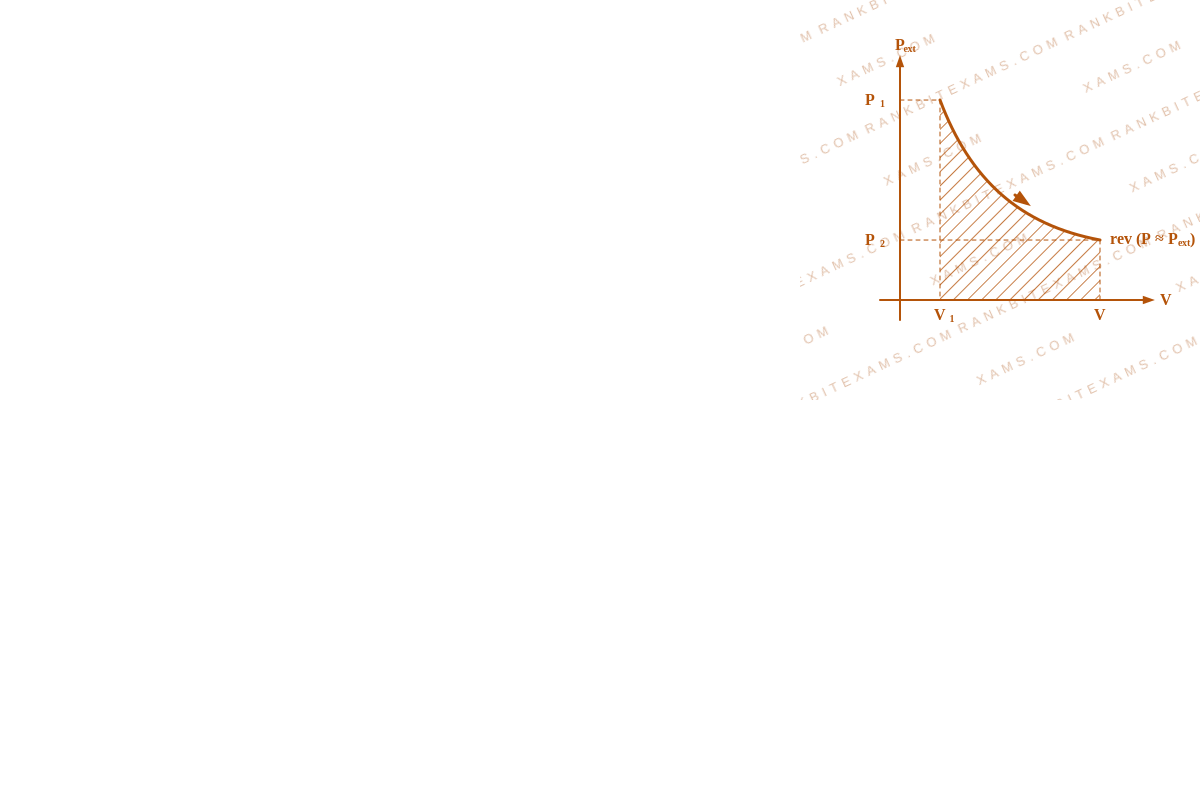
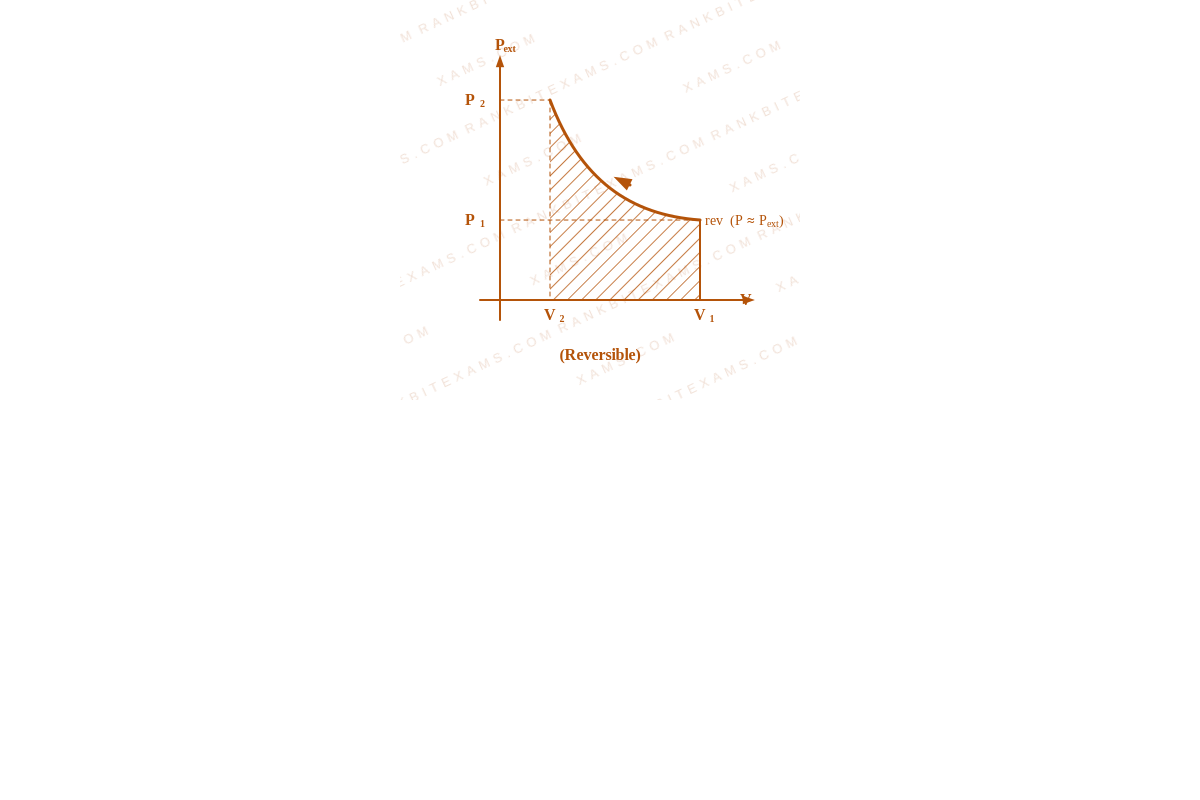
Reversible Path: Since a reversible compression path retraces the exact coordinates of the reversible expansion path, the magnitudes of work are equal:
|wrev, expansion| = |wrev, compression| a = c$$|w_{\text{rev, expansion}}| = |w_{\text{rev, compression}}| \implies a = c$$
P-V indicator diagrams comparing reversible and irreversible expansion/compression
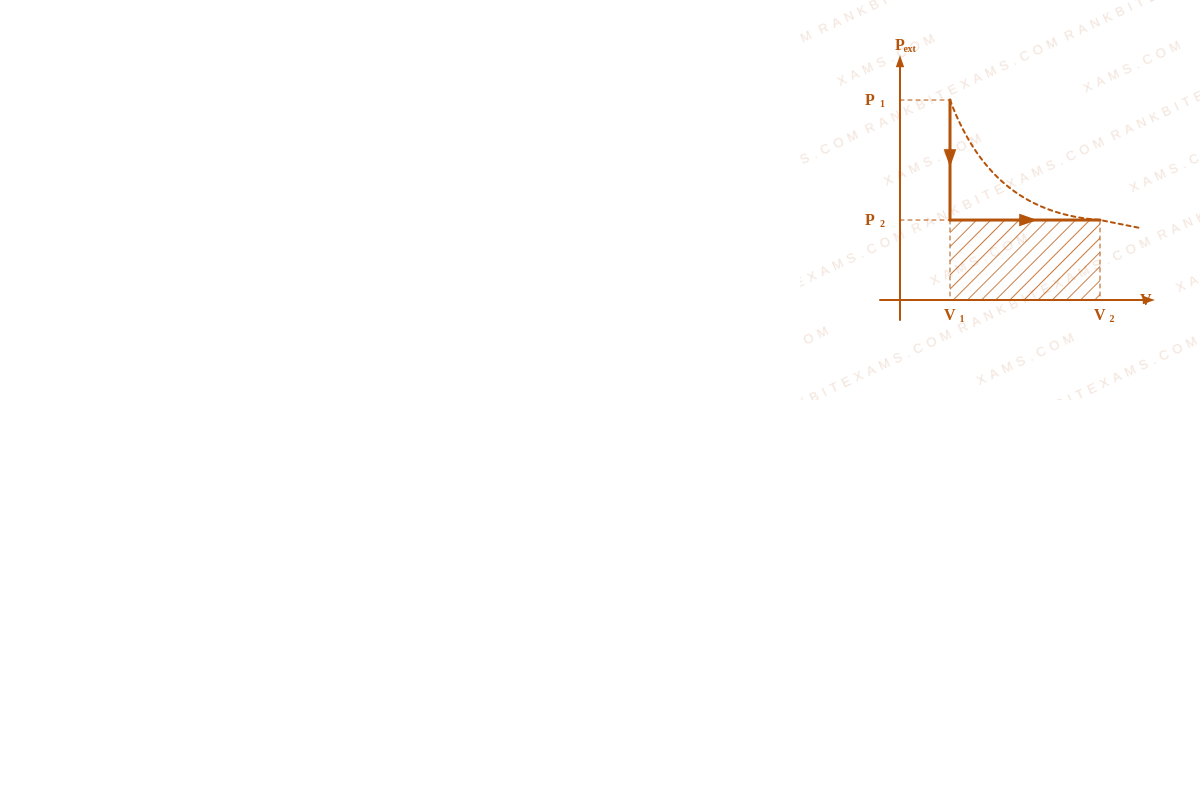
Isothermal Expansion: Reversible work magnitude is the maximum possible work. Hence, for expansion:
|wrev, expansion| > |wirrev, expansion| a > b$$|w_{\text{rev, expansion}}| > |w_{\text{irrev, expansion}}| \implies a > b$$
P-V indicator diagrams comparing reversible and irreversible expansion/compression
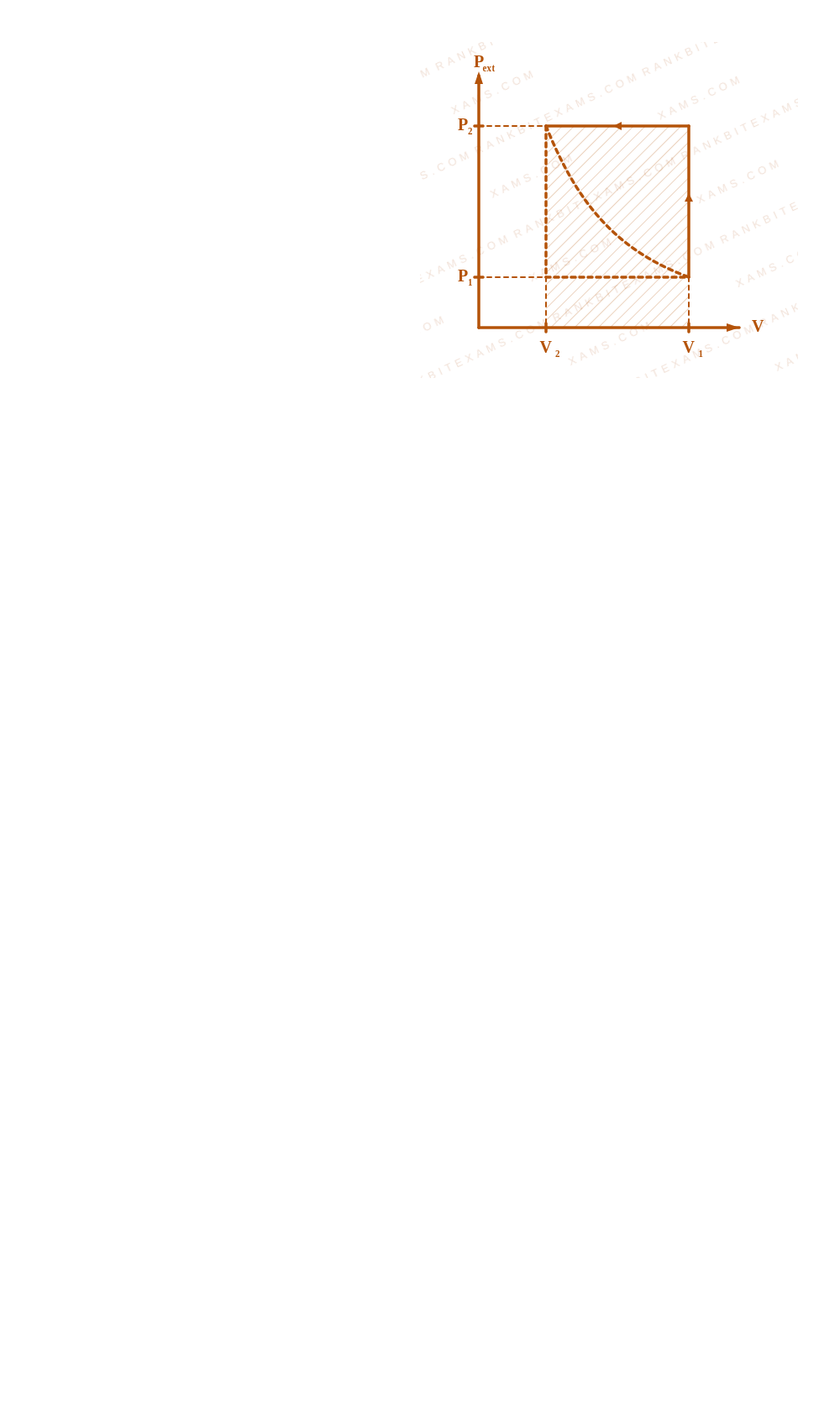
Isothermal Compression: Irreversible compression requires more work than reversible compression because of sudden pressure adjustments against the surroundings:
|wirrev, compression| > |wrev, compression| d > c$$|w_{\text{irrev, compression}}| > |w_{\text{rev, compression}}| \implies d > c$$
P-V indicator diagrams comparing reversible and irreversible expansion/compressionP-V indicator diagrams comparing reversible and irreversible expansion/compression
Step 1: Combine the inequalities
Combining the results:
We have a = c$a = c$
We have d > c$d > c$
We have a > b$a > b$
This leads to the strict inequality sequence:
d > c = a > b$d > c = a > b$
Pattern Recognition
Thermodynamics Principle: Reversible expansion is the most efficient (gives maximum work magnitude), whereas reversible compression is the most efficient (requires minimum work magnitude). Single-stage irreversible compression is always the least efficient, demanding the absolute highest work input.
According to Hess's Law, the net enthalpy change of a reaction is the sum of the enthalpy changes of the individual steps into which it can be divided.
We need 3 CO(g)$3 \mathrm{CO}_{(g)}$ on the product side, so we multiply reaction (2) by 3.
We need Fe₂O3(s)$\mathrm{Fe}_2\mathrm{O}_{3(s)}$ on the reactant side and 2 Fe(s)$2 \mathrm{Fe}_{(s)}$ on the product side, so we reverse reaction (1).
Qjee_main_2024_30_jan_morningWork Done in Cyclic Process
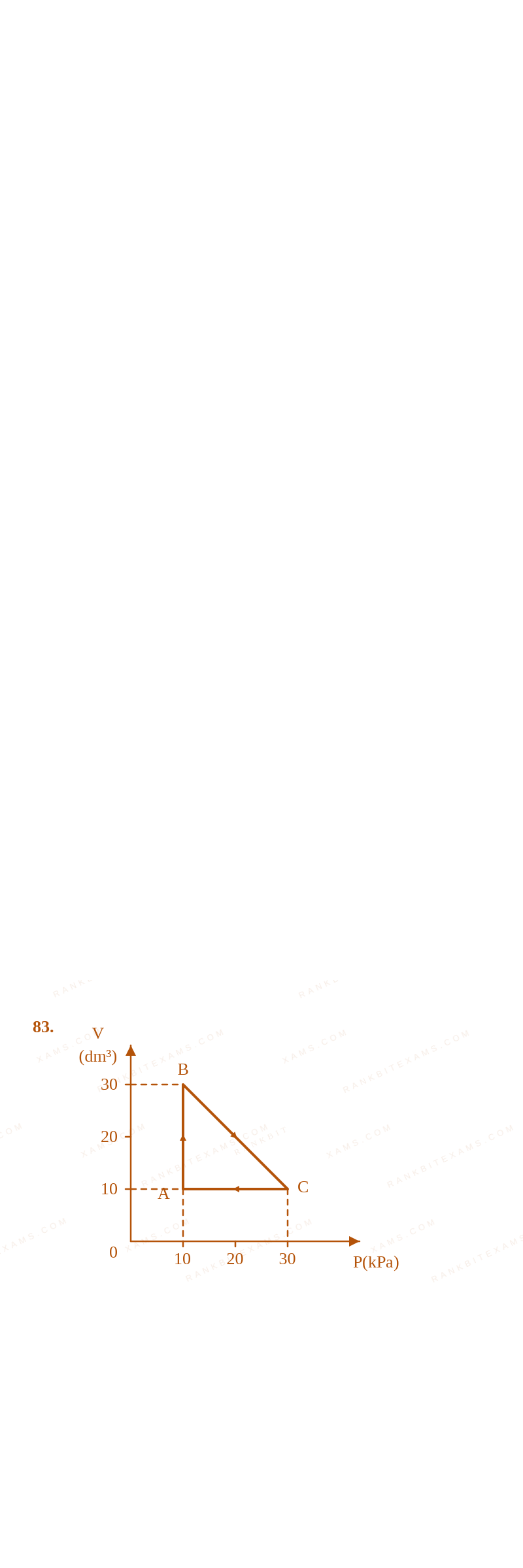
An ideal gas undergoes a cyclic transformation starting from the point A and coming back to the same point by tracing the path Aarrow Barrow Carrow A$A\rightarrow B\rightarrow C\rightarrow A$ as shown in the diagram. The total work done in the process is ________ J.
The image is a graph of Volume (dm3) vs Pressure (kPa) showing a triangular cyclic process starting from A(10,10) to B(10,30) to C(30,10) and back to A.
Numerical Answer.Answer: 200 to 200
Solution
Related Formula
Wcyclic = Area enclosed in P-V graph$$W_{\text{cyclic}} = \text{Area enclosed in P-V graph}$$
Core Logic
The work done in a cyclic process is equal to the magnitude of the area enclosed by the cycle on a Pressure-Volume graph.
Note that the provided graph is Volume (V$V$) on the y-axis versus Pressure (P$P$) on the x-axis.
The path A arrow B arrow C arrow A$A \rightarrow B \rightarrow C \rightarrow A$ is traced in a clockwise direction on the V$V$-P$P$ graph.
Clockwise on a V$V$-P$P$ graph corresponds to anti-clockwise on a standard P$P$-V$V$ graph, meaning net expansion work is done by the gas, making it positive conventionally (or negative depending on chemistry sign convention, but magnitude is asked for).
Step 1: Calculating Area
The enclosed region is a right-angled triangle.
Base of triangle on P-axis = 30 - 10 = 20 kPa$30 - 10 = 20 \text{ kPa}$
Height of triangle on V-axis = 30 - 10 = 20 dm³$30 - 10 = 20 \text{ dm}^3$
1 kPa · 1 L = 1 Joule$1 \text{ kPa} \cdot 1 \text{ L} = 1 \text{ Joule}$. This direct conversion saves time without converting explicitly to standard SI units (Pa$Pa$ and m³$m^3$).
Chapter Mix
Class 11 Chemistry: Thermodynamics
Q90jee_main_2024_31_jan_eveningWork Done in Isothermal Reversible Expansion
If 5 moles$5\text{ moles}$ of an ideal gas expands from 10 L$10\text{ L}$ to a volume of 100 L$100\text{ L}$ at 300 K$300\text{ K}$ under isothermal and reversible condition then work w$w$, is -x J$-x\text{ J}$. The value of x$x$ is ________
(Given R = 8.314 J K⁻¹mol⁻¹$R = 8.314\text{ J K}^{-1}\text{mol}^{-1}$)
For an isothermal and reversible expansion of an ideal gas, work is done by the system on the surroundings, hence it is negative by IUPAC convention.
Given:
n = 5 moles$n = 5\text{ moles}$R = 8.314 J K⁻¹mol⁻¹$R = 8.314\text{ J K}^{-1}\text{mol}^{-1}$T = 300 K$T = 300\text{ K}$V₁ = 10 L$V_1 = 10\text{ L}$V₂ = 100 L$V_2 = 100\text{ L}$
Practice past-year questions one chapter at a time. Pick an exam → subject → chapter and get every PYQ for that topic — pulled together from all past papers — with the chapter's key formulas alongside.
