Rankbit System
JEE Physics: Waves (+15.5%) | Electrostatics: Concentric Shells (-29.7%) | Modern Physics: Photoelectric Clones (+34.2%) | Mathematics: Definite Integrals (+18.1%) | Chemistry: Coordination Splitting (-11.4%) | JEE Physics: Waves (+15.5%) | Electrostatics: Concentric Shells (-29.7%) | Modern Physics: Photoelectric Clones (+34.2%) | Mathematics: Definite Integrals (+18.1%) | Chemistry: Coordination Splitting (-11.4%)

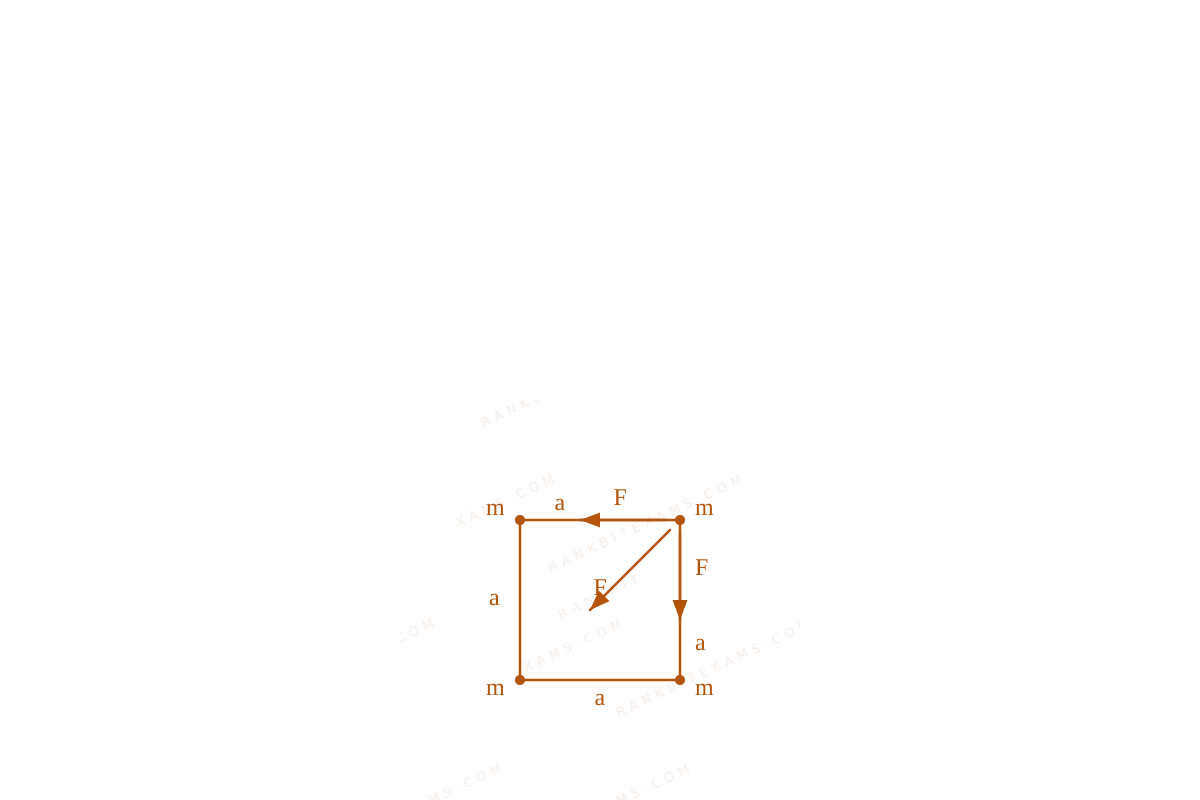
Four identical particles of mass m are kept at the four corners of a square. If the gravitational force exerted on one of the masses by the other masses is left(frac2sqrt2 + 132right)fracmathrmGm^2mathrmL^2, the length of the sides of the square is

Solution & Explanation

### Related Formula F = fracG m_1 m_2r^2 ### Core Logic
Superposition Principle diagram for Q37 - JEE Main 2024 Morning
Let the side length of the square be a. Considering one corner mass, it experiences forces from the adjacent two masses (distance a) and the diagonally opposite mass (distance sqrt2a). The forces from the two adjacent masses are at 90^circ to each other: F = fracGm^2a^2 The resultant of these two is sqrt2F = sqrt2 fracGm^2a^2, directed along the diagonal. ### Step 2: Total Force Equation The force from the diagonal mass is: F' = fracGm^2(sqrt2a)^2 = fracGm^22a^2 Total resultant force F_textnet = sqrt2F + F': F_textnet = sqrt2 fracGm^2a^2 + fracGm^22a^2 = fracGm^2a^2 left( sqrt2 + frac12 right) F_textnet = fracGm^2a^2 left( frac2sqrt2 + 12 right) Equating this to the given force value: left(frac2sqrt2 + 132right)fracGm^2L^2 = fracGm^2a^2 left( frac2sqrt2 + 12 right) frac132 L^2 = frac12 a^2 a^2 = 16 L^2 a = 4L ### Evaluation Rubric / Model Answer null ### Chapter Mix Class 11 Physics: Gravitation
Reference Study Guides

More Gravitation Previous-Year Questions — Page 2

Q6 jee_main_2025_07_april_evening Kepler's Laws of Planetary Motion
Given below are two statements: one is labelled as Assertion (A) and the other is labelled as Reason (R). Assertion (A): The radius vector from the Sun to a planet sweeps out equal areas in equal intervals of time and thus areal velocity of planet is constant. [cite: 55] Reason (R) For a central force field the angular momentum is a constant. [cite: 56] In the light of the above statements, choose the most appropriate answer from the options given below: [cite: 57]
  • A. Both (A) and (R) are correct and (R) is the correct explanation of (A) [cite: 63]
  • B. Both (A) and (R) are correct but (R) is not the correct explanation of (A) [cite: 65]
  • C. A is correct but R is not correct [cite: 72]
  • D. A is not correct but R is correct [cite: 73]

Solution

### Related Formula fracdAdt = fracL2m [cite: 684] ### Core Logic Kepler's Second Law state that the areal velocity fracdAdt is directly proportional to the angular momentum L of the planet[cite: 55, 684]. Because the gravitational force between the Sun and the planet acts strictly along the line joining their centers (a central force field), its torque vectau = vecr times vecF = 0[cite: 56, 686]. Since torque is zero, the angular momentum L remains completely constant over time[cite: 686]. As a consequence, fracdAdt = textconstant[cite: 55, 684]. Both statements are true and (R) is the correct explanation of (A)[cite: 63]. ### Pattern Recognition Areal velocity constancy is a direct geometric manifestation of the conservation of angular momentum under any central force field[cite: 55, 56, 686]. ### Evaluation Rubric / Model Answer null ### Chapter Mix Class 11 Physics: Gravitation

Q25 jee_main_2025_24_jan_evening Acceleration due to Gravity
Acceleration due to gravity on the surface of earth is 'g'. If the diameter of earth is reduced to one third of its original value and mass remains unchanged, then the acceleration due to gravity on the surface of the earth is ____ g.
Numerical Answer. Answer: 9 to 9

Solution

### Related Formula Surface gravitational acceleration: g = fracGMR^2 ### Core Logic Since diameter drops to 1/3, the radius R' also scales down to 1/3 its original value (R' = R/3), while mass M remains constant. New acceleration value g' calculation: g' = fracGM(R/3)^2 = 9 cdot fracGMR^2 = 9g The scaling factor is 9. ### Pattern Recognition Gravity follows an inverse-square law with respect to radius. Shrinking the radius by a factor of n increases surface gravity by n^2 if the mass is unchanged. ### Evaluation Rubric / Model Answer null ### Chapter Mix Class 11 Physics: Gravitation
Q14 jee_main_2025_24_jan_morning Kepler's Laws of Planetary Motion
A satellite is launched into a circular orbit of radius 'R' around the earth. A second satellite is launched into an orbit of radius 1.03 R. The time period of revolution of the second satellite is larger than the first one approximately by :-
  • A. 3%
  • B. 4.5%
  • C. 9%
  • D. 2.5%

Solution

### Related Formula By Kepler's Third Law of Planetary Motion, the square of the orbital period T is proportional to the cube of the orbital radius R: T^2 = K cdot R^3 ### Core Logic Taking logs and differentiating to find fractional errors for small changes: 2 fracDelta TT = 3 fracDelta RR fracDelta TT = frac32 left(fracDelta RR ight) ### Step 1: Computing Percentage Change The change in radius is Delta R = 1.03R - R = 0.03R, which means fracDelta RR = 0.03 or 3\% [cite: 106, 708]. Substitute this into our fraction scaling relation: fracDelta TT = frac32 times 0.03 = 0.045 = 4.5\% ### Pattern Recognition Power factors act as direct linear multipliers for small percentage shifts. Here, the scaling factor is simply frac32 times the radius change. ### Evaluation Rubric / Model Answer null ### Chapter Mix Class 11 Physics: Gravitation
Q11 jee_main_2025_28_jan_evening Escape Velocity
Earth has mass 8 \times and radius 2 \times that of a planet. If the escape velocity from the earth is 11.2 \, textkm/s , the escape velocity in textkm/s from the planet will be:
  • A. 11.2
  • B. 5.6
  • C. 2.8
  • D. 8.4

Solution

### Related Formula The expression for escape velocity from a spherical planetary body is given by: v_textescape = sqrtfrac2GMR ### Core Logic Let the planet's mass be M_P and its radius be R_P. According to the problem statement : * Earth's mass, M_E = 8 M_P implies fracM_PM_E = frac18 * Earth's radius, R_E = 2 R_P implies fracR_ER_P = 2 Taking the ratio of escape velocities : fracv_Pv_E = sqrtleft(fracM_PM_Eright) times left(fracR_ER_Pright) fracv_Pv_E = sqrtfrac18 times 2 = sqrtfrac14 = frac12 Given that v_E = 11.2 text km/s: v_P = frac12 times 11.2 = 5.6 text km/s ### Pattern Recognition Setting up quick ratios prevents substitution mistakes. For any planetary variant, notice how scaling properties scale inside the root operator directly. ### Evaluation Rubric / Model Answer null ### Chapter Mix Class 11 Physics: Gravitation
Q32 jee_main_2024_01_february_morning Acceleration Due to Gravity
If R is the radius of the earth and the acceleration due to gravity on the surface of earth is g = pi^2 mathrm~m/s^2, then the length of the second's pendulum at a height h = 2R from the surface of earth will be:
  • A. frac29mathrm~m
  • B. frac19mathrm~m
  • C. frac49mathrm~m
  • D. frac89mathrm~m

Solution

### Related Formula Variation of g with height: g' = gleft(fracRR+hright)^2 Time period of a simple pendulum: T = 2pisqrtfraclg' ### Core Logic Given height h = 2R, the effective acceleration due to gravity becomes: g' = gleft(fracRR+2Rright)^2 = fracg9 For a second's pendulum, the time period is defined exactly as T = 2mathrm~s. ### Step 1: Calculate Length Substitute T = 2mathrm~s and g' = fracg9 into the time period formula: 2 = 2pisqrtfraclg/9 1 = pisqrtfrac9lg Squaring both sides: 1 = pi^2 cdot frac9lg Since g = pi^2 mathrm~m/s^2: 1 = 9l implies l = frac19mathrm~m ### Pattern Recognition Second's pendulum always has T = 2mathrm~s. Height 2R from the surface means a total distance of 3R from the center, which yields a frac19 drop in gravity. ### Evaluation Rubric / Model Answer null ### Chapter Mix Class 11 Physics: Gravitation Class 11 Physics: Oscillations

More Gravitation Questions — jee_main_2024_31_jan_morning

Practice all Gravitation previous-year questions →

YOUR FIRST PREP STEP STARTS HERE

We Map Every Repeating Question in Competitive Exams.

Say goodbye to generic mock test fatigue. RankBit uses smart analysis to group past exam questions into their foundational Repeating Question Types. Find chapter weightage, track repeating questions, and score higher with targeted practice.

Select Your Target Exam

Choose an exam track below to find formulas per chapter and patterns.

Syncing Exam Intelligence

Mapping formulas and patterns across all tracks…

PATH A — FULL LENGTH PRACTICE

Full Mock Test Hub

Simulate real NTA exam conditions with fully tracked mocks. Time yourself against past papers.

Under Development
PATH B — TARGETED PRACTICE

Topic-wise Practice Hub

Practice past-year questions one chapter at a time. Pick an exam → subject → chapter and get every PYQ for that topic — pulled together from all past papers — with the chapter's key formulas alongside.

Loading Questions... Browse Topics
Latest from the Blog
View all →

Loading articles...