Rankbit System
JEE Physics: Waves (+15.5%) | Electrostatics: Concentric Shells (-29.7%) | Modern Physics: Photoelectric Clones (+34.2%) | Mathematics: Definite Integrals (+18.1%) | Chemistry: Coordination Splitting (-11.4%) | JEE Physics: Waves (+15.5%) | Electrostatics: Concentric Shells (-29.7%) | Modern Physics: Photoelectric Clones (+34.2%) | Mathematics: Definite Integrals (+18.1%) | Chemistry: Coordination Splitting (-11.4%)

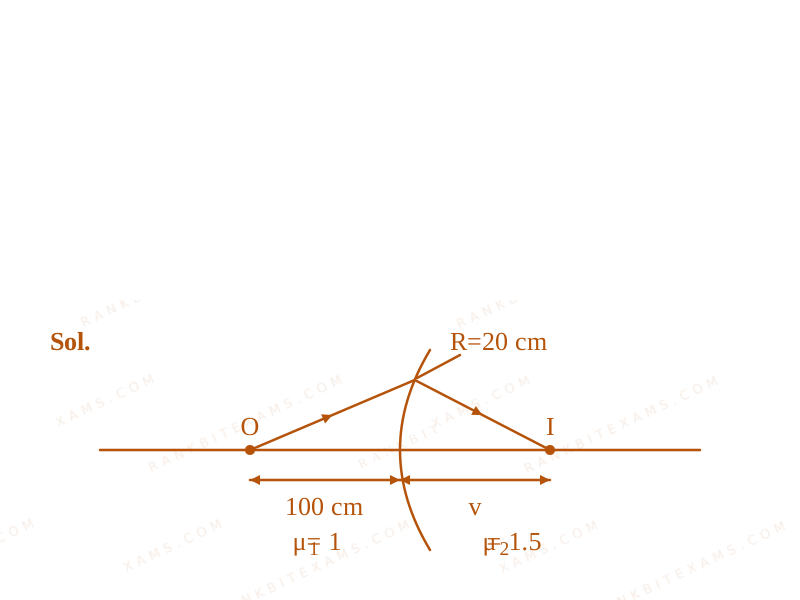
Light from a point source in air falls on a convex curved surface of radius 20 text cm and refractive index 1.5. If the source is located at 100 text cm from the convex surface, the image will be formed at ______ cm from the object.

Numerical Answer Type:
Enter a numerical value Answer: 200 to 200 +4 marks

Solution & Explanation

### Related Formula fracmu_2v - fracmu_1u = fracmu_2 - mu_1R ### Core Logic For a convex refracting surface, the radius of curvature R is positive if the center of curvature lies in the denser medium. mu_1 = 1 text (air) mu_2 = 1.5 text (glass/medium) u = -100 text cm R = +20 text cm
Refraction at Spherical Surfaces diagram for Q52 - JEE Main 2024 Evening
### Step 1: Calculate Image Position frac1.5v - frac1-100 = frac1.5 - 120 frac1.5v + frac1100 = frac0.520 frac1.5v = frac140 - frac1100 frac1.5v = frac5 - 2200 = frac3200 v = frac1.5 times 2003 = 100 text cm ### Step 2: Distance from Object The image is formed at v = +100 text cm from the pole, which is on the other side of the surface. The object is at |u| = 100 text cm from the pole. Distance between object and image = |u| + v = 100 + 100 = 200 text cm. ### Pattern Recognition Always read the final line of optics questions carefully. The question asks for distance "from the object" not "from the surface/pole". This is a classic trap where students answer 100 instead of 200. ### Evaluation Rubric / Model Answer null ### Chapter Mix Class 12 Physics: Ray Optics and Optical Instruments

Reference Study Guides

More Ray Optics and Optical Instruments Previous-Year Questions — Page 7

Q13 jee_main_2025_28_jan_evening Reflection by Spherical Mirrors
A concave mirror produces an image of an object such that the distance between the object and image is 20 \, textcm. If the magnification of the image is -3' , then the magnitude of the radius of curvature of the mirror is:
  • A. 3.75mathrmcm
  • B. 30mathrmcm
  • C. 7.5mathrmcm
  • D. 15mathrmcm

Solution

### Related Formula Magnification m of a mirror is given by: m = -fracvu The mirror equation relates focal length to distance positions: frac1f = frac1v + frac1u implies f = fracuvu+v Radius of curvature R = 2f. ### Core Logic Given, magnification m = -3. This tells us the image is real and inverted[cite: 131, 757]: -3 = -fracvu implies v = 3u Since both real objects and real images lie on the same side in front of a concave mirror, u and v are both negative fields. The physical distance separation between them is: |v| - |u| = 20 implies 3|u| - |u| = 20 implies 2|u| = 20 implies |u| = 10 text cm Therefore, object distance u = -10 text cm and image distance v = -30 text cm . Substitute into the focal equation formula: f = frac(-10)(-30)-10 - 30 = frac300-40 = -7.5 text cm R = 2 times |f| = 2 times 7.5 = 15 text cm ### Step 1: Visual Diagram The visual positioning profile tracking focal path boundaries is given below:
Reflection by Spherical Mirrors diagram for Q13 - JEE Main 2025 Evening
### Pattern Recognition A magnification of -3 tells you immediately that the object lies between the Focus (F) and Center of Curvature (C), while the image forms beyond C. This geometric layout instantly verifies that the radius value must exceed 10text cm. ### Evaluation Rubric / Model Answer null ### Chapter Mix Class 12 Physics: Ray Optics
Q jee_main_2025_29_jan_morning Total Internal Reflection
At the interface between two materials having refractive indices n_1 and n_2 , the critical angle for reflection of an em wave is theta_1C . The n_2 material is replaced by another material having refractive index n_3 , such that the critical angle at the interface between n_1 and n_3 materials is theta_2C . If n_3 > n_2 > n_1 ; fracn_2n_3 = frac25 and sin theta_2C - sin theta_1C = frac12 , then theta_1C is
  • A. sin^-1left(frac16n_1right)
  • B. sin^-1left(frac23n_1 ight)
  • C. sin^-1left(frac56mathrmn_1 ight)
  • D. sin^-1left(frac13n_1 ight)

Solution

### Core Logic Critical angle setups dictate [cite: 613, 614]: sin theta_1C = fracn_1n_2, quad sin theta_2C = fracn_1n_3 [cite: 613, 614] Given sin theta_2C - sin theta_1C = frac12 [cite: 2, 615]: fracn_1n_3 - fracn_1n_2 = frac12 implies n_1 left(frac25 - 1right) = fracn_22 [cite: 617, 619, 621] fracn_1n_2 = -frac56 This produces an impossible negative value for a refractive index ratio, meaning the data contains a contradiction. This question was dropped by NTA.
Q jee_main_2025_29_jan_morning Lenses
Let mathbfu and mathbfv be the distances of the object and the image from a lens of focal length f . The correct graphical representation of mathbfu and mathbfv for a convex lens when |mathbfu| > f , is
  • A. {{IMG_OPT1}}
  • B. {{IMG_OPT2}}
  • C. {{IMG_OPT3}}
  • D. {{IMG_OPT4}}

Solution

### Related Formula (u+f)(v-f) = f^2 ### Core Logic
Lens formula explanation curves
By rewriting the lens equation coordinates with respect to the focal focuses, we track a rectangular hyperbola structure. In the quadrant satisfying |u| > f, the matching curvature coordinates belong strictly to the profile shown in option (2). ### Chapter Mix Class 12 Physics: Ray Optics and Optical Instruments

Q jee_main_2025_29_jan_morning Refraction
Two light beams fall on a transparent material block at point 1 and 2 with angle theta_1 and theta_2 , respectively, as shown in figure. After refraction, the beams intersect at point 3 which is exactly on the interface at other end of the block. Given: the distance between 1 and 2, d = 4sqrt3 mathrm~cm and theta_1 = theta_2 = cos^-1left(fracn_22n_1right) , where refractive index of the block n_2 > refractive index of the outside medium n_1 , then the thickness of the block is ______ cm.
Refraction diagram for Q23 - JEE Main 2025 Morning
The figure details dual incident light lines penetrating an index slab layer to converge perfectly at a pinpoint terminal base boundary position.
Numerical Answer. Answer: 6 to 6

Solution

### Related Formula n_1 sin i = n_2 sin r ### Core Logic
Refraction explanation geometric mapping
The figure details dual incident light lines penetrating an index slab layer to converge perfectly at a pinpoint terminal base boundary position.
By Snell\'s law matching standard boundary normal configurations : n_1 sin(90^circ - theta_1) = n_2 sin theta_3 implies n_1 cos theta_1 = n_2 sin theta_3 [cite: 711, 712] Substituting the angle identity macro given [cite: 2, 713]: n_1 left(fracn_22n_1right) = n_2 sin theta_3 implies sin theta_3 = frac12 implies theta_3 = 30^circ ### Step 1: Geometrical Thickness Resolution From the block triangles geometry : tan 30^circ = fracd/2t implies frac1sqrt3 = fracd2t t = fracdsqrt32 = frac4sqrt3 cdot sqrt32 = 6text cm ### Chapter Mix Class 12 Physics: Ray Optics and Optical Instruments

Q53 jee_main_2024_01_february_morning Lenses
The distance between object and its 3 times magnified virtual image as produced by a convex lens is 20mathrm~cm. The focal length of the lens used is _______ mathrmcm.
Numerical Answer. Answer: 15 to 15

Solution

### Related Formula Lens magnification formula: m = fracvu Thin lens equation: frac1v - frac1u = frac1f ### Core Logic For a virtual image formed by a convex lens, both the object and the image lie on the same side of the lens. The image distance is three times the object distance: v = 3u The distance between the object and its virtual image is given as 20mathrm~cm: v - u = 20mathrm~cm implies 3u - u = 20mathrm~cm 2u = 20mathrm~cm implies u = 10mathrm~cm Applying Cartesian sign conventions: object distance u = -10mathrm~cm and image distance v = -30mathrm~cm. ### Step 1: Calculate Focal Length Substitute these values into the lens formula: frac1-30 - frac1-10 = frac1f -frac130 + frac110 = frac1f frac-1 + 330 = frac230 = frac115 = frac1f implies f = 15mathrm~cm ### Pattern Recognition A virtual image from a convex lens means the object is placed inside the focal point (u < f). This serves as a quick sanity check for your final value (10mathrm~cm < 15mathrm~cm). ✓ ### Evaluation Rubric / Model Answer null ### Chapter Mix Class 12 Physics: Ray Optics and Optical Instruments

More Ray Optics and Optical Instruments Questions — jee_main_2024_31_jan_evening

Practice all Ray Optics and Optical Instruments previous-year questions →

YOUR FIRST PREP STEP STARTS HERE

We Map Every Repeating Question in Competitive Exams.

Say goodbye to generic mock test fatigue. RankBit uses smart analysis to group past exam questions into their foundational Repeating Question Types. Find chapter weightage, track repeating questions, and score higher with targeted practice.

Select Your Target Exam

Choose an exam track below to find formulas per chapter and patterns.

Syncing Exam Intelligence

Mapping formulas and patterns across all tracks…

PATH A — FULL LENGTH PRACTICE

Full Mock Test Hub

Simulate real NTA exam conditions with fully tracked mocks. Time yourself against past papers.

Under Development
PATH B — TARGETED PRACTICE

Topic-wise Practice Hub

Practice past-year questions one chapter at a time. Pick an exam → subject → chapter and get every PYQ for that topic — pulled together from all past papers — with the chapter's key formulas alongside.

Loading Questions... Browse Topics
Latest from the Blog
View all →

Loading articles...