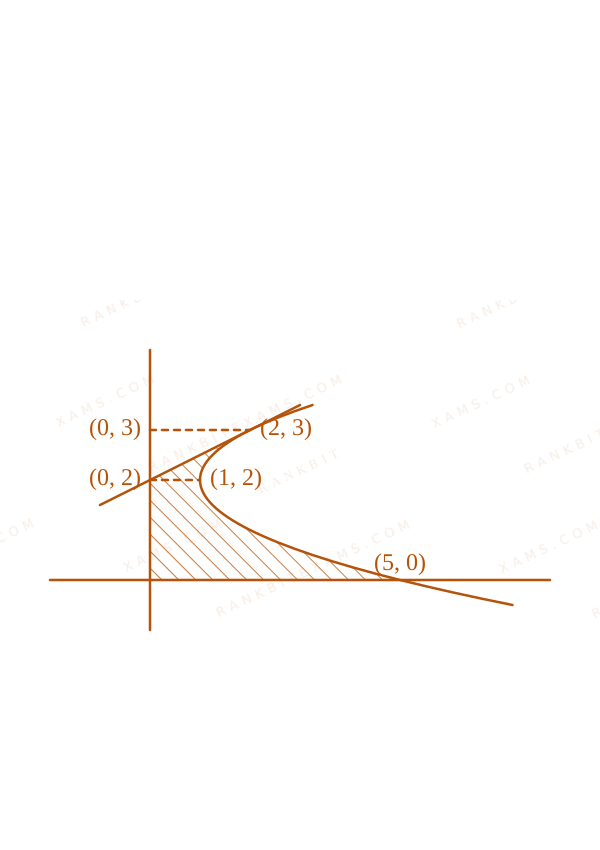
The area of the region enclosed by the parabola (y - 2)² = x - 1$(y - 2)^2 = x - 1$ , the line x - 2y + 4 = 0$x - 2y + 4 = 0$ and the positive coordinate axes is
The line is tangent to the parabola at y = 3$y = 3$. At y = 3$y = 3$, x = 2(3) - 4 = 2$x = 2(3) - 4 = 2$.
We need the area enclosed by the parabola, the line, and the positive coordinate axes.
Let's trace the boundary intercepts.
The line x = 2y - 4$x = 2y - 4$ cuts the y-axis (x=0$x=0$) at y=2$y=2$.
Parabola vertex is at (1, 2)$(1, 2)$. Parabola cuts y-axis (x=0$x=0$) at (y-2)² = -1$(y-2)^2 = -1$ (No real y-intercept).
So the curve (y-2)² = x-1$(y-2)^2 = x-1$ only exists for x ≥ 1$x \ge 1$.
Step 1: Setting up the Integral w.r.t y
Area Under Curve diagram for Q29 - JEE Main 2024 Evening
Because the area is bound by the positive coordinate axes, we track integration strictly in the first quadrant.
The required area is the area between the y-axis, the x-axis, the line, and the curve. Wait, the problem says "area enclosed by the parabola... line... and positive coordinate axes".
Let's integrate with respect to y$y$.
The boundary curves are x = (y-2)² + 1$x = (y-2)^2 + 1$ (which forms the rightmost boundary) and the axes.
The area bounded by the curve with y-axis is from y=0$y=0$ to y=3$y=3$ minus the triangular region cut by the line below y=2$y=2$.
The line intersects the x-axis (y=0$y=0$) at x=-4$x=-4$ and y-axis (x=0$x=0$) at y=2$y=2$.
The positive coordinate axes enforce boundaries at x ≥ 0, y ≥ 0$x \ge 0, y \ge 0$.
So the exact area is the integral of the parabola's x$x$-value from y=0$y=0$ to y=3$y=3$, minus the area of the small triangle outside the region bounded by the line x=2y-4$x=2y-4$ and the axes in the positive quadrant.
The area under the parabola (to the left towards the y-axis) from y=0$y=0$ to y=3$y=3$ is ∫₀³ xparabola dy$\int_0^3 x_{\text{parabola}} dy$.
The line bounds the region on the left from y=2$y=2$ to y=3$y=3$. Between y=0$y=0$ and y=2$y=2$, the area goes fully to the y-axis.
So, area = ∫₀³ xparabola dy - Area of Δ bounded by line and y-axis$\int_0^3 x_{\text{parabola}} dy - \text{Area of } \Delta \text{ bounded by line and y-axis}$.
The triangle bounded by x=2y-4, x=0, y=2, y=3$x=2y-4, x=0, y=2, y=3$ is: base is x=2(3)-4 = 2$x=2(3)-4 = 2$ at y=3$y=3$, height is 1$1$ (from y=2$y=2$ to y=3$y=3$). Triangle area = (1)/(2) × 2 × 1 = 1$\frac{1}{2} \times 2 \times 1 = 1$.
Hence, Enclosed Area = ∫₀³ ((y-2)² + 1) dy - 1$\int_{0}^{3} ((y-2)^2 + 1) dy - 1$.
Instead of evaluating horizontal strips with a broken left-bound, evaluate the total area mapped to the y-axis ∫₀³ x dy$\int_0^3 x dy$ and simply subtract the basic geometric triangle removed by the straight line.
Keywords:#Area bounded by parabola and line#JEE Main 2024 Evening Q29#Integral Calculus JEE Main 2024#Area Under Curve JEE Main 2024
More Integral Calculus Previous-Year Questions — Page 9
Qjee_main_2025_28_jan_eveningIntegration by Parts
Let f: Rarrow R$f:\mathbb{R}\rightarrow\mathbb{R}$ be a twice differentiable function such that f(2)=1$f(2)=1$. If F(x)=xf(x)$F(x)=xf(x)$ for all xin R$x\in\mathbb{R}$, ∫₀²xF(x)dx=6$\int_{0}^{2}xF^{\prime}(x)dx=6$ and ∫₀²x²F(x)dx=40$\int_{0}^{2}x^{2}F^{\prime\prime}(x)dx=40$, then F(2)+∫₀²F(x)dx$F^{\prime}(2)+\int_{0}^{2}F(x)dx$ is equal to:
A.11$11$
B.15$15$
C.6$6$
D.13$13$
Solution
Related Formula
Integration by Parts formula:
∫ u · v dx = u ∫ v dx - ∫ ( u' ∫ v dx ) dx$$\int u \cdot v \, dx = u \int v \, dx - \int \left( u' \int v \, dx \right) dx$$
We need to find F'(2) + ∫₀² F(x) dx$F'(2) + \int_{0}^{2} F(x) dx$:
13 + (-2) = 11$13 + (-2) = 11$
Pattern Recognition
Notice how the definition of f(x)$f(x)$ is mostly a distraction to find F(2)=2$F(2)=2$. The problem is fundamentally testing consecutive applications of integration by parts to reduction structures.
Chapter Mix
Class 12 Mathematics: Definite Integration
Q57jee_main_2025_28_jan_eveningLeibnitz Rule and Definite Integral
Let f be a real valued continuous function defined on the positive real axis such that g(x)=∫₀xtf(t)dt$g(x)=\int_{0}^{x}tf(t)dt$. If g(x³)=x⁶+x⁷$g(x^{3})=x^{6}+x^{7}$ then value of Σr=1¹⁵f(r³)$\sum_{r=1}^{15}f(r^{3})$ is:
A.320$320$
B.340$340$
C.270$270$
D.310$310$
Solution
Related Formula
Newton-Leibnitz Theorem for differentiation under integral sign:
Converting g(x³)$g(x^3)$ directly into a function of variable y=x³$y=x^3$ prevents multi-layer chain rule complications when applying differentiation immediately.
Chapter Mix
Class 11 Mathematics: Sequences and Series
Class 12 Mathematics: Definite Integration
Q66jee_main_2025_29_jan_morningIntegration by Substitution
The integral 80∫₀(π)/(4)(( θ + θ)/(9 + 16 2θ))dθ$80\int_{0}^{\frac{\pi}{4}}\left(\frac{\sin\theta + \cos\theta}{9 + 16\sin 2\theta}\right)\mathrm{d}\theta$ is equal to:
Whenever ( θ + θ)$(\sin\theta + \cos\theta)$ sits inside the numerator, instantly choose t = θ - θ$t = \sin\theta - \cos\theta$ as your core linear substitution engine to clean denominators.
Chapter Mix
Class 12 Mathematics: Definite Integrals
Q71jee_main_2025_29_jan_morningFunctional Equations with Integrals
Let f: (0, ∞) → R$f: (0, \infty) \to \mathbf{R}$ be a twice differentiable function. If for some a ≠ 0$a \neq 0$ , ∫₀¹ f(λ x) dλ = a f(x)$\int_{0}^{1} f(\lambda x) \, \mathrm{d}\lambda = a f(x)$ , f(1) = 1$f(1) = 1$ and f(16) = (1)/(8)$f(16) = \frac{1}{8}$ , then 16 - f'((1)/(16))$16 - f'(\frac{1}{16})$ is equal to
Numerical Answer.Answer: 112
Solution
Related Formula
Leibniz Integral Rule for differentiation: (d)/(dx)∫₀x f(t) dt = f(x)$$\text{Leibniz Integral Rule for differentiation: } \frac{d}{dx}\int_{0}^{x} f(t) \, dt = f(x)$$
Core Logic
Perform variable substitution inside the integral: let λ x = t dλ = (1)/(x) dt$\lambda x = t \implies d\lambda = \frac{1}{x} dt$.
When λ = 0 t = 0$\lambda = 0 \implies t = 0$; when λ = 1 t = x$\lambda = 1 \implies t = x$.
The equation transforms to:
(1)/(x) ∫₀x f(t) dt = a f(x) ∫₀x f(t) dt = a x f(x)$$\frac{1}{x} \int_{0}^{x} f(t) \, dt = a f(x) \implies \int_{0}^{x} f(t) \, dt = a x f(x)$$
Step 1: Differentiate with respect to x
Using Leibniz rule and product rule:
f(x) = a [x f'(x) + f(x)]$$f(x) = a [x f'(x) + f(x)]$$(1 - a)f(x) = a x f'(x) (f'(x))/(f(x)) = (1-a)/(a) (1)/(x)$$(1 - a)f(x) = a x f'(x) \implies \frac{f'(x)}{f(x)} = \frac{1-a}{a} \frac{1}{x}$$
Integrating both sides yields:
ln f(x) = ((1-a)/(a))ln x + c f(x) = C x(1-a)/(a)$$\ln f(x) = \left(\frac{1-a}{a}\right)\ln x + c \implies f(x) = C x^{\frac{1-a}{a}}$$
Step 2: Calculate Constants using boundaries
Given f(1) = 1 C = 1$f(1) = 1 \implies C = 1$.
Given f(16) = (1)/(8) (1)/(8) = (16)(1-a)/(a) 2⁻³ = (2⁴)(1-a)/(a)$f(16) = \frac{1}{8} \implies \frac{1}{8} = (16)^{\frac{1-a}{a}} \implies 2^{-3} = (2^4)^{\frac{1-a}{a}}$
I = ∫₀(π)/(4) x dx ⁴(2x)+ ⁴(2x)$$I = \int_{0}^{\frac{\pi}{4}}\frac{x \, dx}{\sin^{4}(2x)+\cos^{4}(2x)}$$
Substitute 2x = t 2dx = dt dx = (1)/(2)dt$2x = t \implies 2dx = dt \implies dx = \frac{1}{2}dt$.
When x = 0 t = 0$x = 0 \implies t = 0$, and when x = (π)/(4) t = (π)/(2)$x = \frac{\pi}{4} \implies t = \frac{\pi}{2}$.
Let t = y ²t dt = dy$\tan t = y \implies \sec^{2}t \, dt = dy$.
When t = 0 y = 0$t = 0 \implies y = 0$, and when t = (π)/(2) y = ∞$t = \frac{\pi}{2} \implies y = \infty$.
Now put y - (1)/(y) = p (1 + 1y²) dy = dp$y - \frac{1}{y} = p \implies \left(1 + \frac{1}{y^{2}}\right) dy = dp$.
When y → 0^+ p → -∞$y \to 0^+ \implies p \to -\infty$, and when y → ∞ p → ∞$y \to \infty \implies p \to \infty$.
Also, y² + 1y² = p² + 2 = p² + (√(2))²$y^{2} + \frac{1}{y^{2}} = p^{2} + 2 = p^{2} + (\sqrt{2})^{2}$.
xin the numerator and symmetric trigonometric functions in the denominator. Shortcut: The elimination of$ in the numerator and symmetric trigonometric functions in the denominator.
Shortcut: The elimination of $xusing King's property is standard. For integrals containing$ using King's property is standard. For integrals containing $\frac{1+y^2}{1+y^4}, dividing by$, dividing by $y^2transforms the denominator into a perfect square form$ transforms the denominator into a perfect square form $\left(y-\frac{1}{y}\right)^2+2$, making substitution trivial.
Chapter Mix
Class 12 Mathematics: Definite Integrals
Class 11 Mathematics: Trigonometric Identities
More Integral Calculus Questions — jee_main_2024_30_january_evening
Practice past-year questions one chapter at a time. Pick an exam → subject → chapter and get every PYQ for that topic — pulled together from all past papers — with the chapter's key formulas alongside.