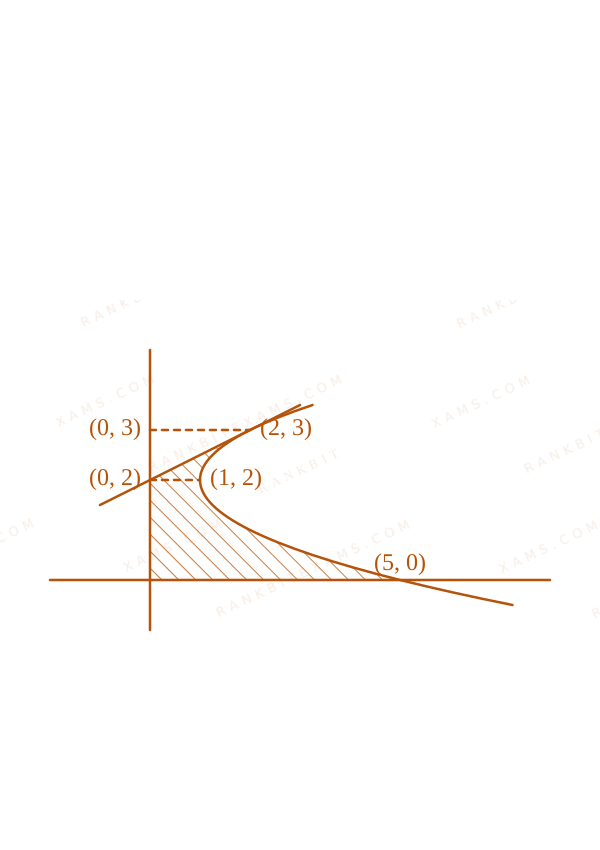
The area of the region enclosed by the parabola (y - 2)² = x - 1$(y - 2)^2 = x - 1$ , the line x - 2y + 4 = 0$x - 2y + 4 = 0$ and the positive coordinate axes is
The line is tangent to the parabola at y = 3$y = 3$. At y = 3$y = 3$, x = 2(3) - 4 = 2$x = 2(3) - 4 = 2$.
We need the area enclosed by the parabola, the line, and the positive coordinate axes.
Let's trace the boundary intercepts.
The line x = 2y - 4$x = 2y - 4$ cuts the y-axis (x=0$x=0$) at y=2$y=2$.
Parabola vertex is at (1, 2)$(1, 2)$. Parabola cuts y-axis (x=0$x=0$) at (y-2)² = -1$(y-2)^2 = -1$ (No real y-intercept).
So the curve (y-2)² = x-1$(y-2)^2 = x-1$ only exists for x ≥ 1$x \ge 1$.
Step 1: Setting up the Integral w.r.t y
Area Under Curve diagram for Q29 - JEE Main 2024 Evening
Because the area is bound by the positive coordinate axes, we track integration strictly in the first quadrant.
The required area is the area between the y-axis, the x-axis, the line, and the curve. Wait, the problem says "area enclosed by the parabola... line... and positive coordinate axes".
Let's integrate with respect to y$y$.
The boundary curves are x = (y-2)² + 1$x = (y-2)^2 + 1$ (which forms the rightmost boundary) and the axes.
The area bounded by the curve with y-axis is from y=0$y=0$ to y=3$y=3$ minus the triangular region cut by the line below y=2$y=2$.
The line intersects the x-axis (y=0$y=0$) at x=-4$x=-4$ and y-axis (x=0$x=0$) at y=2$y=2$.
The positive coordinate axes enforce boundaries at x ≥ 0, y ≥ 0$x \ge 0, y \ge 0$.
So the exact area is the integral of the parabola's x$x$-value from y=0$y=0$ to y=3$y=3$, minus the area of the small triangle outside the region bounded by the line x=2y-4$x=2y-4$ and the axes in the positive quadrant.
The area under the parabola (to the left towards the y-axis) from y=0$y=0$ to y=3$y=3$ is ∫₀³ xparabola dy$\int_0^3 x_{\text{parabola}} dy$.
The line bounds the region on the left from y=2$y=2$ to y=3$y=3$. Between y=0$y=0$ and y=2$y=2$, the area goes fully to the y-axis.
So, area = ∫₀³ xparabola dy - Area of Δ bounded by line and y-axis$\int_0^3 x_{\text{parabola}} dy - \text{Area of } \Delta \text{ bounded by line and y-axis}$.
The triangle bounded by x=2y-4, x=0, y=2, y=3$x=2y-4, x=0, y=2, y=3$ is: base is x=2(3)-4 = 2$x=2(3)-4 = 2$ at y=3$y=3$, height is 1$1$ (from y=2$y=2$ to y=3$y=3$). Triangle area = (1)/(2) × 2 × 1 = 1$\frac{1}{2} \times 2 \times 1 = 1$.
Hence, Enclosed Area = ∫₀³ ((y-2)² + 1) dy - 1$\int_{0}^{3} ((y-2)^2 + 1) dy - 1$.
Instead of evaluating horizontal strips with a broken left-bound, evaluate the total area mapped to the y-axis ∫₀³ x dy$\int_0^3 x dy$ and simply subtract the basic geometric triangle removed by the straight line.
Keywords:#Area bounded by parabola and line#JEE Main 2024 Evening Q29#Integral Calculus JEE Main 2024#Area Under Curve JEE Main 2024
More Integral Calculus Previous-Year Questions — Page 10
Q28jee_main_2024_01_february_morningProperties of Definite Integrals
If ∫-π/2π/2 8√(2) x dx(1+ex)(1+ ⁴x)=απ+β ₑ(3+2√(2)),$\int_{-\pi/2}^{\pi/2}\frac{8\sqrt{2}\cos x\,dx}{(1+e^{\sin x})(1+\sin^{4}x)}=\alpha\pi+\beta \log_{e}(3+2\sqrt{2}),$ where α, β$\alpha, \beta$ are integers, then α²+β²$\alpha^{2}+\beta^{2}$ equals
If ∫ (3)/(2) x + (3)/(2) x√( ³ x ³ x (x - θ)) d x = A √( θ x - θ) + B √( θ - θ x) + C$\int \frac{\sin^{\frac{3}{2}} x + \cos^{\frac{3}{2}} x}{\sqrt{\sin^3 x \cos^3 x \sin (x - \theta)}} d x = A \sqrt{\cos \theta \tan x - \sin \theta} + B \sqrt{\cos \theta - \sin \theta \cot x} + C$, where C$C$ is the integration constant, then AB$AB$ is equal to
A.4sec(2θ)$4\mathrm{sec}(2\theta)$
B.4 θ$4\sec \theta$
C.2 θ$2\sec \theta$
D.8secec(2θ)$8\mathrm{sec}\mathrm{ec}(2\theta)$
Solution
Related Formula
(x - θ) = x θ - x θ$$\sin(x - \theta) = \sin x \cos \theta - \cos x \sin \theta$$
Core Logic
Let us partition the given integral I$I$ into two clean parts I₁$I_1$ and I₂$I_2$:
I = ∫ 3/2 x√( ³ x ³ x ( x θ - x θ)) dx + ∫ 3/2 x√( ³ x ³ x ( x θ - x θ)) dx$$I = \int \frac{\sin^{3/2} x}{\sqrt{\sin^3 x \cos^3 x (\sin x \cos \theta - \cos x \sin \theta)}} \, dx + \int \frac{\cos^{3/2} x}{\sqrt{\sin^3 x \cos^3 x (\sin x \cos \theta - \cos x \sin \theta)}} \, dx$$
Factoring out appropriate powers of x$\sin x$ and x$\cos x$ from inside the roots:
When integrating roots of trigonometric functions involving (x - θ)$(x - \theta)$, try dividing/multiplying fields by ⁿ x$\cos^n x$ or ⁿ x$\sin^n x$ to force x / ² x$\tan x / \sec^2 x$ templates.
If ∫(π)/(6)(π)/(3)√(1 - 2x) dx = α +β √(2) +γ √(3)$\int_{\frac{\pi}{6}}^{\frac{\pi}{3}}\sqrt{1 - \sin 2x}\, dx = \alpha +\beta \sqrt{2} +\gamma \sqrt{3}$ where α ,β$\alpha ,\beta$ and γ$\gamma$ are rational numbers, then 3α + 4β - γ$3\alpha + 4\beta - \gamma$ is equal to
Numerical Answer.Answer: 6 to 6
Solution
Related Formula
√(1 - 2x) = √(( x - x)²) = | x - x|$$\sqrt{1 - \sin 2x} = \sqrt{(\cos x - \sin x)^2} = |\cos x - \sin x|$$
Core Logic
The absolute function | x - x|$|\cos x - \sin x|$ flips sign at x = (π)/(4)$x = \frac{\pi}{4}$ within the boundary range:
For x in [(π)/(6), (π)/(4)]$x \in \left[\frac{\pi}{6}, \frac{\pi}{4}\right]$: x ≥ x | x - x| = x - x$\cos x \geq \sin x \implies |\cos x - \sin x| = \cos x - \sin x$
For x in [(π)/(4), (π)/(3)]$x \in \left[\frac{\pi}{4}, \frac{\pi}{3}\right]$: x ≥ x | x - x| = x - x$\sin x \geq \cos x \implies |\cos x - \sin x| = \sin x - \cos x$
Never forget that √(f(x)²) = |f(x)|$\sqrt{f(x)^2} = |f(x)|$. Skipping modulus checks inside definite root boundaries leads to incorrect answers.
Chapter Mix
Class 12 Mathematics: Integrals
Qjee_main_2024_27_jan_morningProperties of Definite Integrals
If (a, b)$(a, b)$ be the orthocentre of the triangle whose vertices are (1, 2)$(1, 2)$, (2, 3)$(2, 3)$ and (3, 1)$(3, 1)$, and I₁=∫ₐbx~sin(4x-x²)dx$I_{1}=\int_{a}^{b}x~sin(4x-x^{2})dx$, I₂=∫ₐbsin(4x-x²)dx$I_{2}=\int_{a}^{b}sin(4x-x^{2})dx$, then 36 I₁I₂$36\frac{I_{1}}{I_{2}}$ is equal to:
First, find the orthocentre (a,b)$(a,b)$ of Δ ABC$\Delta ABC$ with vertices A(1, 2)$A(1, 2)$, B(2, 3)$B(2, 3)$, and C(3, 1)$C(3, 1)$.
Slope of AB = (3-2)/(2-1) = 1$AB = \frac{3-2}{2-1} = 1$.
The altitude from C$C$ onto AB$AB$ must be perpendicular to AB$AB$, so its slope is -1$-1$.
Equation of altitude from C(3,1)$C(3,1)$:
y - 1 = -1(x - 3) ⇒ x + y = 4$$y - 1 = -1(x - 3) \Rightarrow x + y = 4$$
The orthocentre (a, b)$(a, b)$ lies on all altitudes, including this one. Thus, it satisfies a + b = 4$a + b = 4$.
Step 1: Applying Definite Integral Properties
Given I₁ = ∫ₐ^b x (4x-x²) dx$I_1 = \int_a^b x \sin(4x-x^2) dx$, let's rewrite the argument of sine:
4x - x² = x(4-x)$$4x - x^2 = x(4-x)$$
Apply King's Rule replacing x$x$ with (a+b-x)$(a+b-x)$. Since we proved a+b = 4$a+b = 4$, substitute x$x$ with (4-x)$(4-x)$:
We need the value of 36 (I₁)/(I₂)$36 \frac{I_1}{I_2}$:
36 × 2 = 72$$36 \times 2 = 72$$
Pattern Recognition
Whenever you see ∫ₐ^b x · f(x(a+b-x)) dx$\int_a^b x \cdot f(x(a+b-x)) dx$, immediately apply King's Rule to factor out x$x$. You rarely need the individual values of the integration bounds, only their sum.
Chapter Mix
Class 11 Maths: Straight Lines
Class 12 Maths: Definite Integration
Q9jee_main_2024_27_jan_morningIntegration of Irrational Functions
If ∫₀¹ 1√(3+x)+√(1+x)dx=a+b√(2)+c√(3)$\int_{0}^{1}\frac{1}{\sqrt{3+x}+\sqrt{1+x}}dx=a+b\sqrt{2}+c\sqrt{3}$, where a$a$, b$b$, c$c$ are rational numbers, then 2a+3b-4c$2a+3b-4c$ is equal to:
Practice past-year questions one chapter at a time. Pick an exam → subject → chapter and get every PYQ for that topic — pulled together from all past papers — with the chapter's key formulas alongside.