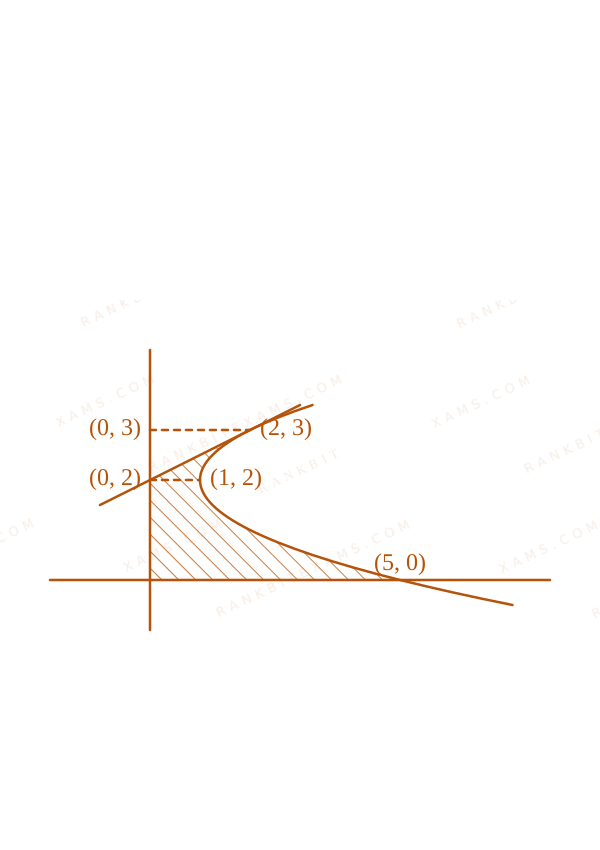
The area of the region enclosed by the parabola (y - 2)² = x - 1$(y - 2)^2 = x - 1$ , the line x - 2y + 4 = 0$x - 2y + 4 = 0$ and the positive coordinate axes is
The line is tangent to the parabola at y = 3$y = 3$. At y = 3$y = 3$, x = 2(3) - 4 = 2$x = 2(3) - 4 = 2$.
We need the area enclosed by the parabola, the line, and the positive coordinate axes.
Let's trace the boundary intercepts.
The line x = 2y - 4$x = 2y - 4$ cuts the y-axis (x=0$x=0$) at y=2$y=2$.
Parabola vertex is at (1, 2)$(1, 2)$. Parabola cuts y-axis (x=0$x=0$) at (y-2)² = -1$(y-2)^2 = -1$ (No real y-intercept).
So the curve (y-2)² = x-1$(y-2)^2 = x-1$ only exists for x ≥ 1$x \ge 1$.
Step 1: Setting up the Integral w.r.t y
Area Under Curve diagram for Q29 - JEE Main 2024 Evening
Because the area is bound by the positive coordinate axes, we track integration strictly in the first quadrant.
The required area is the area between the y-axis, the x-axis, the line, and the curve. Wait, the problem says "area enclosed by the parabola... line... and positive coordinate axes".
Let's integrate with respect to y$y$.
The boundary curves are x = (y-2)² + 1$x = (y-2)^2 + 1$ (which forms the rightmost boundary) and the axes.
The area bounded by the curve with y-axis is from y=0$y=0$ to y=3$y=3$ minus the triangular region cut by the line below y=2$y=2$.
The line intersects the x-axis (y=0$y=0$) at x=-4$x=-4$ and y-axis (x=0$x=0$) at y=2$y=2$.
The positive coordinate axes enforce boundaries at x ≥ 0, y ≥ 0$x \ge 0, y \ge 0$.
So the exact area is the integral of the parabola's x$x$-value from y=0$y=0$ to y=3$y=3$, minus the area of the small triangle outside the region bounded by the line x=2y-4$x=2y-4$ and the axes in the positive quadrant.
The area under the parabola (to the left towards the y-axis) from y=0$y=0$ to y=3$y=3$ is ∫₀³ xparabola dy$\int_0^3 x_{\text{parabola}} dy$.
The line bounds the region on the left from y=2$y=2$ to y=3$y=3$. Between y=0$y=0$ and y=2$y=2$, the area goes fully to the y-axis.
So, area = ∫₀³ xparabola dy - Area of Δ bounded by line and y-axis$\int_0^3 x_{\text{parabola}} dy - \text{Area of } \Delta \text{ bounded by line and y-axis}$.
The triangle bounded by x=2y-4, x=0, y=2, y=3$x=2y-4, x=0, y=2, y=3$ is: base is x=2(3)-4 = 2$x=2(3)-4 = 2$ at y=3$y=3$, height is 1$1$ (from y=2$y=2$ to y=3$y=3$). Triangle area = (1)/(2) × 2 × 1 = 1$\frac{1}{2} \times 2 \times 1 = 1$.
Hence, Enclosed Area = ∫₀³ ((y-2)² + 1) dy - 1$\int_{0}^{3} ((y-2)^2 + 1) dy - 1$.
Instead of evaluating horizontal strips with a broken left-bound, evaluate the total area mapped to the y-axis ∫₀³ x dy$\int_0^3 x dy$ and simply subtract the basic geometric triangle removed by the straight line.
Pull out high powers from the root factor to seamlessly reveal a matching f'(x)$f'(x)$ substitution pair on the outside.
Chapter Mix
Class 12 Mathematics: Integral Calculus
Q75jee_main_2025_24_jan_eveningIndefinite Integration of Algebraic Functions
If ∫ 2x²+5x+9 x²+x+1dx=x x²+x+1+α x²+x+1+β ₑ|x+(1)/(2)+ x²+x+1|+C$\int\frac{2x^{2}+5x+9}{\sqrt{x^{2}+x+1}}dx=x\sqrt{x^{2}+x+1}+\alpha\sqrt{x^{2}+x+1}+\beta\log_{e}\left|x+\frac{1}{2}+\sqrt{x^{2}+x+1}\right|+C$ where C is the constant of integration, then α+2β$\alpha+2\beta$ is equal to \_\_\_\_.
Numerical Answer.Answer: 16
Solution
Related Formula
Standard integration templates for quadratic forms:
When dividing large numerators containing x²$x^2$ elements over quadratic square roots, using matching coefficient expansion rules prevents lengthy substitution errors completely.
Chapter Mix
Class 12 Mathematics: Integrals
Q52jee_main_2025_24_jan_morningProperties of Definite Integrals
If I(m,n) = ∫₀¹ xm-1 (1-x)ⁿ⁻¹ dx$I(m,n) = \int_{0}^{1} x^{m-1} (1-x)^{n-1} dx$ where m, n > 0$m, n > 0$, then I(9,14) + I(10,13)$I(9,14) + I(10,13)$ is :
When dealing with linear combinations of beta functions with shifting parameter indices, directly writing down the definite integral expression often results in immediate algebraic cancellation or simplification via basic factoring.
Chapter Mix
Class 12 Mathematics: Definite Integrals
Q71jee_main_2025_24_jan_morningDifferentiating Under the Integral Sign
Let f$f$ be a differentiable function such that
2(x+2)²f(x) - 3(x+2)² = 10∫₀x(t+2)f(t)dt$$2(x+2)^{2}f(x) - 3(x+2)^{2} = 10\int_{0}^{x}(t+2)f(t)dt$$
for x ≥ 0$x \geq 0$. Then f(2)$f(2)$ is equal to ________.
Numerical Answer.Answer: 19
Solution
Related Formula
The Leibniz Integral Rule template allows direct differentiation of an integral with variable limits:
When an equation contains a variable integral limit ∫₀^x$\int_0^x$, differentiating both sides using the Leibniz rule converts it into a standard differential equation. The initial value is found by setting x = 0$x = 0$ directly in the original expression.
Chapter Mix
Class 12 Mathematics: Definite Integrals
Class 12 Mathematics: Differential Equations
Qjee_main_2025_28_jan_eveningIntegration by Substitution
If f(x) = ∫ 1x1/4(1+x1/4) dx$f(x) = \int \frac{1}{x^{1/4}(1+x^{1/4})} \, dx$, f(0) = -6$f(0) = -6$, then f(1)$f(1)$ is equal to:
A.ₑ2+2$\log_{e}2+2$
B.4( ₑ2-2)$4(\log_{e}2-2)$
C.2- ₑ2$2-\log_{e}2$
D.4( ₑ2+2)$4(\log_{e}2+2)$
Solution
Related Formula
Standard substitution method and logarithmic integral rule:
By adding and subtracting terms in the numerator (t²-1+1$t^2-1+1$), we can quickly bypass long division for polynomials and directly integrate using standard forms.
Chapter Mix
Class 12 Mathematics: Indefinite Integration
More Integral Calculus Questions — jee_main_2024_30_january_evening
Practice past-year questions one chapter at a time. Pick an exam → subject → chapter and get every PYQ for that topic — pulled together from all past papers — with the chapter's key formulas alongside.