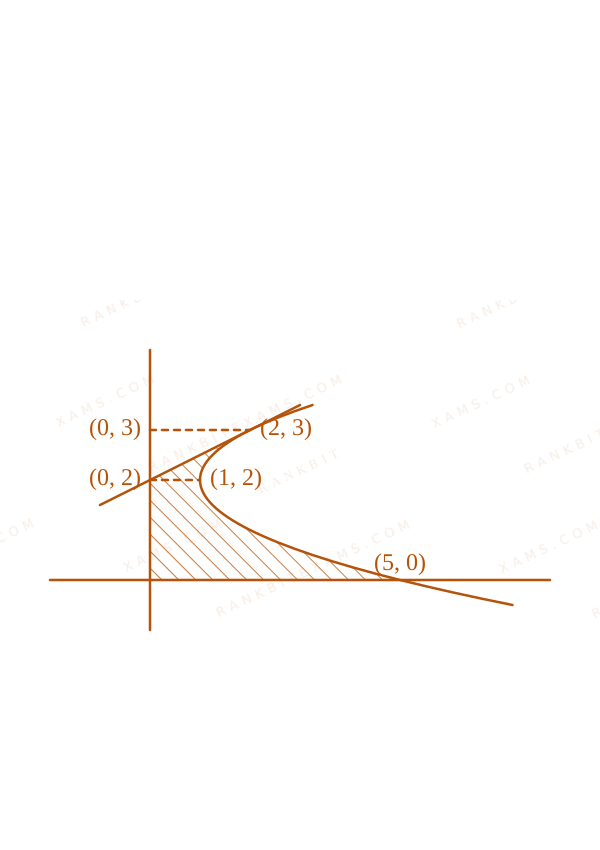
The area of the region enclosed by the parabola (y - 2)² = x - 1$(y - 2)^2 = x - 1$ , the line x - 2y + 4 = 0$x - 2y + 4 = 0$ and the positive coordinate axes is
The line is tangent to the parabola at y = 3$y = 3$. At y = 3$y = 3$, x = 2(3) - 4 = 2$x = 2(3) - 4 = 2$.
We need the area enclosed by the parabola, the line, and the positive coordinate axes.
Let's trace the boundary intercepts.
The line x = 2y - 4$x = 2y - 4$ cuts the y-axis (x=0$x=0$) at y=2$y=2$.
Parabola vertex is at (1, 2)$(1, 2)$. Parabola cuts y-axis (x=0$x=0$) at (y-2)² = -1$(y-2)^2 = -1$ (No real y-intercept).
So the curve (y-2)² = x-1$(y-2)^2 = x-1$ only exists for x ≥ 1$x \ge 1$.
Step 1: Setting up the Integral w.r.t y
Area Under Curve diagram for Q29 - JEE Main 2024 Evening
Because the area is bound by the positive coordinate axes, we track integration strictly in the first quadrant.
The required area is the area between the y-axis, the x-axis, the line, and the curve. Wait, the problem says "area enclosed by the parabola... line... and positive coordinate axes".
Let's integrate with respect to y$y$.
The boundary curves are x = (y-2)² + 1$x = (y-2)^2 + 1$ (which forms the rightmost boundary) and the axes.
The area bounded by the curve with y-axis is from y=0$y=0$ to y=3$y=3$ minus the triangular region cut by the line below y=2$y=2$.
The line intersects the x-axis (y=0$y=0$) at x=-4$x=-4$ and y-axis (x=0$x=0$) at y=2$y=2$.
The positive coordinate axes enforce boundaries at x ≥ 0, y ≥ 0$x \ge 0, y \ge 0$.
So the exact area is the integral of the parabola's x$x$-value from y=0$y=0$ to y=3$y=3$, minus the area of the small triangle outside the region bounded by the line x=2y-4$x=2y-4$ and the axes in the positive quadrant.
The area under the parabola (to the left towards the y-axis) from y=0$y=0$ to y=3$y=3$ is ∫₀³ xparabola dy$\int_0^3 x_{\text{parabola}} dy$.
The line bounds the region on the left from y=2$y=2$ to y=3$y=3$. Between y=0$y=0$ and y=2$y=2$, the area goes fully to the y-axis.
So, area = ∫₀³ xparabola dy - Area of Δ bounded by line and y-axis$\int_0^3 x_{\text{parabola}} dy - \text{Area of } \Delta \text{ bounded by line and y-axis}$.
The triangle bounded by x=2y-4, x=0, y=2, y=3$x=2y-4, x=0, y=2, y=3$ is: base is x=2(3)-4 = 2$x=2(3)-4 = 2$ at y=3$y=3$, height is 1$1$ (from y=2$y=2$ to y=3$y=3$). Triangle area = (1)/(2) × 2 × 1 = 1$\frac{1}{2} \times 2 \times 1 = 1$.
Hence, Enclosed Area = ∫₀³ ((y-2)² + 1) dy - 1$\int_{0}^{3} ((y-2)^2 + 1) dy - 1$.
Instead of evaluating horizontal strips with a broken left-bound, evaluate the total area mapped to the y-axis ∫₀³ x dy$\int_0^3 x dy$ and simply subtract the basic geometric triangle removed by the straight line.
Keywords:#Area bounded by parabola and line#JEE Main 2024 Evening Q29#Integral Calculus JEE Main 2024#Area Under Curve JEE Main 2024
More Integral Calculus Previous-Year Questions — Page 5
Q71jee_main_2025_02_april_morningDefinite Integration with GIF
Let [·]$[\cdot]$ denote the greatest integer function. If ∫₀^e³[ 1ex - 1]dx = α - ₑ2$\int_{0}^{e^{3}}\left[\frac{1}{e^{x - 1}}\right]\mathrm{d}x = \alpha -\log_{e}2$, then α³$\alpha^3$ is equal to ________.
Numerical Answer.Answer: 8 to 8
Solution
Related Formula
Greatest Integer Function boundaries:
[f(x)] = k for k ≤ f(x) < k+1, k in Z$$[f(x)] = k \quad \text{for} \quad k \le f(x) < k+1, \ k \in \mathbb{Z}$$
Core Logic
Analyze the value variations of f(x) = e1-x$f(x) = e^{1-x}$ across the integration limits [0, e³]$[0, e^3]$ to break down the integral into distinct piecewise continuous intervals.
Step 1: Determine Step Function Transition Points
Let y = e1-x$y = e^{1-x}$.
At x = 0 y = e¹ ≈ 2.718$x = 0 \implies y = e^1 \approx 2.718$
As x$x$ increases, e1-x$e^{1-x}$ decreases monotonically.
Find x$x$ where y = 2 e1-x = 2 1-x = ln 2 x = 1 - ln 2$y = 2 \implies e^{1-x} = 2 \implies 1-x = \ln 2 \implies x = 1 - \ln 2$.
Find x$x$ where y = 1 e1-x = 1 1-x = 0 x = 1$y = 1 \implies e^{1-x} = 1 \implies 1-x = 0 \implies x = 1$.
At the final boundary x = e³ y = e1-e³$x = e^3 \implies y = e^{1-e^3}$, which is a very small positive decimal strictly inside (0,1)$(0,1)$.
Step 2: Split the Definite Integral
Rewrite the integral based on the isolated interval blocks:
Always map the function values at the extreme boundary points first. Tracking the downward path from 2.71 arrow 2 arrow 1 arrow 0$2.71 \rightarrow 2 \rightarrow 1 \rightarrow 0$ reveals exactly where the integer thresholds are crossed.
The presence of a linear x$x$ factor in the numerator of a definite integral with symmetric trigonometric bounds is almost always eliminated using the a+b-x$a+b-x$ property. This reduces the integral to a standard substitution problem.
Chapter Mix
Class 12 Mathematics: Integrals
Q60jee_main_2025_07_april_morningProperties of Definite Integrals
The integral ∫₀^π ((x + 3) x)/(1 + 3 ²x) dx$\int_0^\pi \frac{(x + 3)\sin x}{1 + 3\cos^2x} dx$ is equal to:
Let t = √(3) x$t = \sqrt{3}\cos x$. Then dt = -√(3) x dx x dx = - dt√(3)$dt = -\sqrt{3}\sin x dx \implies \sin x dx = -\frac{dt}{\sqrt{3}}$.
Change in integration boundaries:
Whenever you encounter a linear x$x$ factor multiplying trigonometric components in a definite integral with symmetric limits like 0$0$ to π$\pi$, executing King's property first is almost guaranteed to cleanly wipe out that variable element.
Chapter Mix
Class 12 Mathematics: Definite Integrals
Q58jee_main_2025_08_april_eveningProperties of Definite Integrals
Let f(x)$f(x)$ be a a positive function and I₁ = ∫-(1)/(2)¹ 2xf(2x(1 - 2x)) dx$I_1 = \int_{-\frac{1}{2}}^{1} 2xf(2x(1 - 2x)) \, dx$ and I₂ = ∫₋₁² f(x(1 - x)) dx$I_2 = \int_{-1}^{2} f(x(1 - x)) \, dx$. Then the value of (I₂)/(I₁)$\frac{I_2}{I_1}$ is equal to
Perform variable substitution to match the arguments and limit bounds across both separate integral functions before invoking King's property.
Step 1: Perform Base Transformation Substitution
In I₁$I_1$, let 2x = t 2dx = dt$2x = t \implies 2dx = dt$.
Limits mapping: x = -1/2 t = -1$x = -1/2 \implies t = -1$; x = 1 t = 2$x = 1 \implies t = 2$.
I₁ = (1)/(2) ∫₋₁² t f(t(1-t)) dt 2I₁ = ∫₋₁² t f(t(1-t)) dt$$I_1 = \frac{1}{2} \int_{-1}^{2} t f(t(1-t)) \, dt \implies 2I_1 = \int_{-1}^{2} t f(t(1-t)) \, dt$$
Step 2: Invoke Integral Mirror Properties
Apply the identity using parameters (a+b-t) = (1-t)$(a+b-t) = (1-t)$:
Symmetric transformations highlighting factor expressions like x(1-x)$x(1-x)$ coupled with an external linear multiplier term x$x$ naturally simplify to half-weight area forms using reflection rules.
Chapter Mix
Class 12 Mathematics: Definite Integrals
Q61jee_main_2025_08_april_eveningIntegration of Absolute Value Functions
The integral ∫₋₁(3)/(2)(|π²x (π x)|) dx$\int_{-1}^{\frac{3}{2}}\left(\left|\pi^{2}\mathrm{x}\sin (\pi \mathrm{x})\right|\right) dx$ is equal to :
Products of two odd tracking metrics (like linear variable x$x$ matched with sinusoidal waves) yield overall even systems, enabling rapid evaluation over center-aligned domains.
Chapter Mix
Class 12 Mathematics: Definite Integrals
More Integral Calculus Questions — jee_main_2024_30_january_evening
Practice past-year questions one chapter at a time. Pick an exam → subject → chapter and get every PYQ for that topic — pulled together from all past papers — with the chapter's key formulas alongside.