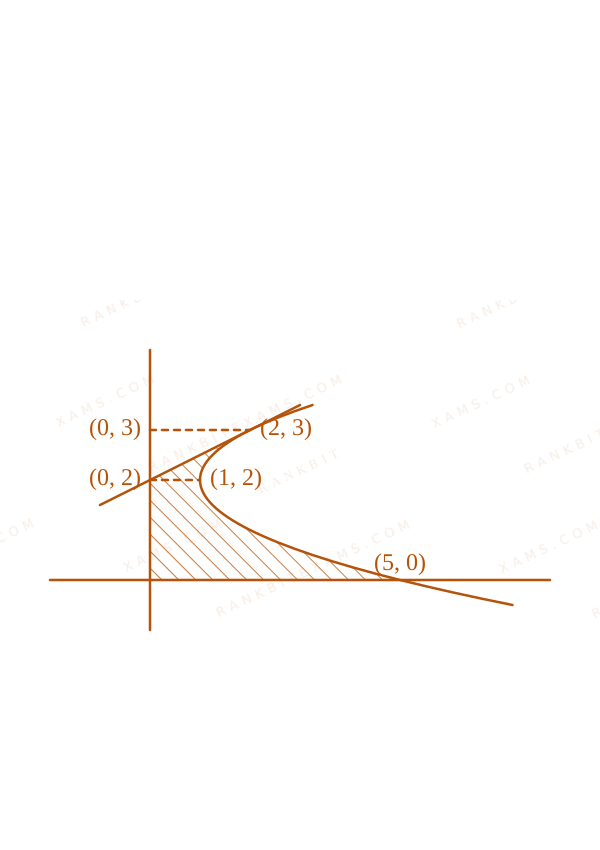
The area of the region enclosed by the parabola (y - 2)^2 = x - 1$(y - 2)^2 = x - 1$ , the line x - 2y + 4 = 0$x - 2y + 4 = 0$ and the positive coordinate axes is
Numerical Answer Type:
Enter a numerical valueAnswer: 5 to 5+4 marks
Solution & Explanation
### Related Formula
textArea enclosed integrating w.r.t y-axis: int (x_textright - x_textleft) dy$\text{Area enclosed integrating w.r.t y-axis: } \int (x_{\text{right}} - x_{\text{left}}) dy$
### Core Logic
Find intersection points between the parabola x = (y-2)^2 + 1$x = (y-2)^2 + 1$ and the line x = 2y - 4$x = 2y - 4$.
Set them equal:
(y-2)^2 + 1 = 2y - 4$(y-2)^2 + 1 = 2y - 4$y^2 - 4y + 4 + 1 = 2y - 4$y^2 - 4y + 4 + 1 = 2y - 4$y^2 - 6y + 9 = 0 Rightarrow (y-3)^2 = 0$y^2 - 6y + 9 = 0 \Rightarrow (y-3)^2 = 0$
The line is tangent to the parabola at y = 3$y = 3$. At y = 3$y = 3$, x = 2(3) - 4 = 2$x = 2(3) - 4 = 2$.
We need the area enclosed by the parabola, the line, and the *positive coordinate axes*.
Let's trace the boundary intercepts.
The line x = 2y - 4$x = 2y - 4$ cuts the y-axis (x=0$x=0$) at y=2$y=2$.
Parabola vertex is at (1, 2)$(1, 2)$. Parabola cuts y-axis (x=0$x=0$) at (y-2)^2 = -1$(y-2)^2 = -1$ (No real y-intercept).
So the curve (y-2)^2 = x-1$(y-2)^2 = x-1$ only exists for x ge 1$x \ge 1$.
### Step 1: Setting up the Integral w.r.t y
Area Under Curve diagram for Q29 - JEE Main 2024 Evening
Because the area is bound by the positive coordinate axes, we track integration strictly in the first quadrant.
The required area is the area between the y-axis, the x-axis, the line, and the curve. Wait, the problem says "area enclosed by the parabola... line... and positive coordinate axes".
Let's integrate with respect to y$y$.
The boundary curves are x = (y-2)^2 + 1$x = (y-2)^2 + 1$ (which forms the rightmost boundary) and the axes.
The area bounded by the curve with y-axis is from y=0$y=0$ to y=3$y=3$ minus the triangular region cut by the line below y=2$y=2$.
The line intersects the x-axis (y=0$y=0$) at x=-4$x=-4$ and y-axis (x=0$x=0$) at y=2$y=2$.
The positive coordinate axes enforce boundaries at x ge 0, y ge 0$x \ge 0, y \ge 0$.
So the exact area is the integral of the parabola's x$x$-value from y=0$y=0$ to y=3$y=3$, minus the area of the small triangle outside the region bounded by the line x=2y-4$x=2y-4$ and the axes in the positive quadrant.
The area under the parabola (to the left towards the y-axis) from y=0$y=0$ to y=3$y=3$ is int_0^3 x_textparabola dy$\int_0^3 x_{\text{parabola}} dy$.
The line bounds the region on the left from y=2$y=2$ to y=3$y=3$. Between y=0$y=0$ and y=2$y=2$, the area goes fully to the y-axis.
So, area = int_0^3 x_textparabola dy - textArea of Delta text bounded by line and y-axis$\int_0^3 x_{\text{parabola}} dy - \text{Area of } \Delta \text{ bounded by line and y-axis}$.
The triangle bounded by x=2y-4, x=0, y=2, y=3$x=2y-4, x=0, y=2, y=3$ is: base is x=2(3)-4 = 2$x=2(3)-4 = 2$ at y=3$y=3$, height is 1$1$ (from y=2$y=2$ to y=3$y=3$). Triangle area = frac12 times 2 times 1 = 1$\frac{1}{2} \times 2 \times 1 = 1$.
Hence, Enclosed Area = int_0^3 ((y-2)^2 + 1) dy - 1$\int_{0}^{3} ((y-2)^2 + 1) dy - 1$.
### Step 2: Evaluating the Integral
textArea = int_0^3 (y^2 - 4y + 5) dy - 1$\text{Area} = \int_{0}^{3} (y^2 - 4y + 5) dy - 1$= left[ fracy^33 - 2y^2 + 5y right]_0^3 - 1$= \left[ \frac{y^3}{3} - 2y^2 + 5y \right]_0^3 - 1$= left( frac273 - 2(9) + 5(3) right) - 0 - 1$= \left( \frac{27}{3} - 2(9) + 5(3) \right) - 0 - 1$= (9 - 18 + 15) - 1 = 6 - 1 = 5$= (9 - 18 + 15) - 1 = 6 - 1 = 5$
### Pattern Recognition
Instead of evaluating horizontal strips with a broken left-bound, evaluate the total area mapped to the y-axis int_0^3 x dy$\int_0^3 x dy$ and simply subtract the basic geometric triangle removed by the straight line.
### Evaluation Rubric / Model Answer
null
### Chapter Mix
Class 12 Maths: Integral Calculus
For xin(-fracpi2,fracpi2)$x\in(-\frac{\pi}{2},\frac{\pi}{2})$, if y(x)=intfracoperatornamecosec x+sin xoperatornamecosec x sec x+tan x sin^2 xdx$y(x)=\int\frac{\operatorname{cosec} x+\sin x}{\operatorname{cosec} x \sec x+\tan x \sin^2 x}dx$ and lim_xrightarrow(fracpi2)^-y(x)=0$\lim_{x\rightarrow(\frac{\pi}{2})^-}y(x)=0$ then y(fracpi4)$y(\frac{\pi}{4})$ is equal to
### Related Formula
int frac1u^2 + a^2 du = frac1a tan^-1left(fracuaright) + C$\int \frac{1}{u^2 + a^2} du = \frac{1}{a} \tan^{-1}\left(\frac{u}{a}\right) + C$
### Core Logic
Simplify the given integrand by converting all trigonometric ratios into sin x$\sin x$ and cos x$\cos x$:
I = fracoperatornamecosec x + sin xoperatornamecosec x sec x + tan x sin^2 x$I = \frac{\operatorname{cosec} x + \sin x}{\operatorname{cosec} x \sec x + \tan x \sin^2 x}$
Numerator: frac1sin x + sin x = frac1 + sin^2 xsin x$\frac{1}{\sin x} + \sin x = \frac{1 + \sin^2 x}{\sin x}$
Denominator: frac1sin x cos x + fracsin xcos x cdot sin^2 x = frac1 + sin^4 xsin x cos x$\frac{1}{\sin x \cos x} + \frac{\sin x}{\cos x} \cdot \sin^2 x = \frac{1 + \sin^4 x}{\sin x \cos x}$
Divide Numerator by Denominator:
I = fracfrac1 + sin^2 xsin xfrac1 + sin^4 xsin x cos x = frac(1 + sin^2 x)cos x1 + sin^4 x$I = \frac{\frac{1 + \sin^2 x}{\sin x}}{\frac{1 + \sin^4 x}{\sin x \cos x}} = \frac{(1 + \sin^2 x)\cos x}{1 + \sin^4 x}$
### Step 1: Apply Substitution
Now rewrite the integral:
y(x) = int frac(1 + sin^2 x)cos x1 + sin^4 x dx$y(x) = \int \frac{(1 + \sin^2 x)\cos x}{1 + \sin^4 x} dx$
Let sin x = t$\sin x = t$, then cos x \, dx = dt$\cos x \, dx = dt$. The integral becomes:
y(x) = int frac1 + t^21 + t^4 dt$y(x) = \int \frac{1 + t^2}{1 + t^4} dt$
Divide numerator and denominator by t^2$t^2$:
y(x) = int frac1 + frac1t^2t^2 + frac1t^2 dt$y(x) = \int \frac{1 + \frac{1}{t^2}}{t^2 + \frac{1}{t^2}} dt$
We know that t^2 + frac1t^2 = left(t - frac1tright)^2 + 2$t^2 + \frac{1}{t^2} = \left(t - \frac{1}{t}\right)^2 + 2$. Let u = t - frac1t$u = t - \frac{1}{t}$, then du = left(1 + frac1t^2right) dt$du = \left(1 + \frac{1}{t^2}\right) dt$.
y(x) = int fracduu^2 + (sqrt2)^2 = frac1sqrt2tan^-1left(fracusqrt2right) + C$y(x) = \int \frac{du}{u^2 + (\sqrt{2})^2} = \frac{1}{\sqrt{2}}\tan^{-1}\left(\frac{u}{\sqrt{2}}\right) + C$y(x) = frac1sqrt2tan^-1left(fract - 1/tsqrt2right) + C = frac1sqrt2tan^-1left(fracsin x - operatornamecosec xsqrt2right) + C$y(x) = \frac{1}{\sqrt{2}}\tan^{-1}\left(\frac{t - 1/t}{\sqrt{2}}\right) + C = \frac{1}{\sqrt{2}}\tan^{-1}\left(\frac{\sin x - \operatorname{cosec} x}{\sqrt{2}}\right) + C$
### Step 2: Solve for Constant C
We are given that lim_xrightarrow(pi/2)^- y(x) = 0$\lim_{x\rightarrow(\pi/2)^-} y(x) = 0$.
As x to fracpi2$x \to \frac{\pi}{2}$, sin x to 1$\sin x \to 1$ and operatornamecosec x to 1$\operatorname{cosec} x \to 1$.
Thus, sin x - operatornamecosec x to 0$\sin x - \operatorname{cosec} x \to 0$.
0 = frac1sqrt2tan^-1left(frac1 - 1sqrt2right) + C$0 = \frac{1}{\sqrt{2}}\tan^{-1}\left(\frac{1 - 1}{\sqrt{2}}\right) + C$0 = frac1sqrt2tan^-1(0) + C Rightarrow C = 0$0 = \frac{1}{\sqrt{2}}\tan^{-1}(0) + C \Rightarrow C = 0$
### Step 3: Find y(pi/4)
Substitute x = fracpi4$x = \frac{\pi}{4}$ into the exact solution y(x) = frac1sqrt2tan^-1left(fracsin x - operatornamecosec xsqrt2right)$y(x) = \frac{1}{\sqrt{2}}\tan^{-1}\left(\frac{\sin x - \operatorname{cosec} x}{\sqrt{2}}\right)$:
At x = fracpi4$x = \frac{\pi}{4}$, sinleft(fracpi4right) = frac1sqrt2$\sin\left(\frac{\pi}{4}\right) = \frac{1}{\sqrt{2}}$ and operatornamecosecleft(fracpi4right) = sqrt2$\operatorname{cosec}\left(\frac{\pi}{4}\right) = \sqrt{2}$.
yleft(fracpi4right) = frac1sqrt2tan^-1left(fracfrac1sqrt2 - sqrt2sqrt2right)$y\left(\frac{\pi}{4}\right) = \frac{1}{\sqrt{2}}\tan^{-1}\left(\frac{\frac{1}{\sqrt{2}} - \sqrt{2}}{\sqrt{2}}\right)$= frac1sqrt2tan^-1left(fracfrac1 - 2sqrt2sqrt2right) = frac1sqrt2tan^-1left(frac-1/sqrt2sqrt2right)$= \frac{1}{\sqrt{2}}\tan^{-1}\left(\frac{\frac{1 - 2}{\sqrt{2}}}{\sqrt{2}}\right) = \frac{1}{\sqrt{2}}\tan^{-1}\left(\frac{-1/\sqrt{2}}{\sqrt{2}}\right)$= frac1sqrt2tan^-1left(-frac12right)$= \frac{1}{\sqrt{2}}\tan^{-1}\left(-\frac{1}{2}\right)$
### Pattern Recognition
A high-degree polynomial of sin x$\sin x$ or cos x$\cos x$ in the denominator matched with their derivative elements on top is the hallmark of the t+1/t$t+1/t$ or t-1/t$t-1/t$ structural substitution form. Dividing out the middle power (t^2$t^2$) aligns the differential instantly.
### Evaluation Rubric / Model Answer
null
### Chapter Mix
Class 12 Mathematics: Integral Calculus
Q18jee_main_2024_29_jan_morningProperties of Definite Integrals
If the value of the integralint_-fracpi2^fracpi2left(fracx^2cos x1+pi^x+frac1+sin^2x1+e^sin x^2023right)dx=fracpi4(pi+a)-2$\int_{-\frac{\pi}{2}}^{\frac{\pi}{2}}\left(\frac{x^2\cos x}{1+\pi^x}+\frac{1+\sin^2x}{1+e^{\sin x^{2023}}}\right)dx=\frac{\pi}{4}(\pi+a)-2$, then the value of a$a$ is
A.3$3$
B.-frac32$-\frac{3}{2}$
C.2$2$
D.frac32$\frac{3}{2}$
Solution
### Related Formula
textKing's Rule Variant: int_-a^a f(x) dx = int_0^a (f(x) + f(-x)) dx$\text{King's Rule Variant: } \int_{-a}^{a} f(x) dx = \int_{0}^{a} (f(x) + f(-x)) dx$
### Core Logic
Let the integral be I$I$.
We apply the property int_-a^a f(x) dx = int_0^a (f(x)+f(-x)) dx$\int_{-a}^a f(x) dx = \int_0^a (f(x)+f(-x)) dx$ to each fractional term independently.
For the first term f_1(x) = fracx^2cos x1+pi^x$f_1(x) = \frac{x^2\cos x}{1+\pi^x}$:
f_1(x) + f_1(-x) = fracx^2cos x1+pi^x + frac(-x)^2cos(-x)1+pi^-x = x^2cos x left( frac11+pi^x + fracpi^xpi^x+1 right) = x^2cos x$f_1(x) + f_1(-x) = \frac{x^2\cos x}{1+\pi^x} + \frac{(-x)^2\cos(-x)}{1+\pi^{-x}} = x^2\cos x \left( \frac{1}{1+\pi^x} + \frac{\pi^x}{\pi^x+1} \right) = x^2\cos x$
For the second term f_2(x) = frac1+sin^2x1+e^sin x^2023$f_2(x) = \frac{1+\sin^2x}{1+e^{\sin x^{2023}}}$:
Observe the exponent: sin(-x)^2023 = sin(-x^2023) = -sin x^2023$\sin(-x)^{2023} = \sin(-x^{2023}) = -\sin x^{2023}$.
f_2(x) + f_2(-x) = frac1+sin^2x1+e^p + frac1+sin^2(-x)1+e^-p = (1+sin^2x) left( frac11+e^p + frace^pe^p+1 right) = 1+sin^2x$f_2(x) + f_2(-x) = \frac{1+\sin^2x}{1+e^{p}} + \frac{1+\sin^2(-x)}{1+e^{-p}} = (1+\sin^2x) \left( \frac{1}{1+e^p} + \frac{e^p}{e^p+1} \right) = 1+\sin^2x$
Thus, the integral radically simplifies to:
I = int_0^pi/2 (x^2cos x + 1 + sin^2 x) dx$I = \int_0^{\pi/2} (x^2\cos x + 1 + \sin^2 x) dx$
### Step 1: Execute Integration by Parts
Evaluate int_0^pi/2 x^2cos x \, dx$\int_0^{\pi/2} x^2\cos x \, dx$ using integration by parts:
u = x^2 Rightarrow du = 2x \, dx$u = x^2 \Rightarrow du = 2x \, dx$dv = cos x \, dx Rightarrow v = sin x$dv = \cos x \, dx \Rightarrow v = \sin x$int x^2cos x dx = x^2sin x - int 2xsin x dx$\int x^2\cos x dx = x^2\sin x - \int 2x\sin x dx$
Applying parts again to int 2xsin x dx$\int 2x\sin x dx$:
int 2xsin x dx = 2x(-cos x) - int 2(-cos x)dx = -2xcos x + 2sin x$\int 2x\sin x dx = 2x(-\cos x) - \int 2(-\cos x)dx = -2x\cos x + 2\sin x$
Substituting back:
left[ x^2sin x + 2xcos x - 2sin x right]_0^pi/2$\left[ x^2\sin x + 2x\cos x - 2\sin x \right]_0^{\pi/2}$
Evaluate at upper limit pi/2$\pi/2$:
(pi/2)^2(1) + 0 - 2(1) = fracpi^24 - 2$(\pi/2)^2(1) + 0 - 2(1) = \frac{\pi^2}{4} - 2$
Evaluate at lower limit 0:
0 + 0 - 0 = 0$0 + 0 - 0 = 0$
So, int_0^pi/2 x^2cos x \, dx = fracpi^24 - 2$\int_0^{\pi/2} x^2\cos x \, dx = \frac{\pi^2}{4} - 2$.
### Step 2: Execute Standard Integrals
Evaluate int_0^pi/2 (1 + sin^2 x) dx$\int_0^{\pi/2} (1 + \sin^2 x) dx$:
= int_0^pi/2 dx + int_0^pi/2 sin^2 x dx$= \int_0^{\pi/2} dx + \int_0^{\pi/2} \sin^2 x dx$= fracpi2 + left[ frac12 cdot fracpi2 right] = fracpi2 + fracpi4 = frac3pi4$= \frac{\pi}{2} + \left[ \frac{1}{2} \cdot \frac{\pi}{2} \right] = \frac{\pi}{2} + \frac{\pi}{4} = \frac{3\pi}{4}$
### Step 3: Combine and Compare
Sum the components to get the total integral I$I$:
I = left(fracpi^24 - 2right) + frac3pi4 = fracpi^24 + frac3pi4 - 2$I = \left(\frac{\pi^2}{4} - 2\right) + \frac{3\pi}{4} = \frac{\pi^2}{4} + \frac{3\pi}{4} - 2$
Factor out fracpi4$\frac{\pi}{4}$:
I = fracpi4(pi + 3) - 2$I = \frac{\pi}{4}(\pi + 3) - 2$
The problem states I = fracpi4(pi + a) - 2$I = \frac{\pi}{4}(\pi + a) - 2$. Comparing the two expressions gives:
a = 3$a = 3$
### Pattern Recognition
Frightening denominators like 1+a^f(x)$1+a^{f(x)}$ in an integral from -L$-L$ to L$L$ where f(x)$f(x)$ is an odd function are almost exclusively designed to cancel out and leave 1 via the f(x)+f(-x)$f(x)+f(-x)$ expansion. Strip the ugly denominators immediately.
### Evaluation Rubric / Model Answer
null
### Chapter Mix
Class 12 Mathematics: Integral Calculus
Let y = f(x)$y = f(x)$ be a thrice differentiable function in (-5, 5)$(-5, 5)$ . Let the tangents to the curve y = f(x)$y = f(x)$ at (1, f(1))$(1, f(1))$ and (3, f(3))$(3, f(3))$ make angles fracpi6$\frac{\pi}{6}$ and fracpi4$\frac{\pi}{4}$ , respectively with positive x-axis. If
27int_1^3left(left(f'(t)right)^2 + 1right)f''(t)dt = alpha + beta sqrt3 quad textwhere alpha, beta text are integers, then the value of alpha +beta text equals$27\int_{1}^{3}\left(\left(f'(t)\right)^{2} + 1\right)f''(t)dt = \alpha + \beta \sqrt{3} \quad \text{where } \alpha, \beta \text{ are integers, then the value of } \alpha +\beta \text{ equals}$
A.-14$-14$
B.26$26$
C.-16$-16$
D.36$36$
Solution
### Related Formula
textSlope of tangent at x=a text is f'(a) = tan theta$\text{Slope of tangent at } x=a \text{ is } f'(a) = \tan \theta$int u^n du = fracu^n+1n+1$\int u^n du = \frac{u^{n+1}}{n+1}$
### Core Logic
Given y=f(x)$y=f(x)$, the derivatives at the given points correspond to the slope of tangents:
left. fracdydx right|_x=1 = f'(1) = tanleft(fracpi6right) = frac1sqrt3$\left. \frac{dy}{dx} \right|_{x=1} = f'(1) = \tan\left(\frac{\pi}{6}\right) = \frac{1}{\sqrt{3}}$left. fracdydx right|_x=3 = f'(3) = tanleft(fracpi4right) = 1$\left. \frac{dy}{dx} \right|_{x=3} = f'(3) = \tan\left(\frac{\pi}{4}\right) = 1$
We must evaluate the integral:
I = int_1^3 left( (f'(t))^2 + 1 right) f''(t) dt$I = \int_{1}^{3} \left( (f'(t))^2 + 1 \right) f''(t) dt$
### Step 1: Integration by Substitution
Let z = f'(t)$z = f'(t)$. Then dz = f''(t)dt$dz = f''(t)dt$.
The limits of integration change accordingly:
When t = 1$t = 1$, z = f'(1) = frac1sqrt3$z = f'(1) = \frac{1}{\sqrt{3}}$
When t = 3$t = 3$, z = f'(3) = 1$z = f'(3) = 1$
The integral becomes:
I = int_1/sqrt3^1 (z^2 + 1) dz$I = \int_{1/\sqrt{3}}^{1} (z^2 + 1) dz$I = left[ fracz^33 + z right]_1/sqrt3^1$I = \left[ \frac{z^3}{3} + z \right]_{1/\sqrt{3}}^{1}$
### Step 2: Evaluating the Definite Integral
Plug in the limits:
I = left( frac1^33 + 1 right) - left( frac13 cdot frac13sqrt3 + frac1sqrt3 right)$I = \left( \frac{1^3}{3} + 1 \right) - \left( \frac{1}{3} \cdot \frac{1}{3\sqrt{3}} + \frac{1}{\sqrt{3}} \right)$I = frac43 - left( frac19sqrt3 + frac99sqrt3 right)$I = \frac{4}{3} - \left( \frac{1}{9\sqrt{3}} + \frac{9}{9\sqrt{3}} \right)$I = frac43 - frac109sqrt3 = frac43 - frac10sqrt327$I = \frac{4}{3} - \frac{10}{9\sqrt{3}} = \frac{4}{3} - \frac{10\sqrt{3}}{27}$
### Step 3: Finding alpha and beta
We are given that 27 cdot I = alpha + betasqrt3$27 \cdot I = \alpha + \beta\sqrt{3}$.
27 left( frac43 - frac10sqrt327 right) = 36 - 10sqrt3$27 \left( \frac{4}{3} - \frac{10\sqrt{3}}{27} \right) = 36 - 10\sqrt{3}$
Comparing with alpha + betasqrt3$\alpha + \beta\sqrt{3}$, we get:
alpha = 36$\alpha = 36$beta = -10$\beta = -10$
Therefore, alpha + beta = 36 - 10 = 26$\alpha + \beta = 36 - 10 = 26$.
### Pattern Recognition
Integrals containing a function derivative alongside its second derivative are classic substitution traps. Set u = f'(x)$u = f'(x)$ directly.
### Evaluation Rubric / Model Answer
null
### Chapter Mix
Class 12 Maths: Integral Calculus
Class 12 Maths: Application of Derivatives
We Map Every Repeating Question in Competitive Exams.
Say goodbye to generic mock test fatigue. RankBit uses smart analysis to group past exam questions into their foundational Repeating Question Types. Find chapter weightage, track repeating questions, and score higher with targeted practice.
Select Your Target Exam
Choose an exam track below to find formulas per chapter and patterns.
Syncing Exam Intelligence
Mapping formulas and patterns across all tracks…
PATH A — FULL LENGTH PRACTICE
Full Mock Test Hub
Simulate real NTA exam conditions with fully tracked mocks. Time yourself against past papers.
Under Development
PATH B — TARGETED PRACTICE
Topic-wise Practice Hub
Practice past-year questions one chapter at a time. Pick an exam → subject → chapter and get every PYQ for that topic — pulled together from all past papers — with the chapter's key formulas alongside.
