The area of the region enclosed by the parabola (y - 2)² = x - 1$(y - 2)^2 = x - 1$ , the line x - 2y + 4 = 0$x - 2y + 4 = 0$ and the positive coordinate axes is
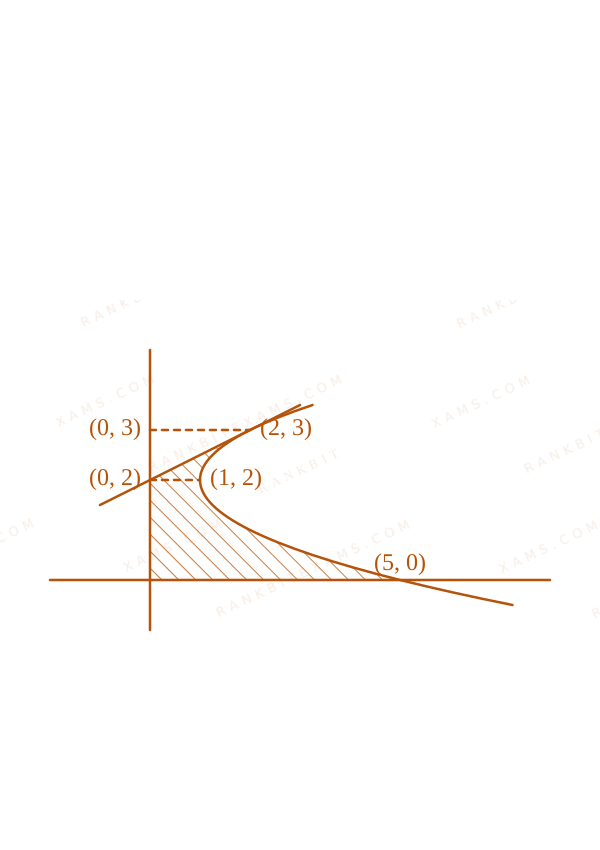
The line is tangent to the parabola at y = 3$y = 3$. At y = 3$y = 3$, x = 2(3) - 4 = 2$x = 2(3) - 4 = 2$.
We need the area enclosed by the parabola, the line, and the positive coordinate axes.
Let's trace the boundary intercepts.
The line x = 2y - 4$x = 2y - 4$ cuts the y-axis (x=0$x=0$) at y=2$y=2$.
Parabola vertex is at (1, 2)$(1, 2)$. Parabola cuts y-axis (x=0$x=0$) at (y-2)² = -1$(y-2)^2 = -1$ (No real y-intercept).
So the curve (y-2)² = x-1$(y-2)^2 = x-1$ only exists for x ≥ 1$x \ge 1$.
Step 1: Setting up the Integral w.r.t y
Area Under Curve diagram for Q29 - JEE Main 2024 Evening
Because the area is bound by the positive coordinate axes, we track integration strictly in the first quadrant.
The required area is the area between the y-axis, the x-axis, the line, and the curve. Wait, the problem says "area enclosed by the parabola... line... and positive coordinate axes".
Let's integrate with respect to y$y$.
The boundary curves are x = (y-2)² + 1$x = (y-2)^2 + 1$ (which forms the rightmost boundary) and the axes.
The area bounded by the curve with y-axis is from y=0$y=0$ to y=3$y=3$ minus the triangular region cut by the line below y=2$y=2$.
The line intersects the x-axis (y=0$y=0$) at x=-4$x=-4$ and y-axis (x=0$x=0$) at y=2$y=2$.
The positive coordinate axes enforce boundaries at x ≥ 0, y ≥ 0$x \ge 0, y \ge 0$.
So the exact area is the integral of the parabola's x$x$-value from y=0$y=0$ to y=3$y=3$, minus the area of the small triangle outside the region bounded by the line x=2y-4$x=2y-4$ and the axes in the positive quadrant.
The area under the parabola (to the left towards the y-axis) from y=0$y=0$ to y=3$y=3$ is ∫₀³ xparabola dy$\int_0^3 x_{\text{parabola}} dy$.
The line bounds the region on the left from y=2$y=2$ to y=3$y=3$. Between y=0$y=0$ and y=2$y=2$, the area goes fully to the y-axis.
So, area = ∫₀³ xparabola dy - Area of Δ bounded by line and y-axis$\int_0^3 x_{\text{parabola}} dy - \text{Area of } \Delta \text{ bounded by line and y-axis}$.
The triangle bounded by x=2y-4, x=0, y=2, y=3$x=2y-4, x=0, y=2, y=3$ is: base is x=2(3)-4 = 2$x=2(3)-4 = 2$ at y=3$y=3$, height is 1$1$ (from y=2$y=2$ to y=3$y=3$). Triangle area = (1)/(2) × 2 × 1 = 1$\frac{1}{2} \times 2 \times 1 = 1$.
Hence, Enclosed Area = ∫₀³ ((y-2)² + 1) dy - 1$\int_{0}^{3} ((y-2)^2 + 1) dy - 1$.
Instead of evaluating horizontal strips with a broken left-bound, evaluate the total area mapped to the y-axis ∫₀³ x dy$\int_0^3 x dy$ and simply subtract the basic geometric triangle removed by the straight line.
Keywords:#Area bounded by parabola and line#JEE Main 2024 Evening Q29#Integral Calculus JEE Main 2024#Area Under Curve JEE Main 2024
More Integral Calculus Previous-Year Questions — Page 6
Q53jee_main_2025_29_jan_eveningArea Enclosed by Two Curves
Let the area enclosed between the curves |y| = 1 - x²$|y| = 1 - x^2$ and x² + y² = 1$x^2 + y^2 = 1$ be α$\alpha$. If 9α = β π + γ$9\alpha = \beta \pi + \gamma$, β, γ$\beta, \gamma$ are integers, then the value of |β - γ|$|\beta - \gamma|$ equals
A.27$27$
B.18$18$
C.15$15$
D.33$33$
Solution
Related Formula
Area enclosed between two symmetric functions across four quadrants:
α = 4 × ( Area of circle in 1st quadrant - ∫₀¹ yparabola dx )$$\alpha = 4 \times \left( \text{Area of circle in } 1^{\text{st}} \text{ quadrant} - \int_{0}^{1} y_{\text{parabola}} \, dx \right)$$
Core Logic
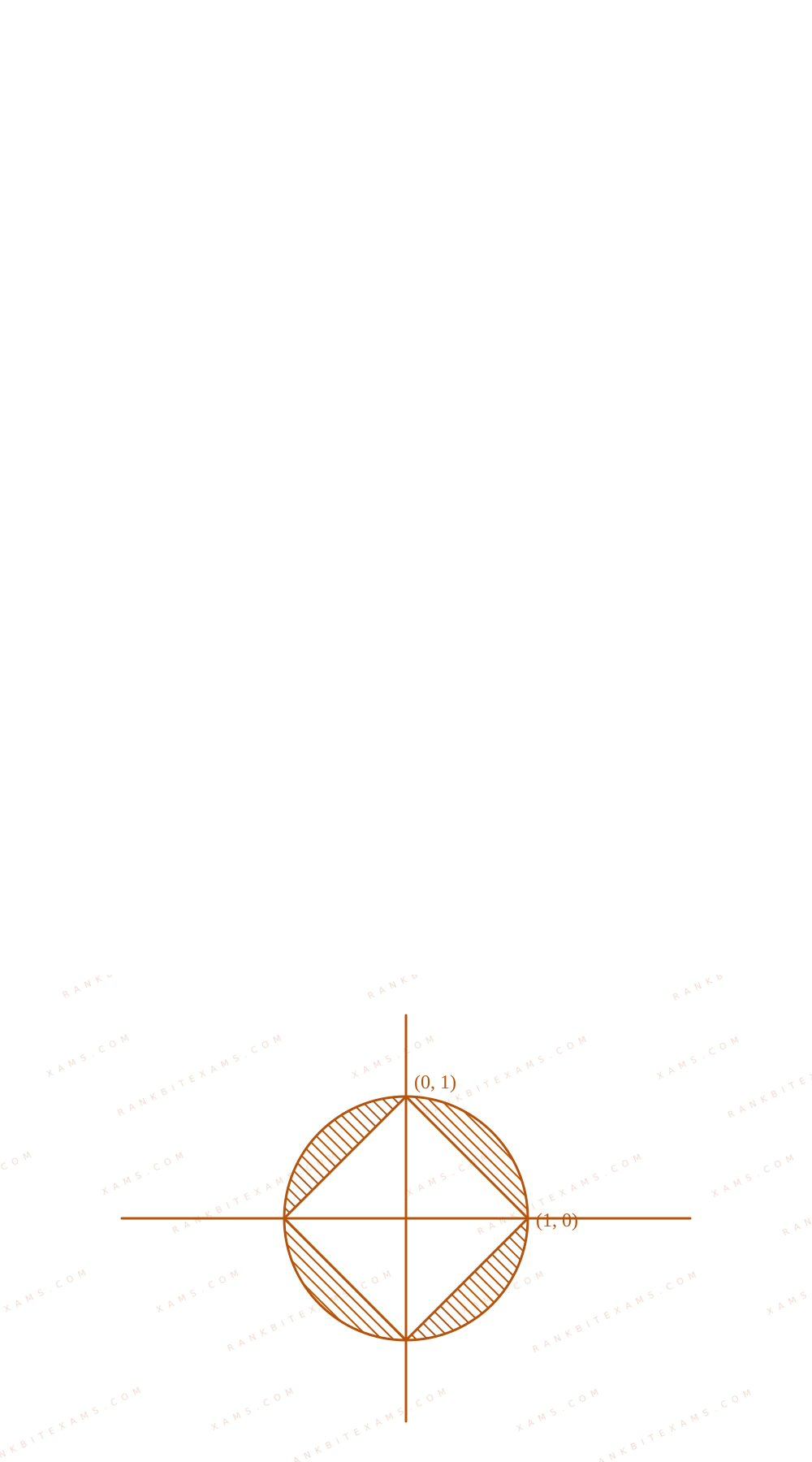
The curves are symmetric across the axes. The region is enclosed between the unit circle x² + y² = 1$x^2 + y^2 = 1$ and the parabolas y = ±(1 - x²)$y = \pm(1 - x^2)$.
Area Enclosed by Two Curves diagram for Q53 - JEE Main 2025 Evening
By symmetry, the area α$\alpha$ in the first quadrant is the area under the circle minus the area under the parabola from x=0$x=0$ to x=1$x=1$.
Step 1: Calculate the Area Components
Area of a circle quadrant with r=1$r=1$ is (π)/(4)$\frac{\pi}{4}$.
Symmetry helps divide the integration work by 4. Recognizing standard shapes (like a circle sector) allows you to bypass complex integration entirely for half of the problem.
Chapter Mix
Class 12 Mathematics: Integral Calculus
Q71jee_main_2025_29_jan_eveningIntegration of Modulus and Greatest Integer Functions
If 24∫₀(pi)/(4)( |4x - (pi)/(12)| + [2 x])dx = 2π +α$24\int_{0}^{\frac{pi}{4}}\left(\sin \left|4x - \frac{pi}{12}\right| + [2\sin x]\right)\mathrm{d}x = 2\pi +\alpha$, where [· ]$[\cdot ]$ denotes the greatest integer function, then α$\alpha$ is equal to
Numerical Answer.Answer: 12 to 12
Solution
Related Formula
Additivity property of definite integrals over split interval boundary points:
Splitting powers of x$x$ to create a direct match with internal derivative differential flags speeds up the integration transformation sequence.
Chapter Mix
Class 12 Mathematics: Integrals
Q67jee_main_2025_03_april_morningDefinite Integral of Greatest Integer Function
Let the domain of the function f(x) = ₂ ₄ ₆(3 + 4x - x²)$f(x) = \log_{2}\log_{4}\log_{6}(3 + 4x - x^{2})$ be (a, b)$(a, b)$. If ∫₀b-a[x²]dx = p - √(q) - √(r)$\int_{0}^{b-a}[x^{2}]dx = p - \sqrt{q} - \sqrt{r}$, where p, q, r in N$p, q, r \in \mathbb{N}$ and (p, q, r) = 1$\gcd(p, q, r) = 1$, and [·]$[\cdot]$ represents the greatest integer function, then p + q + r$p + q + r$ is equal to:
A. 10
B. 8
C. 11
D. 9
Solution
Related Formula
Domain of log chain iterations: For ₂ ₄(M) > 0$\log_2\log_4(M) > 0$, we require ₄(M) > 1 M > 4$\log_4(M) > 1 \implies M > 4$.
Compare values with requested answer template shape:
5 - √(2) - √(3) = p - √(q) - √(r)$$5 - \sqrt{2} - \sqrt{3} = p - \sqrt{q} - \sqrt{r}$$p = 5, q = 2, r = 3$$p = 5, \quad q = 2, \quad r = 3$$Final Sum = p + q + r = 5 + 2 + 3 = 10$$\text{Final Sum} = p + q + r = 5 + 2 + 3 = 10$$
Pattern Recognition
Integrals over greatest integer configurations change value exactly where the inner expression tracks through integer milestones. Mapping boundaries accurately resolves calculations smoothly.
Chapter Mix
Class 12 Mathematics: Integrals
More Integral Calculus Questions — jee_main_2024_30_january_evening
Practice past-year questions one chapter at a time. Pick an exam → subject → chapter and get every PYQ for that topic — pulled together from all past papers — with the chapter's key formulas alongside.