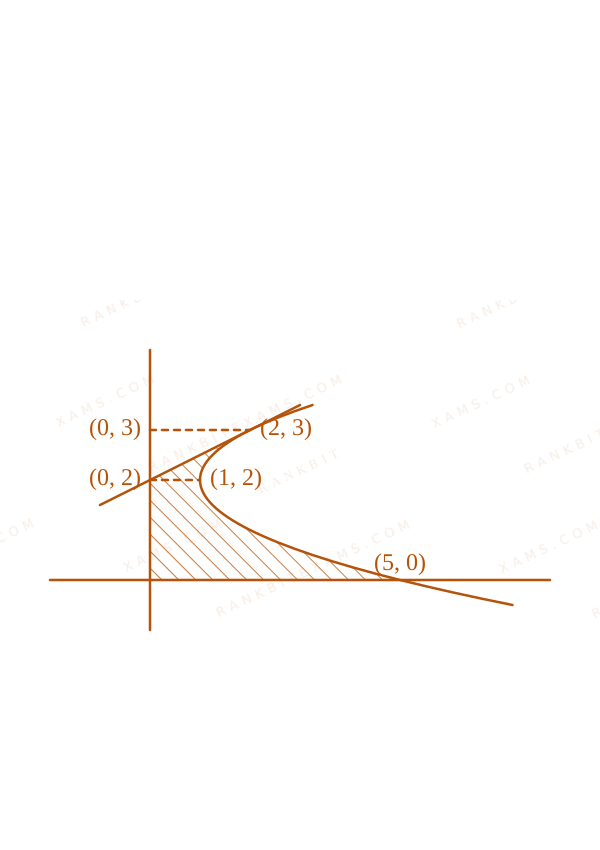
The area of the region enclosed by the parabola (y - 2)² = x - 1$(y - 2)^2 = x - 1$ , the line x - 2y + 4 = 0$x - 2y + 4 = 0$ and the positive coordinate axes is
The line is tangent to the parabola at y = 3$y = 3$. At y = 3$y = 3$, x = 2(3) - 4 = 2$x = 2(3) - 4 = 2$.
We need the area enclosed by the parabola, the line, and the positive coordinate axes.
Let's trace the boundary intercepts.
The line x = 2y - 4$x = 2y - 4$ cuts the y-axis (x=0$x=0$) at y=2$y=2$.
Parabola vertex is at (1, 2)$(1, 2)$. Parabola cuts y-axis (x=0$x=0$) at (y-2)² = -1$(y-2)^2 = -1$ (No real y-intercept).
So the curve (y-2)² = x-1$(y-2)^2 = x-1$ only exists for x ≥ 1$x \ge 1$.
Step 1: Setting up the Integral w.r.t y
Area Under Curve diagram for Q29 - JEE Main 2024 Evening
Because the area is bound by the positive coordinate axes, we track integration strictly in the first quadrant.
The required area is the area between the y-axis, the x-axis, the line, and the curve. Wait, the problem says "area enclosed by the parabola... line... and positive coordinate axes".
Let's integrate with respect to y$y$.
The boundary curves are x = (y-2)² + 1$x = (y-2)^2 + 1$ (which forms the rightmost boundary) and the axes.
The area bounded by the curve with y-axis is from y=0$y=0$ to y=3$y=3$ minus the triangular region cut by the line below y=2$y=2$.
The line intersects the x-axis (y=0$y=0$) at x=-4$x=-4$ and y-axis (x=0$x=0$) at y=2$y=2$.
The positive coordinate axes enforce boundaries at x ≥ 0, y ≥ 0$x \ge 0, y \ge 0$.
So the exact area is the integral of the parabola's x$x$-value from y=0$y=0$ to y=3$y=3$, minus the area of the small triangle outside the region bounded by the line x=2y-4$x=2y-4$ and the axes in the positive quadrant.
The area under the parabola (to the left towards the y-axis) from y=0$y=0$ to y=3$y=3$ is ∫₀³ xparabola dy$\int_0^3 x_{\text{parabola}} dy$.
The line bounds the region on the left from y=2$y=2$ to y=3$y=3$. Between y=0$y=0$ and y=2$y=2$, the area goes fully to the y-axis.
So, area = ∫₀³ xparabola dy - Area of Δ bounded by line and y-axis$\int_0^3 x_{\text{parabola}} dy - \text{Area of } \Delta \text{ bounded by line and y-axis}$.
The triangle bounded by x=2y-4, x=0, y=2, y=3$x=2y-4, x=0, y=2, y=3$ is: base is x=2(3)-4 = 2$x=2(3)-4 = 2$ at y=3$y=3$, height is 1$1$ (from y=2$y=2$ to y=3$y=3$). Triangle area = (1)/(2) × 2 × 1 = 1$\frac{1}{2} \times 2 \times 1 = 1$.
Hence, Enclosed Area = ∫₀³ ((y-2)² + 1) dy - 1$\int_{0}^{3} ((y-2)^2 + 1) dy - 1$.
Instead of evaluating horizontal strips with a broken left-bound, evaluate the total area mapped to the y-axis ∫₀³ x dy$\int_0^3 x dy$ and simply subtract the basic geometric triangle removed by the straight line.
Keywords:#Area bounded by parabola and line#JEE Main 2024 Evening Q29#Integral Calculus JEE Main 2024#Area Under Curve JEE Main 2024
More Integral Calculus Previous-Year Questions — Page 3
Q23jee_main_2026_23_january_eveningProperties of Definite Integrals
The number of elements in the setS = x: x in [0, 100] and ∫₀x t² (x - t) dt = x²$S = \left\{x: x \in [0, 100] \text{ and } \int_{0}^{x} t^{2} \sin(x - t) dt = x^{2}\right\}$ is
Numerical Answer.Answer: 16 to 16
Solution
Related Formula
Integration by parts formula: ∫ u dv = uv - ∫ v du$\int u \, dv = uv - \int v \, du$.
Core Logic
Let I(x) = ∫₀x t² (x - t) dt$I(x) = \int_{0}^{x} t^2 \sin(x - t) dt$. Use integration by parts.
Let u = t²$u = t^2$ and dv = (x - t) dt v = (x - t)$dv = \sin(x - t) dt \implies v = \cos(x - t)$.
x² + 2 x - 2 = x²$$x^2 + 2\cos x - 2 = x^2$$2 x = 2 x = 1$$2\cos x = 2 \implies \cos x = 1$$
The solutions for x = 1$\cos x = 1$ are x = 2nπ$x = 2n\pi$, where n$n$ is an integer.
We need the roots in the interval [0, 100]$[0, 100]$.
0 ≤ 2nπ ≤ 100 0 ≤ n ≤ (100)/(2π) ≈ (100)/(6.28) ≈ 15.92$0 \leq 2n\pi \leq 100 \implies 0 \leq n \leq \frac{100}{2\pi} \approx \frac{100}{6.28} \approx 15.92$.
Since n$n$ must be an integer, n$n$ takes values 0, 1, 2, , 15$0, 1, 2, \dots, 15$.
The total number of solutions is 16$16$.
Pattern Recognition
Convoluted-looking definite integrals containing a shift (x-t)$(x-t)$ often rapidly unpack through successive integration by parts where the polynomial variable diminishes until exhaustion.
Chapter Mix
Class 12 Maths: Definite Integration
Class 11 Maths: Trigonometric Equations
Q11jee_main_2026_24_january_morningIntegration by Substitution
Let f(t) = ∫ ( (1 - ( ₑ t))/(1 - ( ₑ t)) ) dt, t > 1$f(t) = \int \left( \frac{1 - \sin(\log_e t)}{1 - \cos(\log_e t)} \right) dt, t > 1$. If f(eπ/2) = -eπ/2$f(e^{\pi/2}) = -e^{\pi/2}$ and f(eπ/4) = α eπ/4$f(e^{\pi/4}) = \alpha e^{\pi/4}$, then α$\alpha$ equals
Let g(x) = - (x/2)$g(x) = -\cot(x/2)$. Then g'(x) = (1)/(2)cosec²(x/2)$g'(x) = \frac{1}{2}\operatorname{cosec}^2(x/2)$.
The integral fits the standard form ∫ e^x (g(x) + g'(x)) dx$\int e^x (g(x) + g'(x)) dx$.
-eπ/2 ((π/2)/(2)) + C = -eπ/2$$-e^{\pi/2} \cot\left(\frac{\pi/2}{2}\right) + C = -e^{\pi/2}$$-eπ/2 (1) + C = -eπ/2 ⇒ C = 0$$-e^{\pi/2} (1) + C = -e^{\pi/2} \Rightarrow C = 0$$
Logarithmic inputs in integrals are the classic cue to substitute t = e^x$t = e^x$ which inherently sets up the e^x(f(x) + f'(x))$e^x(f(x) + f'(x))$ format.
Chapter Mix
Class 12 Maths: Integrals
Class 11 Maths: Trigonometric Functions
If f(x)$f(x)$ satisfies the relation f(x) = e^x + ∫₀¹ (y + x e^x) f(y) dy$f(x) = e^x + \int_0^1 (y + x e^x) f(y) \, dy$, then e + f(0)$e + f(0)$ is equal to
Numerical Answer.Answer: 2 to 2
Solution
Related Formula
Separate variables out of definite integrals bounds: ∫ₐb k(x) h(y) dy = k(x) ∫ₐb h(y) dy$$\text{Separate variables out of definite integrals bounds: } \int_{a}^{b} k(x) h(y) dy = k(x) \int_{a}^{b} h(y) dy$$
Core Logic
Expand the integral by distributing f(y)$f(y)$:
f(x) = e^x + ∫₀¹ y f(y) dy + x e^x ∫₀¹ f(y) dy$$f(x) = e^x + \int_0^1 y f(y) dy + x e^x \int_0^1 f(y) dy$$
Since the integrals evaluate to constants, let:
A = ∫₀¹ y f(y) dy$$A = \int_0^1 y f(y) dy$$B = ∫₀¹ f(y) dy$$B = \int_0^1 f(y) dy$$
Thus, the function becomes:
f(x) = e^x + A + B x e^x$$f(x) = e^x + A + B x e^x$$
Step 1: Setting up equation for A
Substitute f(y) = e^y + A + B y e^y$f(y) = e^y + A + B y e^y$ back into the integral for A$A$:
A = ∫₀¹ y(e^y + A + B y e^y) dy$$A = \int_0^1 y(e^y + A + B y e^y) dy$$A = ∫₀¹ (y e^y + A y + B y² e^y) dy$$A = \int_0^1 (y e^y + A y + B y^2 e^y) dy$$
Integrate by parts:
∫₀¹ y e^y dy = [y e^y - e^y]₀¹ = (e - e) - (0 - 1) = 1$\int_0^1 y e^y dy = [y e^y - e^y]_0^1 = (e - e) - (0 - 1) = 1$∫₀¹ y² e^y dy = [y² e^y - 2y e^y + 2e^y]₀¹ = (e - 2e + 2e) - 2 = e - 2$\int_0^1 y^2 e^y dy = [y^2 e^y - 2y e^y + 2e^y]_0^1 = (e - 2e + 2e) - 2 = e - 2$∫₀¹ A y dy = (A)/(2)$\int_0^1 A y dy = \frac{A}{2}$
Substitute f(y)$f(y)$ back into the integral for B$B$:
B = ∫₀¹ (e^y + A + B y e^y) dy$$B = \int_0^1 (e^y + A + B y e^y) dy$$
Integrate terms:
∫₀¹ e^y dy = e - 1$\int_0^1 e^y dy = e - 1$∫₀¹ A dy = A$\int_0^1 A dy = A$∫₀¹ B y e^y dy = B(1) = B$\int_0^1 B y e^y dy = B(1) = B$
So,
B = (e - 1) + A + B$$B = (e - 1) + A + B$$
0 = e - 1 + A A = 1 - e$0 = e - 1 + A \implies A = 1 - e$
Step 3: Calculating f(0)
Substitute$
Step 3: Calculating f(0)
Substitute $A = 1 - einto the expression for$ into the expression for $f(0): From the general equation,$:
From the general equation, $f(x) = e^x + A + B x e^x.
e + f(0):$:
$e + f(0) = e + (2 - e) = 2$e + f(0) = e + (2 - e) = 2$
Pattern Recognition
Any integral equation containing definite integrals of the unknown function behaves exactly like a linear system of constants. Strip the independent variable
$
Pattern Recognition
Any integral equation containing definite integrals of the unknown function behaves exactly like a linear system of constants. Strip the independent variable $
xoutside the integral and equate the numerical integral blocks to arbitrary constants like$ outside the integral and equate the numerical integral blocks to arbitrary constants like $Aand$ and $B$.
If ∫( 1-5 ²x ⁵x ²x)dx=f(x)+C$\int\left(\frac{1-5\cos^{2}x}{\sin^{5}x\cos^{2}x}\right)\mathrm{d}x=f(x)+C$ where C$C$ is the constant of integration, then f((π)/(6))-f((π)/(4))$f\left(\frac{\pi}{6}\right)-f\left(\frac{\pi}{4}\right)$ is equal to
Take the first integral I₁ = ∫ (1)/( ⁵ x) · ² x dx$I_1 = \int \frac{1}{\sin^5 x} \cdot \sec^2 x dx$.
Apply Integration by Parts taking u = (1)/( ⁵ x)$u = \frac{1}{\sin^5 x}$ and dv = ² x dx$dv = \sec^2 x dx$:
Integrals of the form ∫ (complicated term 1 - complicated term 2) dx$\int (\text{complicated term 1} - \text{complicated term 2}) dx$ often cancel perfectly when Integration by Parts is applied to just one of the terms. Look for derivative relationships between the numerators.
Let f$f$ be a polynomial function such that f(x²+1)=x⁴+5x²+2$f(x^{2}+1)=x^{4}+5x^{2}+2$, for all xin R$x\in \mathbb{R}$. Then ∫₀³f(x)dx$\int_{0}^{3}f(x)dx$ is equal to
A.(41)/(3)$\frac{41}{3}$
B.(33)/(2)$\frac{33}{2}$
C.(27)/(2)$\frac{27}{2}$
D.(5)/(3)$\frac{5}{3}$
Solution
Core Logic
We need to find the explicit form of f(t)$f(t)$. Let x² + 1 = t$x^2 + 1 = t$.
This implies x² = t - 1$x^2 = t - 1$.
Substitute this back into the given equation f(x²+1) = x⁴ + 5x² + 2$f(x^2+1) = x^4 + 5x^2 + 2$:
Practice past-year questions one chapter at a time. Pick an exam → subject → chapter and get every PYQ for that topic — pulled together from all past papers — with the chapter's key formulas alongside.