Solution
Related Formula
Wcyclic = Area enclosed in P-V graphCore Logic
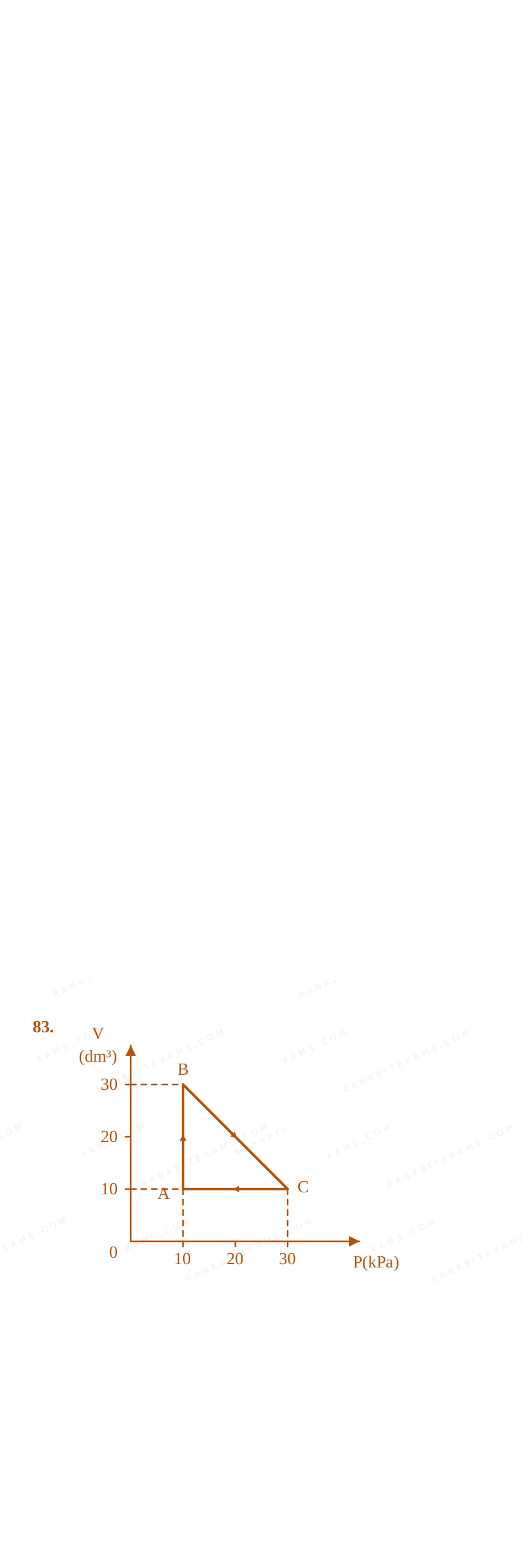
The work done in a cyclic process is equal to the magnitude of the area enclosed by the cycle on a Pressure-Volume graph. Note that the provided graph is Volume (V) on the y-axis versus Pressure (P) on the x-axis. The path A arrow B arrow C arrow A is traced in a clockwise direction on the V-P graph. Clockwise on a V-P graph corresponds to anti-clockwise on a standard P-V graph, meaning net expansion work is done by the gas, making it positive conventionally (or negative depending on chemistry sign convention, but magnitude is asked for).
Step 1: Calculating Area
The enclosed region is a right-angled triangle. Base of triangle on P-axis = 30 - 10 = 20 kPa Height of triangle on V-axis = 30 - 10 = 20 dm³
Area = (1)/(2) × base × height Area = (1)/(2) × 20 × 20 = 200 kPa ³Step 2: Unit conversion
1 kPa = 10³ Pa 1 dm³ = 1 Litre = 10⁻³ m³
W = 200 × 10³ Pa × 10⁻³ m³ W = 200 JPattern Recognition
1 kPa · 1 L = 1 Joule. This direct conversion saves time without converting explicitly to standard SI units (Pa and m³).
Chapter Mix
Class 11 Chemistry: Thermodynamics
