Rankbit System
JEE Physics: Waves (+15.5%) | Electrostatics: Concentric Shells (-29.7%) | Modern Physics: Photoelectric Clones (+34.2%) | Mathematics: Definite Integrals (+18.1%) | Chemistry: Coordination Splitting (-11.4%) | JEE Physics: Waves (+15.5%) | Electrostatics: Concentric Shells (-29.7%) | Modern Physics: Photoelectric Clones (+34.2%) | Mathematics: Definite Integrals (+18.1%) | Chemistry: Coordination Splitting (-11.4%)

In a single slit diffraction pattern, a light of wavelength 6000text AA is used. The distance between the first and third minima in the diffraction pattern is found to be 3text mm when the screen is placed 50text cm away from slits. The width of the slit is x times 10^-4text m. The value of x is:

Numerical Answer Type:
Enter a numerical value Answer: 2 to 2 +4 marks

Solution & Explanation

### Related Formula For single slit diffraction, the position of the n-th minima on the screen is given by: y_n = fracn lambda Db where: * lambda is the wavelength of light. * D is the distance to the screen. * b is the width of the slit. ### Core Logic Given parameters: * Wavelength, lambda = 6000text AA = 6000 times 10^-10text m * Screen distance, D = 50text cm = 0.5text m * Minima distance, y_3 - y_1 = 3text mm = 3 times 10^-3text m ### Step 1: Calculate Slit Width Using the position formula, calculate the separation between 3rd and 1st minima: Delta y = y_3 - y_1 = frac3 lambda Db - frac1 lambda Db = frac2 lambda Db Rearranging to solve for slit width b: b = frac2 lambda DDelta y Substitute the values: b = frac2 times (6000 times 10^-10text m) times 0.5text m3 times 10^-3text m b = frac6000 times 10^-103 times 10^-3 = 2000 times 10^-7text m = 2 times 10^-4text m Comparing this with x times 10^-4text m, we get: x = 2
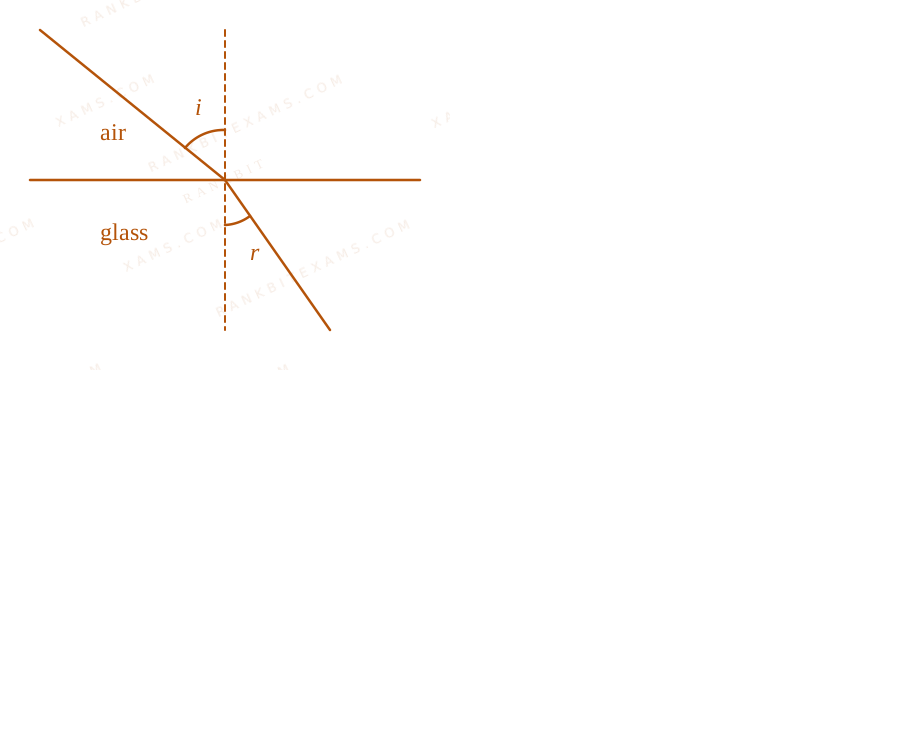
Diagram of single slit diffraction minima positions for Q57
### Pattern Recognition Distance between n-th and m-th minima is Delta y = (n-m)fraclambda Db. Since 3-1 = 2, we get Delta y = 2fraclambda Db. Substitute and scale variables directly. ### Evaluation Rubric / Model Answer null ### Chapter Mix Class 12 Physics: Wave Optics
Reference Study Guides

More Wave Optics Previous-Year Questions — Page 2

Q18 jee_main_2025_08_april_evening Young's Double Slit Experiment
In a Young's double slit experiment, the source is white light. One of the slits is covered by red filter and another by a green filter. In this case:
  • A. There shall be an interference pattern for red distinct from that for green.
  • B. There shall be no interference fringes.
  • C. There shall be alternate interference fringes of red and green.
  • D. There shall be an interference pattern, where each fringe's pattern center is green and outer edges is red.

Solution

### Related Formula For a stable, visible interference pattern to form, the light sources passing through the two slits must be **coherent**: - They must have the same wavelength (or frequency). - They must maintain a constant phase difference over time. ### Core Logic If one slit is covered by a red filter and the other by a green filter: - Only red light (lambda_textred approx 700mathrm~nm) passes through the first slit. - Only green light (lambda_textgreen approx 500mathrm~nm) passes through the second slit. Since the two passing waves have completely different wavelengths and frequencies, they are **incoherent**. ### Step 1: Resulting Pattern Analysis Coherent sources are a prerequisite for producing stable bright and dark interference fringes. Incoherent waves of different frequencies merely superimpose to create a general background illumination without any distinct, observable spatial fringe lines. Thus, **there shall be no interference fringes**. ### Pattern Recognition Sees: YDSE + opposite colored filters (red and green) on slits. Trap: Don't get confused thinking separate patterns will overlay. Since the slits emit different colors, the sources are incoherent, so the interference term langle cosphi rangle = 0. Shortcut: Different colors = different wavelengths = incoherent sources = NO fringes. ✓ ### Evaluation Rubric / Model Answer null ### Chapter Mix Class 12 Physics: Wave Optics

Q25 jee_main_2025_28_jan_morning Young's Double Slit Experiment
A double slit interference experiment performed with a light of wavelength 600mathrmnm forms an interference fringe pattern on a screen with 10^mathrmth bright fringe having its centre at a distance of 10mathrmmm from the central maximum. Distance of the centre of the same 10^mathrmth bright fringe from the central maximum when the source of light is replaced by another source of wavelength 660mathrmnm would be ____________________
Numerical Answer. Answer: 11 to 11

Solution

### Related Formula mathrmY = fracmathrmnlambda mathrmDmathrmd implies mathrmY propto lambda ### Core Logic Since the fringe index mathrmn and apparatus parameters mathrmD, mathrmd remain constant across both runs: fracmathrmy_2mathrmy_1 = fraclambda_2lambda_1 Substituting the values into the proportionality equation: fracmathrmy_210 mathrm~mm = frac660 mathrm~nm600 mathrm~nm mathrmy_2 = 10 times 1.1 = 11 mathrm~mm ### Step 1: Final Numerical Value The distance of the tenth bright fringe shifts to exactly 11 mathrm~mm. ### Pattern Recognition Fringe position scales linearly with wavelength in standard Young's setups. Increasing the wavelength by 10\% shifts the entire pattern outward by exactly 10\%. ### Evaluation Rubric / Model Answer null ### Chapter Mix Class 12 Physics: Wave Optics
Q23 jee_main_2025_03_april_morning Interference Intensities Difference
Two coherent monochromatic light beams of intensities 4I and 9I are superimposed. The difference between the maximum and minimum intensities in the resulting interference pattern is xI. The value of x is ________.
Numerical Answer. Answer: 24 to 24

Solution

### Related Formula For superposition of two coherent beams of intensities I_1 and I_2: I_textmax = left(sqrtI_1 + sqrtI_2right)^2 I_textmin = left(sqrtI_1 - sqrtI_2right)^2 ### Core Logic Given values: - I_1 = 4I - I_2 = 9I Let's calculate the square roots of the intensities: - sqrtI_1 = sqrt4I = 2sqrtI - sqrtI_2 = sqrt9I = 3sqrtI ### Step 1: Calculating Max and Min Intensities Substitute these values into the intensity formulas: I_textmax = (2sqrtI + 3sqrtI)^2 = (5sqrtI)^2 = 25I I_textmin = (3sqrtI - 2sqrtI)^2 = (1sqrtI)^2 = I ### Step 2: Finding the Difference The difference between the maximum and minimum intensities is: I_textmax - I_textmin = 25I - I = 24I Since this difference is given as xI: x = 24 ### Pattern Recognition Algebraic Shortcut: I_textmax - I_textmin = left(sqrtI_1 + sqrtI_2right)^2 - left(sqrtI_1 - sqrtI_2right)^2 = 4sqrtI_1 I_2 Substitute I_1 = 4I and I_2 = 9I: 4sqrt4I cdot 9I = 4sqrt36 I^2 = 4 times 6I = 24I. This beautiful identity (4ab formula) lets you solve the problem instantly without separately calculating maximum and minimum values! ### Evaluation Rubric / Model Answer null ### Chapter Mix Class 12 Physics: Wave Optics
Q15 jee_main_2025_04_april_evening Polarisation
Two polarisers P_1 and P_2 are placed in such a way that the intensity of the transmitted light will be zero. A third polariser P_3 is inserted in between P_1 and P_2 at the particular angle between P_2 and P_3. The transmitted intensity of the light passing through all the three polarisers is maximum. The angle between the polarisers P_2 and P_3 is:
  • A. fracpi4
  • B. fracpi6
  • C. fracpi8
  • D. fracpi3

Solution

### Related Formula Malus's Law: I = I_0 cos^2theta ### Core Logic Since P_1 and P_2 are crossed, the angle between their transmission axes is 90^circ. Let the angle between P_1 and P_3 be theta. Then the angle between P_3 and P_2 is left(90^circ - thetaright). Intensity after passing through P_3: I_1 = I_0 cos^2theta. Intensity after passing through P_2: I_textnet = I_1 cos^2(90^circ - theta) = I_0 cos^2theta sin^2theta. ### Step 1: Maximize Net Intensity Rewrite the expression: I_textnet = fracI_04 [2sinthetacostheta]^2 = fracI_04 [sin(2theta)]^2 For maximum transmitted intensity, sin(2theta) = 1 implies 2theta = 90^circ implies theta = 45^circ = fracpi4. The angle between P_2 and P_3 is 90^circ - 45^circ = 45^circ = fracpi4.
Polarizer alignment schema
### Pattern Recognition Inserting a polarization filter at exactly 45^circ ( pi/4) between crossed polarizers symmetrically splits up components, maximizing overall transmission throughput. ### Evaluation Rubric / Model Answer null ### Chapter Mix Class 12 Physics: Wave Optics
Q24 jee_main_2025_04_april_evening Diffraction and Interference
In a Young's double slit experiment, two slits are located 1.5 mm apart. The distance of screen from slits is 2 m and the wavelength of the source is 400 nm. If the 20 maxima of the double slit pattern are contained within the centre maximum of the single slit diffraction pattern, then the width of each slit is mathrmx times 10^-3text cm, where x-value is ________.
Numerical Answer. Answer: 15 to 15

Solution

### Related Formula Width of central maximum in single-slit diffraction: Delta y_textdiff = frac2lambda Da Fringe width in double-slit interference: beta = fraclambda Dd ### Core Logic Given condition: 20 interference fringes fit inside the central diffraction envelope: 20 times beta = Delta y_textdiff 20 times fraclambda Dd = frac2lambda Da Cancel common parameters: frac10d = frac1a implies a = fracd10 ### Step 1: Substitute Given Parameters Slit separation d = 1.5text mm = 0.15text cm. a = frac0.15text cm10 = 0.015text cm = 15 times 10^-3text cm Comparing with x times 10^-3text cm, the value of x is **15**. ### Pattern Recognition Envelope matching conditions rely strictly on the geometric ratio of slit separation (d) to individual slit width (a). Wavelength (lambda) and screen distance (D) cancel out completely. ### Evaluation Rubric / Model Answer null ### Chapter Mix Class 12 Physics: Wave Optics

More Wave Optics Questions — jee_main_2024_29_january_evening

Practice all Wave Optics previous-year questions →

YOUR FIRST PREP STEP STARTS HERE

We Map Every Repeating Question in Competitive Exams.

Say goodbye to generic mock test fatigue. RankBit uses smart analysis to group past exam questions into their foundational Repeating Question Types. Find chapter weightage, track repeating questions, and score higher with targeted practice.

Select Your Target Exam

Choose an exam track below to find formulas per chapter and patterns.

Syncing Exam Intelligence

Mapping formulas and patterns across all tracks…

PATH A — FULL LENGTH PRACTICE

Full Mock Test Hub

Simulate real NTA exam conditions with fully tracked mocks. Time yourself against past papers.

Under Development
PATH B — TARGETED PRACTICE

Topic-wise Practice Hub

Practice past-year questions one chapter at a time. Pick an exam → subject → chapter and get every PYQ for that topic — pulled together from all past papers — with the chapter's key formulas alongside.

Loading Questions... Browse Topics
Latest from the Blog
View all →

Loading articles...