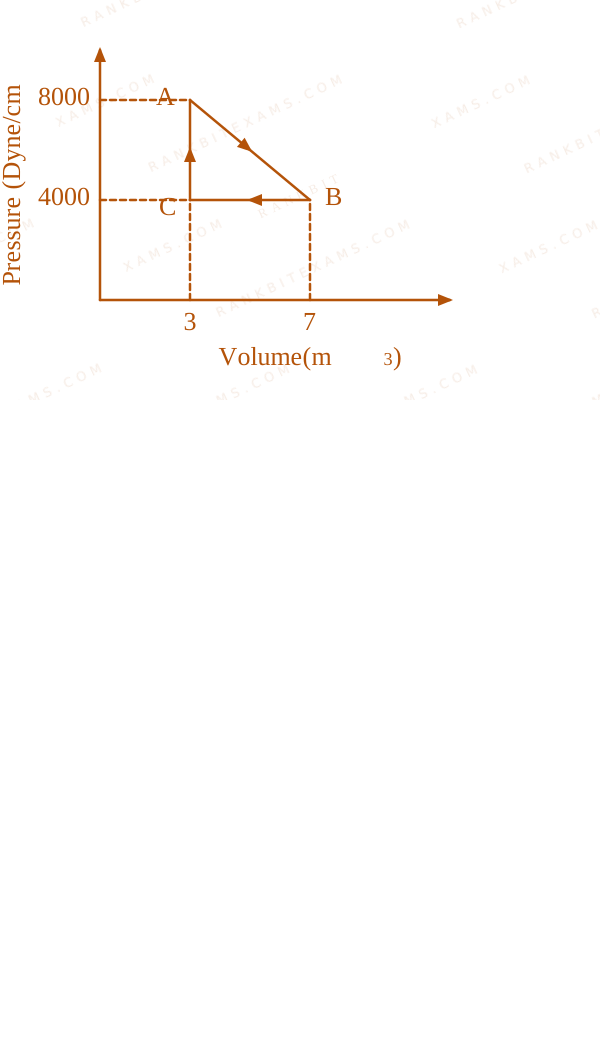
A thermodynamic system is taken from an original state A to an intermediate state B by a linear process as shown in the figure. It's volume is then reduced to the original value from B to C by an isobaric process. The total work done by the gas from A to B and B to C would be:
The graph plots Pressure (Dyne/cm^2) on the y-axis (with coordinates at 4000 and 8000) versus Volume (m^3) on the x-axis (with marks at 3 and 7). State path goes linearly from A to B, then horizontally from B to C.
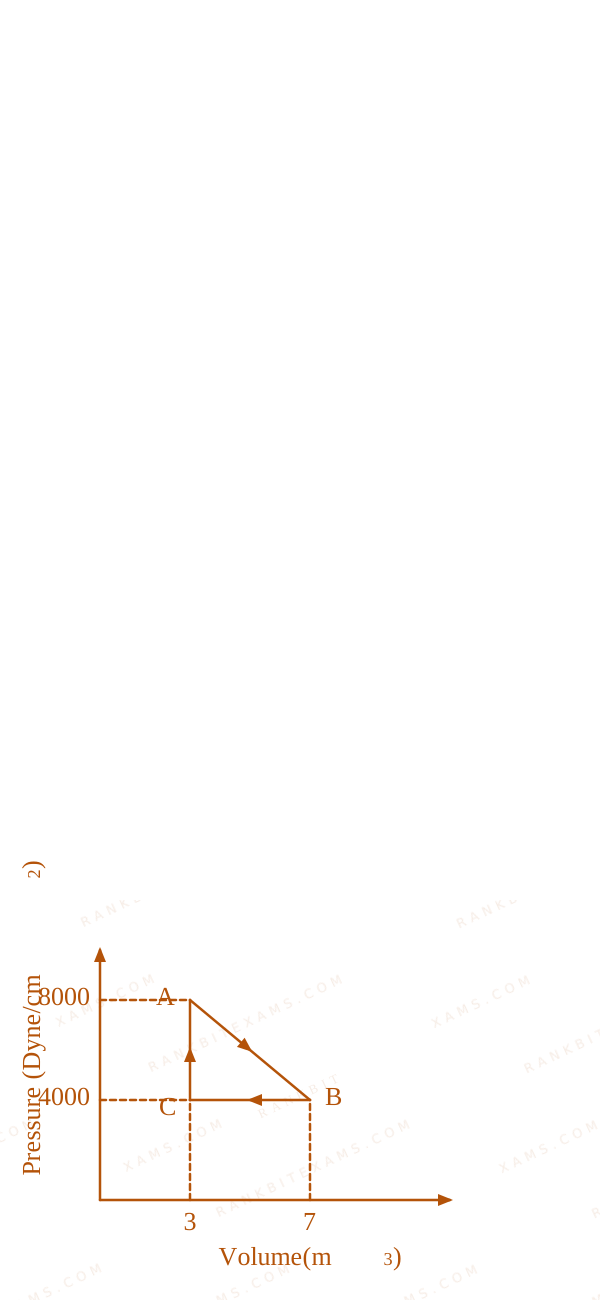
The graph plots Pressure (Dyne/cm^2) on the y-axis (with coordinates at 4000 and 8000) versus Volume (m^3) on the x-axis (with marks at 3 and 7). State path goes linearly from A to B, then horizontally from B to C.
A.33800 ~J$33800 \mathrm{~J}$
B.2200 ~J$2200 \mathrm{~J}$
C.600 ~J$600 \mathrm{~J}$
D.1200 ~J$1200 \mathrm{~J}$
Solution & Explanation
Related Formula
Work done (W$W$) in a thermodynamic process corresponds to the area under the curve on a P-V$P-V$ diagram:
W = ∫ P dV$$W = \int P \, dV$$
Core Logic
Let's compute the work done along the distinct steps AB$AB$ and BC$BC$ matching the values shown in the graph:
The graph plots Pressure (Dyne/cm^2) on the y-axis (with coordinates at 4000 and 8000) versus Volume (m^3) on the x-axis (with marks at 3 and 7). State path goes linearly from A to B, then horizontally from B to C.
Step 1: Calculate Work Done in Process AB
Process AB$AB$ is a linear expansion. Fulfilling the area of the trapezoid underneath path AB$AB$:
Since 800 ~J$800 \mathrm{~J}$ is not present in the options, this question was declared a BONUS.
Pattern Recognition
Always be highly vigilant of mixed unit systems in thermodynamic graphics. Here, pressure is in CGS (Dyne/cm²$\text{Dyne/cm}^2$) while volume is in MKS (m³$\text{m}^3$). Converting early keeps you clear of algebraic traps.
Water falls from a height of 200~m$200\mathrm{~m}$ into a pool. Calculate the rise in temperature of the water assuming no heat dissipation from the water in the pool. (Take g = 10~m/s²$g = 10\mathrm{~m/s}^{2}$, specific heat of water = 4200~J/(kg· K)$= 4200\mathrm{~J/(kg\cdot K)}$)
A.0.23~K$0.23\mathrm{~K}$
B.0.36~K$0.36\mathrm{~K}$
C.0.14~K$0.14\mathrm{~K}$
D.0.48~K$0.48\mathrm{~K}$
Solution
Related Formula
Δ U = mgh and Q = msΔ T$$\Delta U = mgh \quad \text{and} \quad Q = ms\Delta T$$
By conservation of energy (assuming all potential energy goes into heating the water):
mgh = msΔ T Δ T = (gh)/(s)$$mgh = ms\Delta T \implies \Delta T = \frac{gh}{s}$$
where,
g$g$ = acceleration due to gravity
h$h$ = height of the fall
s$s$ = specific heat of water
Δ T$\Delta T$ = rise in temperature
Core Logic
Given parameters:
h = 200~m$h = 200\mathrm{~m}$
g = 10~m/s²$g = 10\mathrm{~m/s}^{2}$
s = 4200~J/(kg· K)$s = 4200\mathrm{~J/(kg\cdot K)}$
Substitute the values to find Δ T$\Delta T$:
Δ T = (10 × 200)/(4200) = (2000)/(4200)$$\Delta T = \frac{10 \times 200}{4200} = \frac{2000}{4200}$$Δ T = (10)/(21) ≈ 0.476~K ≈ 0.48~K$$\Delta T = \frac{10}{21} \approx 0.476\mathrm{~K} \approx 0.48\mathrm{~K}$$
Pattern Recognition
Sees: "Water falling from height h$h$ raises temperature" → Mass cancels out. Δ T = (gh)/(s)$\Delta T = \frac{gh}{s}$.
Shortcut: Always use SI units (swater = 4200~J/kg· K$s_{\text{water}} = 4200\mathrm{~J/kg\cdot K}$ is given; if given in cal/g·^° C$\mathrm{cal/g\cdot^\circ C}$, convert using 1~cal = 4.184~J$1\mathrm{~cal} = 4.184\mathrm{~J}$). ✓
Chapter Mix
Class 11 Physics: Thermodynamics
Class 11 Physics: Work, Energy and Power
A monoatomic gas having γ = (5)/(3)$\gamma = \frac{5}{3}$ is stored in a thermally insulated container and the gas is suddenly compressed to ((1)/(8))th$\left(\frac{1}{8}\right)^{\mathrm{th}}$ of its initial volume. The ratio of final pressure and initial pressure is:
(γ$\gamma$ is the ratio of specific heats of the gas at constant pressure and at constant volume)
Sees: "suddenly compressed" or "thermally insulated container" → Adiabatic process.
Shortcut: P V^γ = constant$P V^\gamma = \text{constant}$. Since the volume goes down by 8$8$ times, the pressure increases by 8γ = 85/3 = 32$8^{\gamma} = 8^{5/3} = 32$ times. ✓
Chapter Mix
Class 11 Physics: Thermodynamics
Qjee_main_2025_29_jan_eveningIsothermal and Adiabatic Processes
Given below are two statements. One is labelled as Assertion (A) and the other is labelled as Reason (R).
**Assertion** (A): With the increase in the pressure of an ideal gas, the volume falls off more rapidly in an isothermal process in comparison to the adiabatic process.
Reason (R): In isothermal process, PV = constant$PV = \text{constant}$, while in adiabatic process PVγ = constant$PV^{\gamma} = \text{constant}$. Here γ$\gamma$ is the ratio of specific heats, P$P$ is the pressure and V$V$ is the volume of the ideal gas.
In the light of the above statements, choose the correct answer from the options given below:
A.Both (A) and (R) are true but (R) is NOT the correct explanation of (A)$\text{Both (A) and (R) are true but (R) is NOT the correct explanation of (A)}$
B.(A) is true but (R) is false$\text{(A) is true but (R) is false}$
C.Both (A) and (R) are true and (R) is the correct explanation of (A)$\text{Both (A) and (R) are true and (R) is the correct explanation of (A)}$
D.(A) is false but (R) is true$\text{(A) is false but (R) is true}$
Isothermal and Adiabatic Processes diagram for Q2 - JEE Main 2025 Evening
When pressure increases (compression), the volume drops. Because the adiabatic curve is steeper, the pressure rises more rapidly for a given drop in volume, or conversely, for a specified increase in pressure, the volume falls off more rapidly in the isothermal process than the adiabatic process. Hence, Assertion (A) is true.
Reason (R) states the governing equations PV = C$PV = C$ and PVγ = C$PV^{\gamma} = C$, which directly lead to these slope expressions via differentiation. Thus, Reason (R) is true and correctly explains Assertion (A).
Pattern Recognition
Adiabatic curves are steeper than isothermal curves on a P-V$P-V$ diagram because γ > 1$\gamma > 1$. For any expansion or compression process, remember that slope magnitude satisfies Slopeadi = γ · Slopeᵢₛₒ$\text{Slope}_{\text{adi}} = \gamma \cdot \text{Slope}_{\text{iso}}$.
Chapter Mix
Class 11 Physics: Thermodynamics
Q6jee_main_2025_29_jan_eveningHeat and Work in Thermodynamic Processes
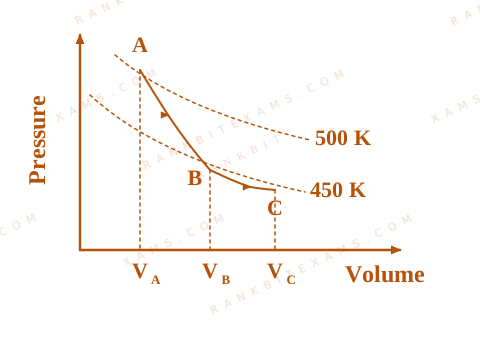
A poly-atomic molecule (CV = 3R, CP = 4R$C_V = 3R, C_P = 4R$, where R$R$ is gas constant) goes from phase space point A(PA = 10⁵~Pa, VA = 4 × 10⁻⁶~m³)$A(P_A = 10^5\mathrm{~Pa}, V_A = 4 \times 10^{-6}\mathrm{~m}^3)$ to point B(PB = 5 × 10⁴~Pa, VB = 6 × 10⁻⁶~m³)$B(P_B = 5 \times 10^4\mathrm{~Pa}, V_B = 6 \times 10^{-6}\mathrm{~m}^3)$ to point C(PC = 10⁴~Pa, VC = 8 × 10⁻⁶~m³)$C(P_C = 10^4\mathrm{~Pa}, V_C = 8 \times 10^{-6}\mathrm{~m}^3)$. A$A$ to B$B$ is an adiabatic path and B$B$ to C$C$ is an isothermal path. The net heat absorbed per unit mole by the system is:
The graph depicts a pressure vs volume plot indicating paths from state A to B (adiabatic) and from B to C (isothermal).
For path A arrow B$A \rightarrow B$:
Since it is given as an adiabatic path:
Δ QAB = 0$$\Delta Q_{AB} = 0$$
For path B arrow C$B \rightarrow C$:
Since it is given as an isothermal path, the change in internal energy Δ UBC = 0$\Delta U_{BC} = 0$. From the first law of thermodynamics, heat absorbed equals work done:
Wait, let's express it in terms of the gas constant R$R$ for a single mole (n=1$n=1$) using temperature data directly provided in the original figure labels (TB = 450~K$T_B = 450\mathrm{~K}$):
Δ QBC = (1) · R · (450) · ln( 8 × 10⁻⁶6 × 10⁻⁶)$$\Delta Q_{BC} = (1) \cdot R \cdot (450) \cdot \ln\left(\frac{8 \times 10^{-6}}{6 \times 10^{-6}}\right)$$Δ QBC = 450 R ln((4)/(3)) = 450 R (ln 4 - ln 3)$$\Delta Q_{BC} = 450 R \ln\left(\frac{4}{3}\right) = 450 R (\ln 4 - \ln 3)$$
Thus, the total net heat absorbed per unit mole is:
Δ Q = 0 + 450 R (ln 4 - ln 3) = 450 R (ln 4 - ln 3)$$\Delta Q = 0 + 450 R (\ln 4 - \ln 3) = 450 R (\ln 4 - \ln 3)$$
Pattern Recognition
Adiabatic paths have zero heat exchange by baseline definition. The calculation boils down directly to the work done during the isothermal stage B arrow C$B \rightarrow C$ matching RT ln(Vf/Vᵢ)$RT \ln(V_f/V_i)$.
Chapter Mix
Class 11 Physics: Thermodynamics
Q7jee_main_2025_28_jan_morningCarnot Engine and Efficiency
A Carnot engine (E) is working between two temperatures 473K and 273K. In a new system two engines - engine E₁$\mathrm{E}_1$ works between 473K to 373K and engine E₂$\mathrm{E}_2$ works between 373K to 273K. If η₁₂$\eta_{12}$ , η₁$\eta_1$ and η₂$\eta_2$ are the efficiencies of the engines E, E₁$\mathrm{E}_1$ and E₂$\mathrm{E}_2$ , respectively, then
A.η₁₂ < η₁ + η₂$\eta_{12} < \eta_1 + \eta_2$
B.η₁₂ = η₁η₂$\eta_{12} = \eta_1\eta_2$
C.η₁₂ = η₁ + η₂$\eta_{12} = \eta_{1} + \eta_{2}$
D.η₁₂ ≥ η₁ + η₂$\eta_{12} \geq \eta_1 + \eta_2$
Solution
Related Formula
η = 1 - TLTH$$\eta = 1 - \frac{\mathrm{T}_L}{\mathrm{T}_H}$$
Core Logic
Let's compute the efficiency parameters explicitly:
Practice past-year questions one chapter at a time. Pick an exam → subject → chapter and get every PYQ for that topic — pulled together from all past papers — with the chapter's key formulas alongside.