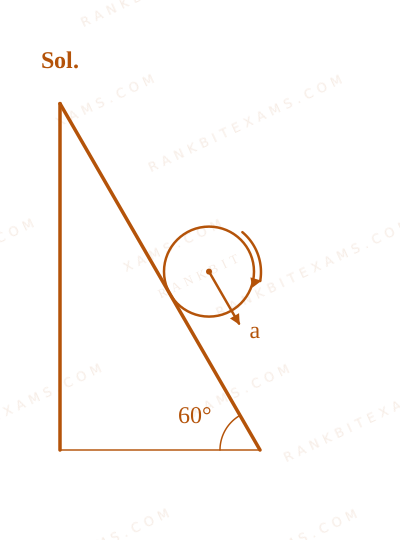
A cylinder is rolling down on an inclined plane of inclination 60°$60^{\circ}$. It's acceleration during rolling down will be x√(3) ~m / s²$\frac{x}{\sqrt{3}} \mathrm{~m / s^{2}}$, where x =$x =$ ________ (use g = 10 ~m/s²$g = 10 \mathrm{~m/s}^{2}$).
Numerical Answer Type:
Enter a numerical valueAnswer: 10 to 10+4 marks
Solution & Explanation
Related Formula
The linear acceleration (a$a$) of a symmetric body performing pure rolling down an inclined plane of angle θ$\theta$ is given by:
a = g θ1 + IcmM R²$$a = \frac{g \sin \theta}{1 + \frac{I_{\text{cm}}}{M R^2}}$$
Core Logic
For a solid cylinder, the moment of inertia about its central longitudinal axis is:
Icm = (1)/(2) M R² IcmM R² = (1)/(2)$$I_{\text{cm}} = \frac{1}{2} M R^2 \implies \frac{I_{\text{cm}}}{M R^2} = \frac{1}{2}$$
Given inclination angle, θ = 60^°$\theta = 60^\circ$, and g = 10 ~m/s²$g = 10 \mathrm{~m/s^2}$.
Free body diagram of a rolling cylinder on an incline for Q54
Step 1: Calculate Linear Acceleration
Substituting the values into the acceleration template:
Comparing this evaluated value with the expression
$
Step 2: Solve for x
Comparing this evaluated value with the expression $
\frac{x}{\sqrt{3}}:$:
$10√(3) = x√(3) x = 10$\frac{10}{\sqrt{3}} = \frac{x}{\sqrt{3}} \implies x = 10$
Therefore, the value of
$
Therefore, the value of $
xis$ is $10.
Pattern Recognition
Pure rolling problems reduce down to tracking the shape factor fraction
$.
Pattern Recognition
Pure rolling problems reduce down to tracking the shape factor fraction $
\beta = 1 + \frac{I}{MR^2}. For solid cylinders it is$. For solid cylinders it is $1.5, for solid spheres it is$, for solid spheres it is $1.4, and for hoops it is$, and for hoops it is $2.0$. This value acts as an effective inertial scaling factor for gravity.
Chapter Mix
Class 11 Physics: System of Particles and Rotational Motion
Free body diagram of a rolling cylinder on an incline for Q54
More System of Particles and Rotational Motion Previous-Year Questions — Page 8
Q12jee_main_2025_04_april_eveningRolling Motion
A wheel is rolling on a plane surface. The speed of a particle on the highest point of the rim is 8 m/s. The speed of the particle on the rim of the wheel at the same level as the centre of wheel, will be:
A.4√(2) m/s$4\sqrt{2}\text{ m/s}$
B.8 m/s$8\text{ m/s}$
C.4 m/s$4\text{ m/s}$
D.8√(2) m/s$8\sqrt{2}\text{ m/s}$
Solution
Related Formula
Velocity of a point on a rolling wheel at angular position θ$\theta$ from the lowest point:
v = 2 vcm ((θ)/(2))$$v = 2 v_{\text{cm}} \sin\left(\frac{\theta}{2}\right)$$
Core Logic
At the highest point, θ = 180^°$\theta = 180^\circ$, so:
For a particle on the rim at the same horizontal level as the center, the angle from the lowest point is θ = 90^°$\theta = 90^\circ$.
Step 1: Compute Speed at Mid-Height
Substituting θ = 90^°$\theta = 90^\circ$ into our velocity relation:
vmid = 2vcm (45^°) = 2 × 4 × 1√(2) = 4√(2) m/s$$v_{\text{mid}} = 2v_{\text{cm}} \sin(45^\circ) = 2 \times 4 \times \frac{1}{\sqrt{2}} = 4\sqrt{2}\text{ m/s}$$Instantaneous center of rotation on rolling wheel
Pattern Recognition
The contact point with the ground is the Instantaneous Center of Rotation (ICR). Distance to top point is 2R$2R$, distance to mid-level point is √(R²+R²) = √(2)R$\sqrt{R^2+R^2} = \sqrt{2}R$. Velocity scales linearly with distance from ICR.
Chapter Mix
Class 11 Physics: Rotational Motion

Q22jee_main_2025_04_april_eveningConservation of Angular Momentum
A solid sphere with uniform density and radius R is rotating initially with constant angular velocity (ω₁)$(\omega_{1})$ about its diameter. After some time during the rotation its starts loosing mass at a uniform rate, with no change in its shape. The angular velocity of the sphere when its radius becomes R / 2$R / 2$ is xω₁$x\omega_{1}$. The value of x is ________.
Numerical Answer.Answer: 32 to 32
Solution
Related Formula
Conservation of Angular Momentum (since no external torque acts):
I₁ ω₁ = I₂ ω₂$$I_1 \omega_1 = I_2 \omega_2$$
For a solid sphere, moment of inertia is:
I = (2)/(5)MR²$$I = \frac{2}{5}MR^2$$
Mass scales with volume:
M ∝ R³$M \propto R^3$
Core Logic
When the radius reduces to R₂ = (R)/(2)$R_2 = \frac{R}{2}$, the mass scales cubically:
Since inertia of a solid sphere scales with M R²$M R^2$ and M ∝ R³$M \propto R^3$, the net moment of inertia scales with R⁵$R^5$. Shrinking the radius by half (1/2$1/2$) cuts down inertia by a factor of (1/2)⁵ = 1/32$(1/2)^5 = 1/32$. Velocity must scale up by 32 to conserve momentum.
Chapter Mix
Class 11 Physics: Rotational Motion
Qjee_main_2025_04_april_morningTorque and Angular Momentum
Which of the following are correct expressions for torque acting on a body?
A. τ = r × L$\vec{\tau} = \vec{r} \times \vec{L}$
B. τ = (d)/(dt)( r × p)$\vec{\tau} = \frac{d}{dt}(\vec{r} \times \vec{p})$
C. τ = r × d pdt$\vec{\tau} = \vec{r} \times \frac{d\vec{p}}{dt}$
D. τ = I α$\vec{\tau} = I\vec{\alpha}$
E. τ = r × F$\vec{\tau} = \vec{r} \times \vec{F}$( r = position vector; p = linear momentum; L = angular momentum; α = angular acceleration; I = moment of inertia; F = force; t = time)$(\vec{r} = \text{position vector}; \vec{p} = \text{linear momentum}; \vec{L} = \text{angular momentum}; \vec{\alpha} = \text{angular acceleration}; I = \text{moment of inertia}; \vec{F} = \text{force}; t = \text{time})$
Choose the correct answer from the options given below:
A. B, D and E Only
B. C and D Only
C. B, C, D and E Only
D. A, B, D and E Only
Solution
Related Formula
Fundamental mathematical definition of torque:
τ = r × F$$\vec{\tau} = \vec{r} \times \vec{F}$$
Rotational analogue of Newton's second law:
τ = d Ldt = I α$$\vec{\tau} = \frac{d\vec{L}}{dt} = I\vec{\alpha}$$
Linear momentum relations:
L = r × p τ = (d)/(dt)( r × p)$$\vec{L} = \vec{r} \times \vec{p} \implies \vec{\tau} = \frac{d}{dt}(\vec{r} \times \vec{p})$$
Core Logic
Let's check each expression sequentially:
A.τ = I × L$\vec{\tau} = \vec{I} \times \vec{L}$ is dimensionally incorrect (Moment of inertia I$I$ is primarily treated as a tensor or scalar placeholder, not crossed directly like this).
B.τ = d Ldt = (d)/(dt)( r × p)$\vec{\tau} = \frac{d\vec{L}}{dt} = \frac{d}{dt}(\vec{r} \times \vec{p})$ is fundamentally correct.
C.τ = r × F = r × d pdt$\vec{\tau} = \vec{r} \times \vec{F} = \vec{r} \times \frac{d\vec{p}}{dt}$ is correct since F = d pdt$\vec{F} = \frac{d\vec{p}}{dt}$.
D.τ = I α$\vec{\tau} = I\vec{\alpha}$ is the standard scalar component/fixed axis formulation.
E.τ = r × F$\vec{\tau} = \vec{r} \times \vec{F}$ is the true physical vector definition.
Thus, statements B, C, D, and E are universally correct representations.
Pattern Recognition
Torque can be represented either through geometric structural parameters (position and force cross products) or via kinematic response properties (rate of change of angular momentum or product of rotational inertia and acceleration).
Chapter Mix
Class 11 Physics: System of Particles and Rotational Motion
Qjee_main_2025_04_april_morningUniform Circular Motion and Dynamics
If L$\vec{L}$ and P$\vec{P}$ represent the angular momentum and linear momentum respectively of a particle of mass 'm$m$' having position vector r = a( i ω t + j ω t)$\vec{r} = a(\hat{i}\cos\omega t + \hat{j}\sin\omega t)$. The direction of force is
A. Opposite to the direction of r$\vec{r}$
B. Opposite to the direction of L$\vec{L}$
C. Opposite to the direction of P$\vec{P}$
D. Opposite to the direction of L × P$\vec{L} \times \vec{P}$
Solution
Related Formula
Acceleration vector equation via secondary derivation:
a = d² rdt²$$\vec{a} = \frac{d^2\vec{r}}{dt^2}$$
Force equation:
F = m a$$\vec{F} = m\vec{a}$$
Core Logic
Given position tracking trace:
r = a( i ω t + j ω t)$$\vec{r} = a(\hat{i}\cos\omega t + \hat{j}\sin\omega t)$$
Velocity vector v$\vec{v}$:
v = d rdt = aω(- i ω t + j ω t)$$\vec{v} = \frac{d\vec{r}}{dt} = a\omega(-\hat{i}\sin\omega t + \hat{j}\cos\omega t)$$
Step 1: Differentiate to find Acceleration
a = d vdt = aω²(- i ω t - j ω t)$$\vec{a} = \frac{d\vec{v}}{dt} = a\omega^2(-\hat{i}\cos\omega t - \hat{j}\sin\omega t)$$a = -ω² [ a( i ω t + j ω t) ] = -ω² r$$\vec{a} = -\omega^2 \left[ a(\hat{i}\cos\omega t + \hat{j}\sin\omega t) \right] = -\omega^2\vec{r}$$
Step 2: Establish Force Direction
F = m a = -mω² r$$\vec{F} = m\vec{a} = -m\omega^2\vec{r}$$
The minus sign indicates the net centripetal pulling force aligns explicitly opposite to the direction of r$\vec{r}$.
Pattern Recognition
The expression describes a standard uniform circular motion profile. In circular configurations, acceleration and centripetal forces point radially inward, directly opposing the outbound position tracker vector.
Chapter Mix
Class 11 Physics: Kinematics
Class 11 Physics: System of Particles and Rotational Motion
Q21jee_main_2025_04_april_morningRolling Motion on an Inclined Plane
A circular ring and a solid sphere having same radius roll down on an inclined plane from rest without slipping. The ratio of their velocities when reached at the bottom of the plane is √((x)/(5))$\sqrt{\frac{x}{5}}$ where x =
Numerical Answer.Answer: 3.5 to 4
Solution
Related Formula
Velocity of a rolling body from mechanical energy conservation:
v = √((2gh)/(1 + (k²)/(R²)))$$v = \sqrt{\frac{2gh}{1 + \frac{k^2}{R^2}}}$$
Core Logic
Evaluate radius of gyration factor coefficients:
For a circular ring: (k²)/(R²) = 1$\frac{k^2}{R^2} = 1$
For a solid sphere: (k²)/(R²) = (2)/(5)$\frac{k^2}{R^2} = \frac{2}{5}$
Matching with the prompt expression format √((x)/(5))$\sqrt{\frac{x}{5}}$ reveals:
x = 3.5$x = 3.5$
Rounding to the nearest integer yields 4.
Pattern Recognition
Objects with lower mass concentration near the center (lower (k²)/(R²)$\frac{k^2}{R^2}$ like the sphere) convert gravitational potential energy into translational kinetic energy more efficiently, rolling faster than hollow equivalents.
Chapter Mix
Class 11 Physics: System of Particles and Rotational Motion
More System of Particles and Rotational Motion Questions — jee_main_2024_29_jan_morning
Practice past-year questions one chapter at a time. Pick an exam → subject → chapter and get every PYQ for that topic — pulled together from all past papers — with the chapter's key formulas alongside.