When a hydrogen atom going from n = 2$n = 2$ to n = 1$n = 1$ emits a photon, its recoil speed is (x)/(5) ~m / s$\frac{x}{5} \mathrm{~m / s}$. Where x =$x =$ _______. (Use: mass of hydrogen atom = 1.6 × 10⁻²⁷ ~kg$= 1.6 \times 10^{-27} \mathrm{~kg}$)
Numerical Answer Type:
Enter a numerical valueAnswer: 17 to 17+4 marks
Solution & Explanation
Related Formula
By conservation of linear momentum, the momentum of the recoiling hydrogen atom matches the momentum of the emitted photon:
patom = pphoton m v = (Δ E)/(c)$$p_{\text{atom}} = p_{\text{photon}} \implies m v = \frac{\Delta E}{c}$$
Hence, the recoil speed v$v$ is:
v = (Δ E)/(m c)$$v = \frac{\Delta E}{m c}$$
where Δ E$\Delta E$ is the energy difference between the electronic energy levels.
Core Logic
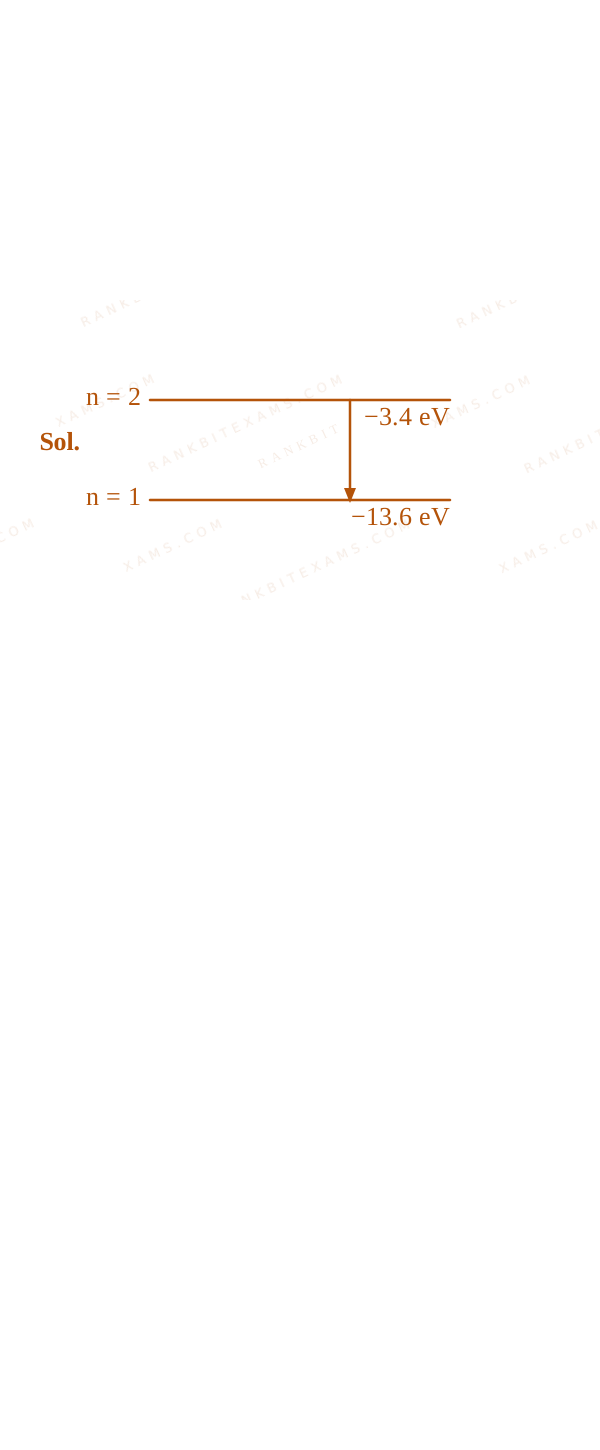
For a hydrogen transition from n = 2$n = 2$ to n = 1$n = 1$:
Equating the computed speed to the given parameter form:
3.4 = (x)/(5) x = 3.4 × 5 = 17$$3.4 = \frac{x}{5} \implies x = 3.4 \times 5 = 17$$
Therefore, the value of x$x$ is 17$17$.
Pattern Recognition
Always look for clean component cancellation matches prior to raw exponential expansion. In this problem, the value 1.6$1.6$ in the electron charge value cancels with the structural atomic mass constant value perfectly.
Chapter Mix
Class 12 Physics: Atoms
Electronic transition energy level diagram from n=2 to n=1 for Q51
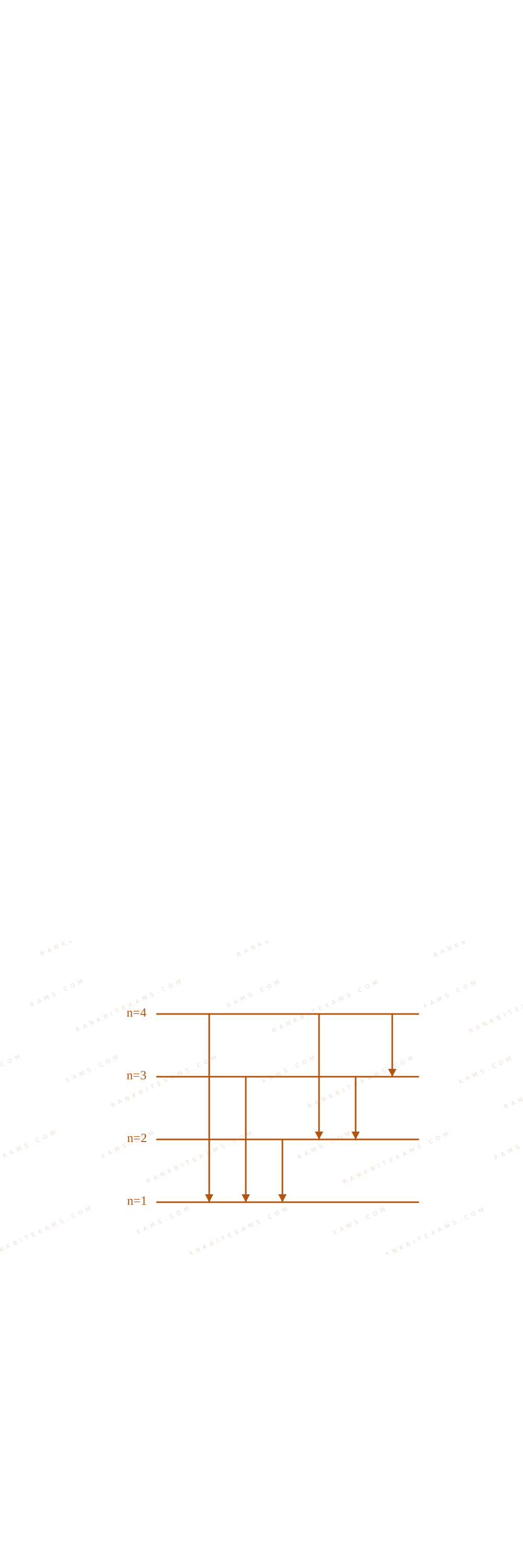
Think of it as counting combinations of transitions between levels: ₙC₂$_nC_2$. For n=4$n=4$, ₄C₂ = 6$_4C_2 = 6$ lines.
Chapter Mix
Class 12 Physics: Atoms
Q5jee_main_2025_24_jan_morningBohr Model of the Hydrogen Atom
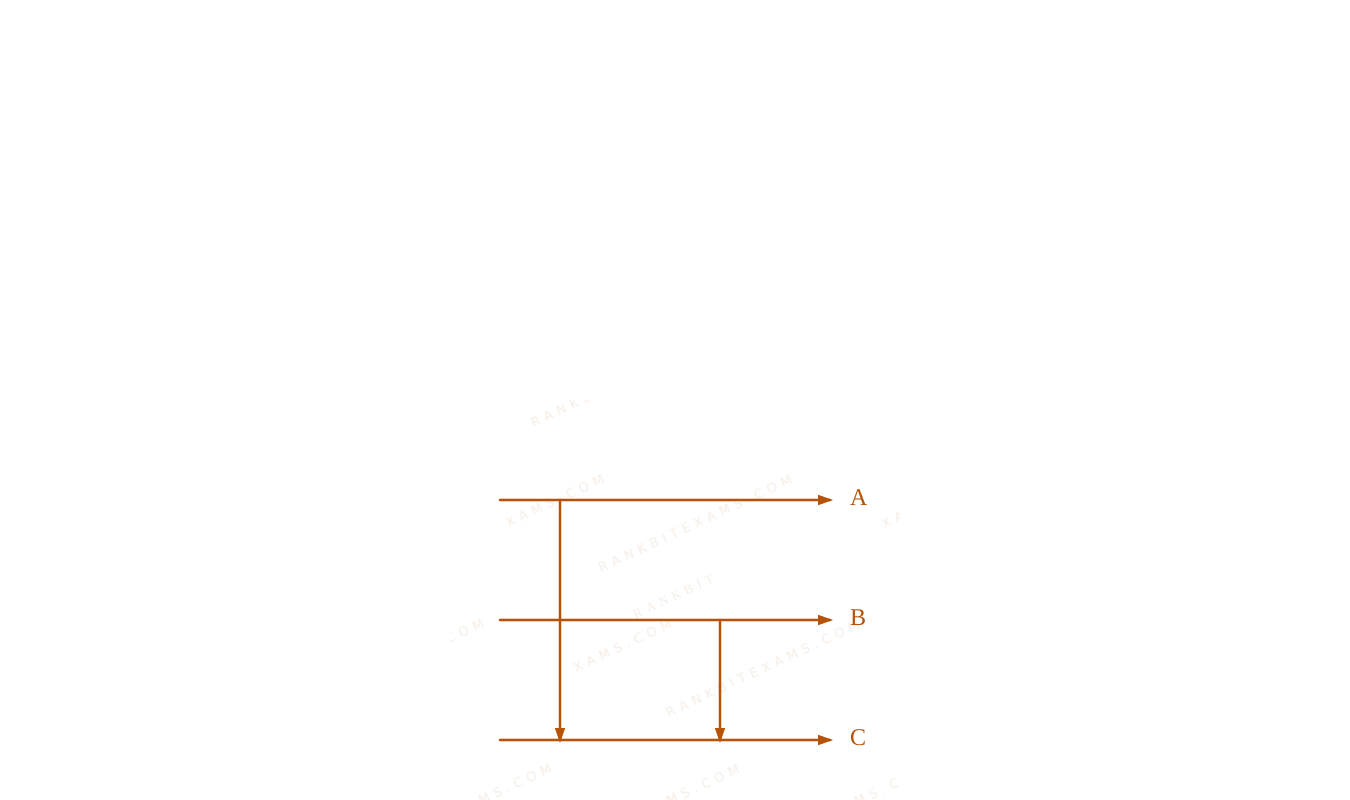
During the transition of electron from state A to state C of a Bohr atom, the wavelength of emitted radiation is 2000 Å and it becomes 6000 Å when the electron jumps from state B to state C. Then the wavelength of the radiation emitted during the transition of electrons from state A to state B is :-
A. 3000 Å
B. 6000 Å
C. 4000 Å
D. 2000 Å
Solution
Related Formula
The energy of the emitted photon during an atomic transition between energy states is given by:
Δ E = (hc)/(λ)$$\Delta E = \frac{hc}{\lambda} $$
where h$h$ is Planck's constant, c$c$ is speed of light, and λ$\lambda$ is the photon wavelength.
Core Logic
Write equations for the energy transitions from the layout of levels Bohr Model of the Hydrogen Atom diagram for Q5 - JEE Main 2025 Morning :
Energy differences add linearly, which means their corresponding inverse wavelengths satisfy a parallel reciprocal subtraction rule: 1λAB = 1λAC - 1λBC$\frac{1}{\lambda_{AB}} = \frac{1}{\lambda_{AC}} - \frac{1}{\lambda_{BC}}$.
Chapter Mix
Class 12 Physics: Atoms
Q7jee_main_2025_28_jan_eveningBohr Model
The frequency of revolution of the electron in Bohr's orbit varies with n$n$ , the principal quantum number as
A.(1)/(n)$\frac{1}{n}$
B.1n³$\frac{1}{\mathrm{n}^3}$
C.1n⁴$\frac{1}{\mathrm{n}^4}$
D.(1)/(n²)$\frac{1}{n^2}$
Solution
Related Formula
The orbital frequency of revolution f$f$ of an electron is inversely proportional to its time period T$T$:
Substitute the proportional relationships of v$v$ and r$r$ into the frequency expression:
f ∝ (((1)/(n)))/(n²) f ∝ (1)/(n³)$$f \propto \frac{\left(\frac{1}{n}\right)}{n^2} \implies f \propto \frac{1}{n^3}$$
Step 1: Verification
Thus, the frequency varies inversely with the cube of the principal quantum number: f ∝ (1)/(n³)$f \propto \frac{1}{n^3}$.
Pattern Recognition
Remember the sequence of powers of n$n$ in Bohr's model: radius expands as n²$n^2$, velocity drops as n⁻¹$n^{-1}$, angular momentum grows as n¹$n^1$, and orbital time period or frequency changes as n³$n^3$ or n⁻³$n^{-3}$ respectively.
Δ E = Efinal - Einitial$$\Delta E = E_{\text{final}} - E_{\text{initial}}$$
Core Logic
To emit radiation in the Balmer series, the hydrogen electron must first be excited to at least the n=3$n=3$ shell. This allows it to jump down to n=2$n=2$ and produce the first spectral line of the Balmer series.
Energy required to transition from ground state (n=1$n=1$) to n=3$n=3$:
Balmer emissions always return down to n=2$n=2$. Thus, the initial excitation starting from ground state n=1$n=1$ must reach at least n=3$n=3$ to create a valid Balmer transition.
Chapter Mix
Class 12 Physics: Atoms
Q49jee_main_2024_29_january_eveningAlpha-particle Scattering and Rutherford's Nuclear Model
Given below are two statements:
Statement I: Most of the mass of the atom and all its positive charge are concentrated in a tiny nucleus and the electrons revolve around it, is Rutherford's model.
Statement II: An atom is a spherical cloud of positive charges with electrons embedded in it, is a special case of Rutherford's model.
In the light of the above statements, choose the most appropriate from the options given below:
A. Both statement I and statement II are false.
B. Statement I is false but statement II is true
C. Statement I is true but statement II is false.
D. Both statement I and statement II are true.
Solution
Core Logic
Statement I: According to Rutherford's planetary model of the atom, almost the entire mass of an atom and all of its positive charge are concentrated in a centrally located small volume called the nucleus, with electrons revolving around it. Thus, Statement I is true.
Statement II: Thomson's model of the atom (plum-pudding model) describes the atom as a spherical cloud of positive charge with electrons embedded in it. This model was proposed before Rutherford's nuclear model and is not a special case of Rutherford's model. Thus, Statement II is false.
Step 1: Conclusion
Therefore, Statement I is true but Statement II is false.
Pattern Recognition
Understand the evolutionary timeline of atomic models:
Thomson's Plum Pudding Model (spherical cloud with embedded electrons)
Rutherford's Nuclear Model (planetary orbital model with tiny centralized nucleus)
They are conceptually distinct, making Statement II false.
Chapter Mix
Class 12 Physics: Atoms
More Atoms Questions — jee_main_2024_29_jan_morning
Practice past-year questions one chapter at a time. Pick an exam → subject → chapter and get every PYQ for that topic — pulled together from all past papers — with the chapter's key formulas alongside.