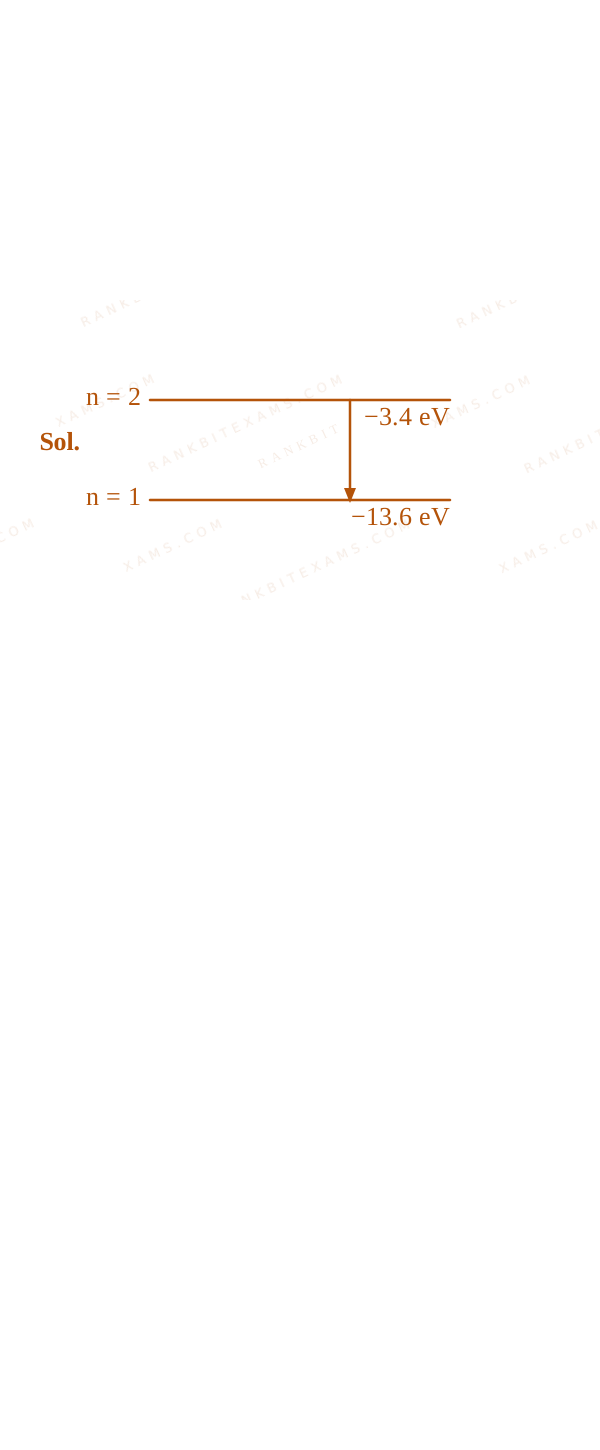
When a hydrogen atom going from n = 2$n = 2$ to n = 1$n = 1$ emits a photon, its recoil speed is (x)/(5) ~m / s$\frac{x}{5} \mathrm{~m / s}$. Where x =$x =$ _______. (Use: mass of hydrogen atom = 1.6 × 10⁻²⁷ ~kg$= 1.6 \times 10^{-27} \mathrm{~kg}$)
Numerical Answer Type:
Enter a numerical valueAnswer: 17 to 17+4 marks
Solution & Explanation
Related Formula
By conservation of linear momentum, the momentum of the recoiling hydrogen atom matches the momentum of the emitted photon:
patom = pphoton m v = (Δ E)/(c)$$p_{\text{atom}} = p_{\text{photon}} \implies m v = \frac{\Delta E}{c}$$
Hence, the recoil speed v$v$ is:
v = (Δ E)/(m c)$$v = \frac{\Delta E}{m c}$$
where Δ E$\Delta E$ is the energy difference between the electronic energy levels.
Core Logic
For a hydrogen transition from n = 2$n = 2$ to n = 1$n = 1$:
Equating the computed speed to the given parameter form:
3.4 = (x)/(5) x = 3.4 × 5 = 17$$3.4 = \frac{x}{5} \implies x = 3.4 \times 5 = 17$$
Therefore, the value of x$x$ is 17$17$.
Pattern Recognition
Always look for clean component cancellation matches prior to raw exponential expansion. In this problem, the value 1.6$1.6$ in the electron charge value cancels with the structural atomic mass constant value perfectly.
Chapter Mix
Class 12 Physics: Atoms

Electronic transition energy level diagram from n=2 to n=1 for Q51
More Atoms Previous-Year Questions — Page 2
Q11jee_main_2025_02_april_eveningBohr's Atomic Model
Assuming the validity of Bohr's atomic model for hydrogen like ions the radius of Li⁺⁺$\mathrm{Li}^{++}$ ion in its ground state is given by 1Xa₀$\frac{1}{\mathrm{X}}\mathrm{a}_0$ , where X = _ _ _ .$\mathrm{X} = \_ \_ \_ .$
(Where a₀$\mathbf{a}_0$ is the first Bohr's radius.)
A.2$2$
B.1$1$
C.3$3$
D.9$9$
Solution
Related Formula
Bohr radius formula for hydrogen-like species:
rₙ = a₀ (n²)/(Z)$$r_n = a_0 \frac{n^2}{Z}$$
Core Logic
For Lithium ion Li⁺⁺$\mathrm{Li}^{++}$:
Atomic number Z = 3$Z = 3$
For ground state, the principal quantum number n = 1$n = 1$
Substitute Z = 3$Z = 3$ and n = 1$n = 1$ into Bohr's radius formula:
Comparing with the given expression (1)/(X) a₀$\frac{1}{X} a_0$:
(1)/(X) a₀ = (a₀)/(3) X = 3$$\frac{1}{X} a_0 = \frac{a_0}{3} \implies X = 3$$
Pattern Recognition
Sees: Ground state radius of hydrogen-like species.
Trap: Confusing the atomic number Z$Z$ of Lithium with Helium (Z=2$Z=2$) or Beryllium (Z=4$Z=4$).
Shortcut: Ground state radius of hydrogenic species is simply a₀ / Z$a_0 / Z$. Since Lithium has Z=3$Z=3$, the ground state radius must be a₀/3$a_0/3$ directly.
Chapter Mix
Class 12 Physics: Atoms
Q7jee_main_2025_03_april_eveningBohr's Model of Hydrogen Atom
Given below are two statements: one is labelled as Assertion A and the other is labelled as Reason R.
Assertion A: The Bohr model is applicable to hydrogen and hydrogen-like atoms only.
Reason R: The formulation of Bohr model does not include repulsive force between electrons.
In the light of the above statements, choose the correct answer from the options given below :
A. Both A and R are true but R is NOT the correct explanation of A.
B. A is false but R is true.
C. Both A and R are true and R is the correct explanation of A.
This basic equation matches ONLY a single electron orbiting a nucleus of charge +Ze$+Ze$.
Core Logic
Assertion Analysis:
Bohr's model matches single-electron species (such as H$\mathrm{H}$, He^+$\mathrm{He}^+$, Li²⁺$\mathrm{Li}^{2+}$, etc.). Hence, Assertion A is true.
Reason Analysis:
The model is restricted because it models ONLY the attractive force between the positive nucleus and one orbiting electron. It cannot handle multi-electron systems due to the presence of inter-electron repulsive forces, which are not integrated into Bohr's simple formulation. Hence, Reason R is true.
Connection Check:
The lack of repulsive forces is exactly why the model fails for multi-electron species and remains applicable only to single-electron (hydrogen-like) species. Thus, R is the correct explanation of A.
Pattern Recognition
For single vs. multi-electron systems in atomic physics: Bohr model = single-electron ONLY. Quantum mechanics (Schrodinger) is required for multi-electron systems due to electron-electron interactions.
Chapter Mix
Class 12 Physics: Atoms
Q24jee_main_2025_03_april_eveningHydrogen Spectrum and Energy Level Transitions
An electron in the hydrogen atom initially in the fourth excited state makes a transition to nth$n^{\text{th}}$ energy state by emitting a photon of energy 2.86 eV. The integer value of n will be ________.
Numerical Answer.Answer: 2 to 2
Solution
Related Formula
The energy of an electron in the n$n$-th shell of a hydrogen atom is:
Memorizing the first few energy levels of the hydrogen atom saves calculation time:
$
Pattern Recognition
Memorizing the first few energy levels of the hydrogen atom saves calculation time:
$
E_1 = -13.6\mathrm{~eV}$
$
E_2 = -3.4\mathrm{~eV}$
$
E_3 = -1.51\mathrm{~eV}$
$
E_4 = -0.85\mathrm{~eV}$
$
E_5 = -0.54\mathrm{~eV}
Recognizing that a transition from
$
Recognizing that a transition from $
-0.54\mathrm{~eV}by emitting$ by emitting $2.86\mathrm{~eV}lands exactly at$ lands exactly at $-3.4\mathrm{~eV}maps directly to$ maps directly to $n=2$ instantly.
Chapter Mix
Class 12 Physics: Atoms
Q15jee_main_2025_07_april_morningBohr Model of Hydrogen Atom
In a hydrogen like ion, the energy difference between the 2nd$2^{\mathrm{nd}}$ excitation energy state and ground is 108.8eV$108.8\mathrm{eV}$ . The atomic number of the ion is
A. 4
B. 2
C. 1
D. 3
Solution
Related Formula
For a hydrogen-like ion of atomic number Z$Z$, the transition energy between states n₂$n_2$ and n₁$n_1$ is:
2^{\mathrm{nd}}excitation"$ excitation" $\implies n = 3. Ground state$. Ground state $\implies n = 1. Shortcut: Energy transition ratio for$.
Shortcut: Energy transition ratio for $1 \to 3is always$ is always $\frac{8}{9}of$ of $13.6 Z^2 \approx 12.1 Z^2. Since$. Since $108.8 / 12.1 \approx 9,$, $Z^2 = 9 \implies Z = 3$.
Practice past-year questions one chapter at a time. Pick an exam → subject → chapter and get every PYQ for that topic — pulled together from all past papers — with the chapter's key formulas alongside.