JEE Main · Physics ↓ Falling

Atoms appeared 22 times across 3 years — 2.5% of Physics. This question is from Bohr Model of the Hydrogen Atom.

Year 2026 2025 2024 Total
Questions 5 8 9 22

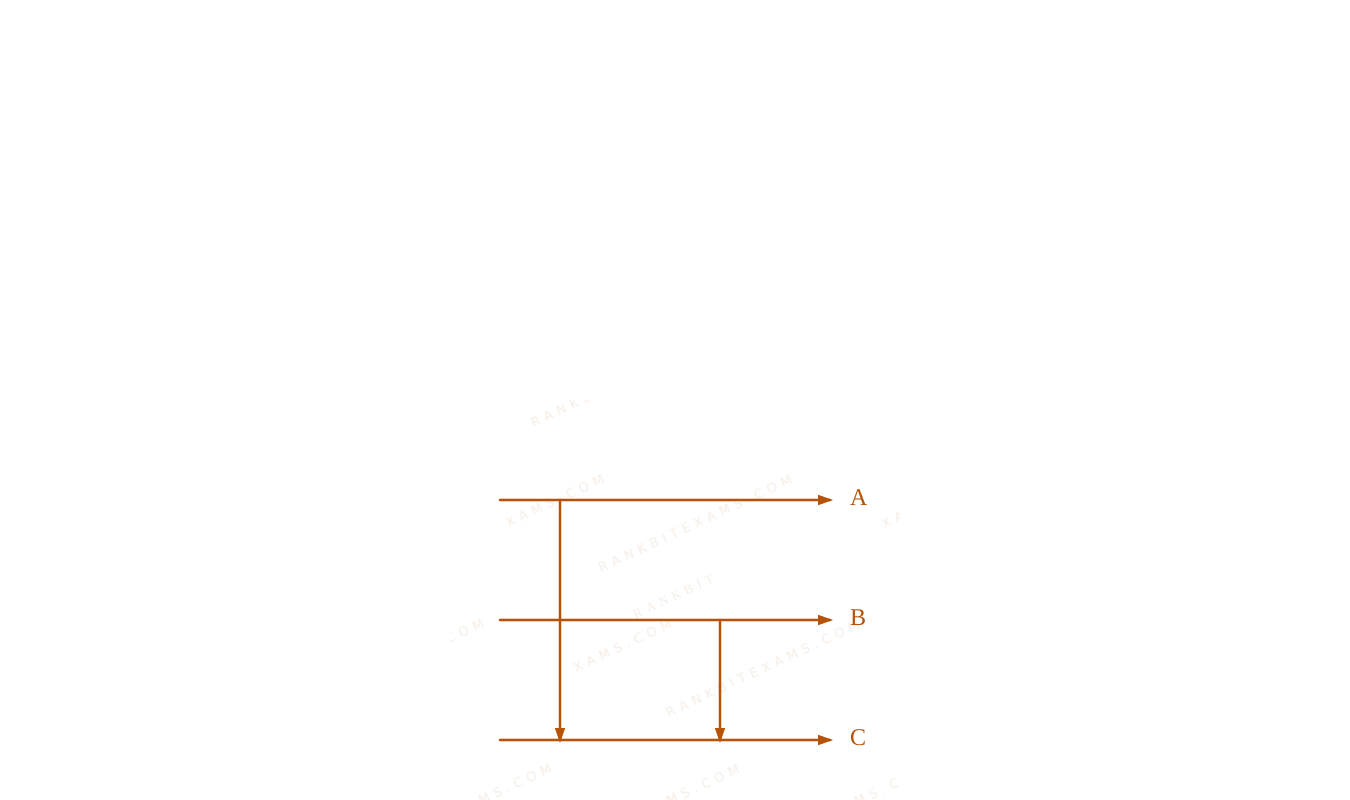
During the transition of electron from state A to state C of a Bohr atom, the wavelength of emitted radiation is 2000 Å and it becomes 6000 Å when the electron jumps from state B to state C. Then the wavelength of the radiation emitted during the transition of electrons from state A to state B is :-

Solution & Explanation

Related Formula

The energy of the emitted photon during an atomic transition between energy states is given by:

Δ E = (hc)/(λ)

where h is Planck's constant, c is speed of light, and λ is the photon wavelength.

Core Logic

Write equations for the energy transitions from the layout of levels

Bohr Model of the Hydrogen Atom diagram for Q5 - JEE Main 2025 Morning
:

EA - EC = hcλAC = hc2000 AA (i) EB - EC = hcλBC = hc6000 AA (ii)
Step 1: Finding Transition A to B

Subtracting equation (ii) from equation (i) gives the net transition energy from A to B :

EA - EB = (EA - EC) - (EB - EC) hcλAB = (hc)/(2000) - (hc)/(6000) 1λAB = (3 - 1)/(6000) = (2)/(6000) = (1)/(3000) λAB = 3000 AA
Pattern Recognition

Energy differences add linearly, which means their corresponding inverse wavelengths satisfy a parallel reciprocal subtraction rule: 1λAB = 1λAC - 1λBC.

Chapter Mix

Class 12 Physics: Atoms

Reference Study Guides

More Atoms Previous-Year Questions

Q38 jee_main_2026_21_jan_morning Alpha Particle Scattering
If an alpha particle with energy 7.7 MeV is bombarded on a thin gold foil, the closest distance from nucleus it can reach is ____ m. (Atomic number of gold = 79 and 14π in₀ = 9 × 10⁹ in SI units)
  • A. 2.95 × 10⁻¹⁴
  • B. 2.95 × 10⁻¹⁶
  • C. 3.85 × 10⁻¹⁶
  • D. 3.85 × 10⁻¹⁴

Solution

Related Formula
Kinitial = Uclosest approach K = 14π ε₀ ((2e)(Ze))/(r₀)
Core Logic

By energy conservation, the entire kinetic energy of the alpha particle gets converted to electrostatic potential energy at the distance of closest approach (r₀). Kᵢ + Uᵢ = Kf + Uf

Kᵢ + 0 = 0 + (1)/(4πε₀) ((2e)(79e))/(r₀)
Step 1: Convert Energy and Solve

Initial kinetic energy Kᵢ = 7.7 MeV = 7.7 × 10⁶ × 1.6 × 10⁻¹⁹ J.

7.7 × 10⁶ × 1.6 × 10⁻¹⁹ = 9 × 10⁹ × (2 × 1.6 × 10⁻¹⁹) × (79 × 1.6 × 10⁻¹⁹)r₀ r₀ = 9 × 10⁹ × 2 × 79 × (1.6 × 10⁻¹⁹)²7.7 × 10⁶ × 1.6 × 10⁻¹⁹ r₀ = 9 × 10⁹ × 158 × 1.6 × 10⁻¹⁹7.7 × 10⁶ r₀ = 2275.2 × 10⁻¹⁰7.7 × 10⁶ = 295.48 × 10⁻¹⁶ m ≈ 2.95 × 10⁻¹⁴ m
Pattern Recognition

Distance of closest approach problem: Simply equate initial Kinetic Energy (in Joules) to Potential Energy k(Z₁e)(Z₂e)/r₀. Alpha particle has charge 2e.

Chapter Mix

Class 12 Physics: Atoms

Q41 jee_main_2026_21_jan_evening Bohr Model
The energy of an electron in an orbit of the Bohr's atom is -0.04E₀ eV where E₀ is the ground state energy. If L is the angular momentum of the electron in this orbit and h is the Planck's constant, then (2π L)/(h) is :
  • A. 2
  • B. 4
  • C. 5
  • D. 6

Solution

Related Formula
Eₙ = (E₀)/(n²) L = (nh)/(2π)
Core Logic

From Bohr's theory, the energy of an electron in the n-th orbit is inversely proportional to n²:

E = -(E₀)/(n²)

Equating this to the given energy:

-(E₀)/(n²) = -0.04 E₀ (1)/(n²) = 0.04 = (1)/(25) n² = 25 n = 5
Step 1: Final Conclusion

Bohr's quantization condition for angular momentum:

L = (nh)/(2π)

Rearranging for the required term:

(2π L)/(h) = n

Since n=5, the value is 5.

Pattern Recognition

The expression 2π L / h is a direct request for the principal quantum number n. Eₙ = E₁ / n² allows finding n instantly.

Chapter Mix

Class 12 Physics: Atoms

Q32 jee_main_2026_22_january_evening Hydrogen Spectrum and Spectral Series
The smallest wavelength of Lyman series is 91 nm. The difference between the largest wavelengths of Paschen and Balmer series is nearly ____ nm.
  • A. 1875
  • B. 1550
  • C. 1217
  • D. 1784

Solution

Related Formula
(1)/(λ) = R ( (1)/(n₁²) - (1)/(n₂²) )
Core Logic

For smallest wavelength of Lyman series (n₁ = 1, n₂ = ∞):

1λL, min = R ((1)/(1²) - 0) R = (1)/(91) ~nm⁻¹

For largest wavelength of Balmer series (n₁ = 2, n₂ = 3):

1λB = R ((1)/(4) - (1)/(9)) = (1)/(91) × (5)/(36) λB = (91 × 36)/(5) = 655.2 ~nm

For largest wavelength of Paschen series (n₁ = 3, n₂ = 4):

1λP = R ((1)/(9) - (1)/(16)) = (1)/(91) × (7)/(144) λP = (91 × 144)/(7) = 1872 ~nm

Difference in wavelengths:

Δ λ = λP - λB = 1872 - 655.2 = 1216.8 ~nm ≈ 1217 ~nm
Step 1: Final Conclusion

The wavelength difference is approximately 1217 ~nm.

Pattern Recognition

Spectral lines: Smallest wavelength arrow n₂ = ∞. Largest wavelength arrow n₂ = n₁ + 1. Rydberg constant R = 1/λL,min. Substitute values into Balmer (2arrow 3) and Paschen (3arrow 4) equations.

Chapter Mix

Class 12 Physics: Atoms

Q38 jee_main_2026_23_january_morning Hydrogen Spectrum
In hydrogen atom spectrum, (R arrow Rydberg's constant) A. the maximum wavelength of the radiation of Lyman series is (4)/(3R) B. the Balmer series lies in the visible region of the spectrum C. the minimum wavelength of the radiation of Paschen series is (9)/(R) D. the minimum wavelength of Lyman series is (5)/(4R) Choose the correct answer from the options given below:
  • A. B, D Only
  • B. A, B and C Only
  • C. A, B and D Only
  • D. A, B Only

Solution

Related Formula
(1)/(λ) = R( 1n₁² - 1n₂²)
Core Logic

Assess each statement using the Rydberg formula. Max wavelength corresponds to min energy (transition from n₁+1 → n₁), and min wavelength corresponds to max energy (n₂ → ∞).

Step 1: Evaluate A and D (Lyman Series)

For Lyman series, n₁ = 1. Maximum wavelength (n₂ = 2):

1λ = R(1 - (1)/(4)) = (3R)/(4) λ = (4)/(3R)

Statement A is correct.

Minimum wavelength (n₂ = ∞):

1λ = R(1 - 0) = R λ = (1)/(R)

Statement D is incorrect.

Step 2: Evaluate B (Balmer Series)

Balmer series corresponds to transitions to n₁ = 2. These transitions primarily emit in the visible spectrum. Statement B is correct.

Step 3: Evaluate C (Paschen Series)

For Paschen series, n₁ = 3. Minimum wavelength (n₂ = ∞):

1λ = R((1)/(9) - 0) = (R)/(9) λ = (9)/(R)

Statement C is correct.

Step 4: Final Conclusion

Statements A, B, and C are correct.

Pattern Recognition

Sees: "minimum/maximum wavelength" → Max wavelength = adjacent orbital drop (n+1 to n). Min wavelength = drop from infinity (∞ to n).

Chapter Mix

Class 12 Physics: Atoms

Q32 jee_main_2026_24_january_morning Bohr Model
Two electrons are moving in orbits of two hydrogen like atoms with speeds 3 × 10⁵ m/s and 2.5 × 10⁵ m/s respectively. If the radii of these orbits are nearly same then the possible order of energy states are ____ respectively.
Bohr orbits speed and radius relations diagram
Mathematical proportionality of velocity and radius in Bohr's model.
  • A. 6 and 5
  • B. 9 and 8
  • C. 8 and 10
  • D. 10 and 12

Solution

Related Formula
v ∝ (Z)/(n) r ∝ (n²)/(Z)
Core Logic

From the proportionalities of speed and radius in the Bohr model:

r ∝ (n²)/(Z)

Since v ∝ (Z)/(n), we can substitute Z ∝ nv. This gives r ∝ (n²)/(nv) = (n)/(v).

Step 1: Ratio Analysis

If the radii are the same, then:

(n₁)/(v₁) = (n₂)/(v₂) (n₁)/(n₂) = (v₁)/(v₂) = (3 × 10⁵)/(2.5 × 10⁵) = (3)/(2.5) = (6)/(5)

Thus, the possible order of energy states (n) is 6 and 5.

Pattern Recognition

By coupling r and v dependencies on Z and n, the Z cancels out allowing a direct ratio linking radius, orbit number, and velocity.

Chapter Mix

Class 12 Physics: Atoms

More Atoms Questions — jee_main_2025_24_jan_morning

Practice all Atoms previous-year questions →

Rankbit System
JEE Physics: Waves (+15.5%) | Electrostatics: Concentric Shells (-29.7%) | Modern Physics: Photoelectric Clones (+34.2%) | Mathematics: Definite Integrals (+18.1%) | Chemistry: Coordination Splitting (-11.4%) | JEE Physics: Waves (+15.5%) | Electrostatics: Concentric Shells (-29.7%) | Modern Physics: Photoelectric Clones (+34.2%) | Mathematics: Definite Integrals (+18.1%) | Chemistry: Coordination Splitting (-11.4%)
