The area (in sq. units) of the part of circle x²+y²=169$x^2+y^2=169$ which is below the line 5x-y=13$5x-y=13$ is (πα)/(2β)-(65)/(2)+(α)/(β) ⁻¹((12)/(13))$\frac{\pi\alpha}{2\beta}-\frac{65}{2}+\frac{\alpha}{\beta}\sin^{-1}(\frac{12}{13})$ where α,β$\alpha,\beta$ are coprime numbers. Then α+β$\alpha+\beta$ is equal to
Numerical Answer Type:
Enter a numerical valueAnswer: 171 to 171+4 marks
Solution & Explanation
Related Formula
Standard Integral: ∫ √(a²-y²) dy = (y)/(2)√(a²-y²) + (a²)/(2) ⁻¹((y)/(a)) + C$$\text{Standard Integral: } \int \sqrt{a^2-y^2} dy = \frac{y}{2}\sqrt{a^2-y^2} + \frac{a^2}{2}\sin^{-1}\left(\frac{y}{a}\right) + C$$Area of right triangle = (1)/(2) × base × height$$\text{Area of right triangle } = \frac{1}{2} \times \text{base} \times \text{height}$$
Core Logic
First, find the points of intersection between the circle x²+y²=169$x^2+y^2=169$ and the line 5x-y=13 ⇒ y = 5x-13$5x-y=13 \Rightarrow y = 5x-13$.
Substitute y$y$ into the circle equation:
The solutions are x=0$x=0$ and x=5$x=5$.
When x=0, y=-13$x=0, y=-13$. Point is (0, -13)$(0, -13)$.
When x=5, y=12$x=5, y=12$. Point is (5, 12)$(5, 12)$.
The required area is bounded below the line x = (y+13)/(5)$x = \frac{y+13}{5}$ and above the right-hand boundary of the circle x = √(169-y²)$x = \sqrt{169-y^2}$ across the y-axis boundaries [-13, 12]$[-13, 12]$.
Area Under Curves
Step 1: Setup Area Integral
Integrate with respect to y$y$ (from left to right curves, bounded horizontally):
Split the integral into two parts:
Part A (Circle): ∫₋₁₃¹² √(169-y²) dy$\int_{-13}^{12} \sqrt{169-y^2} dy$
Part B (Line): ∫₋₁₃¹² (y+13)/(5) dy$\int_{-13}^{12} \frac{y+13}{5} dy$
Comparing this exactly with the given format (πα)/(2β) - (65)/(2) + (α)/(β) ⁻¹((12)/(13))$\frac{\pi\alpha}{2\beta} - \frac{65}{2} + \frac{\alpha}{\beta}\sin^{-1}(\frac{12}{13})$:
We see that (α)/(β) = (169)/(2)$\frac{\alpha}{\beta} = \frac{169}{2}$.
Since 169 and 2 are coprime, α = 169$\alpha = 169$ and β = 2$\beta = 2$.
When evaluating line integrals forming a triangle with horizontal bounds, bypass algebraic integration and visually calculate (1)/(2) · b · h$\frac{1}{2} \cdot b \cdot h$. Here, base=25 along y-axis, height=5 along x-axis, area = 125/2$125/2$. Instantly saves integration time.
Chapter Mix
Class 12 Mathematics: Application of Integrals
Class 11 Mathematics: Straight Lines
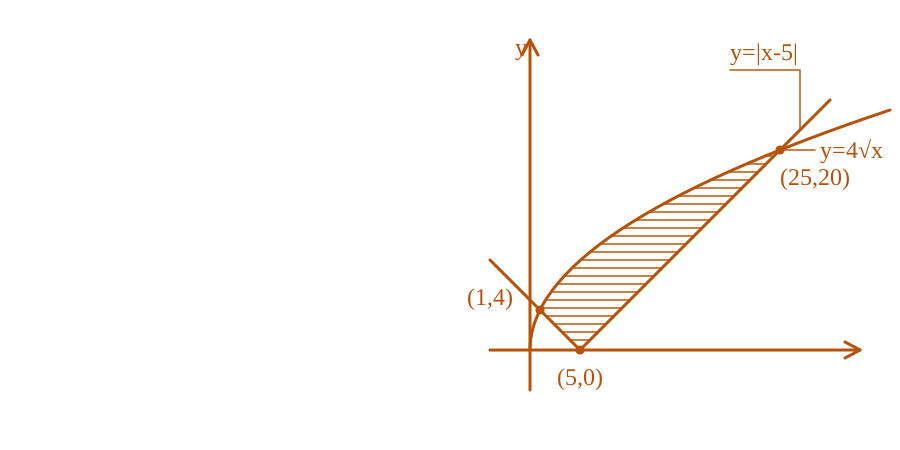
Find the intersections of y = |x - 5|$y = |x - 5|$ and y = 4√(x)$y = 4\sqrt{x}$:
Branch 1: 5 - x = 4√(x) x + 4√(x) - 5 = 0 (√(x) + 5)(√(x) - 1) = 0 x = 1, y = 4$5 - x = 4\sqrt{x} \implies x + 4\sqrt{x} - 5 = 0 \implies (\sqrt{x} + 5)(\sqrt{x} - 1) = 0 \implies x = 1, y = 4$.
Branch 2: x - 5 = 4√(x) x - 4√(x) - 5 = 0 (√(x) - 5)(√(x) + 1) = 0 x = 25, y = 20$x - 5 = 4\sqrt{x} \implies x - 4\sqrt{x} - 5 = 0 \implies (\sqrt{x} - 5)(\sqrt{x} + 1) = 0 \implies x = 25, y = 20$.
Area Bounded by Multiple Curves diagram for Q71 - JEE Main 2025 Morning
Step 1: Set Up Area Definite Integral
Split integration intervals around vertex x = 5$x = 5$ or compute via simple boundary differences:
A = ∫₁²⁵ 4√(x) dx - Area of Left Triangle - Area of Right Triangle$$A = \int_{1}^{25} 4\sqrt{x}\,\mathrm{d}x - \text{Area of Left Triangle} - \text{Area of Right Triangle}$$Area of Left Triangle = (1)/(2) × (5 - 1) × 4 = 8$$\text{Area of Left Triangle} = \frac{1}{2} \times (5 - 1) \times 4 = 8$$Area of Right Triangle = (1)/(2) × (25 - 5) × 20 = 200$$\text{Area of Right Triangle} = \frac{1}{2} \times (25 - 5) \times 20 = 200$$
Subtracting standard geometric triangles beneath linear configurations from total absolute root curves saves significant time compared to managing multiple separate analytical integral pieces.
Chapter Mix
Class 12 Mathematics: Area Under Curves
Q67jee_main_2025_24_jan_eveningArea Under Curves
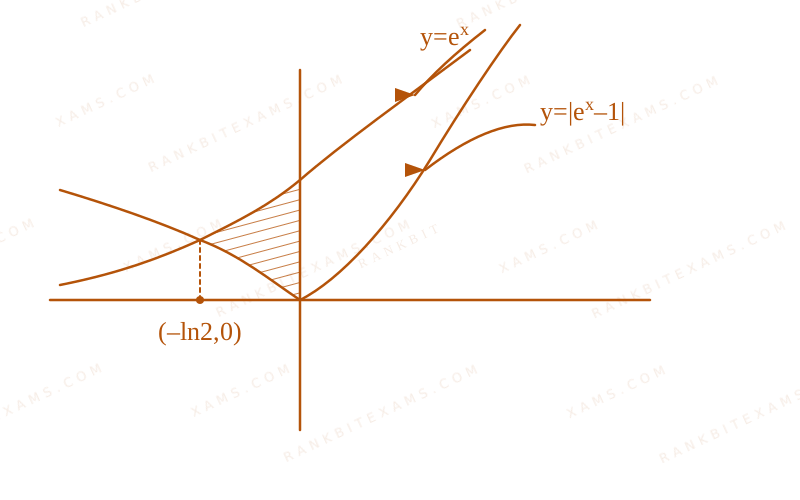
The area of the region enclosed by the curves y=ex,$y=e^{x},$y=|ex-1|$y=|e^{x}-1|$ and y-axis is:
A.1+ ₑ2$1+\log_{e}2$
B.ₑ2$\log_{e}2$
C.2 ₑ2-1$2\log_{e}2-1$
D.1- ₑ2$1-\log_{e}2$
Solution
Related Formula
The area between two curves y₁(x)$y_1(x)$ and y₂(x)$y_2(x)$ from x = a$x = a$ to x = b$x = b$ is given by:
Modulus graphs split at their critical point (e^x = 1 ⇒ x = 0$e^x = 1 \Rightarrow x = 0$). Recognizing that the required segment lies strictly in the negative quadrant simplifies the definition of the upper and lower functions immediately.
Chapter Mix
Class 12 Mathematics: Application of Integrals
Q63jee_main_2025_24_jan_morningArea Bounded by Multiple Curves
The area of the region (x,y) x² + 4x + 2 ≤ y ≤ |x + 2|$\{(x,y)\colon x^2 + 4x + 2 \leq y \leq |x + 2|\}$ is equal to :
A.7$7$
B.24/5$24/5$
C.20/3$20/3$
D.5$5$
Solution
Related Formula
The net area between two intersecting functions y₂(x)$y_2(x)$ and y₁(x)$y_1(x)$ from lower limit a$a$ to upper limit b$b$ is evaluated using the definite integral:
Applying a horizontal variable substitution matching X = x + ± c$X = x + ± c$ shifts complex quadratic forms to centered formats, which avoids tedious arithmetic across asymmetrical integration limits.
Chapter Mix
Class 12 Mathematics: Application of Integrals
Qjee_main_2025_28_jan_eveningArea Bounded by Algebraic and Rational Curves
The area of the region bounded by the curves x(1+y²)=1$x(1+y^{2})=1$ and y²=2x$y^{2}=2x$ is :
Since y$y$ is real, y² = 1 y = ± 1$y^2 = 1 \implies y = \pm 1$.
When y = ± 1$y = \pm 1$, x = (1)/(2)$x = \frac{1}{2}$.
Intersection points are ((1)/(2), 1)$\left(\frac{1}{2}, 1\right)$ and ((1)/(2), -1)$\left(\frac{1}{2}, -1\right)$.
Step 1: Set up and Compute Area Integral
Between y = -1$y = -1$ and y = 1$y = 1$, (1)/(1+y²) ≥ (y²)/(2)$\frac{1}{1+y^2} \ge \frac{y^2}{2}$.
Whenever curves are functions of y²$y^2$, integrating along the y$y$-axis avoids dealing with messy radical functions (square roots) and naturally accounts for symmetry across the x$x$-axis.
Chapter Mix
Class 12 Mathematics: Application of Integrals
Q57jee_main_2025_29_jan_morningArea Under Curves
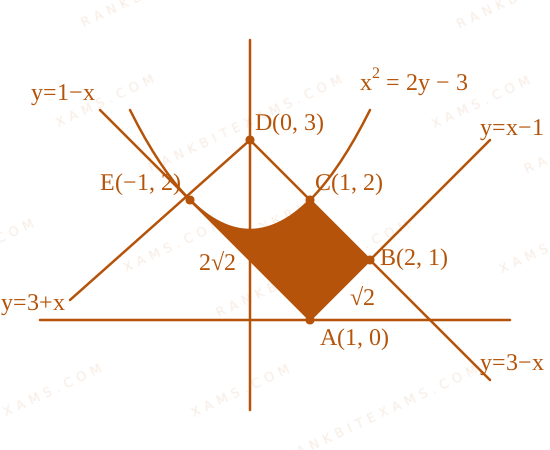
Let the area of the region (x, y) : 2y ≤ x² + 3$\{(x, y) : 2y \leq x^2 + 3$ , y + |x| ≤ 3$y + |x| \leq 3$ , y ≥ |x - 1|$y \geq |x - 1|\}$ be A. Then 6A is equal to:
When dealing with multiple absolute functions (|x|$|x|$, |x-1|$|x-1|$), check for coordinate mirror symmetry across vertical axes to slash total required calculus computations in half.
Chapter Mix
Class 12 Mathematics: Application of Integrals
More Application of Integrals Questions — jee_main_2024_29_jan_morning
Practice past-year questions one chapter at a time. Pick an exam → subject → chapter and get every PYQ for that topic — pulled together from all past papers — with the chapter's key formulas alongside.