Rankbit System
JEE Physics: Waves (+15.5%) | Electrostatics: Concentric Shells (-29.7%) | Modern Physics: Photoelectric Clones (+34.2%) | Mathematics: Definite Integrals (+18.1%) | Chemistry: Coordination Splitting (-11.4%) | JEE Physics: Waves (+15.5%) | Electrostatics: Concentric Shells (-29.7%) | Modern Physics: Photoelectric Clones (+34.2%) | Mathematics: Definite Integrals (+18.1%) | Chemistry: Coordination Splitting (-11.4%)

A wire of length 10text cm and radius sqrt7 times 10^-4text m is connected across the right gap of a meter bridge. When a resistance of 4.5\ Omega is connected on the left gap by using a resistance box, the balance length is found to be at 60text cm from the left end. If the resistivity of the wire is R times 10^-7\ Omegatextm, then the value of R is:

Solution & Explanation

### Related Formula From the balance condition of the meter bridge: fracX_textleftl = fracX_textright100 - l Resistance formula: X = rho fracl_wA = fracrho l_wpi r^2 ### Core Logic First, evaluate the unknown resistance X_textright in the right gap: frac4.560 = fracX_textright40 implies X_textright = frac4.5 times 4060 = 3\ Omega ### Step 1: Calculate Resistivity Value Now map the resistance parameters (l_w = 10text cm = 0.1text m, r = sqrt7 times 10^-4text m): 3 = rho frac0.1frac227 times (sqrt7 times 10^-4)^2 3 = rho frac0.1frac227 times 7 times 10^-8 3 = rho frac0.122 times 10^-8 rho = frac3 times 22 times 10^-80.1 = 66 times 10^-7\ Omegatextm ### Step 2: Compare to find R Given rho = R times 10^-7, comparing coefficients gives: R = 66 ### Pattern Recognition Meter bridge balance simplifies directly to simple scalar component checks. The sqrt7 term perfectly neutralizes the fractional frac227 constant in circular area profiles. ### Evaluation Rubric / Model Answer null ### Chapter Mix Class 12 Physics: Current Electricity
Reference Study Guides

More Current Electricity Previous-Year Questions — Page 5

Q32 jee_main_2024_29_jan_morning Electric Current and Charge
The electric current through a wire varies with time as I = I_0 + beta t, where I_0 = 20 mathrm~A and beta = 3 mathrm~A / s. The amount of electric charge crossed through a section of the wire in 20 mathrm~s is:
  • A. 80 mathrm~C
  • B. 1000 mathrm~C
  • C. 800 mathrm~C
  • D. 1600 mathrm~C

Solution

### Related Formula The relationship between current, charge, and time is given by: I = fracdqdt implies q = int I \, dt ### Core Logic Given the current variation: I = I_0 + beta t Substituting the given values, I_0 = 20 mathrm~A and beta = 3 mathrm~A/s: I = 20 + 3t Thus: fracdqdt = 20 + 3t ### Step 1: Integrate to Find Charge To find the total charge crossing a section of wire from t = 0 to t = 20 mathrm~s: int_0^q dq = int_0^20 (20 + 3t) \, dt q = left[ 20t + frac3t^22 right]_0^20 q = 20(20) + frac3(20)^22 q = 400 + frac3(400)2 = 400 + 600 = 1000 mathrm~C Therefore, the charge crossed is 1000 mathrm~C. ### Pattern Recognition Whenever current is given as a function of time I(t), the total charge is simply the area under the I-t curve, which mathematically corresponds to the definite integral int_t_1^t_2 I(t) \, dt. ### Evaluation Rubric / Model Answer null ### Chapter Mix Class 12 Physics: Current Electricity
Q57 jee_main_2024_29_jan_morning Kirchhoff's Laws and RC Circuits
A 16 \, Omega wire is bend to form a square loop. A 9V battery with internal resistance 1 \, Omega is connected across one of its sides. If a 4 \, mu mathrmF capacitor is connected across one of its diagonals, the energy stored by the capacitor will be fracx2 \, mu mathrmJ. where x = _________.
Numerical Answer. Answer: 81 to 81

Solution

### Related Formula Energy stored (U) by a capacitor of capacitance C under steady state voltage V_C: U = frac12 C V_C^2 ### Core Logic A wire of resistance 16 \, Omega is bent into a square, so each of the 4 sides has a resistance of: R_textside = frac164 = 4 \, Omega The battery is connected across one side. Let this side have resistance 4 \, Omega. The remaining three sides are connected in series, creating a parallel branch with a combined resistance of: R_textseries = 4 + 4 + 4 = 12 \, Omega
Circuit network layout showing the square loop resistance divisions and diagonal capacitor connection for Q57
### Step 1: Calculate Equivalent Resistance and Circuit Current The equivalent external resistance of the parallel loop branches is: R_p = frac12 times 412 + 4 = frac4816 = 3 \, Omega Including the battery's internal resistance (1 \, Omega), the total line current I leaving the battery is: I = fracVR_p + r = frac93 + 1 = frac94 mathrm~A ### Step 2: Find Current through the Main Branches Using the current divider rule, the current I_1 flowing through the longer 12 \, Omega branch is: I_1 = I times frac412 + 4 = frac94 times frac416 = frac916 mathrm~A ### Step 3: Find Potential Difference across the Diagonal In a steady state, the capacitor acts as an open circuit. Let the diagonal link nodes be A and B. The path contains two sides of the 12 \, Omega branch (total resistance = 8 \, Omega): V_C = V_A - V_B = I_1 times 8 = frac916 times 8 = frac92 mathrm~V ### Step 4: Compute Stored Energy and Extract x The stored energy U is: U = frac12 times (4 \, mu mathrmF) times left(frac92right)^2 = frac12 times 4 times frac814 = frac812 \, mu mathrmJ Comparing this directly with the expression fracx2 \, mu mathrmJ: x = 81 Therefore, the value of x is 81. ### Pattern Recognition Remember that capacitors act as standard open circuits when reaching steady-state DC conditions. Simply calculate the node potentials across the bridge connection points using standard current distribution laws first, then execute the energy equation. ### Evaluation Rubric / Model Answer null ### Chapter Mix Class 12 Physics: Current Electricity Class 12 Physics: Electrostatic Potential and Capacitance

Q48 jee_main_2024_30_january_evening Power Dissipation in Resistors
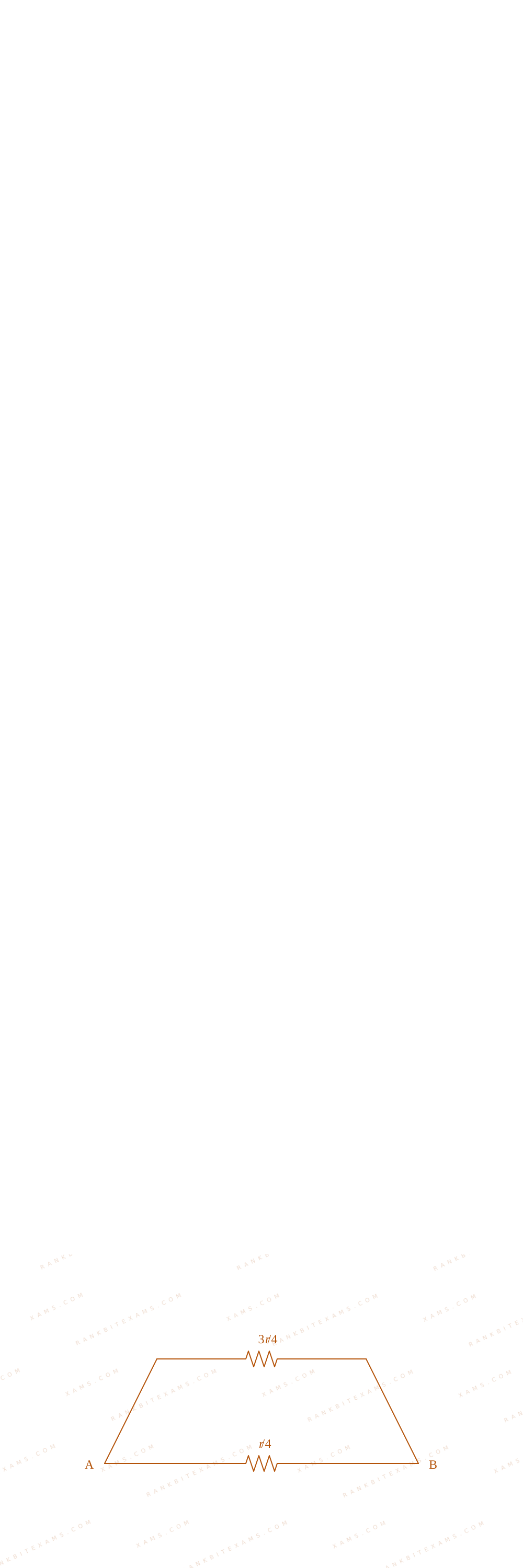
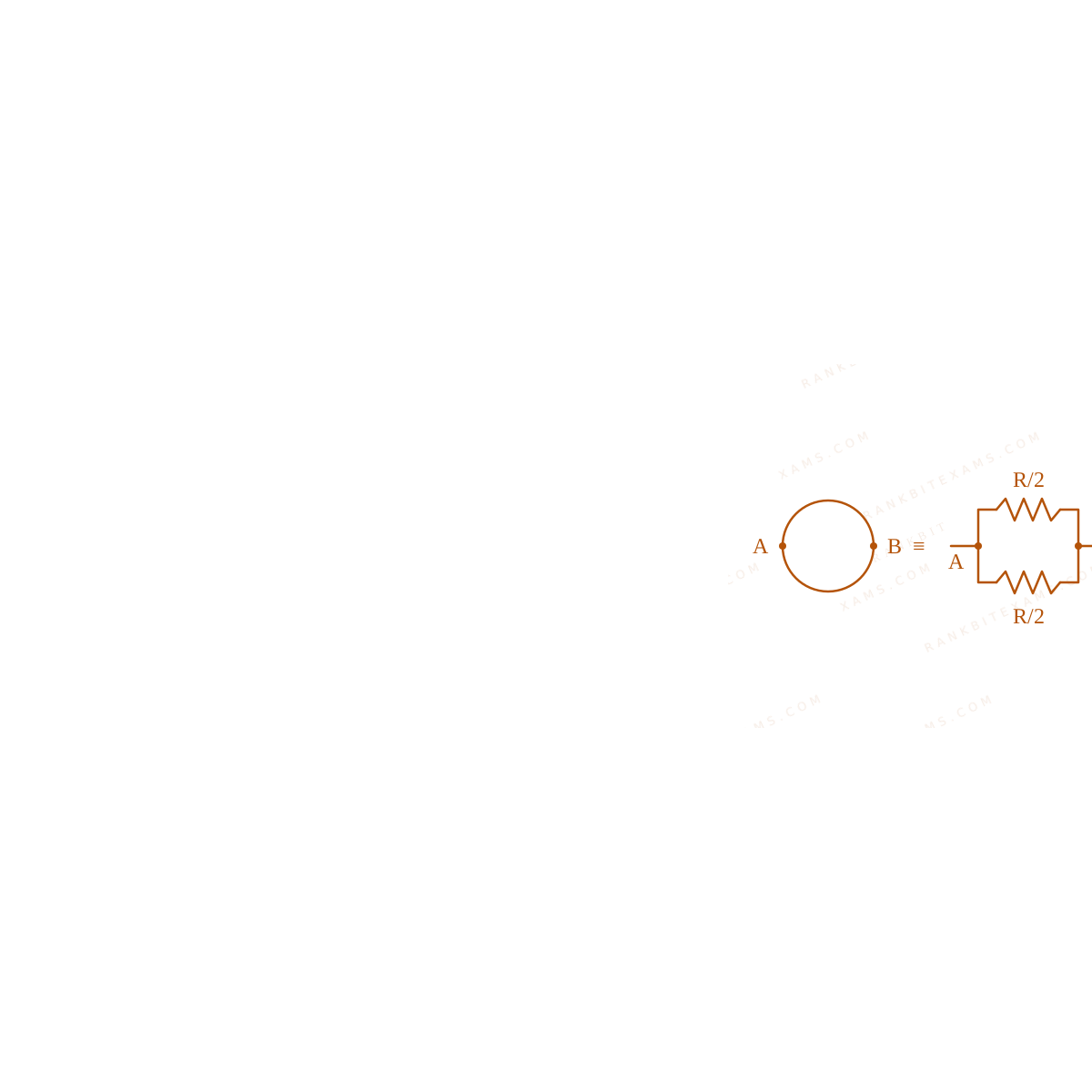
When a potential difference V is applied across a wire of resistance R, it dissipates energy at a rate W. If the wire is cut into two halves and these halves are connected mutually parallel across the same supply, the energy dissipation rate will become:
  • A. 1 / 4 mathrmW
  • B. 1 / 2 mathrmW
  • C. 2 mathrm~W
  • D. 4 mathrm~W

Solution

### Related Formula P = fracV^2R_texteq ### Core Logic Initially, the power (rate of energy dissipation) is W = fracV^2R. When the wire is cut into two halves, each half will have a resistance of fracR2 (since resistance is directly proportional to length). ### Step 1: Equivalent Resistance When these two halves (each of fracR2) are connected in parallel, their equivalent resistance R_texteq is: R_texteq = fracleft(fracR2right) times left(fracR2right)fracR2 + fracR2 = fracR4 ### Step 2: New Power Dissipation The new rate of energy dissipation W' across the same potential difference V is: W' = fracV^2R_texteq = fracV^2fracR4 = 4 fracV^2R W' = 4W ### Pattern Recognition Cutting a resistor into n equal parts and connecting them in parallel reduces the total resistance by a factor of n^2. Consequently, for a constant voltage supply, the power dissipated increases by a factor of n^2. ### Evaluation Rubric / Model Answer null ### Chapter Mix Class 12 Physics: Current Electricity
Q60 jee_main_2024_30_january_evening Voltmeter Resistance
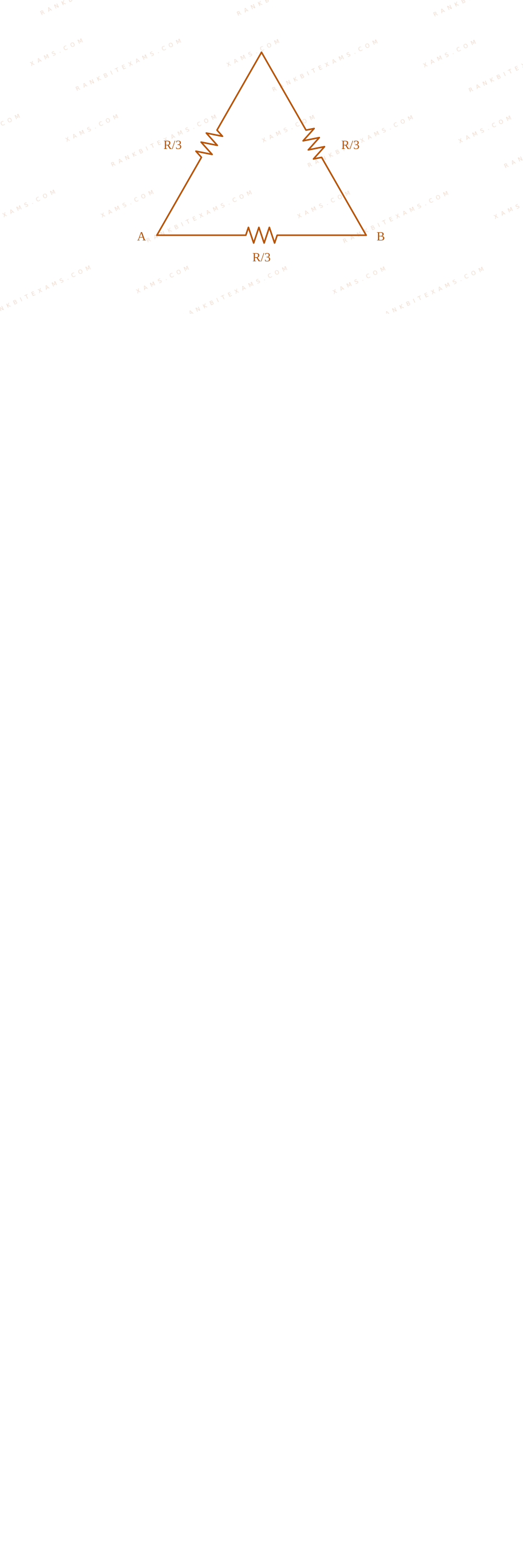
Two resistance of 100Omega and 200Omega are connected in series with a battery of 4 mathrm~V and negligible internal resistance. A voltmeter is used to measure voltage across 100Omega resistance, which gives reading as 1 mathrm~V. The resistance of voltmeter must be ________ Omega.
Numerical Answer. Answer: 200 to 200

Solution

### Related Formula V = I R_texteq R_textparallel = fracR_1 R_2R_1 + R_2 ### Core Logic
Voltmeter Resistance diagram for Q60 - JEE Main 2024 Evening
The voltmeter has some internal resistance R_v and is connected in parallel with the 100Omega resistor. The equivalent resistance of this parallel combination is R_p = frac100 R_v100 + R_v. This combination is in series with the 200Omega resistor. The total voltage applied is 4 mathrm~V. ### Step 1: Set up Voltage Divider The voltage across the parallel combination (the voltmeter reading) is 1 mathrm~V. Therefore, the voltage across the 200Omega resistor must be 4 mathrm~V - 1 mathrm~V = 3 mathrm~V. Using the voltage divider rule (or equating currents since they are in series): I = fracV_200200 = frac3200 mathrm~A ### Step 2: Solve for Voltmeter Resistance The current I also flows through the parallel combination R_p: V_p = I R_p 1 = left(frac3200right) left( frac100 R_v100 + R_v right) 200 (100 + R_v) = 300 R_v 20000 + 200 R_v = 300 R_v 100 R_v = 20000 R_v = 200 Omega ### Pattern Recognition If the voltage splits as 1mathrmV to 3mathrmV, the resistances must be in a 1:3 ratio. So R_p = 200 / 3. Equating 100 R_v / (100+R_v) = 200/3 instantly gives R_v = 200. ### Evaluation Rubric / Model Answer null ### Chapter Mix Class 12 Physics: Current Electricity
Q33 jee_main_2024_30_jan_morning Resistors in Series and Voltage Dividers
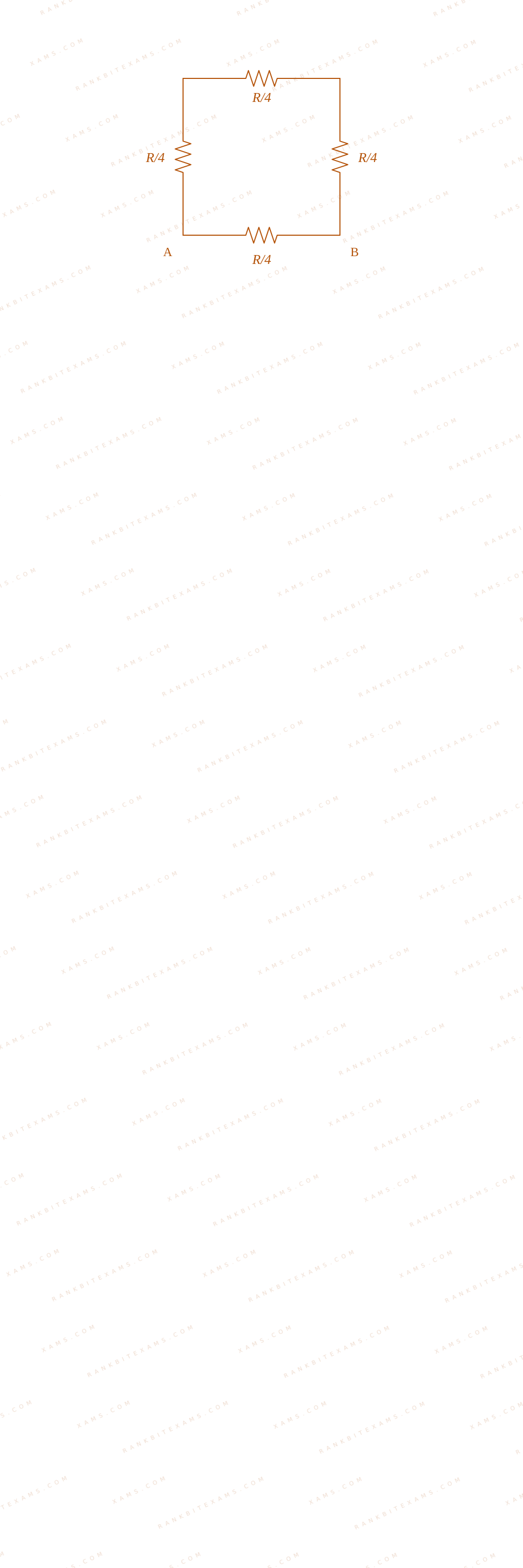
A potential divider circuit is shown in figure. The output voltage V_0 is
Resistors in Series and Voltage Dividers diagram for Q33 - JEE Main 2024 Morning
Circuit containing multiple resistors in series and parallel calculating a specific output voltage.
  • A. 4 mathrm~V
  • B. 2 mathrm~mV
  • C. 0.5 mathrm~V
  • D. 12 mathrm~mV

Solution

### Related Formula V = IR R_texteq = R_1 + R_2 + dots + R_n quad (textfor series) ### Core Logic Observe the circuit diagram. The total equivalent resistance R_texteq of the series network must be calculated by summing all the resistance values shown in the main branch. ### Step 1: Calculate Total Resistance and Current From the given network, assuming the total series resistance is 4000 \,Omega (comprising the 3.3mathrmkOmega resistor and seven 100\,Omega resistors). R_texteq = 4000 \,Omega The total voltage applied across the network is 4 mathrm~V. i = fracVR_texteq = frac44000 = frac11000 mathrm~A ### Step 2: Calculate Output Voltage The output voltage V_0 is tapped across five 100 \,Omega resistors. R_textout = 5 times 100 \,Omega = 500 \,Omega Thus, the output voltage is: V_0 = i cdot R_textout = left(frac11000right) times 500 = 0.5 mathrm~V ### Pattern Recognition A potential divider simply scales the input voltage by the fraction of the resistance tapped over the total resistance: V_0 = V_in times (R_texttap / R_texttotal). Standard DC circuit division. ### Evaluation Rubric / Model Answer null ### Chapter Mix Class 12 Physics: Current Electricity
More Current Electricity Questions — jee_main_2024_27_jan_morning

Practice all Current Electricity previous-year questions →

YOUR FIRST PREP STEP STARTS HERE

We Map Every Repeating Question in Competitive Exams.

Say goodbye to generic mock test fatigue. RankBit uses smart analysis to group past exam questions into their foundational Repeating Question Types. Find chapter weightage, track repeating questions, and score higher with targeted practice.

Select Your Target Exam

Choose an exam track below to find formulas per chapter and patterns.

Syncing Exam Intelligence

Mapping formulas and patterns across all tracks…

PATH A — FULL LENGTH PRACTICE

Full Mock Test Hub

Simulate real NTA exam conditions with fully tracked mocks. Time yourself against past papers.

Under Development
PATH B — TARGETED PRACTICE

Topic-wise Practice Hub

Practice past-year questions one chapter at a time. Pick an exam → subject → chapter and get every PYQ for that topic — pulled together from all past papers — with the chapter's key formulas alongside.

Loading Questions... Browse Topics
Latest from the Blog
View all →

Loading articles...