Rankbit System
JEE Physics: Waves (+15.5%) | Electrostatics: Concentric Shells (-29.7%) | Modern Physics: Photoelectric Clones (+34.2%) | Mathematics: Definite Integrals (+18.1%) | Chemistry: Coordination Splitting (-11.4%) | JEE Physics: Waves (+15.5%) | Electrostatics: Concentric Shells (-29.7%) | Modern Physics: Photoelectric Clones (+34.2%) | Mathematics: Definite Integrals (+18.1%) | Chemistry: Coordination Splitting (-11.4%)

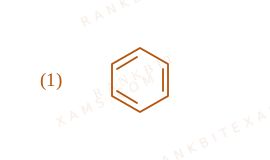
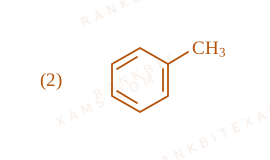
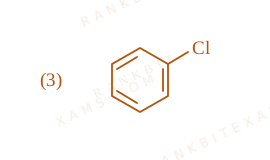
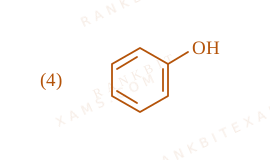
Which of the following compound will most easily be attacked by an electrophile?

Solution & Explanation

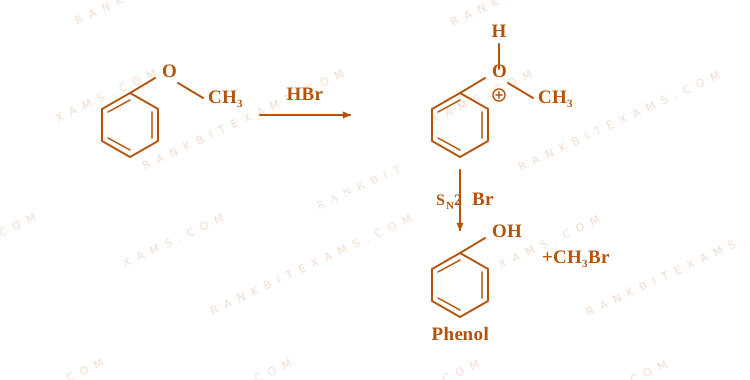
### Core Logic An electrophile seeks electrons. Higher electron density in the benzene ring makes it more susceptible (reactive) to electrophilic attack. The ring's electron density is governed by the inductive (I) and mesomeric/resonance (M) effects of the attached groups. ### Step 1: Evaluate Substituent Effects - Cl (in chlorobenzene): shows weak +M effect but strong -I effect, causing net deactivation. - CH_3 (in toluene): shows +I effect and hyperconjugation, slightly activating the ring. - COOH (in benzoic acid): shows strong -M and -I effect, highly deactivating. - OH (in phenol): shows strong +M effect which dominates its weak -I effect, strongly activating the ring. ### Step 2: Conclusion Phenol has the highest electron density in the ring among the given options due to the strong +M effect of the -OH group. Thus, it is most easily attacked by an electrophile. ### Pattern Recognition Reactivity towards Electrophilic Aromatic Substitution (EAS): Strong +M (-OH, -NH2) > Weak +I/Hyperconjugation (-CH3) > Halogens (-Cl, net deactivating) > Strong -M (-COOH, -NO2). ### Evaluation Rubric / Model Answer null ### Chapter Mix Class 11 Chemistry: Hydrocarbons Class 12 Chemistry: Alcohols, Phenols and Ethers

Reference Study Guides

More Alcohols, Phenols and Ethers Previous-Year Questions — Page 3

Q66 jee_main_2024_30_january_evening Preparation of Alcohols
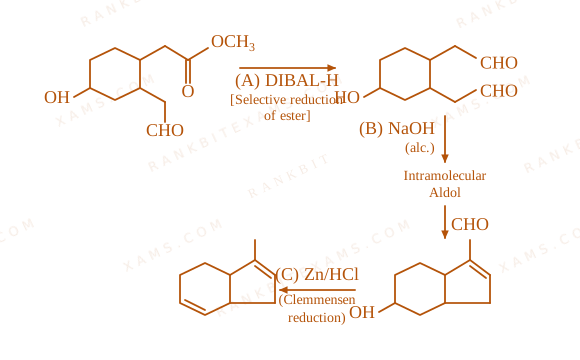
Product A and B formed in the following set of reactions are:
Preparation of Alcohols diagram for Q66 - JEE Main 2024 Evening
The diagram shows a reaction pathway for synthesizing product A and B.
  • A. textA = mathrmCH_2OH text, B = mathrmCH_2OH
  • B. textA = mathrmCH_3OH text, B = mathrmCH_3OH
  • C. textA = mathrmCH_2OH text, B = mathrmCH_3OH
  • D. textA = mathrmCH_3OH text, B = mathrmCH_3OH

Solution

### Core Logic The given substrate is an alkene attached to a benzene ring (styrene derivative). Reaction 1: Acid-catalyzed hydration (H^+ / H_2O) This proceeds via Markovnikov's rule. The proton attacks the alkene to form the most stable carbocation (benzyllic and secondary). Water then attacks this carbocation to yield the alcohol at the substituted position (product A: Ph-CH(OH)-CH_3). Reaction 2: Hydroboration-Oxidation (B_2H_6, then H_2O_2/NaOH) This proceeds via anti-Markovnikov addition of water across the double bond without carbocation rearrangement. The OH group adds to the less substituted carbon atom of the alkene (product B: Ph-CH_2-CH_2-OH).
Reaction pathway for products A and B diagram for Q66 - JEE Main 2024 Evening
The diagram shows a reaction pathway for synthesizing product A and B.
### Pattern Recognition H^+/H_2O = Markovnikov hydration (carbocation intermediate). B_2H_6 / H_2O_2, OH^- = Anti-Markovnikov hydration (concerted, no rearrangement). ### Evaluation Rubric / Model Answer null ### Chapter Mix Class 12 Chemistry: Alcohols Phenols and Ethers Class 11 Chemistry: Hydrocarbons
Q69 jee_main_2024_31_jan_morning Chemical Reactions of Alcohols
Given below are two statements: One is labelled as Assertion A and the other is labelled as Reason R: Assertion A: Alcohols react both as nucleophiles and electrophiles. Reason R: Alcohols react with active metals such as sodium, potassium and aluminum to yield corresponding alkoxides and liberate hydrogen. In the light of the above statements, choose the correct answer from the options given below:
  • A. textA is false but R is true.
  • B. textA is true but R is false.
  • C. textBoth A and R are true and R is the correct explanation of A.
  • D. textBoth A and R are true but R is NOT the correct explanation of A.

Solution

### Core Logic Assertion (A) is correct. Alcohols can act as nucleophiles (in reactions involving O-H bond cleavage) and as electrophiles (in reactions involving C-O bond cleavage after protonation). Reason (R) is correct. Alcohols react with active metals to form alkoxides and H_2 gas. However, Reason (R) only explains the acidic nature of the O-H bond (which relates to nucleophilic behavior when broken) but does not explain the electrophilic behavior (C-O cleavage). Thus, (R) is not the correct explanation for (A). ### Evaluation Rubric / Model Answer null ### Chapter Mix Class 12 Chemistry: Alcohols, Phenols and Ethers
Q74 jee_main_2024_31_jan_morning Acidity of Phenols
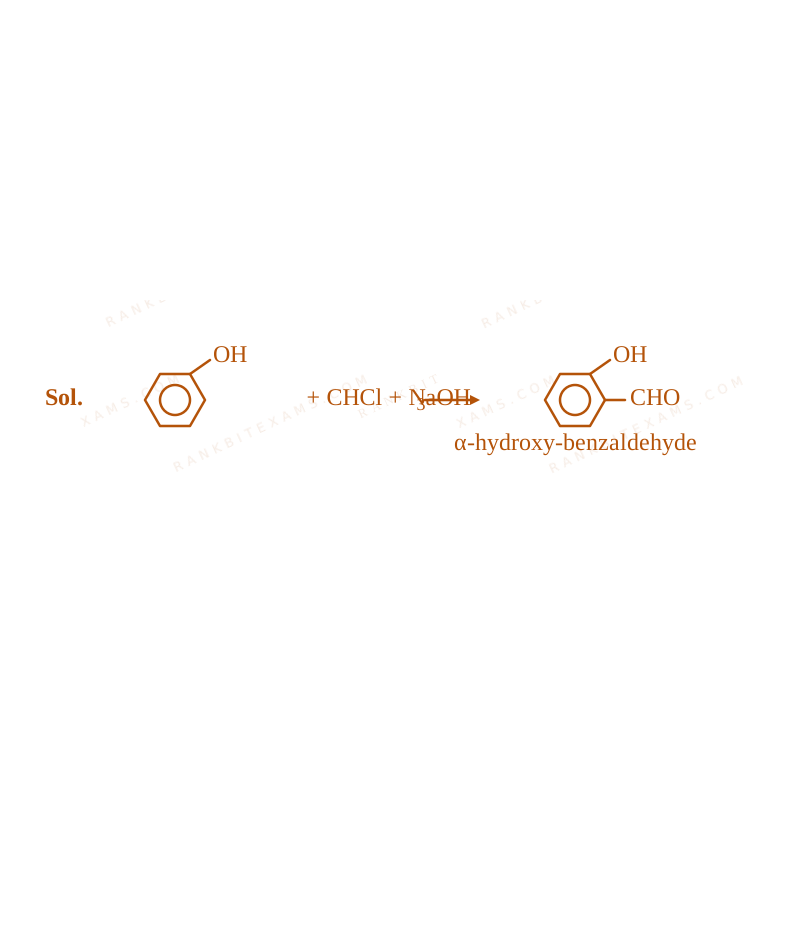
Given below are two statements: One is labelled as Assertion A and the other is labelled as Reason R: Assertion A: pK_a value of phenol is 10.0 while that of ethanol is 15.9. Reason R: Ethanol is stronger acid than phenol. In the light of the above statements, choose the correct answer from the options given below:
  • A. textA is true but R is false.
  • B. textA is false but R is true.
  • C. textBoth A and R are true and R is the correct explanation of A.
  • D. textBoth A and R are true but R is NOT the correct explanation of A.

Solution

### Core Logic Assertion A is true: Phenol has a pK_a of around 10.0, and ethanol has a pK_a of around 15.9. Reason R is false: A lower pK_a value implies higher acidity. Therefore, phenol is a stronger acid than ethanol. This is because the conjugate base of phenol (phenoxide ion) is resonance-stabilized, whereas the ethoxide ion is destabilized by the +I effect of the ethyl group. ### Evaluation Rubric / Model Answer null ### Chapter Mix Class 12 Chemistry: Alcohols, Phenols and Ethers
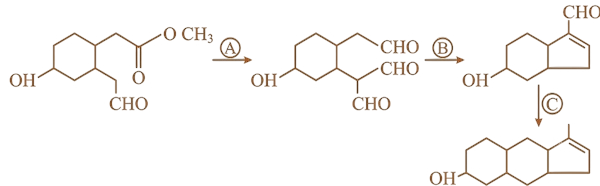
More Alcohols, Phenols and Ethers Questions — jee_main_2024_01_february_morning

Practice all Alcohols, Phenols and Ethers previous-year questions →

YOUR FIRST PREP STEP STARTS HERE

We Map Every Repeating Question in Competitive Exams.

Say goodbye to generic mock test fatigue. RankBit uses smart analysis to group past exam questions into their foundational Repeating Question Types. Find chapter weightage, track repeating questions, and score higher with targeted practice.

Select Your Target Exam

Choose an exam track below to find formulas per chapter and patterns.

Syncing Exam Intelligence

Mapping formulas and patterns across all tracks…

PATH A — FULL LENGTH PRACTICE

Full Mock Test Hub

Simulate real NTA exam conditions with fully tracked mocks. Time yourself against past papers.

Under Development
PATH B — TARGETED PRACTICE

Topic-wise Practice Hub

Practice past-year questions one chapter at a time. Pick an exam → subject → chapter and get every PYQ for that topic — pulled together from all past papers — with the chapter's key formulas alongside.

Loading Questions... Browse Topics
Latest from the Blog
View all →

Loading articles...