Water drops fall from a tap on the floor, 5 m below, at regular intervals of time, the first drop strikes the floor when the sixth drop begins to fall. The height at which the fourth drop will be from ground, at the instant when the first drop strikes the ground is ____ m.
(g = 10 ~m/s²)$(g = 10 \mathrm{~m/s}^{2})$
A.2.5$2.5$
B.4.0$4.0$
C.4.2$4.2$
D.3.8$3.8$
Solution & Explanation
Related Formula
h = ut + (1)/(2)gt²$$h = ut + \frac{1}{2}gt^2$$
Core Logic
Since drops fall at regular intervals, find the total time of fall for the first drop and divide it by the number of intervals to get the time gap between successive drops.
The first drop strikes the floor when the sixth drop begins to fall. There are exactly 5 intervals between the 1st and 6th drop.
Time between each drop Δ t = 1 ~sec5 = 0.2 ~sec$\Delta t = \frac{1 \mathrm{~sec}}{5} = 0.2 \mathrm{~sec}$.
Step 3: Distance of the Fourth Drop
The 4th drop has been falling for 2 intervals (since drops 6, 5, 4 mean the 4th drop was released 2 × 0.2 ~s$2 \times 0.2 \mathrm{~s}$ after the 6th drop started... wait, no. The 4th drop was released before the 5th and 6th).
Time of fall for the 4th$4^{\text{th}}$ drop is:
It was released 2 intervals after the 1st drop, so it has been falling for 1.0 - 2(0.2) = 0.6 ~s$1.0 - 2(0.2) = 0.6 \mathrm{~s}$? Wait, the PDF solution says:
"Time of fall for 4th$4^{\text{th}}$ drop is 1 - 0.6 = 0.4 ~sec$1 - 0.6 = 0.4 \mathrm{~sec}$"
Let's trace: 6th drop (0s fall), 5th drop (0.2s fall), 4th drop (0.4s fall).
Distance fallen by 4th$4^{\text{th}}$ drop:
In 'falling drops' problems, if N drops are in the air, there are (N-1) time intervals. The kth$k^{\text{th}}$ drop from the top has fallen for (k-1)$(k-1)$ intervals.
Checking options, only | A + B| = 2R ((θ)/(2))$|\vec{A} + \vec{B}| = 2R \cos \left(\frac{\theta}{2}\right)$ is correctly paired in the choice list.
Pattern Recognition
Standard geometry shortcut: Addition of two equal vectors yields a cosine half-angle dependency. Subtraction yields a sine half-angle dependency. (+ → )$(+ \to \cos)$, (- → )$(- \to \sin)$.
Chapter Mix
Class 11 Physics: Motion in a Plane
Qjee_main_2024_31_jan_morningProjectile Motion
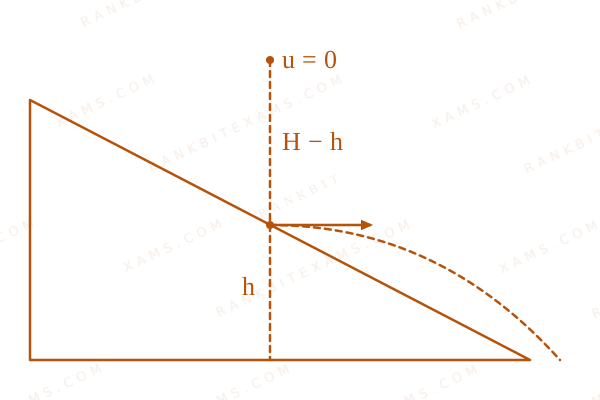
A body starts falling freely from height H$H$ hits an inclined plane in its path at height h$h$. As a result of this perfectly elastic impact, the direction of the velocity of the body becomes horizontal. The value of (H)/(h)$\frac{H}{h}$ for which the body will take the maximum time to reach the ground is
Numerical Answer.Answer: 2 to 2
Solution
Related Formula
t = √((2d)/(g))$$t = \sqrt{\frac{2d}{g}}$$
Core Logic
Projectile Motion diagram for Q55 - JEE Main 2024 Morning
The body falls freely from height H$H$ to height h$h$. The distance fallen is (H - h)$(H - h)$.
Time taken to fall this distance:
After elastic impact, the vertical velocity becomes zero (the entire velocity is directed horizontally). From height h$h$, it now acts as a horizontal projectile.
The time taken to reach the ground vertically from height h$h$ is:
Squaring both sides:
H - h = h$H - h = h$H = 2h$H = 2h$
(H)/(h) = 2$$\frac{H}{h} = 2$$
Chapter Mix
Class 11 Physics: Kinematics
Q33jee_main_2024_31_jan_morningDifferentiation In Kinematics
The relation between time 't$t$' and distance 'x$x$' is t = α x² + β x$t = \alpha x^2 + \beta x$, where α$\alpha$ and β$\beta$ are constants. The relation between acceleration (a$a$) and velocity (v$v$) is:
Standard kinematic shortcut: Whenever t = Ax² + Bx$t = Ax^2 + Bx$, v = (2Ax+B)⁻¹$v = (2Ax+B)^{-1}$ and a = -2A v³$a = -2A v^3$. Memorizing this directly saves derivation time during the exam.
Chapter Mix
Class 11 Physics: Kinematics
More Motion in a Straight Line Questions — jee_main_2026_28_january_morning
Practice past-year questions one chapter at a time. Pick an exam → subject → chapter and get every PYQ for that topic — pulled together from all past papers — with the chapter's key formulas alongside.