A particle moves along the x-axis and has its displacement x varying with time t according to the equation x=c_0(t^2-2)+c(t-2)^2$x=c_{0}(t^{2}-2)+c(t-2)^{2}$ where c_0$c_{0}$ and c are constants of appropriate dimensions. Then, which of the following statements is correct?
A.the acceleration of the particle is 2c_0$2c_{0}$
B.the acceleration of the particle is 2c
C.the initial velocity of the particle is 4c
D.the acceleration of the particle is 2(c+c_0)$2(c+c_{0})$
Solution & Explanation
### Related Formula
In rectilinear kinematics:
- Velocity:
v = fracdxdt$$v = \frac{dx}{dt}$$
- Acceleration:
a = fracdvdt = fracd^2xdt^2$$a = \frac{dv}{dt} = \frac{d^2x}{dt^2}$$
### Core Logic
Given position-time function:
$
### Core Logic
Given position-time function:
$x(t) = c_0 (t^2 - 2) + c (t - 2)^2$x(t) = c_0 (t^2 - 2) + c (t - 2)^2$
### Step 1: Differentiate once to get velocity ($
### Step 1: Differentiate once to get velocity ($v)
$)
$v = fracdxdt = fracddtleft[c_0(t^2 - 2)right] + fracddtleft[c(t-2)^2right]$v = \frac{dx}{dt} = \frac{d}{dt}\left[c_0(t^2 - 2)\right] + \frac{d}{dt}\left[c(t-2)^2\right]$$
$v = c_0 (2t) + c cdot 2(t-2) = 2 c_0 t + 2 c(t - 2)$v = c_0 (2t) + c \cdot 2(t-2) = 2 c_0 t + 2 c(t - 2)$
### Step 2: Differentiate again to get acceleration ($
### Step 2: Differentiate again to get acceleration ($a)
$)
$a = fracdvdt = fracddtleft[2 c_0 t + 2 c(t - 2)right]$a = \frac{dv}{dt} = \frac{d}{dt}\left[2 c_0 t + 2 c(t - 2)\right]$$
$a = 2 c_0 + 2 c = 2(c + c_0)$a = 2 c_0 + 2 c = 2(c + c_0)$
This shows acceleration is constant and equals $
This shows acceleration is constant and equals $2(c + c_0), matching Statement (4).
### Pattern Recognition
Whenever a position function is a pure quadratic polynomial in $, matching Statement (4).
### Pattern Recognition
Whenever a position function is a pure quadratic polynomial in $t, the acceleration is constant and equal to $, the acceleration is constant and equal to $2 \times the coefficient of the $ the coefficient of the $t^2 term.
Rewriting $ term.
Rewriting $x(t):
$:
$x(t) = (c_0 + c)t^2 - 4ct + (4c - 2c_0)$x(t) = (c_0 + c)t^2 - 4ct + (4c - 2c_0)$
The coefficient of $
The coefficient of $t^2 is $ is $(c_0 + c). Thus, acceleration is $. Thus, acceleration is $2(c_0 + c)$ directly.
### Evaluation Rubric / Model Answer
null
### Chapter Mix
Class 11 Physics: Motion in a Straight Line
Keywords:#displacement varying with time acceleration kinematic derivatives#JEE Main 2025 Evening Q14#Motion in a Straight Line velocity#double differentiation acceleration formula
More Motion in a Straight Line Previous-Year Questions
Water drops fall from a tap on the floor, 5 m below, at regular intervals of time, the first drop strikes the floor when the sixth drop begins to fall. The height at which the fourth drop will be from ground, at the instant when the first drop strikes the ground is ____ m.
(g = 10 mathrm~m/s^2)$(g = 10 \mathrm{~m/s}^{2})$
A.2.5$2.5$
B.4.0$4.0$
C.4.2$4.2$
D.3.8$3.8$
Solution
### Related Formula
h = ut + frac12gt^2$$h = ut + \frac{1}{2}gt^2$$
### Core Logic
Since drops fall at regular intervals, find the total time of fall for the first drop and divide it by the number of intervals to get the time gap between successive drops.
Falling water drops diagram
### Step 1: Total Time of Fall
Time taken by the first drop to reach the ground (h = 5 mathrm~m$h = 5 \mathrm{~m}$):
t = sqrtfrac2hg = sqrtfrac2 times 510 = 1 mathrm~sec$$t = \sqrt{\frac{2h}{g}} = \sqrt{\frac{2 \times 5}{10}} = 1 \mathrm{~sec}$$
### Step 2: Time Interval Between Drops
The first drop strikes the floor when the sixth drop begins to fall. There are exactly 5 intervals between the 1st and 6th drop.
Time between each drop Delta t = frac1 mathrm~sec5 = 0.2 mathrm~sec$\Delta t = \frac{1 \mathrm{~sec}}{5} = 0.2 \mathrm{~sec}$.
### Step 3: Distance of the Fourth Drop
The 4th drop has been falling for 2 intervals (since drops 6, 5, 4 mean the 4th drop was released 2 times 0.2 mathrm~s$2 \times 0.2 \mathrm{~s}$ after the 6th drop started... wait, no. The 4th drop was released before the 5th and 6th).
Time of fall for the 4^textth$4^{\text{th}}$ drop is:
It was released 2 intervals after the 1st drop, so it has been falling for 1.0 - 2(0.2) = 0.6 mathrm~s$1.0 - 2(0.2) = 0.6 \mathrm{~s}$? Wait, the PDF solution says:
"Time of fall for 4^textth$4^{\text{th}}$ drop is 1 - 0.6 = 0.4 mathrm~sec$1 - 0.6 = 0.4 \mathrm{~sec}$"
Let's trace: 6th drop (0s fall), 5th drop (0.2s fall), 4th drop (0.4s fall).
Distance fallen by 4^textth$4^{\text{th}}$ drop:
h' = frac12 g t^2 = frac12 times 10 times (0.4)^2 = 0.8 mathrm~m$$h' = \frac{1}{2} g t^2 = \frac{1}{2} \times 10 \times (0.4)^2 = 0.8 \mathrm{~m}$$
### Step 4: Height from Ground
Height from ground = Total height - Distance fallen
H = 5 - 0.8 = 4.2 mathrm~m$$H = 5 - 0.8 = 4.2 \mathrm{~m}$$
### Pattern Recognition
In 'falling drops' problems, if N drops are in the air, there are (N-1) time intervals. The k^textth$k^{\text{th}}$ drop from the top has fallen for (k-1)$(k-1)$ intervals.
### Evaluation Rubric / Model Answer
null
### Chapter Mix
Class 11 Physics: Motion in a Straight Line
Q15jee_main_2025_02_april_eveningDistance and Displacement
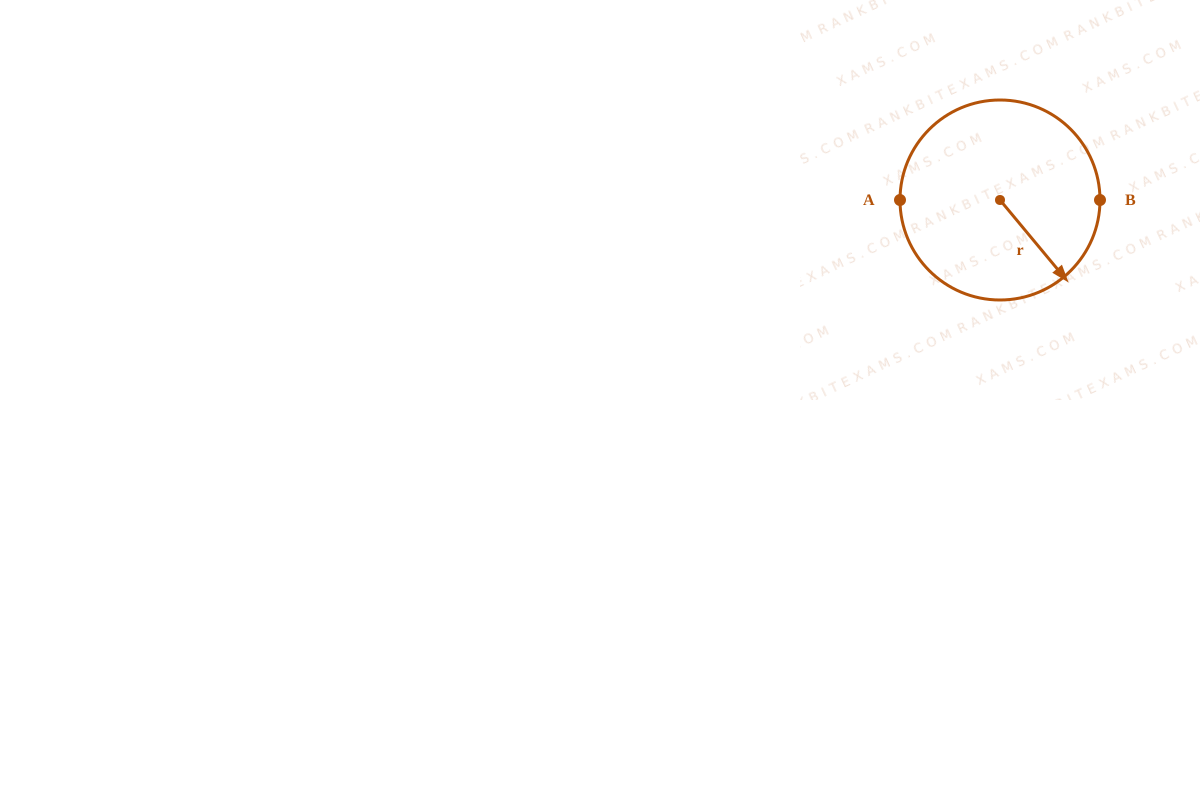
A sportsman runs around a circular track of radius r$r$ such that he traverses the path ABAB. The distance travelled and displacement, respectively, are
The diagram displays a circular track of radius r with diametrically opposite points A and B.
### Related Formula
1. Distance: Total actual path length covered.
2. Displacement: Shortest straight-line distance connecting the initial and final position.
3. Circumference of a complete circle = 2pi r$2\pi r$
4. Semicircular arc length = pi r$\pi r$
### Core Logic
The trajectory is defined by the sequence of points A to B to A to B$A \to B \to A \to B$:
1. **Distance Travelled:**
- Segment 1 (A to B$A \to B$): Semicircular path of length pi r$\pi r$
- Segment 2 (B to A$B \to A$): Semicircular path of length pi r$\pi r$
- Segment 3 (A to B$A \to B$): Semicircular path of length pi r$\pi r$
- Total distance:
textDistance = pi r + pi r + pi r = 3pi r$$\text{Distance} = \pi r + \pi r + \pi r = 3\pi r$$
2. **Displacement:**
- Initial position: A$A$
- Final position: B$B$
- Since points A$A$ and B$B$ represent diametrically opposite positions on the circle, the shortest distance between them is equal to the diameter of the circle:
textDisplacement = 2r$$\text{Displacement} = 2r$$
### Step 1: Write result
The actual distance travelled is 3pi r$3\pi r$ and the magnitude of displacement is 2r$2r$.
### Pattern Recognition
Sees: Circular kinematics path tracing.
Trap: Accidentally substituting straight chords for the distance arcs, or assuming the loop returns fully to A (which would yield a zero displacement).
Shortcut: The path ends at B. Since 3 half-loops are made, distance = 3 times pi r = 3pi r$3 \times \pi r = 3\pi r$. The direct path from start A to end B is just the diameter 2r$2r$.
### Evaluation Rubric / Model Answer
null
### Chapter Mix
Class 11 Physics: Motion in a Straight Line
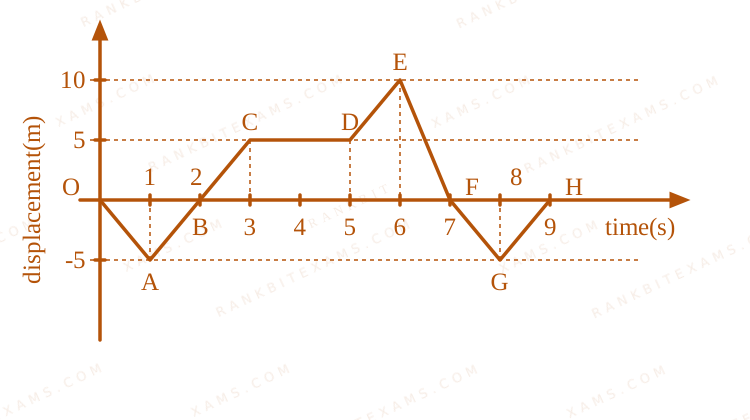
The displacement x$x$ versus time graph is shown below. A graph plotting displacement vs time tracking linear changes, plateaus, and reversals.
(A) The average velocity during 0 to 3 s is 10 m/s
(B) The average velocity during 3 to 5 s is 0 m/s
(C) The instantaneous velocity at t=2$t=2$ s is 5 m/s
(D) The average velocity during 5 to 7 s and instantaneous velocity at t=6.5$t=6.5$ s are equal
(E) The average velocity from t=0$t=0$ to t=9$t=9$ s is zero
Choose the correct answer from the options given below:
A. (A), (D), (E) only
B. (B), (C), (D) only
C. (B), (D), (E) only
D. (B), (C), (E) only
Solution
### Related Formula
langle v rangle = fracDelta xDelta t = fracx_f - x_it_f - t_i$$\langle v \rangle = \frac{\Delta x}{\Delta t} = \frac{x_f - x_i}{t_f - t_i}$$v_textinst = fracdxdt = textslope of xtext-t text graph$$v_{\text{inst}} = \frac{dx}{dt} = \text{slope of } x\text{-}t \text{ graph}$$
### Core Logic
Let's test each statement using coordinates from the given graph:
- For (A): At t=0, x=0$t=0, x=0$; at t=3, x=5$t=3, x=5$. langle v rangle = frac5-03 = frac53text m/s neq 10text m/s$\langle v \rangle = \frac{5-0}{3} = \frac{5}{3}\text{ m/s} \neq 10\text{ m/s}$ (Incorrect).
- For (B): At t=3, x=5$t=3, x=5$; at t=5, x=5$t=5, x=5$. langle v rangle = frac5-52 = 0text m/s$\langle v \rangle = \frac{5-5}{2} = 0\text{ m/s}$ (Correct).
### Step 1: Evaluate Remaining Statements
- For (C): Segment from 0 to 3s passes through points (0, -5)$(0, -5)$ or starts linearly. The slope from t=0$t=0$ to t=3$t=3$ can be calculated from the linear line segment: textslope = frac5 - (-10)3 = 5text m/s$\text{slope} = \frac{5 - (-10)}{3} = 5\text{ m/s}$. Thus, instantaneous velocity at t=2text s$t=2\text{ s}$ is 5text m/s$5\text{ m/s}$ (Correct).
- For (D): Slope during 5 to 7s vs instantaneous slope at t=6.5text s$t=6.5\text{ s}$ are completely different because the path changes slope.
- For (E): At t=0, x=-5$t=0, x=-5$ and at t=9, x=-5$t=9, x=-5$. Since net displacement is zero, the average velocity from t=0$t=0$ to t=9text s$t=9\text{ s}$ is zero (Correct).
Thus, (B), (C), and (E) are the correct statements.
### Pattern Recognition
Average velocity requires only initial and final positions (x_f, x_i$x_f, x_i$). Instantaneous velocity reads directly off the segment's geometric slope. If initial and final coordinates match, average velocity is unconditionally zero.
### Evaluation Rubric / Model Answer
null
### Chapter Mix
Class 11 Physics: Motion in a Straight Line
Q9jee_main_2025_28_jan_eveningVelocity Time Graphs
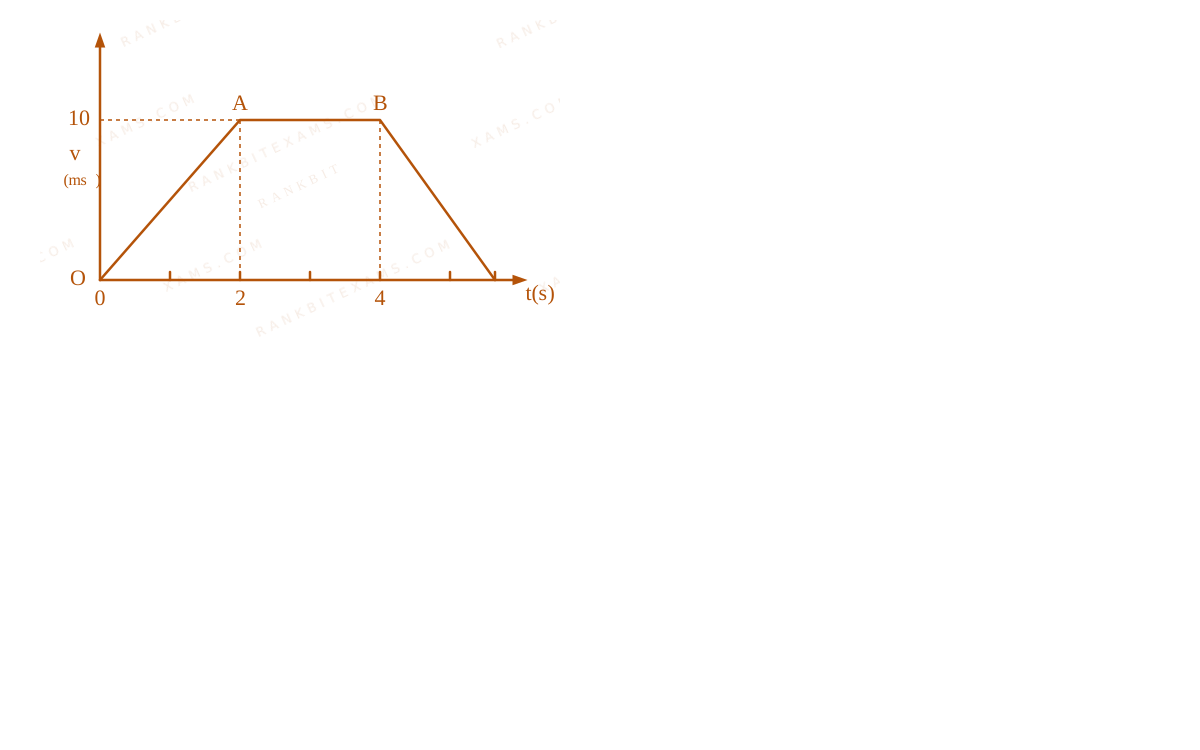
The velocity-time graph of an object moving along a straight line is shown in figure. What is the distance covered by the object between t = 0$t = 0$ to t = 4s$t = 4s$ ?
The velocity-time profile tracking motion across consecutive geometric shapes up to 4 seconds.
A.30mathrmm$30\mathrm{m}$
B.10mathrmm$10\mathrm{m}$
C.13mathrmm$13\mathrm{m}$
D.11mathrmm$11\mathrm{m}$
Solution
### Related Formula
The distance traveled by an object equals the total area enclosed under its velocity-time (v-t$v-t$) plot along the time axis, treating all regional boundaries as strictly positive metrics:
textDistance = int |v| \, dt$$\text{Distance} = \int |v| \, dt$$
### Core Logic
From the geometric grid profile between t = 0$t = 0$ and t = 4text s$t = 4\text{ s}$:
1. **First Region (t=0$t=0$ to t=2text s$t=2\text{ s}$)**: Forms a \right-angled \triangle with base = 2text s$= 2\text{ s}$ and peak height = 10text ms^-1$= 10\text{ ms}^{-1}$.
textArea_1 = frac12 times 2 times 10 = 10 text m$$\text{Area}_1 = \frac{1}{2} \times 2 \times 10 = 10 \text{ m}$$
2. **Second Region (t=2$t=2$ to t=4text s$t=4\text{ s}$)**: Forms a standard rectangle with width = (4 - 2) = 2text s$= (4 - 2) = 2\text{ s}$ and height = 10text ms^-1$= 10\text{ ms}^{-1}$.
textArea_2 = 2 times 10 = 20 text m$$\text{Area}_2 = 2 \times 10 = 20 \text{ m}$$
Summing the areas together to extract total displacement path:
textTotal Distance = 10 + 20 = 30 text m$$\text{Total Distance} = 10 + 20 = 30 \text{ m}$$
### Pattern Recognition
Always differentiate between distance and displacement on graph tracks. Displacement treats components below the axis as negative fields, while distance calculates absolute geometric magnitudes without direction.
### Evaluation Rubric / Model Answer
null
### Chapter Mix
Class 11 Physics: Motion in a Straight Line
More Motion in a Straight Line Questions — jee_main_2025_03_april_evening
We Map Every Repeating Question in Competitive Exams.
Say goodbye to generic mock test fatigue. RankBit uses smart analysis to group past exam questions into their foundational Repeating Question Types. Find chapter weightage, track repeating questions, and score higher with targeted practice.
Select Your Target Exam
Choose an exam track below to find formulas per chapter and patterns.
Syncing Exam Intelligence
Mapping formulas and patterns across all tracks…
PATH A — FULL LENGTH PRACTICE
Full Mock Test Hub
Simulate real NTA exam conditions with fully tracked mocks. Time yourself against past papers.
Practice past-year questions one chapter at a time. Pick an exam → subject → chapter and get every PYQ for that topic — pulled together from all past papers — with the chapter's key formulas alongside.