If ∫( 1-5 ²x ⁵x ²x)dx=f(x)+C where C is the constant of integration, then f((π)/(6))-f((π)/(4)) is equal to

Solution & Explanation

Core Logic

Split the integral into two terms:

I = ∫ (1)/( ⁵ x ² x) dx - ∫ (5 ² x)/( ⁵ x ² x) dx I = ∫ ( ² x)/( ⁵ x) dx - 5 ∫ (1)/( ⁵ x) dx
Step 1: Integration by Parts

Take the first integral I₁ = ∫ (1)/( ⁵ x) · ² x dx. Apply Integration by Parts taking u = (1)/( ⁵ x) and dv = ² x dx:

I₁ = (1)/( ⁵ x) · x - ∫ ( -(5 x)/( ⁶ x) ) x dx I₁ = ( x)/( ⁵ x) + 5 ∫ ( x)/( ⁶ x) · ( x)/( x) dx I₁ = ( x)/( ⁵ x) + 5 ∫ (1)/( ⁵ x) dx
Step 2: Re-substituting into Total Integral
I = ( ( x)/( ⁵ x) + 5 ∫ (1)/( ⁵ x) dx ) - 5 ∫ (1)/( ⁵ x) dx

The integral terms exactly cancel out:

I = ( x)/( ⁵ x) + C

Thus, f(x) = ( x)/( ⁵ x).

Step 3: Function Evaluation

Calculate f((π)/(6)):

f((π)/(6)) = ( (π/6))/( ⁵(π/6)) = 1/√(3)(1/2)⁵ = 32√(3)

Calculate f((π)/(4)):

f((π)/(4)) = ( (π/4))/( ⁵(π/4)) = 1(1/√(2))⁵ = (√(2))⁵ = 4√(2)

Difference:

f((π)/(6)) - f((π)/(4)) = 32√(3) - 4√(2) = 4√(3)(8 - √(6))
Pattern Recognition

Integrals of the form ∫ (complicated term 1 - complicated term 2) dx often cancel perfectly when Integration by Parts is applied to just one of the terms. Look for derivative relationships between the numerators.

Chapter Mix

Class 12 Mathematics: Integrals

Reference Study Guides

More Integrals Previous-Year Questions — Page 6

Q53 jee_main_2025_29_jan_evening Area Enclosed by Two Curves
Let the area enclosed between the curves |y| = 1 - x² and x² + y² = 1 be α. If 9α = β π + γ, β, γ are integers, then the value of |β - γ| equals
  • A. 27
  • B. 18
  • C. 15
  • D. 33

Solution

Related Formula

Area enclosed between two symmetric functions across four quadrants:

α = 4 × ( Area of circle in 1st quadrant - ∫₀¹ yparabola dx )
Core Logic

The curves are symmetric across the axes. The region is enclosed between the unit circle x² + y² = 1 and the parabolas y = ±(1 - x²).
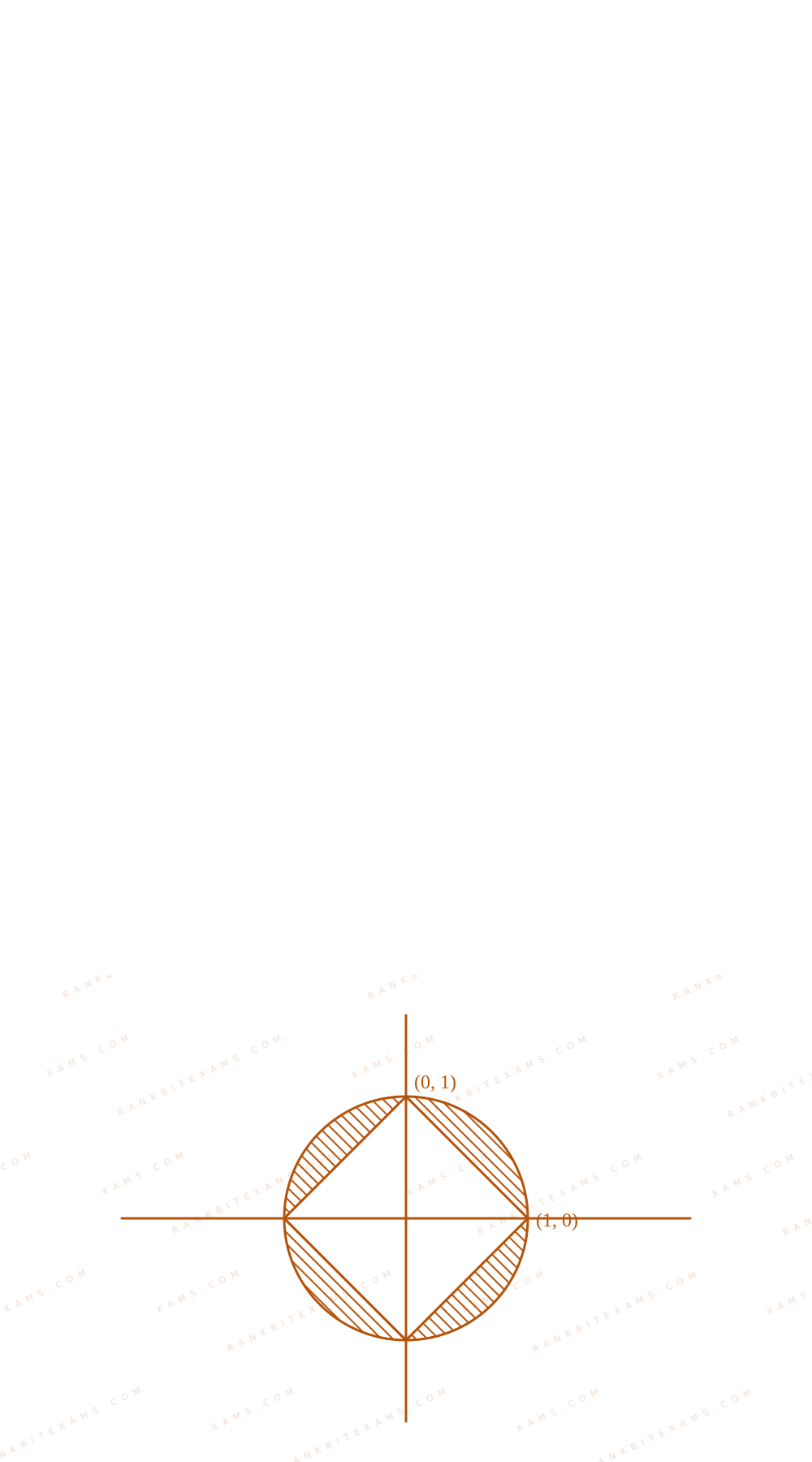
Area Enclosed by Two Curves diagram for Q53 - JEE Main 2025 Evening

By symmetry, the area α in the first quadrant is the area under the circle minus the area under the parabola from x=0 to x=1.

Step 1: Calculate the Area Components

Area of a circle quadrant with r=1 is (π)/(4).

Area under the parabola:

∫₀¹ (1 - x²) dx = [ x - (x³)/(3) ]₀¹ = 1 - (1)/(3) = (2)/(3)
Step 2: Evaluate the Total Area
α = 4 [ (π)/(4) - (2)/(3) ] = π - (8)/(3)

Multiplying both sides by 9:

9α = 9π - 24

Comparing with 9α = βπ + γ, we get:

β = 9, γ = -24

Hence,

|β - γ| = |9 - (-24)| = 33
Pattern Recognition

Symmetry helps divide the integration work by 4. Recognizing standard shapes (like a circle sector) allows you to bypass complex integration entirely for half of the problem.

Chapter Mix

Class 12 Mathematics: Integral Calculus

Q71 jee_main_2025_29_jan_evening Integration of Modulus and Greatest Integer Functions
If 24∫₀(pi)/(4)( |4x - (pi)/(12)| + [2 x])dx = 2π +α, where [· ] denotes the greatest integer function, then α is equal to
Numerical Answer. Answer: 12 to 12

Solution

Related Formula

Additivity property of definite integrals over split interval boundary points:

∫ₐc g(x) dx = ∫ₐb g(x) dx + ∫bc g(x) dx
Core Logic

Separate the integration tracking flow into two component operations:

I₁ = ∫₀(pi)/(4) |4x - (pi)/(12)| dx I₂ = ∫₀(pi)/(4) [2 x] dx
Step 1: Solve Modulus Integral Term

The argument changes sign inside absolute value bounds when 4x - (pi)/(12) = 0 x = (pi)/(48):

I₁ = ∫₀(pi)/(48) - (4x - (pi)/(12)) dx + ∫(pi)/(48)(pi)/(4) (4x - (pi)/(12)) dx = (1)/(4) [ (4x - (pi)/(12)) ]₀(pi)/(48) - (1)/(4) [ (4x - (pi)/(12)) ](pi)/(48)(pi)/(4)

Evaluating across numerical boundaries gives:

24 · I₁ = 24((1)/(2)) = 12
Step 2: Solve Greatest Integer Component and Combine

Analyze step limits inside greatest integer block [2 x]: For x in [0, (pi)/(6)), 0 ≤ 2 x < 1 [2 x] = 0. For x in [(pi)/(6), (pi)/(4)], 1 ≤ 2 x < √(2) [2 x] = 1.

I₂ = ∫₀(pi)/(6) 0 dx + ∫(pi)/(6)(pi)/(4) 1 dx = (pi)/(4) - (pi)/(6) = (pi)/(12)

Combine both sections aggregated by multiplier 24:

Total = 12 + 24((pi)/(12)) = 2π + 12

Comparing directly with expression statement parameters 2π + α isolates response value: α = 12

Pattern Recognition

Modulus arguments and step functions require isolating inflection transition numbers directly to break integrations up neatly.

Chapter Mix

Class 12 Mathematics: Definite Integration

Q jee_main_2025_28_jan_morning Properties of Definite Integrals (King's Property)
If ∫-(π)/(2)(π)/(2)(96x² ²x)/((1 + e^x)) dx = π (α π² +β),α ,β in Z, then (α + β)² equals:
  • A. 144
  • B. 196
  • C. 100
  • D. 64

Solution

Related Formula

King's property for definite integration:

∫ₐ^b f(x) dx = ∫ₐ^b f(a+b-x) dx
Core Logic

Apply the identity x → -x to the integral:

I = ∫-(π)/(2)(π)/(2) (96x² ² x)/(1 + e^x) dx = ∫-(π)/(2)(π)/(2) 96x² ² x1 + e-x dx
Step 1: Adding both integral variations

Adding the equations eliminates the exponential denominator term (1+e^x):

2I = ∫-(π)/(2)(π)/(2) 96x² ² x · [(1)/(1+e^x) + (e^x)/(1+e^x)] dx I = 48 ∫₀(π)/(2) x² (1 + 2x) dx
Step 2: Evaluating the integrated components

Integrating by parts gives:

I = π (2π² - 12)

Matching coefficients with the template: α = 2 and \beta = -12.

(α + β)² = (2 - 12)² = (-10)² = 100
Pattern Recognition

Exponential denominators like 1+e^x in symmetric integral intervals are prime candidates for simplification using King's property.

Chapter Mix

Class 12 Maths: Definite Integrals

Q65 jee_main_2025_03_april_morning Methods of Integration by Substitution
Let f(x) = ∫ x³√(3 - x²) dx. If 5f(√(2)) = -4, then f(1) is equal to:
  • A. - 2√(2)5
  • B. - 8√(2)5
  • C. - 4√(2)5
  • D. - 6√(2)5

Solution

Related Formula

Method of algebraic parameter substitution: Set 3-x² = t² -2xdx = 2tdt xdx = -tdt

Core Logic

Perform the specified variable parameter replacement steps:

3 - x² = t² x dx = -t dt

Rewrite the internal integral block components:

f(x) = ∫ x² · √(3-x²) · (x dx) = ∫ (3-t²) · t · (-t dt) = ∫ (t⁴ - 3t²) dt = (t⁵)/(5) - t³ + C

Return to original reference variable x:

f(x) = (3-x²)5/25 - (3-x²)3/2 + C
Step 1: Constant integration resolving

Evaluate function boundary conditions at x = √(2):

f(√(2)) = (3-2)5/25 - (3-2)3/2 + C = (1)/(5) - 1 + C = -(4)/(5) + C

Given 5f(√(2)) = -4 f(√(2)) = -(4)/(5).

-(4)/(5) + C = -(4)/(5) C = 0
Step 2: Numeric tracking value

Evaluate final targeted definition state value at x=1:

f(1) = (3-1)5/25 - (3-1)3/2 = 25/25 - 23/2 = 23/2((2)/(5) - 1) = 2√(2)(-(3)/(5)) = - 6√(2)5
Pattern Recognition

Splitting powers of x to create a direct match with internal derivative differential flags speeds up the integration transformation sequence.

Chapter Mix

Class 12 Mathematics: Integrals

Q67 jee_main_2025_03_april_morning Definite Integral of Greatest Integer Function
Let the domain of the function f(x) = ₂ ₄ ₆(3 + 4x - x²) be (a, b). If ∫₀b-a[x²]dx = p - √(q) - √(r), where p, q, r in N and (p, q, r) = 1, and [·] represents the greatest integer function, then p + q + r is equal to:
  • A. 10
  • B. 8
  • C. 11
  • D. 9

Solution

Related Formula

Domain of log chain iterations: For ₂ ₄(M) > 0, we require ₄(M) > 1 M > 4.

Core Logic

Trace internal arguments outward sequentially:

₄ ₆(3 + 4x - x²) > 0 ₆(3 + 4x - x²) > 1 3 + 4x - x² > 6¹ x² - 4x + 3 < 0 (x-1)(x-3) < 0 x in (1, 3)

Thus, determine limits:

a = 1, b = 3 b - a = 2
Step 1: Setting up the greatest integer function integration

We need to evaluate ∫₀² [x²] dx. Identify step boundary switch locations inside range [0, 2]:

  • For x in [0, 1): [x²] = 0
  • For x in [1, √(2)): [x²] = 1
  • For x in [√(2), √(3)): [x²] = 2
  • For x in [√(3), 2): [x²] = 3
  • Set up separate boundary component integrations:

∫₀² [x²] dx = ∫₀¹ 0 dx + ∫₁√(2) 1 dx + ∫√(2)√(3) 2 dx + ∫√(3)² 3 dx = 0 + (√(2) - 1) + 2(√(3) - √(2)) + 3(2 - √(3)) = √(2) - 1 + 2√(3) - 2√(2) + 6 - 3√(3) = 5 - √(2) - √(3)
Step 2: Matching coefficients

Compare values with requested answer template shape:

5 - √(2) - √(3) = p - √(q) - √(r) p = 5, q = 2, r = 3 Final Sum = p + q + r = 5 + 2 + 3 = 10
Pattern Recognition

Integrals over greatest integer configurations change value exactly where the inner expression tracks through integer milestones. Mapping boundaries accurately resolves calculations smoothly.

Chapter Mix

Class 12 Mathematics: Integrals

More Integrals Questions — jee_main_2026_28_january_morning

Practice all Integrals previous-year questions →

Rankbit System
JEE Physics: Waves (+15.5%) | Electrostatics: Concentric Shells (-29.7%) | Modern Physics: Photoelectric Clones (+34.2%) | Mathematics: Definite Integrals (+18.1%) | Chemistry: Coordination Splitting (-11.4%) | JEE Physics: Waves (+15.5%) | Electrostatics: Concentric Shells (-29.7%) | Modern Physics: Photoelectric Clones (+34.2%) | Mathematics: Definite Integrals (+18.1%) | Chemistry: Coordination Splitting (-11.4%)