Let f(t) = int left( frac1 - sin(log_e t)1 - cos(log_e t) right) dt, t > 1. If f(e^pi/2) = -e^pi/2 and f(e^pi/4) = alpha e^pi/4, then alpha equals

Solution & Explanation

### Related Formula int e^x (g(x) + g'(x)) dx = e^x g(x) + C 1 - cos x = 2sin^2(x/2) sin x = 2sin(x/2)cos(x/2) ### Core Logic Let log_e t = x Rightarrow t = e^x Rightarrow dt = e^x dx. f(t) = int frac1 - sin x1 - cos x e^x dx = int e^x left( frac12sin^2(x/2) - frac2sin(x/2)cos(x/2)2sin^2(x/2) right) dx = int e^x left( frac12operatornamecosec^2(x/2) - cot(x/2) right) dx ### Step 1: Integration Let g(x) = -cot(x/2). Then g'(x) = frac12operatornamecosec^2(x/2). The integral fits the standard form int e^x (g(x) + g'(x)) dx. f(t) = -e^x cotleft(fracx2right) + C = -t cotleft(fraclog_e t2right) + C ### Step 2: Finding Constant of Integration Given f(e^pi/2) = -e^pi/2: -e^pi/2 cotleft(fracpi/22right) + C = -e^pi/2 -e^pi/2 (1) + C = -e^pi/2 Rightarrow C = 0 ### Step 3: Calculating Alpha Find f(e^pi/4): f(e^pi/4) = -e^pi/4 cotleft(fracpi/42right) = -e^pi/4 cotleft(fracpi8right) Recall cot(pi/8) = sqrt2 + 1. f(e^pi/4) = -e^pi/4(sqrt2 + 1) = alpha e^pi/4 Thus, alpha = -(1 + sqrt2) = -1 - sqrt2. ### Pattern Recognition Logarithmic inputs in integrals are the classic cue to substitute t = e^x which inherently sets up the e^x(f(x) + f'(x)) format. ### Evaluation Rubric / Model Answer null ### Chapter Mix Class 12 Maths: Integrals Class 11 Maths: Trigonometric Functions

Reference Study Guides

More Integrals Previous-Year Questions

Q23 jee_main_2026_22_january_morning Integration by Substitution
If int(sin x)^frac-112(cos x)^frac-52dx= -fracp_1q_1(cot x)^frac92-fracp_2q_2(cot x)^frac52-fracp_3q_3(cot x)^frac12+fracp_4q_4(cot x)^frac-32+C, where p_i and q_i are positive integers with gcd(p_i, q_i)=1 for i=1, 2, 3, 4 and C is the constant of integration, then frac15p_1p_2p_3p_4q_1q_2q_3q_4 is equal to ____.
Numerical Answer. Answer: 16 to 16

Solution

### Related Formula textWhen powers of sine and cosine add up to a negative even integer, extract sec^2 x text and substitute tan x = t ### Core Logic Integral: I = int sin^-11/2 x cos^-5/2 x \, dx The sum of powers is -frac112 - frac52 = -8. Convert the integrand entirely into terms of tan x and sec x by dividing and multiplying by cos^-11/2 x. I = int left(fracsin xcos xright)^-11/2 cos^-11/2 x cos^-5/2 x \, dx I = int (tan x)^-11/2 (cos x)^-8 \, dx I = int (tan x)^-11/2 sec^8 x \, dx ### Step 1: Integration by Substitution Rewrite sec^8 x = (sec^2 x)^3 sec^2 x = (1 + tan^2 x)^3 sec^2 x. I = int (tan x)^-11/2 (1 + tan^2 x)^3 sec^2 x \, dx Substitute t = tan x implies dt = sec^2 x \, dx. I = int t^-11/2 (1 + t^2)^3 \, dt Expand (1 + t^2)^3 = 1 + 3t^2 + 3t^4 + t^6. I = int t^-11/2 (1 + 3t^2 + 3t^4 + t^6) \, dt I = int (t^-11/2 + 3t^-7/2 + 3t^-3/2 + t^1/2) \, dt ### Step 2: Evaluating the Anti-derivatives Integrate term by term: I = fract^-9/2-9/2 + 3fract^-5/2-5/2 + 3fract^-1/2-1/2 + fract^3/23/2 + C I = -frac29t^-9/2 - frac65t^-5/2 - 6t^-1/2 + frac23t^3/2 + C Substitute back t = tan x = frac1cot x, which implies t^-a = (cot x)^a. I = -frac29(cot x)^9/2 - frac65(cot x)^5/2 - frac61(cot x)^1/2 + frac23(cot x)^-3/2 + C ### Step 3: Variable Assignment Comparing with -fracp_1q_1(cot x)^9/2 - fracp_2q_2(cot x)^5/2 - fracp_3q_3(cot x)^1/2 + fracp_4q_4(cot x)^-3/2: p_1 = 2, q_1 = 9 p_2 = 6, q_2 = 5 p_3 = 6, q_3 = 1 p_4 = 2, q_4 = 3 Calculate frac15 p_1 p_2 p_3 p_4q_1 q_2 q_3 q_4: = frac15(2)(6)(6)(2)(9)(5)(1)(3) = frac15 times 144135 = frac2160135 = 16 ### Pattern Recognition If int sin^m x cos^n x \,dx has m+n as a negative even integer, unconditionally extract sec^|m+n|x and set tan x = t. The expansion expands gracefully into polynomial power rules without any trig substitution hassle. ### Evaluation Rubric / Model Answer null ### Chapter Mix Class 12 Maths: Indefinite Integration
Q12 jee_main_2026_22_january_evening Area Under Curves
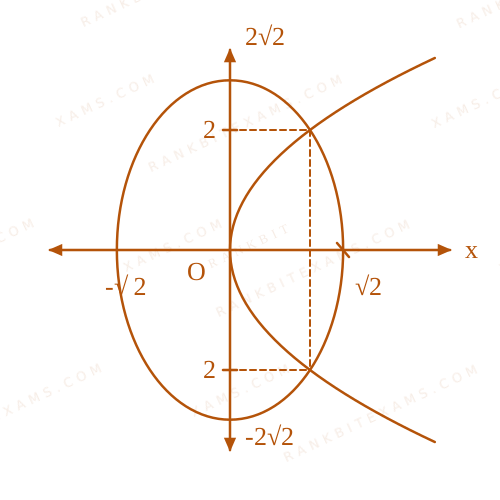
The area of the region A = \(x,y) : 4x^2 + y^2 le 8 text and y^2 le 4x\ is:
  • A. fracpi2 + 2
  • B. pi + frac23
  • C. pi + 4
  • D. fracpi2 + frac13

Solution

### Related Formula Area enclosed between curves is computed by breaking into integration regions at intersection points. ### Core Logic
Area bounded by ellipse and parabola for Q12 - JEE Main 2026 Evening
Find intersection of 4x^2 + y^2 = 8 and y^2 = 4x: 4x^2 + 4x - 8 = 0 implies x^2 + x - 2 = 0 implies x = 1 quad (x > 0) For x in [0, 1], region bounded by parabola y = pm 2sqrtx. For x in [1, sqrt2], region bounded by ellipse y = pm sqrt8 - 4x^2. ### Step 1: Definite Integration textArea = 2 int_0^1 2sqrtx dx + 2 int_1^sqrt2 sqrt8 - 4x^2 dx = 4 left[ frac23 x^3/2 right]_0^1 + 4 int_1^sqrt2 sqrt2 - x^2 dx = frac83 + 4 cdot frac12 left[ xsqrt2-x^2 + 2sin^-1left(fracxsqrt2right) right]_1^sqrt2 = frac83 + 2 left[ left(0 + 2 cdot fracpi2right) - left(1 + 2 cdot fracpi4right) right] = frac83 + 2pi - 2 - pi = pi + frac23 Area = pi + frac23 sq. units. ### Pattern Recognition Split area integration at intersection x=1 between parabola boundary and ellipse boundary. ### Evaluation Rubric / Model Answer null ### Chapter Mix Class 12 Maths: Integral Calculus
Q22 jee_main_2026_22_january_evening Definite Integral and King's Property
Let [cdot] be the greatest integer function. If alpha = int_0^64 left(x^1/3 - [x^1/3]right) dx, then frac1pi int_0^alphapi left( fracsin^2thetasin^6theta + cos^6theta right) dtheta is equal to ____.
Numerical Answer. Answer: 36 to 36

Solution

### Related Formula King's property of definite integrals: int_a^b f(x)dx = int_a^b f(a+b-x)dx. ### Core Logic 1. Evaluate alpha: int_0^64 x^1/3 dx = left[ frac34 x^4/3 right]_0^64 = frac34 (256) = 192 int_0^64 [x^1/3] dx = int_0^1 0 dx + int_1^8 1 dx + int_8^27 2 dx + int_27^64 3 dx = 0 + 7(1) + 19(2) + 37(3) = 7 + 38 + 111 = 156 Thus, alpha = 192 - 156 = 36. ### Step 1: Evaluate Trigonometric Integral Let E = frac1pi int_0^36pi fracsin^2thetasin^6theta + cos^6theta dtheta = frac36pi int_0^pi fracsin^2thetasin^6theta + cos^6theta dtheta = frac72pi int_0^pi/2 fracsin^2thetasin^6theta + cos^6theta dtheta Let J = \int_{0}^{\pi/2} \frac{\sin^2\theta}{\sin^6\theta + \cos^6\theta} d\theta. By King's property, J = \int_{0}^{\pi/2} \frac{\cos^2\theta}{\sin^6\theta + \cos^6\theta} d\theta. 2J = int_0^pi/2 frac1sin^6theta + cos^6theta dtheta = int_0^infty frac1 + lambda^2lambda^4 - lambda^2 + 1 dlambda = fracpi2 implies J = fracpi4 Wait, checking addition: 2J = \frac{\pi}{2} \implies J = \frac{\pi}{2} when evaluating \int_0^{\infty} \frac{1 + 1/\lambda^2}{\lambda^2 - 1 + 1/\lambda^2} d\lambda = \pi. So J = \frac{\pi}{2}. ### Step 2: Final Calculation E = frac72pi times fracpi2 = 36$ ### Pattern Recognition Break fractional part integral into piecewise constant steps; convert periodic trigonometric integral using symmetry. ### Evaluation Rubric / Model Answer null ### Chapter Mix Class 12 Maths: Integral Calculus
Q2 jee_main_2026_23_january_morning Indefinite Integration
Let f(x) = int frac(2 - x^2)e^x(sqrt1 + x)(1 - x)^frac32 dx. If f(0) = 0, then fleft(frac12right) is equal to:
  • A. sqrt3e - 1
  • B. sqrt2e + 1
  • C. sqrt2e - 1
  • D. sqrt3e + 1

Solution

### Related Formula int e^x [g(x) + g'(x)] dx = e^x g(x) + C ### Core Logic Rewrite the numerator (2 - x^2) as (1 - x^2) + 1 to split the integral into two recognizable parts matching the e^x [g(x) + g'(x)] form. I = int e^x left( frac(1 - x^2) + 1sqrt1 + x cdot (1 - x)^3/2 right) dx = int e^x left( frac1 - x^2sqrt1 + x cdot (1 - x)^3/2 + frac1sqrt1 + x cdot (1 - x)^3/2 right) dx ### Step 1: Simplify Terms Simplify the first term: frac1 - x^2sqrt1 + x cdot (1 - x)^3/2 = frac(1 - x)(1 + x)sqrt1 + x cdot (1 - x)sqrt1 - x = fracsqrt1 + xsqrt1 - x = sqrtfrac1 + x1 - x Now verify if the derivative of g(x) = sqrtfrac1 + x1 - x matches the second term. g'(x) = frac12sqrtfrac1+x1-x cdot frac(1-x)(1) - (1+x)(-1)(1-x)^2 = fracsqrt1-x2sqrt1+x cdot frac2(1-x)^2 = frac1sqrt1+x cdot (1-x)^3/2 This perfectly matches the second term. Thus, the integral evaluates to: f(x) = e^x sqrtfrac1 + x1 - x + C ### Step 2: Apply Boundary Conditions Given f(0) = 0: e^0 sqrtfrac1 + 01 - 0 + C = 0 Rightarrow 1 + C = 0 Rightarrow C = -1 So, f(x) = e^x sqrtfrac1 + x1 - x - 1. ### Step 3: Evaluate at x = 1/2 fleft(frac12right) = e^1/2 sqrtfrac1 + 1/21 - 1/2 - 1 = e^1/2 sqrtfrac3/21/2 - 1 = sqrt3e - 1 ### Pattern Recognition Any integral involving e^x multiplied by an algebraic fraction heavily signals the use of int e^x [g(x) + g'(x)] dx. Breaking the numerator into (1-x^2) + 1 is the classic key to unlock this. ### Evaluation Rubric / Model Answer null ### Chapter Mix Class 12 Maths: Integrals
Q10 jee_main_2026_23_january_morning Definite Integration Properties
The value of the integral intlimits_fracpi24^frac5pi24fracdx1+sqrt[3]tan 2x is:
  • A. fracpi12
  • B. fracpi18
  • C. fracpi6
  • D. fracpi3

Solution

### Related Formula int_a^b f(x) dx = int_a^b f(a + b - x) dx quad (textKing's Property) ### Core Logic Let I = int_fracpi24^frac5pi24fracdx1+sqrt[3]tan 2x dots (1) Apply King's property. Here a + b = fracpi24 + frac5pi24 = frac6pi24 = fracpi4. Replace x with fracpi4 - x: I = int_fracpi24^frac5pi24fracdx1+sqrt[3]tan 2left(fracpi4 - xright) ### Step 1: Apply Trigonometric Identity Notice that tan 2left(fracpi4 - xright) = tanleft(fracpi2 - 2xright) = cot 2x. So, I = int_fracpi24^frac5pi24fracdx1+sqrt[3]cot 2x. Convert cot 2x to frac1tan 2x: I = int_fracpi24^frac5pi24fracsqrt[3]tan 2xsqrt[3]tan 2x+1 dx dots (2) ### Step 2: Add the Integrals Add equations (1) and (2): 2I = int_fracpi24^frac5pi24 frac1 + sqrt[3]tan 2x1 + sqrt[3]tan 2x dx = int_fracpi24^frac5pi24 (1) dx 2I = left[ x right]_fracpi24^frac5pi24 = frac5pi24 - fracpi24 = frac4pi24 = fracpi6 I = frac12 left( fracpi6 right) = fracpi12 ### Pattern Recognition Limits of pi/24 and 5pi/24 add up to pi/4. When dealing with tan(2x), multiplying by 2 transforms this upper/lower sum to pi/2, establishing the classic tan/cot symmetry map triggered by King's Property. ### Evaluation Rubric / Model Answer null ### Chapter Mix Class 12 Maths: Integrals

More Integrals Questions — jee_main_2026_24_january_morning

Practice all Integrals previous-year questions →

Rankbit System
JEE Physics: Waves (+15.5%) | Electrostatics: Concentric Shells (-29.7%) | Modern Physics: Photoelectric Clones (+34.2%) | Mathematics: Definite Integrals (+18.1%) | Chemistry: Coordination Splitting (-11.4%) | JEE Physics: Waves (+15.5%) | Electrostatics: Concentric Shells (-29.7%) | Modern Physics: Photoelectric Clones (+34.2%) | Mathematics: Definite Integrals (+18.1%) | Chemistry: Coordination Splitting (-11.4%)
