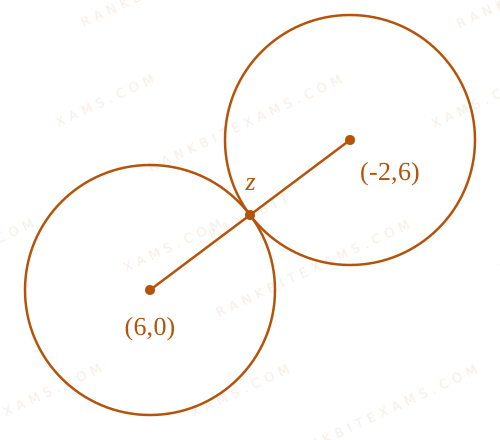
Let z be a complex number such that |z - 6| = 5 and |z + 2 - 6i| = 5. Then the value of z³ + 3z² - 15z + 141 is equal to

Solution & Explanation

Core Logic

Geometry of Complex Numbers
The given equations represent two circles in the complex plane: Circle 1: Center C₁(6, 0), radius r₁ = 5 Circle 2: Center C₂(-2, 6), radius r₂ = 5

Distance between the centers C₁ and C₂:

C₁C₂ = √((-2 - 6)² + (6 - 0)²) = √(64 + 36) = 10

Notice that C₁C₂ = r₁ + r₂ = 5 + 5 = 10. This means the two circles touch each other externally at exactly one point.

Step 1: Finding z

Since the circles touch externally, the common point z is the midpoint of the line segment joining the centers C₁ and C₂.

z = (6 + (-2))/(2) + i (0 + 6)/(2)

z = 2 + 3i

Step 2: Simplifying the Polynomial

We have z = 2 + 3i. z - 2 = 3i Squaring both sides: (z - 2)² = -9

z² - 4z + 4 = -9 z² - 4z + 13 = 0

z² = 4z - 13

Step 3: Evaluating the Expression

We need to evaluate z³ + 3z² - 15z + 141. First, find z³:

z³ = z · z² = z(4z - 13) = 4z² - 13z

Substitute z² = 4z - 13 again:

z³ = 4(4z - 13) - 13z = 16z - 52 - 13z = 3z - 52

Now substitute z³ and z² into the target expression:

(3z - 52) + 3(4z - 13) - 15z + 141 = 3z - 52 + 12z - 39 - 15z + 141 = (3z + 12z - 15z) + (-52 - 39 + 141)

= 0 + 50 = 50

Pattern Recognition

When given two complex distance modulus equations |z-z₁|=r₁ and |z-z₂|=r₂, always check the distance between centers |z₁ - z₂|. If it exactly equals r₁ + r₂, the single unique solution is the section formula midpoint.

Chapter Mix

Class 11 Mathematics: Complex Numbers and Quadratic Equations

Reference Study Guides

More Complex Numbers and Quadratic Equations Previous-Year Questions — Page 9

Q26 jee_main_2024_31_jan_morning Properties of Modulus and Argument
If α denotes the number of solutions of |1 - i|^x = 2^x and β = ((|z|)/( (z))), where z = (π)/(4) (1 + i)⁴ ( 1 - √(π) i√(π) + i + √(π) - i1 + √(π) i), i = √(-1), then the distance of the point (α, β) from the line 4x - 3y = 7 is
Numerical Answer. Answer: 3 to 3

Solution

Core Logic
|1 - i|^x = 2^x (√(2))^x = 2^x 2x/2 = 2^x

This implies (x)/(2) = x x = 0. There is exactly 1 solution, so α = 1.

Step 1: Simplify complex number z
(1+i)⁴ = ((1+i)²)² = (1 + i² + 2i)² = (2i)² = -4

Thus, z = -π ( (1-√(π)i)(√(π)-i)π + 1 + (√(π)-i)(1-√(π)i)1 + π )

Step 2: Simplify Bracket

Let's expand the terms directly: z = (π)/(4)(-4) [ √(π) - π i - i - √(π)π + 1 + √(π) - i - π i - √(π)1 + π ]

= -π [ (-i(π+1))/(π+1) + (-i(π+1))/(π+1) ] = -π [ -i - i ] = 2π i
Step 3: Find beta

For z = 2π i: |z| = 2π and (z) = (π)/(2).

β = (|z|)/( (z)) = (2π)/(π/2) = 4
Step 4: Distance from Line

Distance of point (α, β) = (1, 4) from the line 4x - 3y - 7 = 0:

D = |4(1) - 3(4) - 7|√(4² + (-3)²) = (|4 - 12 - 7|)/(5) = (|-15|)/(5) = 3
Chapter Mix

Class 11 Maths: Complex Numbers and Quadratic Equations Class 11 Maths: Straight Lines

More Complex Numbers and Quadratic Equations Questions — jee_main_2026_28_january_morning

Practice all Complex Numbers and Quadratic Equations previous-year questions →

Rankbit System
JEE Physics: Waves (+15.5%) | Electrostatics: Concentric Shells (-29.7%) | Modern Physics: Photoelectric Clones (+34.2%) | Mathematics: Definite Integrals (+18.1%) | Chemistry: Coordination Splitting (-11.4%) | JEE Physics: Waves (+15.5%) | Electrostatics: Concentric Shells (-29.7%) | Modern Physics: Photoelectric Clones (+34.2%) | Mathematics: Definite Integrals (+18.1%) | Chemistry: Coordination Splitting (-11.4%)