Let the set C = (x,y) x² -2y = 2023, x,yin N$C = \left\{(x,y)\mid x^2 -2^{y} = 2023, x,y\in \mathbb{N}\right\}$. Then Σ(x,y)in C(x + y)$\sum_{(x,y)\in C}(x + y)$ is equal to
Numerical Answer Type:
Enter a numerical valueAnswer: 46 to 46+4 marks
Solution & Explanation
Related Formula
Analyze structural equations through modular constraints (e.g., modulo 3 or 4) to limit potential bounds.
Core Logic
Given the equation: x² - 2^y = 2023$x^2 - 2^y = 2023$.
Let us inspect the numbers modulo 8:
2023 ≡ 7 8$$2023 \equiv 7 \pmod 8$$
A perfect square x²$x^2$ can only be congruent to 0, 1, 4 8$0, 1, 4 \pmod 8$.
If y ≥ 3$y \geq 3$, then 2^y ≡ 0 8 x² ≡ 7 8$2^y \equiv 0 \pmod 8 \implies x^2 \equiv 7 \pmod 8$, which is impossible.
Therefore, y$y$ must be less than 3. Since y in N$y \in \mathbb{N}$, the only choices are y = 1$y = 1$ or y = 2$y = 2$.
Exponential Diophantine equations (equations with variables in exponents) are best analyzed using modular arithmetic constraints to quickly find small finite upper bounds.
Chapter Mix
Class 11 Mathematics: Principle of Mathematical Induction / Number Theory
Keywords:#Modular Residue Analysis#Diophantine Enclosures#Perfect Square Constraints#JEE Main 2024 Advanced Math
More Complex Numbers and Quadratic Equations Previous-Year Questions
Q17jee_main_2026_21_jan_morningCube Roots of Unity
If x² + x + 1 = 0$x^{2} + x + 1 = 0$ , then the value of (x+ 1x)⁴+(x²+ 1x²)⁴+(x³+ 1x³)⁴+…+(x²⁵+ 1x²⁵)⁴$\left(\mathrm{x}+\frac{1}{\mathrm{x}}\right)^{4}+\left(\mathrm{x}^{2}+\frac{1}{\mathrm{x}^{2}}\right)^{4}+\left(\mathrm{x}^{3}+\frac{1}{\mathrm{x}^{3}}\right)^{4}+\ldots+\left(\mathrm{x}^{25}+\frac{1}{\mathrm{x}^{25}}\right)^{4}$ is :
Properties of cube roots of unity: ω³ = 1$\omega^3 = 1$ and 1 + ω + ω² = 0$1 + \omega + \omega^2 = 0$.
Core Logic
Let α = ω$\alpha = \omega$. Then (1)/(x) = (1)/(ω) = ω²$\frac{1}{x} = \frac{1}{\omega} = \omega^2$.
The series is Σk=1²⁵ (ω^k + ω2k)⁴$\sum_{k=1}^{25} (\omega^k + \omega^{2k})^4$.
Evaluate the term Tk = (ω^k + ω2k)⁴$T_k = (\omega^k + \omega^{2k})^4$ based on the modulo of k$k$ with 3.
Powers of x+1/x$x+1/x$ when x$x$ solves x² ± x + 1 = 0$x^2 \pm x + 1 = 0$ perfectly orbit around periods of 3 or 6. Isolate the 3m$3m$ resonant beats (which hit pure scalars like 1+1=2$1+1=2$) versus the out-of-phase beats (which collapse to -1$-1$ or 1$1$ via basic ω$\omega$ identities).
Chapter Mix
Class 11 Maths: Complex Numbers and Quadratic Equations
Q19jee_main_2026_21_jan_eveningGeometry of Complex Numbers
Let z$z$ be the complex number satisfying |z-5|≤ 3$|z-5|\leq 3$ and having maximum positive principal argument. Then 34|(5z-12)/(5iz+16)|²$34\left|\frac{5z-12}{5iz+16}\right|^{2}$ is equal to:
A.16$16$
B.12$12$
C.26$26$
D.20$20$
Solution
Related Formula
For maximum argument of z on a circle, the ray from origin is tangent to the circle.$$\text{For maximum argument of } z \text{ on a circle, the ray from origin is tangent to the circle.}$$If |z-a| ≤ r, maximum argument implies θ = (r)/(|a|) and coordinates are x=a ²θ, y=a θ θ$$\text{If } |z-a| \leq r, \text{ maximum argument implies } \sin\theta = \frac{r}{|a|} \text{ and coordinates are } x=a\cos^2\theta, y=a\sin\theta\cos\theta$$
Core Logic
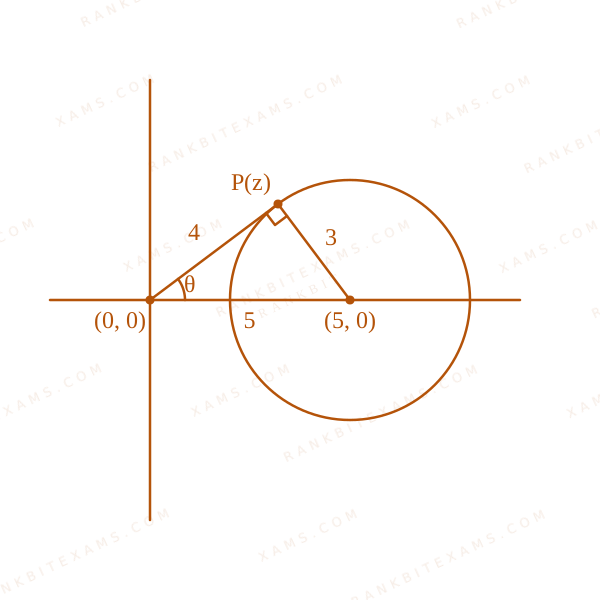
Complex geometry maximum argument diagram for Q19 - JEE Main 2026 Evening
The condition |z-5|≤ 3$|z-5|\leq 3$ represents a disk centered at (5,0)$(5,0)$ with radius 3$3$.
To maximize the principal argument θ$\theta$, the ray from origin must touch the circle in the first quadrant.
The tangent, origin, and center form a right-angled triangle.
Step 1: Locate the Point z
From geometry, hypotenuse c = 5$c = 5$, opposite (radius) r = 3$r = 3$.
The adjacent side (length of tangent) is √(5² - 3²) = 4$\sqrt{5^2 - 3^2} = 4$.
The angle of tangency θ$\theta$ satisfies θ = (3)/(5)$\sin\theta = \frac{3}{5}$ and θ = (4)/(5)$\cos\theta = \frac{4}{5}$.
The point P(z)$P(z)$ lies on the circle and the tangent ray:
For maximum (z)$\arg(z)$ on |z-c| = r$|z-c| = r$ where c$c$ is real, z$z$ coordinates are given by geometric projection: z = √(c²-r²)( θ + i θ)$z = \sqrt{c^2-r^2}(\cos\theta + i\sin\theta)$ where θ = r/c$\sin\theta = r/c$.
Chapter Mix
Class 11 Maths: Complex Numbers
Q21jee_main_2026_22_january_morningCube Roots of Unity
Cube Roots of Unity diagram for Q21 - JEE Main 2026 Morning
Pattern Recognition
Complex expressions with ω$\omega$ raised to large powers almost always exploit rotational symmetry. If coefficients are permuted circularly (A, B, C) → (C, A, B) → (B, C, A)$(A, B, C) \to (C, A, B) \to (B, C, A)$, multiplying by ω$\omega$ maps them to one another, meaning their sum of 3n$3n$ or symmetric powers identically nullifies.
Chapter Mix
Class 11 Maths: Complex Numbers
Q4jee_main_2026_22_january_eveningComplex Equations and Modulus
Let S = z in C : 4z² + z = 0$S = \{z \in \mathbb{C} : 4z^2 + \overline{z} = 0\}$. Then Σz in S |z|²$\sum_{z \in S} |z|^2$ is equal to:
A.(3)/(16)$\frac{3}{16}$
B.(7)/(64)$\frac{7}{64}$
C.(1)/(16)$\frac{1}{16}$
D.(5)/(64)$\frac{5}{64}$
Solution
Related Formula
For z = x + iy$z = x + iy$, z = x - iy$\overline{z} = x - iy$ and |z|² = x² + y²$|z|^2 = x^2 + y^2$.
Core Logic
Substitute z = x + iy$z = x + iy$ into 4z² + z = 0$4z^2 + \overline{z} = 0$:
Separate complex equation into real and imaginary components to systematically find all roots.
Chapter Mix
Class 11 Maths: Complex Numbers
Q17jee_main_2026_23_january_morningGeometry of Complex Numbers
Let S = z : 3 ≤ |2z - 3(1 + i)| ≤ 7$S = \{z : 3 \leq |2z - 3(1 + i)| \leq 7\}$ be a set of complex numbers. Then z in S | ( z + (1)/(2)(5 + 3i) ) |$\min_{z \in S} \left| \left( z + \frac{1}{2}(5 + 3i) \right) \right|$ is equal to:
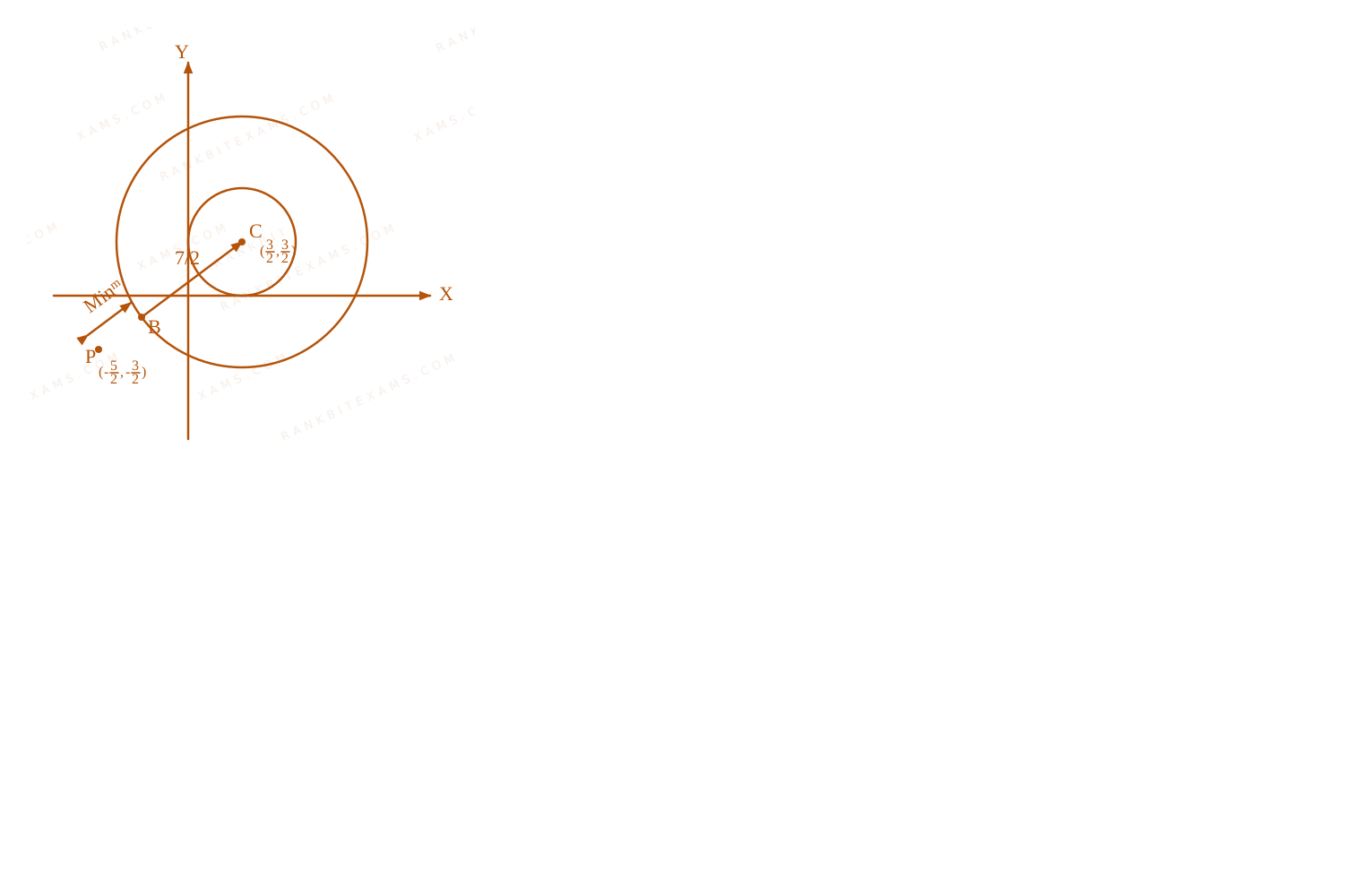
This represents an annular region bounded by two concentric circles centered at C = (3)/(2) + (3)/(2)i$C = \frac{3}{2} + \frac{3}{2}i$ with radii r₁ = (3)/(2)$r_1 = \frac{3}{2}$ and r₂ = (7)/(2)$r_2 = \frac{7}{2}$.
Geometry of Complex Numbers diagram for Q17 - JEE Main 2026 Morning
Step 1: Identify the Target Point
We need to minimize | z - ( -(5)/(2) - (3)/(2)i ) |$\left| z - \left( -\frac{5}{2} - \frac{3}{2}i \right) \right|$.
Let P$P$ be the point -(5)/(2) - (3)/(2)i$-\frac{5}{2} - \frac{3}{2}i$. The expression represents the distance from point P$P$ to a point z$z$ in the set S$S$.
Step 2: Distance from Center to P
Calculate the distance PC$PC$ between the center of the circles C((3)/(2), (3)/(2))$C\left(\frac{3}{2}, \frac{3}{2}\right)$ and the point P(-(5)/(2), -(3)/(2))$P\left(-\frac{5}{2}, -\frac{3}{2}\right)$:
Since 5 > (7)/(2)$5 > \frac{7}{2}$, the point P$P$ lies outside the outer circle.
Step 3: Minimum Distance Calculation
The shortest distance from an external point to an annular region is the distance to the outer boundary along the line connecting the point to the center.
z in S |z - P| = PC - router$$\min_{z \in S} |z - P| = PC - r_{\text{outer}}$$Minimum Distance = 5 - (7)/(2) = (10 - 7)/(2) = (3)/(2)$$\text{Minimum Distance} = 5 - \frac{7}{2} = \frac{10 - 7}{2} = \frac{3}{2}$$
Pattern Recognition
Transforming |az - b|$|az - b|$ by factoring out a$a$ immediately reveals the true geometric center. Shortest distance to any ring/circle from an external point is always collinear with the center: d - Router$d - R_{outer}$.
Chapter Mix
Class 11 Maths: Complex Numbers and Quadratic Equations
More Complex Numbers and Quadratic Equations Questions — jee_main_2024_29_january_evening
Practice past-year questions one chapter at a time. Pick an exam → subject → chapter and get every PYQ for that topic — pulled together from all past papers — with the chapter's key formulas alongside.