Let A = z in C : |z - 2| ≤ 4 and B = z in C : |z - 2| + |z + 2| = 5. Then the max |z₁ - z₂| : z₁ in A and z₂ in B is

Solution & Explanation

Core Logic

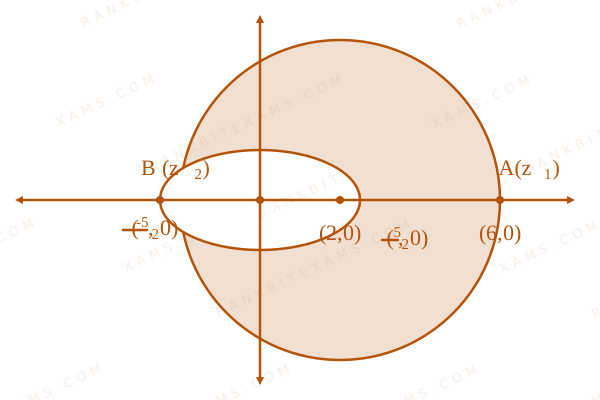
Analyze region A: |z - 2| ≤ 4 represents a solid disk with center (2, 0) and radius R=4. Its rightmost point on the real axis is (6, 0) and leftmost is (-2, 0).

Analyze locus B: |z - 2| + |z + 2| = 5 represents an ellipse with foci at (2, 0) and (-2, 0), and major axis length 2a = 5 ⇒ a = (5)/(2). The equation of the ellipse is (x²)/((5/2)²) + (y²)/(b²) = 1. Its leftmost vertex is at (-(5)/(2), 0).

Complex geometry loci map

Execution

To maximize |z₁ - z₂|, we need the maximum geometric distance between any point in the disk A and any point on the ellipse B. By visualizing the placement on the coordinate plane: The rightmost point of the circle A is z₁ = 6. The leftmost point of the ellipse B is z₂ = -(5)/(2). The distance between them is the maximum horizontal span since both shapes are symmetric around the real axis and their extremes occur on the real axis.

|z₁ - z₂| = 6 - (-(5)/(2)) = 6 + (5)/(2) = (17)/(2)
Pattern Recognition

Maximum distance problems between loci in the complex plane almost always resolve to finding the extreme diametric points along their shared axis of symmetry (usually the real axis).

Chapter Mix

Class 11 Maths: Complex Numbers and Quadratic Equations Class 11 Maths: Conic Sections

Reference Study Guides

More Complex Numbers and Quadratic Equations Previous-Year Questions — Page 9

Q26 jee_main_2024_31_jan_morning Properties of Modulus and Argument
If α denotes the number of solutions of |1 - i|^x = 2^x and β = ((|z|)/( (z))), where z = (π)/(4) (1 + i)⁴ ( 1 - √(π) i√(π) + i + √(π) - i1 + √(π) i), i = √(-1), then the distance of the point (α, β) from the line 4x - 3y = 7 is
Numerical Answer. Answer: 3 to 3

Solution

Core Logic
|1 - i|^x = 2^x (√(2))^x = 2^x 2x/2 = 2^x

This implies (x)/(2) = x x = 0. There is exactly 1 solution, so α = 1.

Step 1: Simplify complex number z
(1+i)⁴ = ((1+i)²)² = (1 + i² + 2i)² = (2i)² = -4

Thus, z = -π ( (1-√(π)i)(√(π)-i)π + 1 + (√(π)-i)(1-√(π)i)1 + π )

Step 2: Simplify Bracket

Let's expand the terms directly: z = (π)/(4)(-4) [ √(π) - π i - i - √(π)π + 1 + √(π) - i - π i - √(π)1 + π ]

= -π [ (-i(π+1))/(π+1) + (-i(π+1))/(π+1) ] = -π [ -i - i ] = 2π i
Step 3: Find beta

For z = 2π i: |z| = 2π and (z) = (π)/(2).

β = (|z|)/( (z)) = (2π)/(π/2) = 4
Step 4: Distance from Line

Distance of point (α, β) = (1, 4) from the line 4x - 3y - 7 = 0:

D = |4(1) - 3(4) - 7|√(4² + (-3)²) = (|4 - 12 - 7|)/(5) = (|-15|)/(5) = 3
Chapter Mix

Class 11 Maths: Complex Numbers and Quadratic Equations Class 11 Maths: Straight Lines

More Complex Numbers and Quadratic Equations Questions — jee_main_2026_28_january_evening

Practice all Complex Numbers and Quadratic Equations previous-year questions →

Rankbit System
JEE Physics: Waves (+15.5%) | Electrostatics: Concentric Shells (-29.7%) | Modern Physics: Photoelectric Clones (+34.2%) | Mathematics: Definite Integrals (+18.1%) | Chemistry: Coordination Splitting (-11.4%) | JEE Physics: Waves (+15.5%) | Electrostatics: Concentric Shells (-29.7%) | Modern Physics: Photoelectric Clones (+34.2%) | Mathematics: Definite Integrals (+18.1%) | Chemistry: Coordination Splitting (-11.4%)