Consider the following statements about manganate and permanganate ions. Identify the correct statements:
(A) The geometry of both manganate and permanganate ions is tetrahedral.
(B) The oxidation states of Mn in manganate and permanganate are +7 and +6, respectively.
(C) Oxidation of Mn(II) salt by peroxodisulphate gives manganate ion as the final product.
(D) Manganate ion is paramagnetic and permanganate ions is diamagnetic.
(E) Acidified permanganate ion reduces oxalate, nitrite and iodide ions.
Choose the correct answer from the options given below:
A.(1)text A, C and D Only$(1)\text{ A, C and D Only}$
B.(2)text A, B and C Only$(2)\text{ A, B and C Only}$
C.(3)text A, D and E Only$(3)\text{ A, D and E Only}$
D.(4)text A and D Only$(4)\text{ A and D Only}$
Solution & Explanation
### Core Logic
(A) Both MnO_4^2-$MnO_{4}^{2-}$ (Manganate) and MnO_4^-$MnO_{4}^{-}$ (Permanganate) have tetrahedral geometry utilizing d^3s$d^3s$ hybridization. (Correct)
(B) The oxidation state of Mn in manganate (MnO_4^2-$MnO_{4}^{2-}$) is +6 and in permanganate (MnO_4^-$MnO_{4}^{-}$) is +7. The statement swaps these. (Incorrect)
(C) Mn^2+ + S_2O_8^2- rightarrow MnO_4^-$Mn^{2+} + S_{2}O_{8}^{2-} \rightarrow MnO_{4}^{-}$ (Permanganate ion), not manganate. (Incorrect)
(D) MnO_4^-$MnO_{4}^{-}$ (Mn in +7, d^0$d^0$) is diamagnetic. MnO_4^2-$MnO_{4}^{2-}$ (Mn in +6, d^1$d^1$) is paramagnetic. (Correct)
(E) Acidified permanganate ion is an oxidizing agent, meaning it OXIDIZES oxalate, nitrite, and iodide ions; it does not reduce them. (Incorrect)
### Step 1: Final Conclusion
Statements A and D are correct.
### Pattern Recognition
Recall MnO_4^-$MnO_4^-$ is purple, diamagnetic, +7 state, powerful oxidizing agent. MnO_4^2-$MnO_4^{2-}$ is green, paramagnetic, +6 state. Oxidizing agent means it reduces itself, thus oxidizes other substrates.
### Evaluation Rubric / Model Answer
null
### Chapter Mix
Class 12 Chemistry: The d- and f-Block Elements
Keywords:#manganate and permanganate ions#JEE Main 2026 Evening Q57#The d- and f-Block Elements JEE Main 2026#Properties Of Permanganate And Manganate Ions JEE Main 2026
More The d- and f-Block Elements Previous-Year Questions
Q63jee_main_2026_21_jan_morningCompounds of Transition Elements
MnO_4^2-$MnO_{4}^{2-}$, in acidic medium, disproportionates to :
A.Mn_2O_7text and MnO_2$Mn_{2}O_{7}\text{ and }MnO_{2}$
B.mathrmMnO_4^-text and MnO$\mathrm{MnO}_4^-\text{ and }MnO$
C.mathrmMnO_4^-text and mathrmMnO_2$\mathrm{MnO}_4^-\text{ and }\mathrm{MnO}_2$
D.mathrmMn_2mathrmO_7text and MnO$\mathrm{Mn}_{2}\mathrm{O}_{7}\text{ and }MnO$
Solution
### Related Formula
3mathrmMnO_4^2- + 4mathrmH^+ rightarrow 2mathrmMnO_4^- + mathrmMnO_2 + 2mathrmH_2mathrmO$$3\mathrm{MnO}_4^{2-} + 4\mathrm{H}^+ \rightarrow 2\mathrm{MnO}_4^- + \mathrm{MnO}_2 + 2\mathrm{H}_2\mathrm{O}$$
### Core Logic
Manganate ion (mathrmMnO_4^2-$\mathrm{MnO}_4^{2-}$), where Mn is in +6 oxidation state, is unstable in acidic medium and undergoes disproportionation.
It oxidizes to Permanganate (mathrmMnO_4^-$\mathrm{MnO}_4^-$, +7 state) and reduces to Manganese dioxide (mathrmMnO_2$\mathrm{MnO}_2$, +4 state).
### Pattern Recognition
Manganate (green, +6) disproportionates in acid to Permanganate (purple, +7) and MnO_2$MnO_2$ (brown/black precipitate, +4).
### Evaluation Rubric / Model Answer
null
### Chapter Mix
Class 12 Chemistry: d and f Block Elements
Q75jee_main_2026_21_jan_morningChromyl Chloride Test and Chromate Chemistry
Consider the following reactions:
NaCl + K_2Cr_2O_7 + H_2SO_4 rightarrow A + KHSO_4 + NaHSO_4 + H_2O$NaCl + K_{2}Cr_{2}O_{7} + H_{2}SO_{4} \rightarrow A + KHSO_{4} + NaHSO_{4} + H_{2}O$A + NaOH rightarrow B + NaCl + H_2O$A + NaOH \rightarrow B + NaCl + H_{2}O$B + H_2SO_4 + H_2O_2 rightarrow C + Na_2SO_4 + H_2O$B + H_{2}SO_{4} + H_{2}O_{2} \rightarrow C + Na_{2}SO_{4} + H_{2}O$
In the product 'C', 'X' is the number of O_2^2-$O_{2}^{2-}$ units, 'Y' is the total number oxygen atoms present and 'Z' is the oxidation state of Cr. The value of X + Y + Z$X + Y + Z$ is ____.
Numerical Answer.Answer: 13 to 13
Solution
### Core Logic
The first reaction is the classical **Chromyl Chloride Test**:
4mathrmNaCl + mathrmK_2Cr_2O_7 + 6mathrmH_2SO_4 rightarrow 2mathrmCrO_2Cl_2 (textA) + 2mathrmKHSO_4 + 4mathrmNaHSO_4 + 3mathrmH_2O$4\mathrm{NaCl} + \mathrm{K_2Cr_2O_7} + 6\mathrm{H_2SO_4} \rightarrow 2\mathrm{CrO_2Cl_2} (\text{A}) + 2\mathrm{KHSO_4} + 4\mathrm{NaHSO_4} + 3\mathrm{H_2O}$
Product A is Chromyl chloride (mathrmCrO_2Cl_2$\mathrm{CrO_2Cl_2}$), a red-orange gas.
When Chromyl chloride gas is passed into NaOH solution, it forms a yellow solution of sodium chromate (B):
mathrmCrO_2Cl_2 (textA) + 4mathrmNaOH rightarrow mathrmNa_2CrO_4 (textB) + 2mathrmNaCl + 2mathrmH_2O$\mathrm{CrO_2Cl_2} (\text{A}) + 4\mathrm{NaOH} \rightarrow \mathrm{Na_2CrO_4} (\text{B}) + 2\mathrm{NaCl} + 2\mathrm{H_2O}$
Acidifying the sodium chromate solution with H_2SO_4$H_2SO_4$ and adding H_2O_2$H_2O_2$ yields a deep blue solution of Chromium(VI) peroxide, CrO_5$CrO_5$ (C):
mathrmNa_2CrO_4 (textB) + mathrmH_2SO_4 + 2mathrmH_2O_2 rightarrow mathrmCrO_5 (textC) + mathrmNa_2SO_4 + 3mathrmH_2O$\mathrm{Na_2CrO_4} (\text{B}) + \mathrm{H_2SO_4} + 2\mathrm{H_2O_2} \rightarrow \mathrm{CrO_5} (\text{C}) + \mathrm{Na_2SO_4} + 3\mathrm{H_2O}$
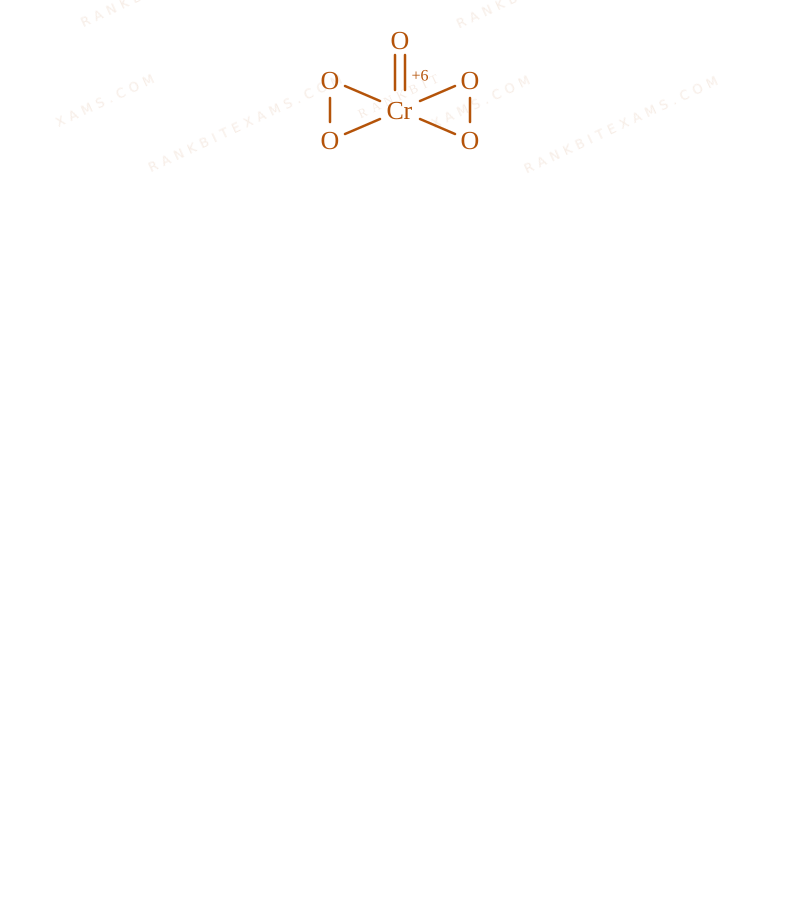
Structure of CrO_5$CrO_5$:
Chromyl Chloride Test diagram for Q75 - JEE Main 2026 Morning
- It has a butterfly structure.
- Number of peroxy units (O_2^2-$O_2^{2-}$), X = 2$X = 2$.
- Total number of oxygen atoms, Y = 5$Y = 5$.
- Oxidation state of Cr, Z = +6$Z = +6$.
Sum: X + Y + Z = 2 + 5 + 6 = 13$X + Y + Z = 2 + 5 + 6 = 13$.
### Step 1: Final Calculation
X + Y + Z = 13$X + Y + Z = 13$
### Pattern Recognition
Chromyl chloride testrightarrow$\rightarrow$CrO_2Cl_2$CrO_2Cl_2$ (red gas). Absorbed in NaOH rightarrow$\rightarrow$Na_2CrO_4$Na_2CrO_4$ (yellow). Tested with H_2O_2/H^+$H_2O_2/H^+$rightarrow$\rightarrow$CrO_5$CrO_5$ (butterfly structure, blue, two peroxy links, Cr in +6).
### Evaluation Rubric / Model Answer
null
### Chapter Mix
Class 12 Chemistry: d and f Block Elements
Class 11 Chemistry: Redox Reactions
Q66jee_main_2026_21_jan_eveningOxides of Manganese and Properties
Given below are some of the statements about textMn$\text{Mn}$ and textMn_2textO_7$\text{Mn}_2\text{O}_7$. Identify the correct statements:
A. Mn forms the oxide textMn_2textO_7$\text{Mn}_2\text{O}_7$ in which Mn is in its highest oxidation state.
B. Oxygen stabilizes the Mn in higher oxidation states by forming multiple bonds with Mn.
C. textMn_2textO_7$\text{Mn}_2\text{O}_7$ is an ionic oxide.
D. The structure of textMn_2textO_7$\text{Mn}_2\text{O}_7$ consists of one bridged oxygen.
Choose the correct answer from the options given below:
A.(1) text A, B, C and D$(1) \text{ A, B, C and D}$
B.(2) text A, B and D Only$(2) \text{ A, B and D Only}$
C.(3) text A, C and D Only$(3) \text{ A, C and D Only}$
D.(4) text A, B and C Only$(4) \text{ A, B and C Only}$
Solution
### Core Logic
- A is correct: textMn_2textO_7$\text{Mn}_2\text{O}_7$ features Mn in +7 state (its highest oxidation state).
- B is correct: Oxygen stabilizes high oxidation states via multiple bonding.
- C is incorrect: textMn_2textO_7$\text{Mn}_2\text{O}_7$ is a covalent green oil/oxide, not ionic.
- D is correct: Structure consists of two textMnO_4$\text{MnO}_4$ tetrahedra sharing one bridging oxygen atom (textO_3textMn-textO-textMnO_3$\text{O}_3\text{Mn}-\text{O}-\text{MnO}_3$).
### Step 1: Final Conclusion
Statements A, B and D are correct, matching option (2).
### Pattern Recognition
Sees: Properties and bonding of transition metal oxides like textMn_2textO_7$\text{Mn}_2\text{O}_7$.
Trap: Assuming high oxidation state oxides of transition metals are ionic.
### Chapter Mix
Class 12 Chemistry: The d- and f-Block Elements
Q58jee_main_2026_22_january_morningReactions of Transition Metals
A first row transition metal (M) does not liberate H_2$H_{2}$ gas from dilute HCl. 1 mol of aqueous solution of MSO_4$MSO_{4}$ is treated with excess of aqueous KCN and then H_2S(g)$H_{2}S(g)$ is passed through the solution. The amount of MS (metal sulphide) formed from the above reaction is ____ mol.
A.text2$\text{2}$
B.text1$\text{1}$
C.text3$\text{3}$
D.text0$\text{0}$
Solution
### Related Formula
Cu^2+ + 4CN^- rightarrow [Cu(CN)_4]^3- quad (textafter redox with CN^-)$$Cu^{2+} + 4CN^{-} \rightarrow [Cu(CN)_{4}]^{3-} \quad (\text{after redox with } CN^-)$$
### Core Logic
The first-row transition metal that does not liberate H_2$H_{2}$ gas from dilute HCl is Copper (Cu), because its standard reduction potential is positive (E^circ_Cu^2+/Cu = +0.34text V$E^{\circ}_{Cu^{2+}/Cu} = +0.34\text{ V}$).
When CuSO_4$CuSO_{4}$ is treated with excess KCN, it forms a very stable soluble cyano complex:
CuSO_4 + 2KCN rightarrow Cu(CN)_2 + K_2SO_4$$CuSO_{4} + 2KCN \rightarrow Cu(CN)_{2} + K_{2}SO_{4}$$2Cu(CN)_2 rightarrow 2CuCN + (CN)_2$2Cu(CN)_{2} \rightarrow 2CuCN + (CN)_{2}$CuCN + 3KCN rightarrow K_3[Cu(CN)_4]$CuCN + 3KCN \rightarrow K_{3}[Cu(CN)_{4}]$
The complex ion [Cu(CN)_4]^3-$[Cu(CN)_{4}]^{3-}$ is highly stable (a perfect complex). When H_2S$H_{2}S$ is passed through this solution, it does not yield sufficient Cu^+$Cu^{+}$ ions to exceed the solubility product (K_sp$K_{sp}$) of Cu_2S$Cu_{2}S$.
### Step 1: Final Conclusion
Since no copper sulphide precipitates, the amount of MS formed is 0 moles.
### Pattern Recognition
Cu and Cd separation: Cu^2+$Cu^{2+}$ forms a very stable cyanide complex that does not precipitate with H_2S$H_2S$, whereas Cd^2+$Cd^{2+}$ forms a less stable complex that does precipitate as CdS$CdS$.
### Evaluation Rubric / Model Answer
null
### Chapter Mix
Class 12 Chemistry: d and f Block Elements
Class 12 Chemistry: Coordination Compounds
Q54jee_main_2026_22_january_eveningIonization Enthalpy Trends in Transition Metals
Given below are two statements:
Statement-I: The first ionization enthalpy of Cr is lower than that of Mn.
Statement-II: The second and third ionization enthalpies of Cr are higher than those of Mn.
In the light of the above statements, choose the correct answer from the options given below:
A. Both Statement-I and Statement-II are false.
B. Statement-I is true but Statement-II is false.
C. Both Statement-I and Statement-II are true.
D. Statement-I is false but Statement-II is true.
Solution
### Related Formula
textElectronic Configurations: textCr = [textAr]3d^5 4s^1, quad textMn = [textAr]3d^5 4s^2$$\text{Electronic Configurations: } \text{Cr} = [\text{Ar}]3d^5 4s^1, \quad \text{Mn} = [\text{Ar}]3d^5 4s^2$$
### Core Logic
Step 1: Compare IE_1$IE_1$:
textCr: 4s^1 implies textRemoval of single 4s text electron requires less energy than removing 4s^2 text in Mn.$$\text{Cr}: 4s^1 \implies \text{Removal of single } 4s \text{ electron requires less energy than removing } 4s^2 \text{ in Mn.}$$
Hence, IE_1(textCr) < IE_1(textMn)$IE_1(\text{Cr}) < IE_1(\text{Mn})$ (Statement-I is TRUE).
Step 2: Compare IE_2$IE_2$ and IE_3$IE_3$:
textCr^+ = 3d^5 implies textstable half-filled configuration d^5, text so IE_2(textCr) > IE_2(textMn)$$\text{Cr}^+ = 3d^5 \implies \text{stable half-filled configuration } d^5, \text{ so } IE_2(\text{Cr}) > IE_2(\text{Mn})$$textFor IE_3, textMn^2+ = 3d^5 implies textremoving electron from stable 3d^5 text in Mn^2+ text requires more energy than Cr^2+ (3d^4).$$\text{For } IE_3, \text{Mn}^{2+} = 3d^5 \implies \text{removing electron from stable } 3d^5 \text{ in Mn}^{2+} \text{ requires more energy than Cr}^{2+} (3d^4).$$
Hence, IE_3(textCr) < IE_3(textMn)$IE_3(\text{Cr}) < IE_3(\text{Mn})$. Thus Statement-II is FALSE.
### Pattern Recognition
Sees: Ionization enthalpy comparison of Cr and Mn.
Shortcut: Stable 3d^5$3d^5$ configuration in textCr^+$\text{Cr}^+$ makes IE_2$IE_2$ very high, whereas 3d^5$3d^5$ in textMn^2+$\text{Mn}^{2+}$ makes IE_3$IE_3$ of Mn higher than Cr.
### Evaluation Rubric / Model Answer
null
### Chapter Mix
Class 12 Chemistry: d- and f-Block Elements
Class 11 Chemistry: Classification of Elements and Periodicity in Properties
More The d- and f-Block Elements Questions — jee_main_2026_28_january_evening
We Map Every Repeating Question in Competitive Exams.
Say goodbye to generic mock test fatigue. RankBit uses smart analysis to group past exam questions into their foundational Repeating Question Types. Find chapter weightage, track repeating questions, and score higher with targeted practice.
Select Your Target Exam
Choose an exam track below to find formulas per chapter and patterns.
Syncing Exam Intelligence
Mapping formulas and patterns across all tracks…
PATH A — FULL LENGTH PRACTICE
Full Mock Test Hub
Simulate real NTA exam conditions with fully tracked mocks. Time yourself against past papers.
Practice past-year questions one chapter at a time. Pick an exam → subject → chapter and get every PYQ for that topic — pulled together from all past papers — with the chapter's key formulas alongside.