Related Formula
Image of point (x₁, y₁) in line ax + by + c = 0 is given by:$$\text{Image of point } (x_1, y_1) \text{ in line } ax + by + c = 0 \text{ is given by:}$$
(x - x₁)/(a) = (y - y₁)/(b) = -2 (ax₁ + by₁ + c)/(a² + b²)$$\frac{x - x_1}{a} = \frac{y - y_1}{b} = -2 \frac{ax_1 + by_1 + c}{a^2 + b^2}$$
Core Logic
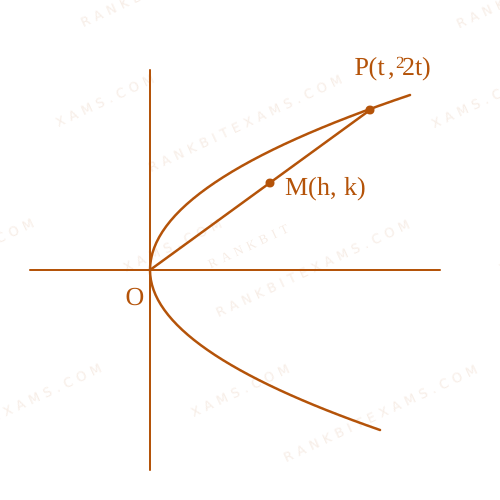
Take a general parametric point P$P$ on the parabola x² = 4y$x^2 = 4y$, which is P(2t, t²)$P(2t, t^2)$.
We find the mirror image Q(h, k)$Q(h, k)$ of P$P$ with respect to the line x - y - 1 = 0$x - y - 1 = 0$.
Step 1: Finding the Image Coordinates
(h - 2t)/(1) = (k - t²)/(-1) = -2 (2t - t² - 1)/(1² + (-1)²)$$\frac{h - 2t}{1} = \frac{k - t^2}{-1} = -2 \frac{2t - t^2 - 1}{1^2 + (-1)^2}$$
(h - 2t)/(1) = (k - t²)/(-1) = -(2t - t² - 1) = t² - 2t + 1$$\frac{h - 2t}{1} = \frac{k - t^2}{-1} = -(2t - t^2 - 1) = t^2 - 2t + 1$$
Solving for h$h$:
h - 2t = t² - 2t + 1 h = t² + 1$$h - 2t = t^2 - 2t + 1 \implies h = t^2 + 1$$
Solving for k$k$:
k - t² = -(t² - 2t + 1) = -t² + 2t - 1 k = 2t - 1$$k - t^2 = -(t^2 - 2t + 1) = -t^2 + 2t - 1 \implies k = 2t - 1$$
Step 2: Eliminating the Parameter
From k = 2t - 1$k = 2t - 1$, we get t = (k + 1)/(2)$t = \frac{k + 1}{2}$.
Substitute t$t$ into h$h$:
h = ((k + 1)/(2))² + 1$$h = \left(\frac{k + 1}{2}\right)^2 + 1$$
h - 1 = ((k + 1)²)/(4)$$h - 1 = \frac{(k + 1)^2}{4}$$
(k + 1)² = 4(h - 1)$$(k + 1)^2 = 4(h - 1)$$
Step 3: Finding Target Values
Replacing (h, k)$(h, k)$ with (x, y)$(x, y)$, the image parabola is:
(y + 1)² = 4(x - 1)$$(y + 1)^2 = 4(x - 1)$$
Comparing this with (y + α)² = b(x - c)$(y + \alpha)^2 = b(x - c)$:
α = 1, b = 4, c = 1$\alpha = 1, b = 4, c = 1$
a + b + c = 1 + 4 + 1 = 6$$a + b + c = 1 + 4 + 1 = 6$$
Pattern Recognition
To find the image of a conic section across a linear axis, it is almost always computationally cleaner to reflect its general parametric point rather than manipulating the implicit Cartesian equation through coordinate transformations.
Chapter Mix
Class 11 Maths: Parabola
Class 11 Maths: Straight Lines