Related Formula
K = (1)/(2)mu²$$K = \frac{1}{2}mu^{2}$$
Kₓ = (1)/(2)m(u θ)² = K ² θ$$K_{x} = \frac{1}{2}m(u \cos \theta)^{2} = K \cos^{2} \theta$$
Core Logic
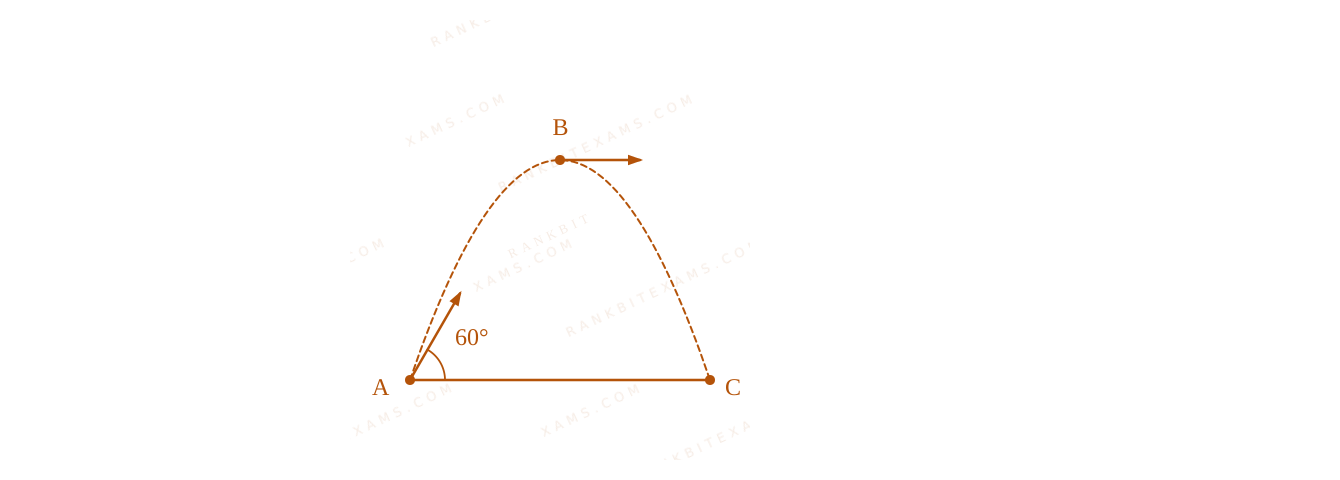
For a projectile with no air resistance, horizontal velocity remains constant. At the highest point (B), the vertical velocity is zero, so the kinetic energy is entirely due to the horizontal velocity. At point C, it hits the ground with the same speed as projected, restoring full kinetic energy.
Step 1: Find KE at distinct points
(KE)A = K = (1)/(2)mu²$$(\text{KE})_{A} = K = \frac{1}{2}mu^{2}$$
At maximum height (B), velocity is vB = u 60° = (u)/(2)$v_{B} = u \cos 60^{\circ} = \frac{u}{2}$.
(KE)B = (1)/(2)m((u)/(2))² = (1)/(4)((1)/(2)mu²) = (K)/(4)$$(\text{KE})_{B} = \frac{1}{2}m\left(\frac{u}{2}\right)^{2} = \frac{1}{4}\left(\frac{1}{2}mu^{2}\right) = \frac{K}{4}$$
At landing point (C), speed is identical to initial speed u$u$.
(KE)C = K$$(\text{KE})_{C} = K$$
Step 2: Calculate Ratio
The required ratio is between the difference in kinetic energies at points C and B, to that at point A:
Ratio = KC - KBKA$$\text{Ratio} = \frac{K_{C} - K_{B}}{K_{A}}$$
Ratio = (K - (K)/(4))/(K) = ((3K)/(4))/(K) = (3)/(4)$$\text{Ratio} = \frac{K - \frac{K}{4}}{K} = \frac{\frac{3K}{4}}{K} = \frac{3}{4}$$
Pattern Recognition
Sees: "KE at highest point" → Substitute K ² θ$K \cos^2 \theta$. For θ = 60°$\theta = 60^{\circ}$, 60° = 1/2$\cos 60^{\circ} = 1/2$, so KB = K/4$K_B = K/4$. The difference with ground is 3K/4$3K/4$.
Chapter Mix
Class 11 Physics: Motion in a Plane