Let S = z : 3 ≤ |2z - 3(1 + i)| ≤ 7 be a set of complex numbers. Then z in S | ( z + (1)/(2)(5 + 3i) ) | is equal to:

Solution & Explanation

Core Logic

Simplify the condition for set S:

3 ≤ |2(z - (3)/(2)(1 + i))| ≤ 7 (3)/(2) ≤ |z - (3)/(2)(1 + i)| ≤ (7)/(2)

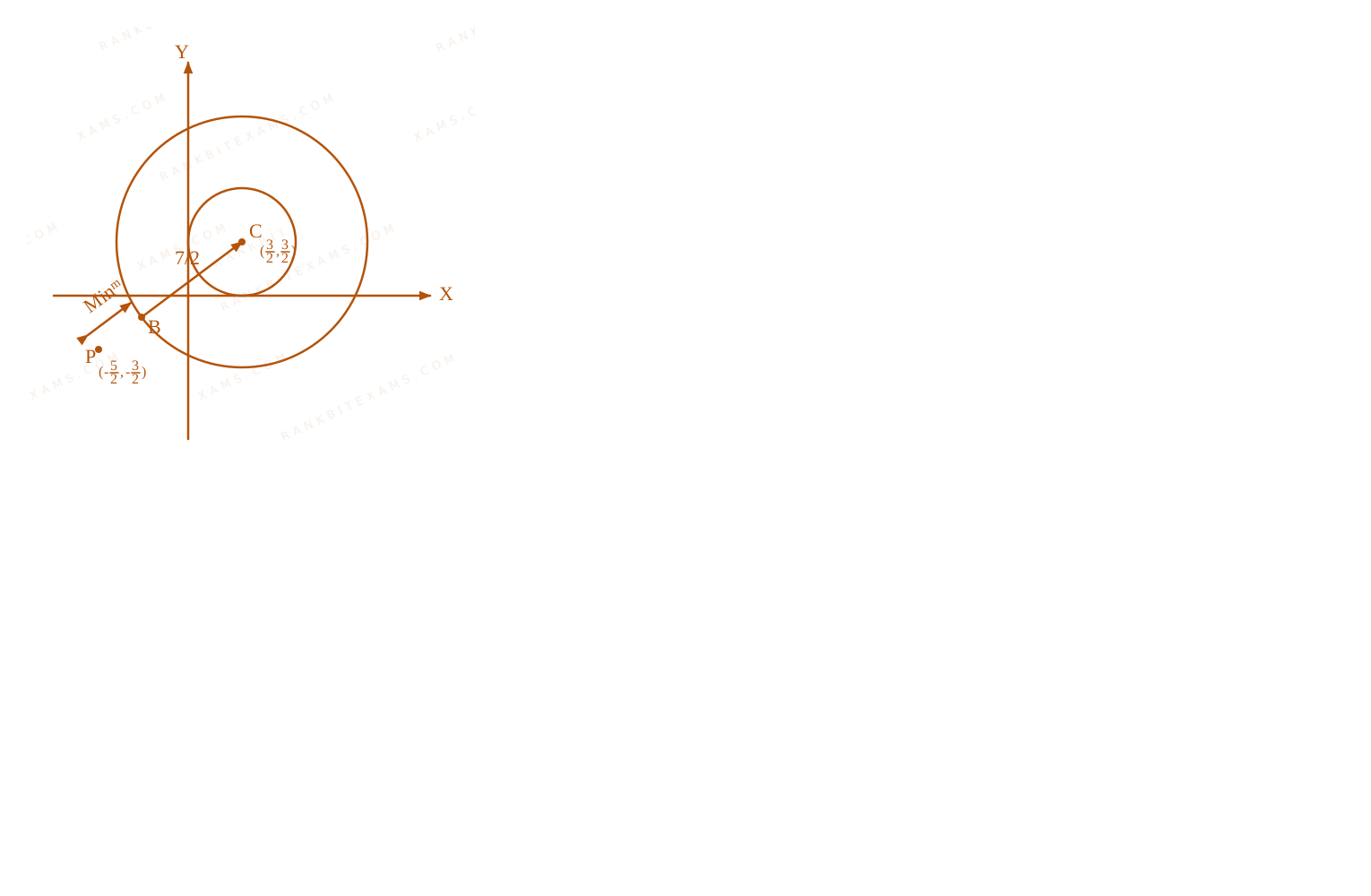
This represents an annular region bounded by two concentric circles centered at C = (3)/(2) + (3)/(2)i with radii r₁ = (3)/(2) and r₂ = (7)/(2).

Geometry of Complex Numbers diagram for Q17 - JEE Main 2026 Morning

Step 1: Identify the Target Point

We need to minimize | z - ( -(5)/(2) - (3)/(2)i ) |. Let P be the point -(5)/(2) - (3)/(2)i. The expression represents the distance from point P to a point z in the set S.

Step 2: Distance from Center to P

Calculate the distance PC between the center of the circles C((3)/(2), (3)/(2)) and the point P(-(5)/(2), -(3)/(2)):

PC = √(( (3)/(2) - (-(5)/(2)) )² + ( (3)/(2) - (-(3)/(2)) )²) PC = √(( (8)/(2) )² + ( (6)/(2) )²) = √(4² + 3²) = √(16 + 9) = √(25) = 5

Since 5 > (7)/(2), the point P lies outside the outer circle.

Step 3: Minimum Distance Calculation

The shortest distance from an external point to an annular region is the distance to the outer boundary along the line connecting the point to the center.

z in S |z - P| = PC - router Minimum Distance = 5 - (7)/(2) = (10 - 7)/(2) = (3)/(2)
Pattern Recognition

Transforming |az - b| by factoring out a immediately reveals the true geometric center. Shortest distance to any ring/circle from an external point is always collinear with the center: d - Router.

Chapter Mix

Class 11 Maths: Complex Numbers and Quadratic Equations

Reference Study Guides

More Complex Numbers and Quadratic Equations Previous-Year Questions — Page 9

Q26 jee_main_2024_31_jan_morning Properties of Modulus and Argument
If α denotes the number of solutions of |1 - i|^x = 2^x and β = ((|z|)/( (z))), where z = (π)/(4) (1 + i)⁴ ( 1 - √(π) i√(π) + i + √(π) - i1 + √(π) i), i = √(-1), then the distance of the point (α, β) from the line 4x - 3y = 7 is
Numerical Answer. Answer: 3 to 3

Solution

Core Logic
|1 - i|^x = 2^x (√(2))^x = 2^x 2x/2 = 2^x

This implies (x)/(2) = x x = 0. There is exactly 1 solution, so α = 1.

Step 1: Simplify complex number z
(1+i)⁴ = ((1+i)²)² = (1 + i² + 2i)² = (2i)² = -4

Thus, z = -π ( (1-√(π)i)(√(π)-i)π + 1 + (√(π)-i)(1-√(π)i)1 + π )

Step 2: Simplify Bracket

Let's expand the terms directly: z = (π)/(4)(-4) [ √(π) - π i - i - √(π)π + 1 + √(π) - i - π i - √(π)1 + π ]

= -π [ (-i(π+1))/(π+1) + (-i(π+1))/(π+1) ] = -π [ -i - i ] = 2π i
Step 3: Find beta

For z = 2π i: |z| = 2π and (z) = (π)/(2).

β = (|z|)/( (z)) = (2π)/(π/2) = 4
Step 4: Distance from Line

Distance of point (α, β) = (1, 4) from the line 4x - 3y - 7 = 0:

D = |4(1) - 3(4) - 7|√(4² + (-3)²) = (|4 - 12 - 7|)/(5) = (|-15|)/(5) = 3
Chapter Mix

Class 11 Maths: Complex Numbers and Quadratic Equations Class 11 Maths: Straight Lines

More Complex Numbers and Quadratic Equations Questions — jee_main_2026_23_january_morning

Practice all Complex Numbers and Quadratic Equations previous-year questions →

Rankbit System
JEE Physics: Waves (+15.5%) | Electrostatics: Concentric Shells (-29.7%) | Modern Physics: Photoelectric Clones (+34.2%) | Mathematics: Definite Integrals (+18.1%) | Chemistry: Coordination Splitting (-11.4%) | JEE Physics: Waves (+15.5%) | Electrostatics: Concentric Shells (-29.7%) | Modern Physics: Photoelectric Clones (+34.2%) | Mathematics: Definite Integrals (+18.1%) | Chemistry: Coordination Splitting (-11.4%)