JEE Main · Chemistry ↑ Rising

p-Block Elements appeared 43 times across 3 years — 5% of Chemistry. This question is from Xenon Compounds.

Year 2026 2025 2024 Total
Questions 16 14 13 43

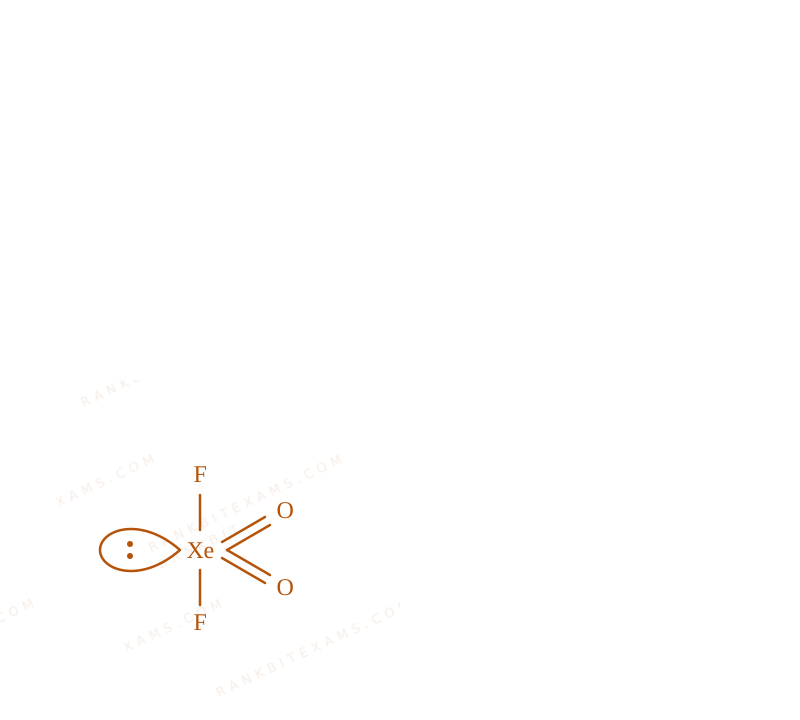
Which statements are NOT TRUE about XeO₂F₂? A. It has a see-saw shape. B. Xe has 5 electron pairs in its valence shell in XeO₂F₂. C. The O–Xe–O bond angle is close to 180°. D. The F–Xe–F bond angle is close to 180°. E. Xe has 16 valence electrons in XeO₂F₂. Choose the correct answer from the options given below.
Xenon Compounds diagram for Q63 - JEE Main 2026 Evening
Relevant molecular shapes of Xenon derivatives to assist in evaluating VSEPR geometries.

Solution & Explanation

Related Formula

Steric Number = Number of σ-bonds + Number of lone pairs on central atom

Core Logic

Evaluate the VSEPR structure of XeO₂F₂: Central atom Xe has 8 valence electrons. It forms 2 double bonds with Oxygen (2 × 2 = 4 electrons used) and 2 single bonds with Fluorine (2 × 1 = 2 electrons used). Total electrons used in bonding = 6. Remaining valence electrons on Xe = 8 - 6 = 2, which forms 1 lone pair. Steric Number = 4 (bond pairs) + 1 (lone pair) = 5 electron pairs. Hybridization is sp³d. Geometry is trigonal bipyramidal. According to Bent's rule, the highly electronegative F atoms occupy axial positions, while the double-bonded O atoms and the lone pair occupy equatorial positions. This results in a "see-saw" shape.

Step 1: Check Statements

A. True. The molecule has a see-saw shape. B. False. Xe is surrounded by 4 σ-bonds, 2 π-bonds, and 1 lone pair. In total, counting individual bonds, Xe has 7 electron pairs in its valence shell (4 σ, 2 π, 1 lp) = 14 valence electrons. C. False. The O atoms occupy equatorial positions, so the O-Xe-O bond angle is close to 120°, not 180°. D. True. The F atoms are axial, so the F-Xe-F bond angle is close to 180°. E. False. The central Xe atom has 14 valence electrons involved (8 from octet, plus sharing from ligands), not 16.

We need to find the INCORRECT statements, which are B, C, and E.

Pattern Recognition

In sp³d hybridization, bulky groups (double bonds, lone pairs) always occupy equatorial positions to minimize 90° repulsions. Highly electronegative groups (F) are forced into axial positions.

Chapter Mix

Class 11 Chemistry: Chemical Bonding and Molecular Structure Class 12 Chemistry: p-Block Elements

Xenon Compounds solution diagram 1 for Q63 - JEE Main 2026 Evening
Relevant molecular shapes of Xenon derivatives to assist in evaluating VSEPR geometries.

Reference Study Guides

More p-Block Elements Previous-Year Questions — Page 9

Q64 jee_main_2024_31_jan_evening Properties of Sulphur and Halogens
Given below are two statements: Statement I: S₈ solid undergoes disproportionation reaction under alkaline conditions to form S²⁻ and S₂O₃²⁻ Statement II: ClO₄^- can undergo disproportionation reaction under acidic condition. In the light of the above statements, choose the most appropriate answer from the options given below:
  • A. Statement I is correct but statement II is incorrect.
  • B. Statement I is incorrect but statement II is correct
  • C. Both statement I and statement II are incorrect.
  • D. Both statement I and statement II are correct.

Solution

Core Logic

Statement I: S₈ disproportionates in alkaline medium to give sulphide (S²⁻) and thiosulphate (S₂O₃²⁻). The reaction is:

S₈ + 12OH^- arrow 4S²⁻ + 2S₂O₃²⁻ + 6H₂O

This is a correct statement.

Statement II: ClO₄^- contains chlorine in its highest possible oxidation state of +7. A species can undergo disproportionation only if the element can exist in both higher and lower oxidation states than the present one. Since chlorine cannot exceed +7, ClO₄^- cannot undergo disproportionation. This is an incorrect statement.

Step 1: Final Conclusion

Statement I is correct, and Statement II is incorrect. Therefore, option (1) is the correct answer.

Chapter Mix

Class 11 Chemistry: Redox Reactions Class 12 Chemistry: The p-Block Elements

Q61 jee_main_2024_31_jan_morning Group 18 Elements
Give below are two statements: Statement-I: Noble gases have very high boiling points. Statement-II: Noble gases are monoatomic gases. They are held together by strong dispersion forces. Because of this they are liquefied at very low temperature. Hence, they have very high boiling points. In the light of the above statements, choose the correct answer from the options given below:
  • A. Statement I is false but Statement II is true.
  • B. Both Statement I and Statement II are true.
  • C. Statement I is true but Statement II is false.
  • D. Both Statement I and Statement II are false.

Solution

Core Logic

Statement I and II are False.

Noble gases have low boiling points. Noble gases are held together by weak dispersion forces.

Pattern Recognition

Noble gases are characterized by extremely weak intermolecular forces (London dispersion forces) because they are monoatomic and non-polar, which directly results in very low boiling and melting points.

Chapter Mix

Class 12 Chemistry: The p-Block Elements

Q79 jee_main_2024_31_jan_morning Group 14 Elements
Consider the oxides of group 14 elements SiO₂, GeO₂, SnO₂, PbO₂, CO and GeO. The amphoteric oxides are
  • A. GeO, GeO₂
  • B. SiO₂, GeO₂
  • C. SnO₂, PbO₂
  • D. SnO₂, CO

Solution

Core Logic

In Group 14 elements, the nature of oxides varies down the group: CO is neutral. CO₂ and SiO₂ are acidic. GeO₂ is distinctly acidic. SnO₂ and PbO₂ are amphoteric.

Pattern Recognition

Tin (Sn) and Lead (Pb) mostly form amphoteric oxides (e.g., SnO, SnO₂, PbO, PbO₂), distinguishing them from the acidic oxides of Carbon and Silicon.

Chapter Mix

Class 11 Chemistry: The p-Block Elements

More p-Block Elements Questions — jee_main_2026_23_january_evening

Practice all p-Block Elements previous-year questions →

Rankbit System
JEE Physics: Waves (+15.5%) | Electrostatics: Concentric Shells (-29.7%) | Modern Physics: Photoelectric Clones (+34.2%) | Mathematics: Definite Integrals (+18.1%) | Chemistry: Coordination Splitting (-11.4%) | JEE Physics: Waves (+15.5%) | Electrostatics: Concentric Shells (-29.7%) | Modern Physics: Photoelectric Clones (+34.2%) | Mathematics: Definite Integrals (+18.1%) | Chemistry: Coordination Splitting (-11.4%)