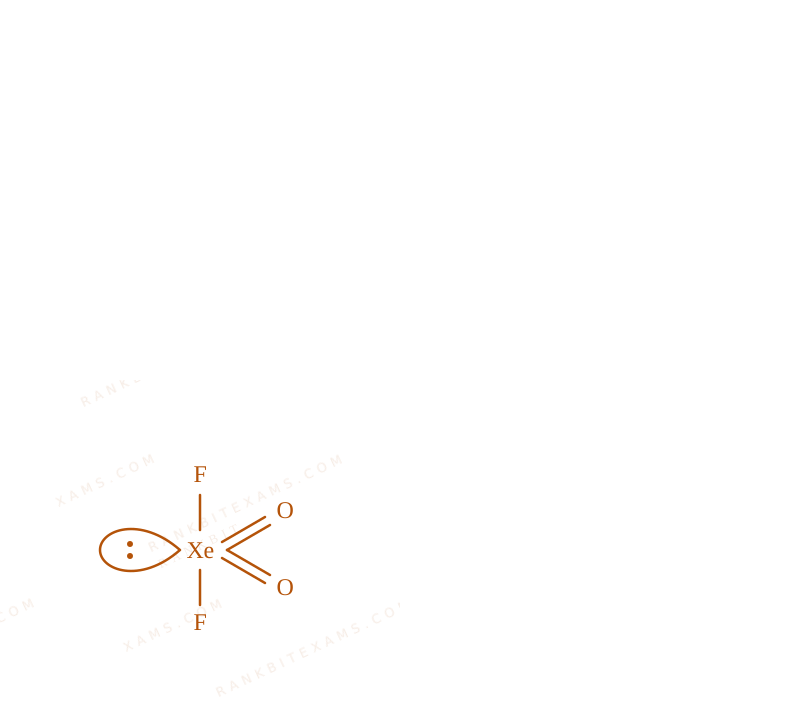
Which statements are NOT TRUE about XeO_2F_2? A. It has a see-saw shape. B. Xe has 5 electron pairs in its valence shell in XeO_2F_2. C. The O–Xe–O bond angle is close to 180^circ. D. The F–Xe–F bond angle is close to 180^circ. E. Xe has 16 valence electrons in XeO_2F_2. Choose the correct answer from the options given below.
Xenon Compounds diagram for Q63 - JEE Main 2026 Evening
Relevant molecular shapes of Xenon derivatives to assist in evaluating VSEPR geometries.

Solution & Explanation

### Related Formula textSteric Number = textNumber of sigmatext-bonds + textNumber of lone pairs on central atom ### Core Logic Evaluate the VSEPR structure of XeO_2F_2: Central atom Xe has 8 valence electrons. It forms 2 double bonds with Oxygen (2 times 2 = 4 electrons used) and 2 single bonds with Fluorine (2 times 1 = 2 electrons used). Total electrons used in bonding = 6. Remaining valence electrons on Xe = 8 - 6 = 2, which forms 1 lone pair. textSteric Number = 4 (textbond pairs) + 1 (textlone pair) = 5 electron pairs. Hybridization is sp^3d. Geometry is trigonal bipyramidal. According to Bent's rule, the highly electronegative F atoms occupy axial positions, while the double-bonded O atoms and the lone pair occupy equatorial positions. This results in a "see-saw" shape. ### Step 1: Check Statements A. True. The molecule has a see-saw shape. B. False. Xe is surrounded by 4 sigma-bonds, 2 pi-bonds, and 1 lone pair. In total, counting individual bonds, Xe has 7 electron pairs in its valence shell (4 sigma, 2 pi, 1 lp) = 14 valence electrons. C. False. The O atoms occupy equatorial positions, so the O-Xe-O bond angle is close to 120^circ, not 180^circ. D. True. The F atoms are axial, so the F-Xe-F bond angle is close to 180^circ. E. False. The central Xe atom has 14 valence electrons involved (8 from octet, plus sharing from ligands), not 16. We need to find the INCORRECT statements, which are B, C, and E. ### Pattern Recognition In sp^3d hybridization, bulky groups (double bonds, lone pairs) always occupy equatorial positions to minimize 90^circ repulsions. Highly electronegative groups (F) are forced into axial positions. ### Evaluation Rubric / Model Answer null ### Chapter Mix Class 11 Chemistry: Chemical Bonding and Molecular Structure Class 12 Chemistry: p-Block Elements
Xenon Compounds solution diagram 1 for Q63 - JEE Main 2026 Evening
Relevant molecular shapes of Xenon derivatives to assist in evaluating VSEPR geometries.

Reference Study Guides

More p-Block Elements Previous-Year Questions

Q51 jee_main_2026_21_jan_morning Reactions of Lead Compounds
Consider the following reactions. PbCl_2 + K_2CrO_4 rightarrow A + 2KCl (Hot solution) A + NaOH rightleftharpoons B + Na_2CrO_4 PbSO_4 + 4CH_3COONH_4 rightarrow (NH_4)_2SO_4 + X In the above reactions, A, B and X are respectively
  • A. mathrmNa_2[mathrmPb(OH)_2] , PbCrO_4text and (mathrmNH_4)_2[mathrmPb(mathrmCH_3mathrmCOO)_4]
  • B. PbCrO_4 , mathrmNa_2[mathrmPb(OH)_4]text and [mathrmPb(mathrmNH_3)_4]mathrmSO_4
  • C. mathrmNa_2[mathrmPb(OH)_2] , PbCrO_4text and [mathrmPb(mathrmNH_3)_4]mathrmSO_4
  • D. PbCrO_4 , mathrmNa_2[mathrmPb(OH)_4]text and (mathrmNH_4)_2[mathrmPb(mathrmCH_3mathrmCOO)_4]

Solution

### Core Logic The precipitation and complex formation reactions of Lead are: mathrmPbCl_2 + mathrmK_2mathrmCrO_4 rightarrow mathrmPbCrO_4 + 2mathrmKCl quad (textHot solution) quad textso, A is mathrmPbCrO_4 mathrmPbCrO_4 + 4mathrmNaOH \ (excess) rightarrow mathrmNa_2[mathrmPb(OH)_4] + mathrmNa_2mathrmCrO_4 quad textso, B is mathrmNa_2[mathrmPb(OH)_4] mathrmPbSO_4 + 4mathrmCH_3mathrmCOONH_4 rightarrow (mathrmNH_4)_2 [mathrmPb(CH_3COO)_4] + (mathrmNH_4)_2mathrmSO_4 quad textso, X is (mathrmNH_4)_2[mathrmPb(CH_3COO)_4] ### Pattern Recognition Lead forms a yellow precipitate of lead chromate (A), which is amphoteric and dissolves in excess NaOH to form soluble plumbate(II) complex (B). It also forms a stable soluble complex with ammonium acetate (X). ### Evaluation Rubric / Model Answer null ### Chapter Mix Class 11 Chemistry: p-Block Elements Class 12 Chemistry: d and f Block Elements

Q55 jee_main_2026_21_jan_morning Group 13 and 14 Compounds
Given below are two statements : Statement I : The number of pairs among [SiO_2, CO_2], [SnO, SnO_2], [PbO, PbO_2] and [GeO, GeO_2], which contain oxides that are both amphoteric is 2. Statement II : BF_3 is an electron deficient molecule can act as a lewis acid, forms adduct with NH_3 and has a trigonal planar geometry. In the light of the above statement, choose the correct answer from the option given below.
  • A. textBoth Statement I and Statement II are true.
  • B. textBoth Statement I and Statement II are false.
  • C. textStatement I is true but Statement II is false.
  • D. textStatement I is false Statement II is true.

Solution

### Core Logic Evaluating Statement I: - SiO_2, CO_2, GeO, GeO_2 are acidic in nature. - SnO, SnO_2, PbO, PbO_2 are amphoteric in nature. Therefore, the pairs [SnO, SnO_2] and [PbO, PbO_2] contain oxides that are both amphoteric. Number of such pairs = 2. Statement I is True. Evaluating Statement II: - BF_3 has 6 electrons in the outermost shell of the central Boron atom. It is electron-deficient and acts as a Lewis acid. - It accepts a lone pair from Lewis bases like NH_3 to form an adduct. - In BF_3, Boron is sp^2 hybridized, resulting in a trigonal planar geometry. Statement II is True. ### Step 1: Conclusion Both statements are factually correct. ### Pattern Recognition Oxides of heavier Group 14 elements (Sn, Pb) are typically amphoteric in both their +2 and +4 oxidation states. BF_3 is the quintessential Lewis acid. ### Evaluation Rubric / Model Answer null ### Chapter Mix Class 11 Chemistry: p-Block Elements Class 11 Chemistry: Chemical Bonding and Molecular Structure
Q70 jee_main_2026_21_jan_evening Chromyl Chloride Test
On heating a mixture of common salt and textK_2textCr_2textO_7 in equal amount along with concentrated textH_2textSO_4 in a test tube, a gas is evolved. Formula of the gas evolved and oxidation state of the central metal atom in the gas respectively are: (1) textCrO_2textCl_2 and +5 (2) textCrO_2textCl_2 and +6 (3) textCr_2textO_2textCl_2 and +6 (4) textCr_2textO_2textCl_2 and +3
  • A. (1) \ textCrO_2textCl_2 text and +5
  • B. (2) \ textCrO_2textCl_2 text and +6
  • C. (3) \ textCr_2textO_2textCl_2 text and +6
  • D. (4) \ textCr_2textO_2textCl_2 text and +3

Solution

### Core Logic This is the classic Chromyl Chloride test: 4textNaCl + textK_2textCr_2textO_7 + 6textH_2textSO_4 longrightarrow 2textKHSO_4 + 2textCrO_2textCl_2 + 4textNaHSO_4 + 3textH_2textO In chromyl chloride (textCrO_2textCl_2), chromium is in the +6 oxidation state. ### Step 1: Final Conclusion The gas is textCrO_2textCl_2 and the oxidation state of Cr is +6, corresponding to option (2). ### Pattern Recognition Sees: qualitative analysis test for chloride ions (chromyl chloride test). Trap: Confusing oxidation state of chromium in dichromate versus chromyl chloride. ### Chapter Mix Class 12 Chemistry: p-Block Elements
Q55 jee_main_2026_22_january_morning Ionization Enthalpy Trends
A 'p'-block element (E) and hydrogen form a binary cation (EH_x)^+, while EH_3 on treatment with K_2HgI_4 in alkaline medium gives a precipitate of basic mercury(II)amido-iodine. Given below are first ionisation enthalpy values (kJtext mol^-1) for first element each from group 13, 14, 15 and 16. Identify the correct first ionisation enthalpy value for element E.
  • A. text1312
  • B. text1086
  • C. text1402
  • D. text801

Solution

### Related Formula NH_3 + K_2HgI_4 + KOH rightarrow HgOcdot Hg(NH_2)I downarrow + KI + H_2O ### Core Logic The reagent K_2HgI_4 in alkaline medium is Nessler's reagent. It gives a brown precipitate (iodide of Millon's base) with ammonia (NH_3). Therefore, the compound EH_3 is NH_3, and the element (E) is Nitrogen (N). The binary cation is the ammonium ion (NH_4^+). We need to find the first ionization enthalpy of Nitrogen among the first elements of groups 13 (B), 14 (C), 15 (N), and 16 (O). Due to its stable half-filled 2p^3 configuration, Nitrogen has a remarkably high first ionization energy, higher than Oxygen. The order is: B < C < O < N. Among the given values (801, 1086, 1312, 1402), 1402 kJtext mol^-1 is the highest and corresponds to Nitrogen. ### Step 1: Final Conclusion Element E is Nitrogen, and its correct first ionization enthalpy is 1402 kJtext mol^-1. ### Pattern Recognition Always remember the ionization energy exception across period 2: N > O and Be > B due to stable half-filled and fully-filled orbitals. ### Evaluation Rubric / Model Answer null ### Chapter Mix Class 11 Chemistry: Classification of Elements and Periodicity in Properties Class 12 Chemistry: p-Block Elements
Q64 jee_main_2026_22_january_morning Hydrides and Bond Properties
Given below are two statements: Statement I: The halogen that makes longest bond with hydrogen in HX, has the smallest covalent radius in its group. Statement II: A group 15 element's hydride EH_3 has the lowest boiling point among corresponding hydrides of other group 15 elements. The maximum covalency of that element E is 4. In the light of the above statements, choose the correct answer from the options given below.
  • A. textBoth Statement I and Statement II are true.
  • B. textStatement I is false but Statement II is true.
  • C. textBoth Statement I and Statement II are false.
  • D. textStatement I is true but Statement II is false.

Solution

### Core Logic Evaluate Statement I: The bond length of HX increases down the group (HF < HCl < HBr < HI) due to the increasing atomic radius of the halogen. Therefore, the halogen making the longest bond is Iodine (I). However, Iodine has the *largest* covalent radius in the group, not the smallest. Thus, Statement I is false. Evaluate Statement II: In group 15 hydrides, the boiling point order is PH_3 < AsH_3 < NH_3 < SbH_3 < BiH_3. The hydride with the lowest boiling point is PH_3 (Phosphine). The maximum covalency of Phosphorus is 6 (as seen in PF_6^-) because it has empty d-orbitals, not 4. Only Nitrogen has a maximum covalency of 4. Since the element is P, statement II is also false. ### Step 1: Final Conclusion Both Statement I and Statement II are false. ### Pattern Recognition Standard p-block trends: Boiling points of hydrides show anomalies due to hydrogen bonding. NH_3, H_2O, and HF jump out of the trend. P, S, Cl hydrides mark the lowest points. ### Evaluation Rubric / Model Answer null ### Chapter Mix Class 12 Chemistry: p-Block Elements

More p-Block Elements Questions — jee_main_2026_23_january_evening

Practice all p-Block Elements previous-year questions →

Rankbit System
JEE Physics: Waves (+15.5%) | Electrostatics: Concentric Shells (-29.7%) | Modern Physics: Photoelectric Clones (+34.2%) | Mathematics: Definite Integrals (+18.1%) | Chemistry: Coordination Splitting (-11.4%) | JEE Physics: Waves (+15.5%) | Electrostatics: Concentric Shells (-29.7%) | Modern Physics: Photoelectric Clones (+34.2%) | Mathematics: Definite Integrals (+18.1%) | Chemistry: Coordination Splitting (-11.4%)