Q26
jee_main_2025_29_jan_evening
Magnetic Properties of Coordination Compounds
The calculated spin-only magnetic moments of K₃[Fe(OH)₆] and K₄[Fe(OH)₆] respectively are:
(1) 4.90 and 4.90 B.M.
(2) 5.92 and 4.90 B.M.
(3) 3.87 and 4.90 B.M.
(4) 4.90 and 5.92 B.M.
Solution
Related Formula
mu = sqrtn(n+2) B.M.Core Logic
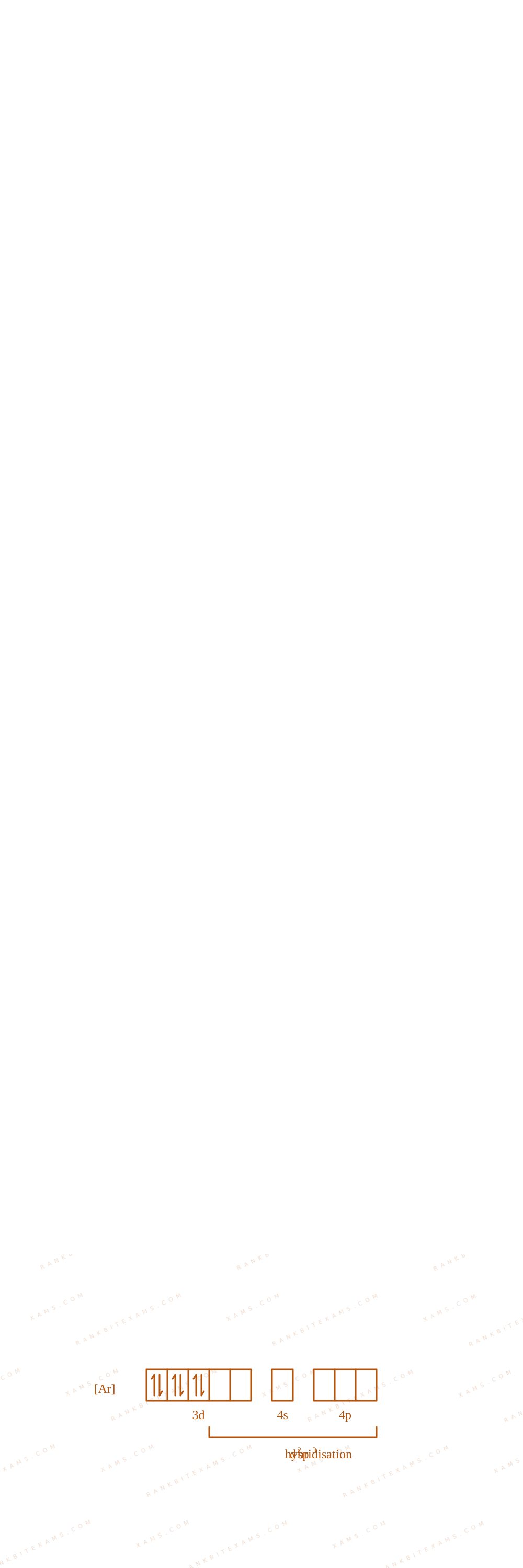
In K₃[Fe(OH)₆], iron is in the +3 oxidation state (Fe³⁺ = 3d⁵). Since OH⁻ is a weak field ligand, no pairing of electrons takes place. The number of unpaired electrons (n) is 5.
mu = sqrt5(5+2) = sqrt35 approx 5.92 B.M.In K₄[Fe(OH)₆], iron is in the +2 oxidation state (Fe²⁺ = 3d⁶). Since OH⁻ is a weak field ligand, no pairing occurs. The number of unpaired electrons (n) is 4.
mu = sqrt4(4+2) = sqrt24 approx 4.90 B.M.Pattern Recognition
Identify the ligand field strength first. OH⁻ is a weak field ligand in the spectrochemical series, so it does not cause pairing in either Fe²⁺ or Fe³⁺ configurations.
Chapter Mix
Class 12 Chemistry: Coordination Compounds