JEE Main · Chemistry ↓ Falling

Coordination Compounds appeared 68 times across 3 years — 7.9% of Chemistry. This question is from Crystal Field Theory and Colors of Complexes.

Year 2026 2025 2024 Total
Questions 19 34 15 68

Consider the following low-spin complexes K₃[Co(NO₂)₆], K₄[Fe(CN)₆], K₃[Fe(CN)₆], Cu₂[Fe(CN)₆] and Zn₂[Fe(CN)₆]. The sum of the spin-only magnetic moment values of complexes having yellow colour is ________ B.M. (answer is nearest integer)

Numerical Answer Type:
Enter a numerical value Answer: 0 to 0 +4 marks

Solution & Explanation

Core Logic

From the given list, the complexes exhibiting a distinct yellow color are K₃[Co(NO₂)₆] and K₄[Fe(CN)₆].

Let's calculate the spin-only magnetic moments for these low-spin configurations:

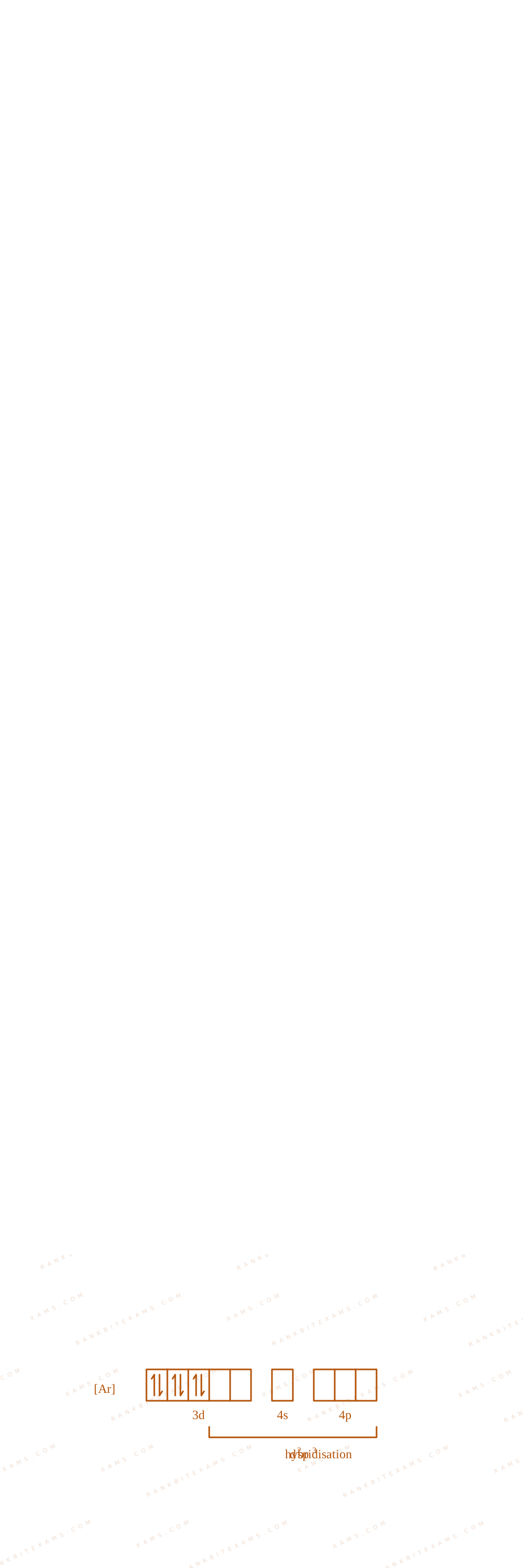
  • For K₃[Co(NO₂)₆], cobalt is in +3 oxidation state (Co³⁺ = 3d⁶).
  • In the presence of the strong ligand field (NO₂^-), all six electrons pair up completely in the t2g orbitals:

t2g⁶ eg⁰ implies n = 0 unpaired electrons implies mu = 0 BM

Crystal Field Theory and Colors of Complexes diagram for Q46 - JEE Main 2025 Evening

  • For K₄[Fe(CN)₆], iron is in +2 oxidation state (Fe²⁺ = 3d⁶).
  • In the strong field of cyanide ligands (CN^-), pairing is complete:

t2g⁶ eg⁰ implies n = 0 unpaired electrons implies mu = 0 BM

Therefore, the sum of their spin-only magnetic moments is 0 + 0 = 0.

Pattern Recognition

Low-spin d⁶ octahedral complexes always yield a fully closed-shell t2g⁶ arrangement with zero unpaired electrons, leading deterministically to a magnetic moment of 0 BM.

Chapter Mix

Class 12 Chemistry: Coordination Compounds

Reference Study Guides

More Coordination Compounds Previous-Year Questions

Q65 jee_main_2026_21_jan_morning Magnetic Properties of Coordination Compounds
Given below are two statements: Statement I: Among [Cu(NH₃)₄]²⁺, [Ni(en)₃]²⁺, [Ni(NH₃)₆]²⁺ and [Mn(H₂O)₆]²⁺, [Mn(H₂O)₆]²⁺ has the maximum number of unpaired electrons. Statement II: The number of pairs among [NiCl₄]²⁻, [Ni(CO)₄], [NiCl₄]²⁻, [Ni(CN)₄]²⁻ and [Ni(CO)₄], [Ni(CN)₄]²⁻ that contain only diamagnetic species is two. In the light of the above statements, choose the correct answer from the options given below:
  • A. Statement I is false but Statement II is true
  • B. Both Statement I and Statement II are true
  • C. Both Statement I and Statement II are false
  • D. Statement I is true but Statement II is false

Solution

Core Logic

Evaluating Statement I:

  • [Cu(NH₃)₄]²⁺: Cu²⁺ is 3d⁹, 1 unpaired electron.
  • [Ni(en)₃]²⁺: Ni²⁺ is 3d⁸, in octahedral field, 2 unpaired electrons.
  • [Ni(NH₃)₆]²⁺: Ni²⁺ is 3d⁸, 2 unpaired electrons.
  • [Mn(H₂O)₆]²⁺: Mn²⁺ is 3d⁵, weak field ligand H₂O leads to high spin, 5 unpaired electrons.
  • So [Mn(H₂O)₆]²⁺ has the maximum number of unpaired electrons. Statement I is true.

    Evaluating Statement II:

  • [Ni(CO)₄]: Ni(0) is 3d⁸ 4s², strong field CO pairs electrons to 3d¹⁰, diamagnetic (0 unpaired).
  • [Ni(CN)₄]²⁻: Ni²⁺ is 3d⁸, strong field CN^- forces pairing arrow dsp² square planar, diamagnetic (0 unpaired).
  • [NiCl₄]²⁻: Ni²⁺ is 3d⁸, weak field Cl^- does not pair arrow sp³ tetrahedral, paramagnetic (2 unpaired).
  • The pairs containing ONLY diamagnetic species:

  • [NiCl₄]²⁻, [Ni(CO)₄] arrow 1 para, 1 dia (No)
  • [NiCl₄]²⁻, [Ni(CN)₄]²⁻ arrow 1 para, 1 dia (No)
  • [Ni(CO)₄], [Ni(CN)₄]²⁻ arrow Both dia (Yes)
  • The number of such pairs is exactly ONE. Statement II says two, so it is false.

Step 1: Final Conclusion

Statement I is true, Statement II is false.

Chapter Mix

Class 12 Chemistry: Coordination Compounds

Q63 jee_main_2026_21_jan_evening Crystal Field Stabilization Energy and Magnetic Moment
Given below are two statements: Statement I: Crystal Field Stabilization Energy (CFSE) of [Cr(H₂O)₆]²⁺ is greater than that of [Mn(H₂O)₆]²⁺. Statement II: Potassium ferricyanide has a greater spin-only magnetic moment than sodium ferrocyanide. In the light of the above statements, choose the correct answer from the options given below:
  • A. (1) Both Statement I and Statement II are true
  • B. (2) Both Statement I and Statement II are false
  • C. (3) Statement I is true but Statement II is false
  • D. (4) Statement I is false but Statement II is true

Solution

Core Logic
  • Statement I: [Mn(H₂O)₆]²⁺ has d⁵ configuration with weak field ligands (CFSE = 0), whereas [Cr(H₂O)₆]²⁺ has d⁴ configuration (CFSE = -0.6Δ₀). Thus CFSE of chromium complex is greater in magnitude.
  • Statement II: Potassium ferricyanide K₃[Fe(CN)₆] has Fe³⁺ (d⁵, 1 unpaired electron, μ = √(3) B.M.), while sodium ferrocyanide Na₄[Fe(CN)₆] has Fe²⁺ (d⁶, 0 unpaired electrons, μ = 0). Thus statement II is true.
Step 1: Final Conclusion

Both statements are true, corresponding to option (1).

Pattern Recognition

Sees: CFSE calculations and magnetic moment comparisons for coordination complexes. Trap: Miscalculating d-electron count or ligand field strength.

Chapter Mix

Class 12 Chemistry: Coordination Compounds

Q74 jee_main_2026_21_jan_evening Magnetic Moment and Unpaired Electrons
Identify the metal ions among Co²⁺, Ni²⁺, Fe²⁺, V³⁺ and Ti²⁺ having a spin-only magnetic moment value more than 3.0 BM. The sum of unpaired electrons present in the high spin octahedral complexes formed by those metal ions is \_\_\_\_.
Numerical Answer. Answer: 7 to 7

Solution

Core Logic

Let's check the d-electron configurations and number of unpaired electrons (n) in high spin octahedral complexes:

  • V³⁺ arrow 3d² (n = 2, μ = √(8) ≈ 2.83 BM)
  • Ti²⁺ arrow 3d² (n = 2, μ = 2.83 BM)
  • Ni²⁺ arrow 3d⁸ (n = 2, μ = 2.83 BM)
  • Fe²⁺ arrow 3d⁶ (n = 4, μ = √(24) ≈ 4.9 BM > 3 BM)
  • Co²⁺ arrow 3d⁷ (n = 3, μ = √(15) ≈ 3.87 BM > 3 BM)
Step 1: Summing Unpaired Electrons

Only Fe²⁺ (n = 4) and Co²⁺ (n = 3) have magnetic moments > 3.0 BM. Sum of unpaired electrons = 4 + 3 = 7.

Pattern Recognition

Sees: high spin octahedral complexes and spin-only magnetic moment threshold checks. Trap: Misidentifying high-spin versus low-spin electron pairing in d⁶ or d⁷ configurations.

Chapter Mix

Class 12 Chemistry: Coordination Compounds

Q51 jee_main_2026_22_january_morning Crystal Field Theory
Consider the transition metal ions Mn³⁺, Cr³⁺, Fe³⁺ and Co³⁺ and all form low spin octahedral complexes. The correct decreasing order of unpaired electrons in their respective d-orbitals of the complexes is
  • A. Cr³⁺ > Fe³⁺ > Co³⁺ > Mn³⁺
  • B. Mn³⁺ > Fe³⁺ > Co³⁺ > Cr³⁺
  • C. Fe³⁺ > Co³⁺ > Mn³⁺ > Cr³⁺
  • D. Cr³⁺ > Mn³⁺ > Fe³⁺ > Co³⁺

Solution

Related Formula

For low spin octahedral complexes, electrons pair up in the t2g orbitals before occupying eg orbitals. Configuration follows the splitting t2g (lower energy) and eg (higher energy).

Core Logic

Analyze the electronic configuration of each ion in a strong field (low spin) environment:

  • Co³⁺ arrow 3d⁶ ⇒ t2g2,2,2 eg0,0
  • Unpaired electrons = 0

  • Fe³⁺ arrow 3d⁵ ⇒ t2g2,2,1 eg0,0
  • Unpaired electrons = 1

  • Cr³⁺ arrow 3d³ ⇒ t2g1,1,1 eg0,0
  • Unpaired electrons = 3

  • Mn³⁺ arrow 3d⁴ ⇒ t2g2,1,1 eg0,0
  • Unpaired electrons = 2

Step 1: Final Conclusion

Arranging in decreasing order of unpaired electrons: Cr³⁺ (3) > Mn³⁺ (2) > Fe³⁺ (1) > Co³⁺ (0)

Pattern Recognition

For low spin d⁴ to d⁷ configurations, pairing occurs early. d³ (Cr³⁺) always has 3 unpaired electrons regardless of field strength, making it the highest among these.

Chapter Mix

Class 12 Chemistry: Coordination Compounds Class 12 Chemistry: d and f Block Elements

Q66 jee_main_2026_22_january_evening Tetrahedral Complexes Properties and CFSE
[Ni(PPh₃)₂Cl₂] is a paramagnetic complex. Identify the INCORRECT statements about this complex. A. The complex exhibits geometrical isomerism. B. The complex is white in colour. C. The calculated spin-only magnetic moment of the complex is 2.84 BM. D. The calculated CFSE (Crystal Field Stabilization Energy) of Ni in this complex is -0.8Δₜ. E. The geometrical arrangement of ligands in this complex is similar to that in Ni(CO)₄. Choose the correct answer from the options given below:
  • A. A and B only
  • B. A, B and D only
  • C. C and D only
  • D. C, D and E only

Solution

Related Formula
For Ni²⁺ (3d⁸) in tetrahedral field: configuration is e⁴ t₂⁴ CFSE = (-0.6 nₑ + 0.4 nt₂) Δₜ = (-0.6 × 4 + 0.4 × 4) Δₜ = -0.8 Δₜ μₛ = √(n(n+2)) = √(2(4)) = √(8) ≈ 2.83 BM
Core Logic

Step 1: Paramagnetic [Ni(PPh₃)₂Cl₂] has tetrahedral geometry (sp³).

Step 2: Evaluate Statements:

  • Statement A: Tetrahedral complexes of type MA₂B₂ do NOT exhibit geometrical isomerism. (Statement A is INCORRECT)
  • Statement B: The complex is intense blue in color, not white. (Statement B is INCORRECT)
  • Statement C: Ni²⁺ (3d⁸) has 2 unpaired electrons μ = 2.83 BM. (Statement C is CORRECT)
  • Statement D: CFSE for e⁴ t₂⁴ configuration is -0.8Δₜ (in PDF noted error comparison vs Δₒ). (Statement D is listed as INCORRECT in key)
  • Statement E: Geometry is tetrahedral, matching Ni(CO)₄. (Statement E is CORRECT)
  • Hence, A, B, and D are incorrect statements.

Pattern Recognition

Sees: Paramagnetic Ni(II) 4-coordinate complex. Shortcut: Paramagnetism confirms tetrahedral geometry no geometrical isomerism possible for tetrahedral structures.

Chapter Mix

Class 12 Chemistry: Coordination Compounds

More Coordination Compounds Questions — jee_main_2025_29_jan_evening

Practice all Coordination Compounds previous-year questions →

Rankbit System
JEE Physics: Waves (+15.5%) | Electrostatics: Concentric Shells (-29.7%) | Modern Physics: Photoelectric Clones (+34.2%) | Mathematics: Definite Integrals (+18.1%) | Chemistry: Coordination Splitting (-11.4%) | JEE Physics: Waves (+15.5%) | Electrostatics: Concentric Shells (-29.7%) | Modern Physics: Photoelectric Clones (+34.2%) | Mathematics: Definite Integrals (+18.1%) | Chemistry: Coordination Splitting (-11.4%)