JEE Main · Mathematics ↓ Falling

Differential Equations appeared 46 times across 3 years — 5.3% of Mathematics. This question is from Variable Separable Form.

Year 2026 2025 2024 Total
Questions 13 17 16 46

If y = y(x) satisfies the differential equation 16 ( x + 9√(x)) (4 + 9 + √(x)) y dy = (1 + 2 y) dx, x > 0 and y(256) = (π)/(2), y(49) = α, then 2 α is equal to:

Solution & Explanation

Related Formula

Variable separable differential equation:

∫ ( y)/(1 + 2 y) dy = ∫ dx16 x + 9√(x) (4 + 9 + √(x))
Core Logic

Let t = 4 + 9 + √(x). Then:

dt = 12 9+√(x) · 12√(x) dx = dx4 x(9+√(x)) = dx4 x + 9√(x)

Substitute into differential equation:

(1)/(2) ln |1 + 2 y| = ∫ (4 dt)/(16 t) = (1)/(4) ln t + C (1)/(2) ln (1 + 2 y) = (1)/(4) ln (4 + 9 + √(x)) + C
Step 1: Determine Constant C

Using initial condition y(256) = (π)/(2):

(1)/(2) ln(3) = (1)/(4) ln(4 + √(9 + 16)) + C = (1)/(4) ln(9) + C = (1)/(2) ln 3 + C C = 0
Step 2: Calculate for x = 49

For x = 49, y = α:

(1)/(2) ln (1 + 2 α) = (1)/(4) ln(4 + √(9 + 7)) = (1)/(4) ln 8 ln(1 + 2 α) = (1)/(2) ln 8 = ln(2√(2)) 1 + 2 α = 2√(2) 2 α = 2√(2) - 1
Pattern Recognition

Identify substitution t = 4 + 9 + √(x) to simplify complex radical integral expression.

Chapter Mix

Class 12 Maths: Differential Equations Class 12 Maths: Indefinite Integration

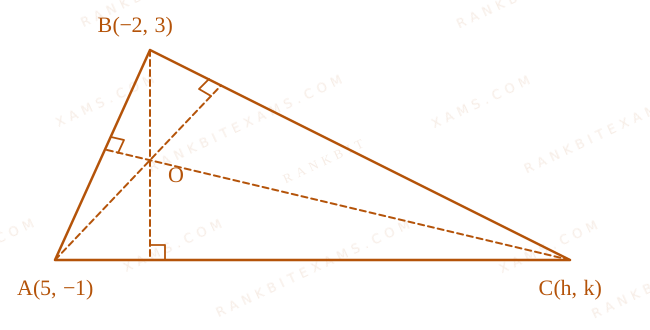
Triangle orthocenter diagram for Q6 - JEE Main 2026 Evening

Reference Study Guides

More Differential Equations Previous-Year Questions — Page 10

Q11 jee_main_2024_31_jan_morning Linear Differential Equations
Let y = y(x) be the solution of the differential equation (dy)/(dx) = (( x) + y)/( x( x - x x)), x in (0, (π)/(2)) satisfying the condition y((π)/(4)) = 2. Then, y((π)/(3)) is
  • A. √(3)(2 + ₑ√(3))
  • B. √(3)2(2 + ₑ 3)
  • C. √(3)(1 + 2 ₑ 3)
  • D. √(3)(2 + ₑ 3)

Solution

Core Logic
(dy)/(dx) = (( x)/( x) + y)/( x ((1)/( x) - ( ² x)/( x))) = ( x + y x)/( x (1 - ² x)) (dy)/(dx) = ( x + y x)/( x ² x) = ² x + (2y)/( 2x) (dy)/(dx) - 2 (2x)y = ² x
Step 1: Integrating Factor

This is an LDE of form (dy)/(dx) + Py = Q.

I.F. = e∫ -2 (2x) dx

Let 2x = t 2dx = dt.

I.F. = e-∫ t dt = e-ln| (t/2)| = e-ln| x| = (1)/(| x|)
Step 2: Solution of LDE
y(I.F.) = ∫ Q(I.F.) dx + C y(1)/( x) = ∫ ² x (1)/( x) dx + C

Let x = t ² x dx = dt.

y(1)/( x) = ∫ (dt)/(t) + C = ln| x| + C y = x(ln| x| + C)
Step 3: Boundary Value

Given y(π/4) = 2:

2 = 1(ln 1 + C) C = 2

Thus, y = x (ln| x| + 2). At x = π/3:

y(π/3) = √(3)(ln√(3) + 2)
Chapter Mix

Class 12 Maths: Differential Equations

More Differential Equations Questions — jee_main_2026_22_january_evening

Practice all Differential Equations previous-year questions →

Rankbit System
JEE Physics: Waves (+15.5%) | Electrostatics: Concentric Shells (-29.7%) | Modern Physics: Photoelectric Clones (+34.2%) | Mathematics: Definite Integrals (+18.1%) | Chemistry: Coordination Splitting (-11.4%) | JEE Physics: Waves (+15.5%) | Electrostatics: Concentric Shells (-29.7%) | Modern Physics: Photoelectric Clones (+34.2%) | Mathematics: Definite Integrals (+18.1%) | Chemistry: Coordination Splitting (-11.4%)