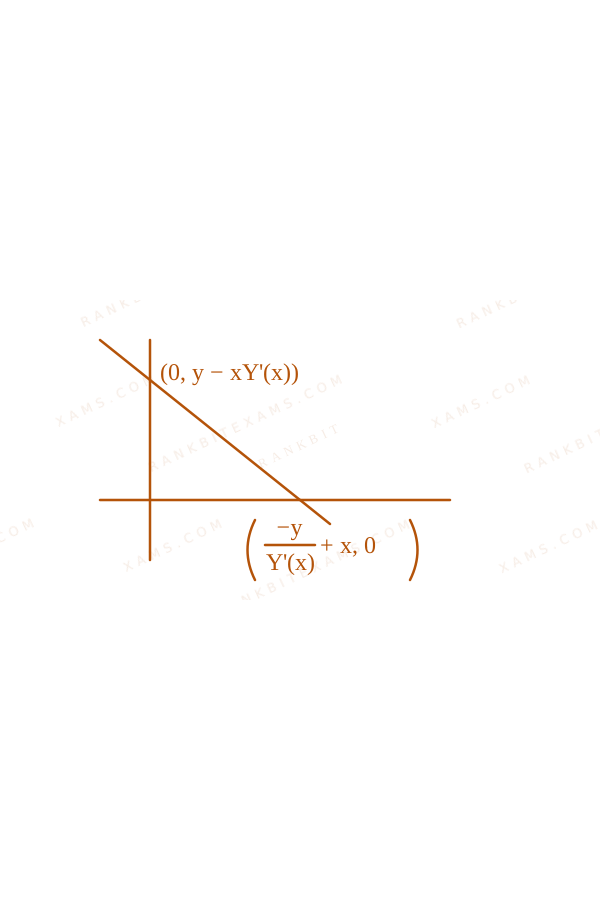
Let Y = Y(X)$Y = Y(X)$ be a curve lying in the first quadrant such that the area enclosed by the line Y - y = Y'(x)(X - x)$Y - y = Y'(x)(X - x)$ and the co-ordinate axes, where (x, y)$(x, y)$ is any point on the curve, is always frac-y^22Y'(x) + 1$\frac{-y^2}{2Y'(x)} + 1$ , Y'(x) neq 0$Y'(x) \neq 0$ . If Y(1) = 1$Y(1) = 1$ , then 12Y(2)$12Y(2)$ equals
Numerical Answer Type:
Enter a numerical valueAnswer: 20 to 20+4 marks
Solution & Explanation
### Related Formula
textEquation of tangent at (x, y): Y - y = fracdydx(X - x)$\text{Equation of tangent at } (x, y): Y - y = \frac{dy}{dx}(X - x)$textArea of Right Triangle: frac12 times textbase times textheight$\text{Area of Right Triangle: } \frac{1}{2} \times \text{base} \times \text{height}$
### Core Logic
The line Y - y = y'(X - x)$Y - y = y'(X - x)$ intersects the axes to form a triangle.
Let's find the intercepts:
X-intercept (set Y=0$Y=0$): -y = y'(X - x) Rightarrow X = x - fracyy'$-y = y'(X - x) \Rightarrow X = x - \frac{y}{y'}$
Y-intercept (set X=0$X=0$): Y - y = y'(-x) Rightarrow Y = y - xy'$Y - y = y'(-x) \Rightarrow Y = y - xy'$
The area of the triangle bounded by the coordinate axes is:
textArea = frac12 left( x - fracyy' right) (y - xy') = frac-y^22y' + 1$\text{Area} = \frac{1}{2} \left( x - \frac{y}{y'} \right) (y - xy') = \frac{-y^2}{2y'} + 1$Linear Differential Equation diagram for Q21 - JEE Main 2024 Evening
### Step 1: Setting up the Differential Equation
Expand the Area equation:
frac12 left[ xy - x^2y' - fracy^2y' + xy right] = frac-y^22y' + 1$\frac{1}{2} \left[ xy - x^2y' - \frac{y^2}{y'} + xy \right] = \frac{-y^2}{2y'} + 1$
Multiply by 2:
2xy - x^2y' - fracy^2y' = -fracy^2y' + 2$2xy - x^2y' - \frac{y^2}{y'} = -\frac{y^2}{y'} + 2$
Cancel -fracy^2y'$-\frac{y^2}{y'}$ from both sides:
2xy - x^2y' = 2$2xy - x^2y' = 2$
### Step 2: Solving the Linear Differential Equation
Rearrange into standard LDE form:
x^2 fracdydx - 2xy = -2$x^2 \frac{dy}{dx} - 2xy = -2$fracdydx - frac2xy = -frac2x^2$\frac{dy}{dx} - \frac{2}{x}y = -\frac{2}{x^2}$
Find the Integrating Factor (IF):
textI.F. = e^int -frac2x dx = e^-2ln x = x^-2 = frac1x^2$\text{I.F.} = e^{\int -\frac{2}{x} dx} = e^{-2\ln x} = x^{-2} = \frac{1}{x^2}$
Multiply the LDE by the IF:
y cdot frac1x^2 = int left( -frac2x^2 right) frac1x^2 dx + C$y \cdot \frac{1}{x^2} = \int \left( -\frac{2}{x^2} \right) \frac{1}{x^2} dx + C$y x^-2 = -2 int x^-4 dx + C$y x^{-2} = -2 \int x^{-4} dx + C$y x^-2 = -2 left( fracx^-3-3 right) + C$y x^{-2} = -2 \left( \frac{x^{-3}}{-3} \right) + C$fracyx^2 = frac23x^3 + C$\frac{y}{x^2} = \frac{2}{3x^3} + C$y = frac23x + Cx^2$y = \frac{2}{3x} + Cx^2$
### Step 3: Applying Initial Conditions
Given Y(1) = 1$Y(1) = 1$ (i.e., when x=1, y=1$x=1, y=1$):
1 = frac23(1) + C(1)^2 Rightarrow 1 = frac23 + C Rightarrow C = frac13$1 = \frac{2}{3(1)} + C(1)^2 \Rightarrow 1 = \frac{2}{3} + C \Rightarrow C = \frac{1}{3}$
Thus, the curve is:
y = frac23x + fracx^23$y = \frac{2}{3x} + \frac{x^2}{3}$
We need to find 12Y(2)$12Y(2)$:
Y(2) = frac23(2) + frac2^23 = frac13 + frac43 = frac53$Y(2) = \frac{2}{3(2)} + \frac{2^2}{3} = \frac{1}{3} + \frac{4}{3} = \frac{5}{3}$12Y(2) = 12 left( frac53 right) = 4 times 5 = 20$12Y(2) = 12 \left( \frac{5}{3} \right) = 4 \times 5 = 20$
### Pattern Recognition
Geometrical word problems forming an Area differential equation almost always reduce to a first-order Linear Differential Equation (LDE) or an Exact differential form once you cleanly substitute the axis intercepts.
### Evaluation Rubric / Model Answer
null
### Chapter Mix
Class 12 Maths: Differential Equations
Class 12 Maths: Application of Derivatives
Let f:[1,infty) to [2,infty)$f:[1,\infty) \to [2,\infty)$ be a differentiable function. If 10int_1^xf(t)mathrmdt = 5xf(x) - x^5 - 9$10\int_{1}^{x}f(t)\mathrm{d}t = 5xf(x) - x^{5} - 9$ for all x geq 1$x \geq 1$, then the value of f(3)$f(3)$ is:
A. 18
B. 32
C. 22
D. 26
Solution
### Related Formula
textLeibniz Rule for Differentiation under Integral Sign: fracddx int_u(x)^v(x) f(t) dt = f(v(x)) v'(x) - f(u(x)) u'(x)$\text{Leibniz Rule for Differentiation under Integral Sign: } \frac{d}{dx} \int_{u(x)}^{v(x)} f(t) dt = f(v(x)) v'(x) - f(u(x)) u'(x)$textStandard Linear Differential Equation: fracdydx + P(x) y = Q(x)$\text{Standard Linear Differential Equation: } \frac{dy}{dx} + P(x) y = Q(x)$
### Core Logic
Differentiating both sides with respect to x$x$ eliminates the definite integral and leads to a first-order linear differential equation.
### Step 1: Differentiate both sides
Apply differentiation with respect to x$x$ using the Leibniz Rule on the left side, and product rule on the right side:
10 f(x) = 5 f(x) + 5x f'(x) - 5x^4$10 f(x) = 5 f(x) + 5x f'(x) - 5x^4$5 f(x) + 5x^4 = 5x f'(x) implies f(x) + x^4 = x f'(x)$5 f(x) + 5x^4 = 5x f'(x) \implies f(x) + x^4 = x f'(x)$
Letting y = f(x)$y = f(x)$, we rewrite it as:
fracdydx - fracyx = x^3$\frac{dy}{dx} - \frac{y}{x} = x^3$
### Step 2: Solve the Linear Differential Equation
The integrating factor (I.F.) is:
textI.F. = e^int -frac1x dx = e^-ln x = frac1x$\text{I.F.} = e^{\int -\frac{1}{x} dx} = e^{-\ln x} = \frac{1}{x}$
Multiply by the I.F. and integrate:
y cdot frac1x = int x^3 cdot frac1x dx = int x^2 dx = fracx^33 + C$y \cdot \frac{1}{x} = \int x^3 \cdot \frac{1}{x} dx = \int x^2 dx = \frac{x^3}{3} + C$
Thus, the general solution is:
f(x) = fracx^43 + C x$f(x) = \frac{x^4}{3} + C x$
### Step 3: Apply Boundary Conditions
Substitute x = 1$x = 1$ into the original integral equation:
10 int_1^1 f(t) dt = 5(1) f(1) - 1^5 - 9$10 \int_{1}^{1} f(t) dt = 5(1) f(1) - 1^5 - 9$0 = 5 f(1) - 10 implies f(1) = 2$0 = 5 f(1) - 10 \implies f(1) = 2$
Now, substitute x = 1$x = 1$ and f(1) = 2$f(1) = 2$ into our general solution to find C$C$:
2 = frac13 + C implies C = frac53$2 = \frac{1}{3} + C \implies C = \frac{5}{3}$
Therefore, the complete function is:
f(x) = fracx^43 + frac5x3$f(x) = \frac{x^4}{3} + \frac{5x}{3}$
### Step 4: Compute f(3)
Evaluate the function at x = 3$x = 3$:
f(3) = frac3^43 + frac5(3)3 = 27 + 5 = 32$f(3) = \frac{3^4}{3} + \frac{5(3)}{3} = 27 + 5 = 32$
### Pattern Recognition
Whenever a definite integral is defined from a constant to the variable x$x$ within an equation, differentiating immediately reduces it to a differential equation. Finding the value of f(a)$f(a)$ at the lower bound is a standard method to get the constant of integration.
### Evaluation Rubric / Model Answer
null
### Chapter Mix
Class 12 Mathematics: Differential Equations
Q71jee_main_2025_02_april_eveningFirst Order Linear Differential Equations
Let y = y(x)$y = y(x)$ be the solution of the differential equation fracdydx + 2ysec^2 x = 2sec^2 x + 3tan x cdot sec^2 x$\frac{dy}{dx} + 2y\sec^2 x = 2\sec^2 x + 3\tan x \cdot \sec^2 x$ such that y(0) = frac54$y(0) = \frac{5}{4}$. Then 12left(yleft(fracpi4right) - e^-2right)$12\left(y\left(\frac{\pi}{4}\right) - e^{-2}\right)$ is equal to ____________.
Numerical Answer.Answer: 21 to 21
Solution
### Related Formula
textLinear Differential equation form: fracdydx + P(x) y = Q(x)$\text{Linear Differential equation form: } \frac{dy}{dx} + P(x) y = Q(x)$textIntegrating Factor: I.F. = e^int P(x) dx$\text{Integrating Factor: } I.F. = e^{\int P(x) dx}$textGeneral solution: y cdot I.F. = int Q(x) cdot I.F. \, dx + C$\text{General solution: } y \cdot I.F. = \int Q(x) \cdot I.F. \, dx + C$
### Core Logic
This is a first-order linear differential equation. We calculate the Integrating Factor first to write down the integral solution.
### Step 1: Find the Integrating Factor (I.F.)
Here, P(x) = 2sec^2 x$P(x) = 2\sec^2 x$ and Q(x) = 2sec^2 x + 3tan x cdot sec^2 x$Q(x) = 2\sec^2 x + 3\tan x \cdot \sec^2 x$:
textI.F. = e^int 2sec^2 x dx = e^2tan x$\text{I.F.} = e^{\int 2\sec^2 x dx} = e^{2\tan x}$
### Step 2: Obtain the General Solution
Multiply both sides by the integrating factor:
y cdot e^2tan x = int e^2tan x left( 2sec^2 x + 3tan x cdot sec^2 x right) dx$y \cdot e^{2\tan x} = \int e^{2\tan x} \left( 2\sec^2 x + 3\tan x \cdot \sec^2 x \right) dx$
Let t = tan x implies dt = sec^2 x dx$t = \tan x \implies dt = \sec^2 x dx$. The integral becomes:
int e^2t (2 + 3t) dt = int 2 e^2t dt + 3 int t e^2t dt$\int e^{2t} (2 + 3t) dt = \int 2 e^{2t} dt + 3 \int t e^{2t} dt$
Applying integration by parts for the second term:
3 int t e^2t dt = 3 left[ fract e^2t2 - int frace^2t2 dt right] = frac3t e^2t2 - frac3e^2t4$3 \int t e^{2t} dt = 3 \left[ \frac{t e^{2t}}{2} - \int \frac{e^{2t}}{2} dt \right] = \frac{3t e^{2t}}{2} - \frac{3e^{2t}}{4}$
Summing all parts:
y cdot e^2tan x = e^2t + frac3t e^2t2 - frac3e^2t4 + C = e^2tan x left[ 1 + frac3tan x2 - frac34 right] + C$y \cdot e^{2\tan x} = e^{2t} + \frac{3t e^{2t}}{2} - \frac{3e^{2t}}{4} + C = e^{2\tan x} \left[ 1 + \frac{3\tan x}{2} - \frac{3}{4} \right] + C$y = frac3tan x2 + frac14 + C e^-2tan x$y = \frac{3\tan x}{2} + \frac{1}{4} + C e^{-2\tan x}$
### Step 3: Apply the boundary conditions
Using the initial boundary condition y(0) = frac54$y(0) = \frac{5}{4}$:
frac54 = frac3(0)2 + frac14 + C e^0 implies C = 1$\frac{5}{4} = \frac{3(0)}{2} + \frac{1}{4} + C e^{0} \implies C = 1$
Thus, the complete function is:
y(x) = frac3tan x2 + frac14 + e^-2tan x$y(x) = \frac{3\tan x}{2} + \frac{1}{4} + e^{-2\tan x}$
### Step 4: Compute the final value
Evaluate the function at x = fracpi4$x = \frac{\pi}{4}$:
yleft(fracpi4right) = frac3(1)2 + frac14 + e^-2 = frac74 + e^-2$y\left(\frac{\pi}{4}\right) = \frac{3(1)}{2} + \frac{1}{4} + e^{-2} = \frac{7}{4} + e^{-2}$
Now, calculate the requested value:
12 left( yleft(fracpi4right) - e^-2 right) = 12 left( frac74 right) = 21$12 \left( y\left(\frac{\pi}{4}\right) - e^{-2} \right) = 12 \left( \frac{7}{4} \right) = 21$
### Pattern Recognition
Integration by parts substitution: When integrating terms of the form int e^at P(t) dt$\int e^{at} P(t) dt$ (where P(t)$P(t)$ is a polynomial), substituting the polynomial variable directly simplifies the exponential integration factors cleanly.
### Evaluation Rubric / Model Answer
null
### Chapter Mix
Class 12 Mathematics: Differential Equations
Q72jee_main_2025_02_april_morningSolving First Order Differential Equations
Let f: mathbbR to mathbbR$f: \mathbb{R} \to \mathbb{R}$ be a thrice differentiable odd function satisfying f'(x) geq 0$f'(x) \geq 0$, f'(x) = f(x)$f'(x) = f(x)$, f(0) = 0$f(0) = 0$, f'(0) = 3$f'(0) = 3$. Then 9f(log_e 3)$9f(\log_e 3)$ is equal to ________.
Numerical Answer.Answer: 36 to 36
Solution
### Related Formula
Standard variable separable integration form:
int frac1sqrty^2 + a^2 \, mathrmdy = lnleft|y + sqrty^2 + a^2right| + C$\int \frac{1}{\sqrt{y^2 + a^2}} \, \mathrm{d}y = \ln\left|y + \sqrt{y^2 + a^2}\right| + C$
### Core Logic
The original paper solution states the structure equation setup as f''(x) = f(x)$f''(x) = f(x)$. Multiply by f'(x)$f'(x)$ on both sides to transform it into a integrable derivative form.
### Step 1: Integrate the derivative identity
f'(x) cdot f''(x) = f'(x) cdot f(x)$f'(x) \cdot f''(x) = f'(x) \cdot f(x)$
Integrate both sides with respect to x$x$:
frac(f'(x))^22 = frac(f(x))^22 + C implies (f'(x))^2 = (f(x))^2 + C'$\frac{(f'(x))^2}{2} = \frac{(f(x))^2}{2} + C \implies (f'(x))^2 = (f(x))^2 + C'$
### Step 2: Find the constant of integration
Use initial conditions f(0) = 0$f(0) = 0$ and f'(0) = 3$f'(0) = 3$:
3^2 = 0^2 + C' implies C' = 9$3^2 = 0^2 + C' \implies C' = 9$
Thus, (f'(x))^2 = (f(x))^2 + 9$(f'(x))^2 = (f(x))^2 + 9$. Given f'(x) ge 0$f'(x) \ge 0$:
f'(x) = sqrt(f(x))^2 + 9$f'(x) = \sqrt{(f(x))^2 + 9}$
### Step 3: Variable Separation and Solution Form
Let y = f(x) implies fracmathrmdymathrmdx = sqrty^2 + 9$y = f(x) \implies \frac{\mathrm{d}y}{\mathrm{d}x} = \sqrt{y^2 + 9}$:
int fracmathrmdysqrty^2 + 9 = int mathrmdx implies lnleft|y + sqrty^2 + 9right| = x + C_2$\int \frac{\mathrm{d}y}{\sqrt{y^2 + 9}} = \int \mathrm{d}x \implies \ln\left|y + \sqrt{y^2 + 9}\right| = x + C_2$
Substitute initial condition x=0, y=0$x=0, y=0$:
ln|0 + sqrt9| = 0 + C_2 implies C_2 = ln 3$\ln|0 + \sqrt{9}| = 0 + C_2 \implies C_2 = \ln 3$
Therefore, lnleft|y + sqrty^2 + 9right| = x + ln 3 implies y + sqrty^2 + 9 = 3e^x$\ln\left|y + \sqrt{y^2 + 9}\right| = x + \ln 3 \implies y + \sqrt{y^2 + 9} = 3e^x$.
### Step 4: Compute targeted value
We need to evaluate at x = ln 3$x = \ln 3$:
y + sqrty^2 + 9 = 3e^ln 3 = 3(3) = 9$y + \sqrt{y^2 + 9} = 3e^{\ln 3} = 3(3) = 9$sqrty^2 + 9 = 9 - y$\sqrt{y^2 + 9} = 9 - y$
Square both sides:
y^2 + 9 = 81 - 18y + y^2 implies 18y = 72 implies y = 4$y^2 + 9 = 81 - 18y + y^2 \implies 18y = 72 \implies y = 4$
Thus, f(ln 3) = 4$f(\ln 3) = 4$. Multiply by 9$9$:
9 f(ln 3) = 9(4) = 36$9 f(\ln 3) = 9(4) = 36$
### Pattern Recognition
Multiplying a second derivative by the first derivative (f'f''$f'f''$) is a classic trick to convert a second-order linear differential equation into a first-order separable layout, opening a clear path to the solution.
### Evaluation Rubric / Model Answer
null
### Chapter Mix
Class 12 Mathematics: Differential Equations
Class 12 Mathematics: Differential Calculus
Let y = y(x)$y = y(x)$ be the solution curve of the differential equation mathrmx(x^2 + e^x)dy + (e^x(x - 2)y - x^3)dx = 0, x > 0,$\mathrm{x(x^2 + e^x)dy + (e^x(x - 2)y - x^3)dx = 0, x > 0,}$ passing through the point (1,0)$(1,0)$ . Then y(2)$y(2)$ is equal to:
We Map Every Repeating Question in Competitive Exams.
Say goodbye to generic mock test fatigue. RankBit uses smart analysis to group past exam questions into their foundational Repeating Question Types. Find chapter weightage, track repeating questions, and score higher with targeted practice.
Select Your Target Exam
Choose an exam track below to find formulas per chapter and patterns.
Syncing Exam Intelligence
Mapping formulas and patterns across all tracks…
PATH A — FULL LENGTH PRACTICE
Full Mock Test Hub
Simulate real NTA exam conditions with fully tracked mocks. Time yourself against past papers.
Under Development
PATH B — TARGETED PRACTICE
Topic-wise Practice Hub
Practice past-year questions one chapter at a time. Pick an exam → subject → chapter and get every PYQ for that topic — pulled together from all past papers — with the chapter's key formulas alongside.
