JEE Main · Physics → Steady

Waves appeared 22 times across 3 years — 2.5% of Physics. This question is from Wave on a String.

Year 2026 2025 2024 Total
Questions 7 10 5 22

Two strings (A, B) having linear densities μA = 2 × 10⁻⁴ kg/m and μB = 4 × 10⁻⁴ kg/m and lengths LA = 2.5 m and LB = 1.5 m respectively are joined. Free ends of A and B are tied to two rigid supports C and D, respectively creating a tension of 500 N in the wire. Two identical pulses, sent from C and D ends, take time t₁ and t₂ , respectively, to reach the joint. The ratio t₁/t₂ is :

Solution & Explanation

Related Formula
v = √((T)/(μ)) t = (L)/(v)
Core Logic

Given LA = 2.5 m, LB = 1.5 m, T = 500 N. Velocity in string A:

vA = √((T)/(μA)) = 5002 × 10⁻⁴ = √(2500000) = 5 √(10) × 10² m/s

Velocity in string B:

vB = √((T)/(μB)) = 5004 × 10⁻⁴ = √(1250000) = 5 √(5) × 10² m/s
Step 1: Calculate Ratio of Times

Time taken to reach joint:

t₁ = LAvA = 2.55 √(10) × 10² t₂ = LBvB = 1.55 √(5) × 10²

Ratio:

t₁t₂ = 2.55√(10) × 5√(5)1.5 = (2.5)/(1.5) × √(5)√(10) = (5)/(3) × 1√(2) t₁t₂ = (1.666)/(1.414) ≈ 1.18
Pattern Recognition

Time ratio is proportional to L√(T/μ) = L √(μ/T). Thus t₁/t₂ = (L₁/L₂) √(μ₁/μ₂) directly.

Chapter Mix

Class 11 Physics: Waves

Reference Study Guides

More Waves Previous-Year Questions — Page 5

Q37 jee_main_2024_31_jan_evening Speed of Sound in Gases
The speed of sound in oxygen at S.T.P. will be approximately: (Given, R = 8.3 J K⁻¹ , γ = 1.4)
  • A. 310 m/s
  • B. 333 m/s
  • C. 341 m/s
  • D. 325 m/s

Solution

Related Formula
v = √((γ RT)/(M))
Core Logic

For Oxygen (O₂) at standard temperature and pressure (S.T.P.): T = 273 K M = 32 g/mol = 32 × 10⁻³ kg/mol γ = 1.4 R = 8.3 J K⁻¹ mol⁻¹

Step 1: Calculate Velocity
v = 1.4 × 8.3 × 27332 × 10⁻³ v = 3172.2632 × 10⁻³ v = √(99.133 × 10³) v = √(99133) ≈ 314.85 m/s

Approximating to the closest given option yields 310 m/s.

Pattern Recognition

For diatomic gases around room temp or STP, velocities range roughly from 250 to 350 m/s depending on molar mass (N₂ ≈ 334, O₂ ≈ 315). Recognize 315 is closest to option (1) due to standard approximations taken in exams.

Chapter Mix

Class 11 Physics: Waves Class 11 Physics: Kinetic Theory of Gases
Q jee_main_2024_31_jan_morning Organ Pipes
The fundamental frequency of a closed organ pipe is equal to the first overtone frequency of an open organ pipe. If length of the open pipe is 60~cm, the length of the closed pipe will be:
  • A. 60~cm
  • B. 45~cm
  • C. 30~cm
  • D. 15~cm

Solution

Related Formula
fclosed, fundamental = (v)/(4Lc) fopen, 1st overtone = (2v)/(2Lₒ)
Core Logic

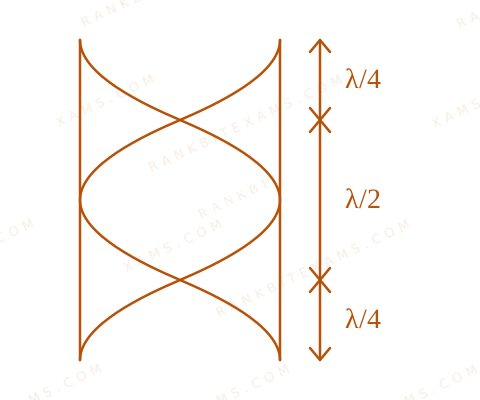
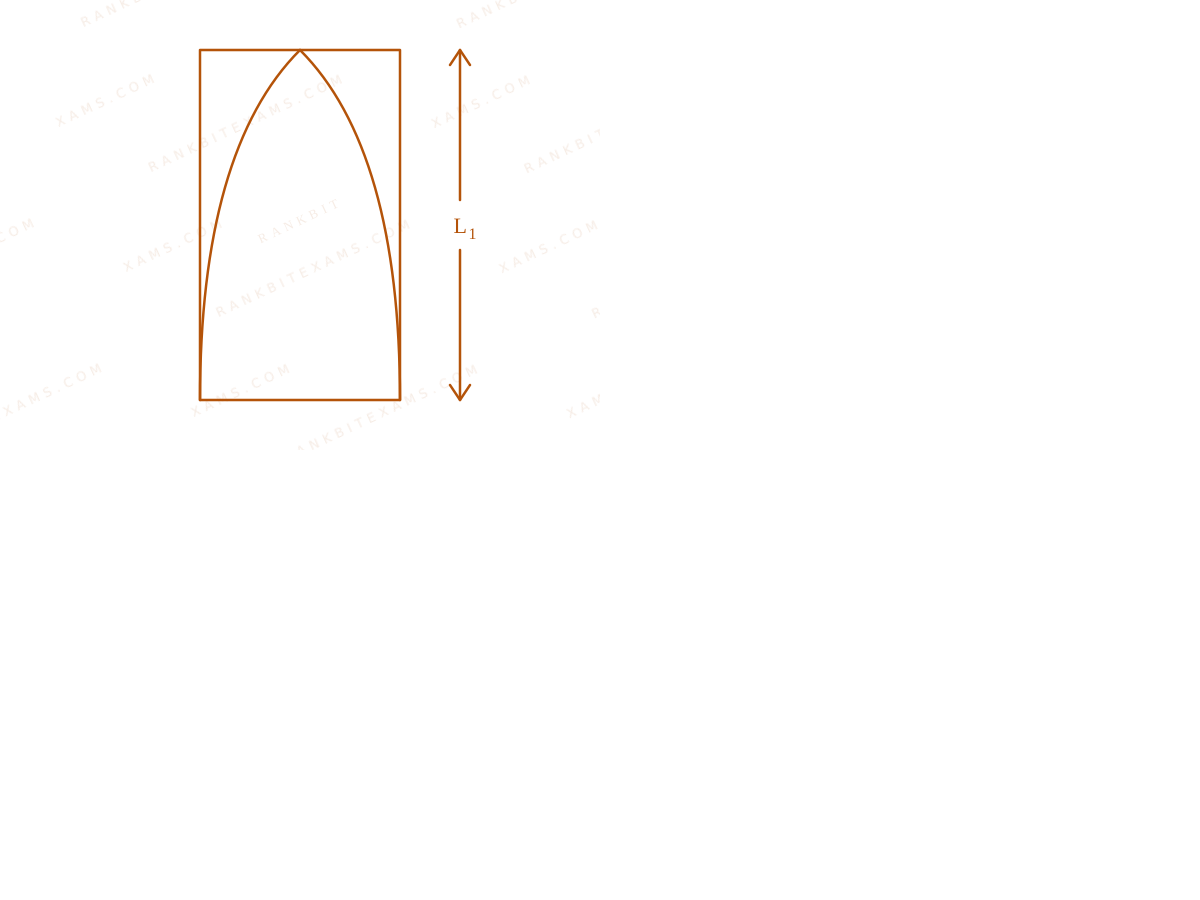
Organ Pipes diagram for Q45 - JEE Main 2024 Morning

Organ Pipes diagram for Q45 - JEE Main 2024 Morning

For a closed organ pipe, the fundamental frequency (1st harmonic) is:

f₁ = (v)/(λ) = (v)/(4L₁)

where L₁ is the length of the closed pipe.

For an open organ pipe, the first overtone (2nd harmonic) is:

f₂ = (2v)/(2L₂) = (v)/(L₂)

where L₂ is the length of the open pipe (L₂ = 60 cm).

Step 2: Equating Frequencies

Given f₁ = f₂:

(v)/(4L₁) = (v)/(L₂)

L₂ = 4L₁

60 = 4 × L₁ L₁ = 15 cm
Chapter Mix

Class 11 Physics: Waves

More Waves Questions — jee_main_2026_21_jan_morning

Practice all Waves previous-year questions →

Rankbit System
JEE Physics: Waves (+15.5%) | Electrostatics: Concentric Shells (-29.7%) | Modern Physics: Photoelectric Clones (+34.2%) | Mathematics: Definite Integrals (+18.1%) | Chemistry: Coordination Splitting (-11.4%) | JEE Physics: Waves (+15.5%) | Electrostatics: Concentric Shells (-29.7%) | Modern Physics: Photoelectric Clones (+34.2%) | Mathematics: Definite Integrals (+18.1%) | Chemistry: Coordination Splitting (-11.4%)