In a microscope the objective is having focal length f_0 = 2text cm and eye-piece is having focal length f_e = 4text cm. The tube length is 32 cm. The magnification produced by this microscope for normal adjustment is ____.

Numerical Answer Type:
Enter a numerical value Answer: 100 to 100 +4 marks

Solution & Explanation

### Related Formula m approx fracLf_0 times fracDf_e ### Core Logic For a compound microscope in normal adjustment (image formed at infinity), the magnifying power is given by the standard approximation: m simeq fracl Df_0 f_e where l is the tube length, D = 25text cm is the least distance of distinct vision. ### Step 1: Substitute Values Given values: l = 32text cm f_0 = 2text cm f_e = 4text cm D = 25text cm (standard assumption when not given) m = frac322 times frac254 m = 16 times frac254 = 4 times 25 = 100
Microscope solution diagram for Q50 - JEE Main 2026 Morning
### Pattern Recognition Compound microscope formulas: Normal adjustment to image at infty, m = (L/f_0)(D/f_e). Image at near point D, m = (L/f_0)(1 + D/f_e). Default to standard approximation when given tube length. ### Evaluation Rubric / Model Answer null ### Chapter Mix Class 12 Physics: Ray Optics and Optical Instruments

Reference Study Guides

More Ray Optics and Optical Instruments Previous-Year Questions — Page 7

Q15 jee_main_2025_24_jan_morning Lens Maker's Formula
A plano-convex lens having radius of curvature of first surface 2 cm exhibits focal length of f_1 in air. Another plano-convex lens with first surface radius of curvature 3 cm has focal length of f_2 when it is immersed in a liquid of refractive index 1.2. If both the lenses are made of same glass of refractive index 1.5, the ratio of f_1 and f_2 will be :-
  • A. 3:5
  • B. 1:3
  • C. 1:2
  • D. 2:3

Solution

### Related Formula Lens Maker's Formula for a lens in a surrounding medium of refractive index mu_m is: frac1f = left(fracmu_textlensmu_m - 1 ight)left(frac1R_1 - frac1R_2 ight) ### Core Logic For a plano-convex configuration, the flat side has an infinite radius of curvature (R_2 = infty implies frac1R_2 = 0). ### Step 1: Evaluating Respective Focal Scales For the first lens setup in air (mu_m = 1) : frac1f_1 = (1.5 - 1)left(frac12 - 0 ight) = 0.5 times frac12 = frac14 implies f_1 = 4text cm For the second lens setup immersed inside fluid (mu_m = 1.2) : frac1f_2 = left(frac1.51.2 - 1 ight)left(frac13 - 0 ight) = (1.25 - 1)frac13 = frac0.253 = frac112 implies f_2 = 12text cm Taking their direct ratio : f_1 : f_2 = 4 : 12 = 1 : 3 ### Pattern Recognition Always separate the refractive index multiplier from the geometric shape factor. This lets you calculate each change independently before taking the final ratio. ### Evaluation Rubric / Model Answer null ### Chapter Mix Class 12 Physics: Ray Optics and Optical Instruments
Q6 jee_main_2025_28_jan_evening Refraction at Spherical Surfaces
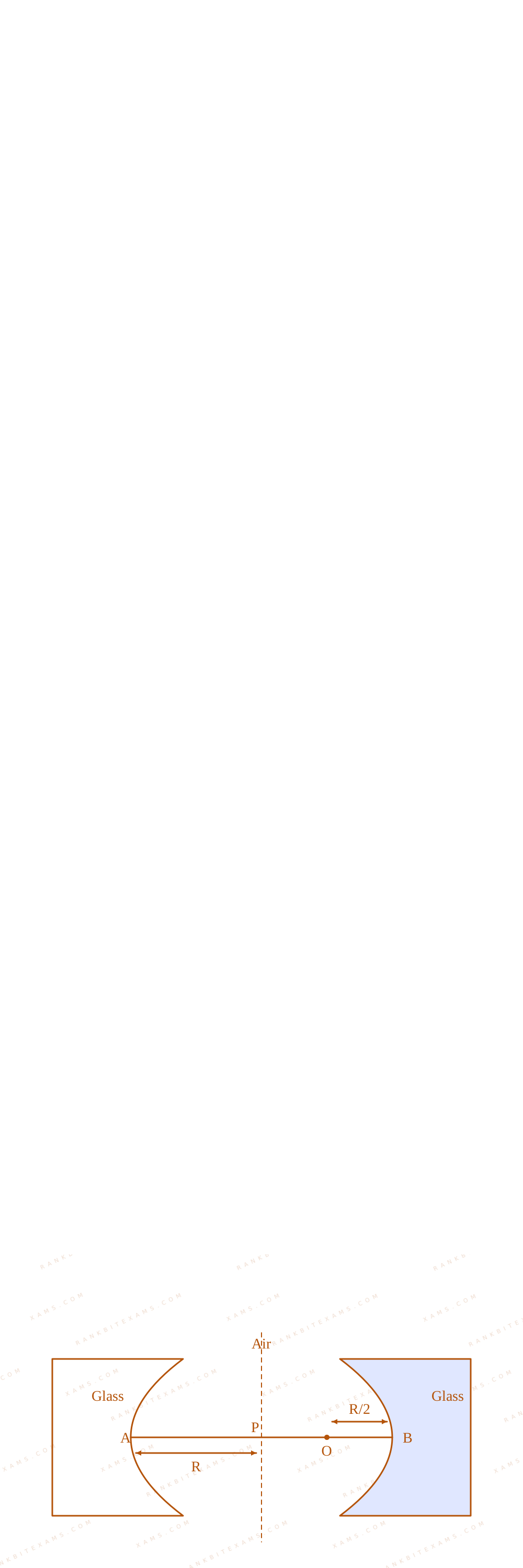
In a long glass tube, mixture of two liquids A and B with refractive indices 1.3 and 1.4 respectively, forms a convex refractive meniscus towards A. If an object placed at 13mathrmcm from the vertex of the meniscus in A forms an image with a magnification of -2 then the radius of curvature of meniscus is :
  • A. 1 \, textcm
  • B. frac13mathrmcm
  • C. frac23 mathrm~cm
  • D. frac43 mathrm~cm

Solution

### Related Formula For refraction at a single spherical surface separating two mediums : fracn_2v - fracn_1u = fracn_2 - n_1R Linear magnification for a spherical refracting boundary is given by: m = fracv / n_2u / n_1 = fracv cdot n_1u cdot n_2$ ### Core Logic Given parameters from the text [cite: 17, 651, 654]: * Refractive index of Medium A, $n_1 = 1.3$ * Refractive index of Medium B, $n_2 = 1.4$ * Object distance, $u = -13 text cm$ * Magnification, $m = -2$ Using the magnification formula to locate image position $v$ : -2 = \frac{v \cdot 1.3}{(-13) \cdot 1.4} -2 = \frac{1.3 \cdot v}{-18.2} \implies 1.3 v = 36.4 \implies v = 28 \text{ cm} Now substitute $u = -13$, $v = 28$, $n_1 = 1.3$, $n_2 = 1.4$ into the boundary equation: \frac{1.4}{28} - \frac{1.3}{-13} = \frac{1.4 - 1.3}{R} \frac{1}{20} + \frac{1}{10} = \frac{0.1}{R} \frac{1 + 2}{20} = \frac{0.1}{R} \implies \frac{3}{20} = \frac{1}{10R} 30 R = 20 \implies R = \frac{2}{3} \text{ cm}$ ### Step 1: Visual Context The visual system configuration of the refracting interface is tracked here:
Refraction at Spherical Surfaces diagram for Q6 - JEE Main 2025 Evening
### Pattern Recognition Keep precise track of sign conventions for single spherical surfaces. A convex meniscus towards A means the center of curvature lies inside medium B, meaning
R$ will mathematically return as a positive parameter. ### Evaluation Rubric / Model Answer null ### Chapter Mix Class 12 Physics: Ray Optics

Q13 jee_main_2025_28_jan_evening Reflection by Spherical Mirrors
A concave mirror produces an image of an object such that the distance between the object and image is 20 \, textcm. If the magnification of the image is -3' , then the magnitude of the radius of curvature of the mirror is:
  • A. 3.75mathrmcm
  • B. 30mathrmcm
  • C. 7.5mathrmcm
  • D. 15mathrmcm

Solution

### Related Formula Magnification m of a mirror is given by: m = -fracvu The mirror equation relates focal length to distance positions: frac1f = frac1v + frac1u implies f = fracuvu+v Radius of curvature R = 2f. ### Core Logic Given, magnification m = -3. This tells us the image is real and inverted[cite: 131, 757]: -3 = -fracvu implies v = 3u Since both real objects and real images lie on the same side in front of a concave mirror, u and v are both negative fields. The physical distance separation between them is: |v| - |u| = 20 implies 3|u| - |u| = 20 implies 2|u| = 20 implies |u| = 10 text cm Therefore, object distance u = -10 text cm and image distance v = -30 text cm . Substitute into the focal equation formula: f = frac(-10)(-30)-10 - 30 = frac300-40 = -7.5 text cm R = 2 times |f| = 2 times 7.5 = 15 text cm ### Step 1: Visual Diagram The visual positioning profile tracking focal path boundaries is given below:
Reflection by Spherical Mirrors diagram for Q13 - JEE Main 2025 Evening
### Pattern Recognition A magnification of -3 tells you immediately that the object lies between the Focus (F) and Center of Curvature (C), while the image forms beyond C. This geometric layout instantly verifies that the radius value must exceed 10text cm. ### Evaluation Rubric / Model Answer null ### Chapter Mix Class 12 Physics: Ray Optics

Q jee_main_2025_29_jan_morning Total Internal Reflection
At the interface between two materials having refractive indices n_1 and n_2 , the critical angle for reflection of an em wave is theta_1C . The n_2 material is replaced by another material having refractive index n_3 , such that the critical angle at the interface between n_1 and n_3 materials is theta_2C . If n_3 > n_2 > n_1 ; fracn_2n_3 = frac25 and sin theta_2C - sin theta_1C = frac12 , then theta_1C is
  • A. sin^-1left(frac16n_1right)
  • B. sin^-1left(frac23n_1 ight)
  • C. sin^-1left(frac56mathrmn_1 ight)
  • D. sin^-1left(frac13n_1 ight)

Solution

### Core Logic Critical angle setups dictate [cite: 613, 614]: sin theta_1C = fracn_1n_2, quad sin theta_2C = fracn_1n_3 [cite: 613, 614] Given sin theta_2C - sin theta_1C = frac12 [cite: 2, 615]: fracn_1n_3 - fracn_1n_2 = frac12 implies n_1 left(frac25 - 1right) = fracn_22 [cite: 617, 619, 621] fracn_1n_2 = -frac56 This produces an impossible negative value for a refractive index ratio, meaning the data contains a contradiction. This question was dropped by NTA.
Q jee_main_2025_29_jan_morning Lenses
Let mathbfu and mathbfv be the distances of the object and the image from a lens of focal length f . The correct graphical representation of mathbfu and mathbfv for a convex lens when |mathbfu| > f , is
  • A.
  • B.
  • C.
  • D.

Solution

### Related Formula (u - f)(v - f) = f^2 > **Note:** Expanding (u - f)(v - f) = f^2 yields uv - f(u + v) = 0, which simplifies directly to the magnitude form of the lens formula frac1v + frac1u = frac1f. --- ### Core Logic #### 1. Lens Formula and Sign Conventions For a convex lens forming a real image (|u| > f): * **Object distance (u):** Negative (-u) * **Image distance (v):** Positive (+v) * **Focal length (f):** Positive (+f) Substituting these into the standard lens formula frac1v - frac1u = frac1f: frac1v - left(-frac1uright) = frac1f frac1v + frac1u = frac1f --- #### 2. Analyzing Graphical Behavior ##### **A. The v vs. u Graph** Rearranging the equation for v: frac1v = frac1f - frac1u = fracu - fuf implies v = fracufu - f * **When u to f:** v to infty (Vertical asymptote at u = f) * **When u to infty:** v to f (Horizontal asymptote at v = f) * **When u = 2f:** v = 2f This relationship represents a **rectangular hyperbola** when plotting magnitudes (or in the respective coordinate quadrants under Cartesian sign conventions). ##### **B. The frac1v vs. frac1u Graph** Plotting the reciprocals (frac1v on the y-axis and frac1u on the x-axis): frac1v = -frac1u + frac1f This matches the straight-line equation y = mx + c: * **Slope (m):** -1 * **Intercept (c):** frac1f --- ### Chapter Mix Class 12 Physics: Ray Optics and Optical Instruments

More Ray Optics and Optical Instruments Questions — jee_main_2026_21_jan_morning

Practice all Ray Optics and Optical Instruments previous-year questions →

Rankbit System
JEE Physics: Waves (+15.5%) | Electrostatics: Concentric Shells (-29.7%) | Modern Physics: Photoelectric Clones (+34.2%) | Mathematics: Definite Integrals (+18.1%) | Chemistry: Coordination Splitting (-11.4%) | JEE Physics: Waves (+15.5%) | Electrostatics: Concentric Shells (-29.7%) | Modern Physics: Photoelectric Clones (+34.2%) | Mathematics: Definite Integrals (+18.1%) | Chemistry: Coordination Splitting (-11.4%)
YOUR FIRST PREP STEP STARTS HERE

We Map Every Repeating Question in Competitive Exams.

Say goodbye to generic mock test fatigue. RankBit uses smart analysis to group past exam questions into their foundational Repeating Question Types. Find chapter weightage, track repeating questions, and score higher with targeted practice.

Select Your Target Exam

Choose an exam track below to find formulas per chapter and patterns.

Syncing Exam Intelligence

Mapping formulas and patterns across all tracks…

PATH A — FULL LENGTH PRACTICE

Full Mock Test Hub

Simulate real NTA exam conditions with fully tracked mocks. Time yourself against past papers.

Now Live Open
PATH B — TARGETED PRACTICE

Topic-wise Practice Hub

Practice past-year questions one chapter at a time. Pick an exam → subject → chapter and get every PYQ for that topic — pulled together from all past papers — with the chapter's key formulas alongside.

Loading Questions... Browse Topics
Latest from the Blog
View all →

Loading articles...