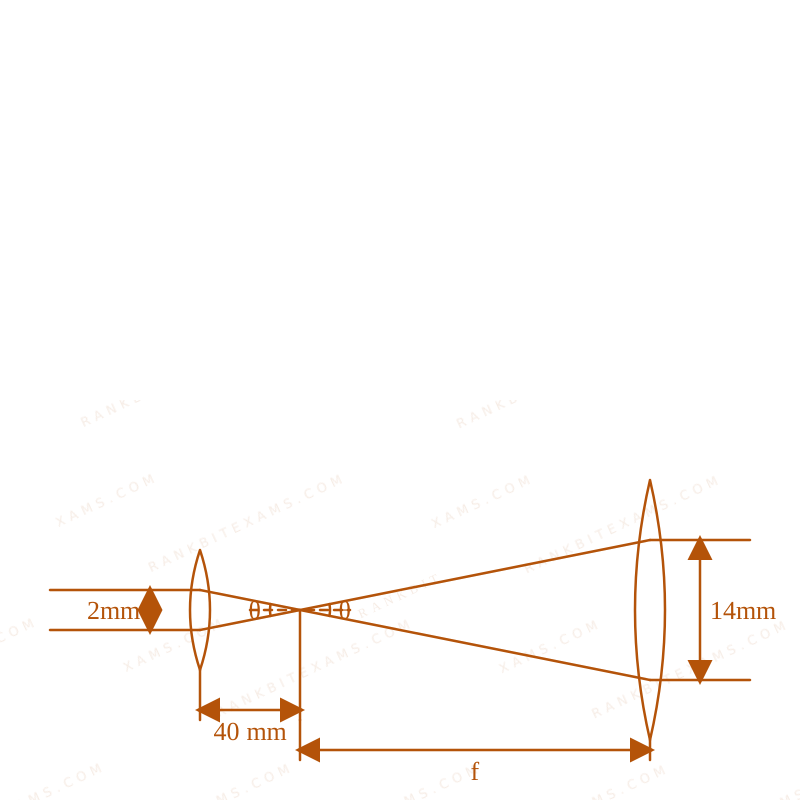
A collimated beam of light of diameter 2 mm is propagating along x-axis. The beam is required to be expanded in a collimated beam of diameter 14 mm using a system of two convex lenses. If first lens has focal length 40 mm, then the focal length of second lens is ____ mm.

Numerical Answer Type:
Enter a numerical value Answer: 280 to 280 +4 marks

Solution & Explanation

### Related Formula textMagnification m = fracD_textoutD_textin = fracf_2f_1 ### Core Logic For a beam expander using two convex lenses, the lenses are arranged such that their focal points coincide. This creates an afocal system where parallel input rays remain parallel upon output.
Lenses solution diagram for Q46 - JEE Main 2026 Morning
By similar triangles at the focal point: tan theta = fracD_1 / 2f_1 = fracD_2 / 2f_2 ### Step 1: Solving for f2 fracD_1f_1 = fracD_2f_2 frac240 = frac14f_2 f_2 = 14 times frac402 = 14 times 20 = 280text mm ### Pattern Recognition A standard beam expander (Keplerian telescope design used in reverse) has f_2/f_1 = D_2/D_1. ### Evaluation Rubric / Model Answer null ### Chapter Mix Class 12 Physics: Ray Optics and Optical Instruments

More Ray Optics and Optical Instruments Previous-Year Questions — Page 10

Q34 jee_main_2024_31_jan_morning Prism Deviation
The refractive index of a prism with apex angle A is cot(A/2). The angle of minimum deviation is :
  • A. delta_mathrmm = 180^circ - A
  • B. delta_mathrmm = 180^circ - 3A
  • C. delta_mathrmm = 180^circ - 4A
  • D. delta_mathrmm = 180^circ - 2A

Solution

### Related Formula mu = fracsinleft(fracA + delta_m2right)sinleft(fracA2right) ### Core Logic Given that the refractive index mu = cotleft(fracA2right). Substituting this into the prism formula: cotleft(fracA2right) = fracsinleft(fracA + delta_m2right)sinleft(fracA2right) fraccosleft(fracA2right)sinleft(fracA2right) = fracsinleft(fracA + delta_m2right)sinleft(fracA2right) Equating the numerators: cosleft(fracA2right) = sinleft(fracA + delta_m2right) We can rewrite cosine in terms of sine: sinleft(fracpi2 - fracA2right) = sinleft(fracA + delta_m2right) ### Step 2: Solve for Deviation Comparing the angles inside the sine functions: fracpi2 - fracA2 = fracA2 + fracdelta_m2 Multiply the entire equation by 2: pi - A = A + delta_m delta_m = pi - 2A Converting radians to degrees: delta_m = 180^circ - 2A ### Pattern Recognition Whenever refractive index mu = cot(A/2), the relation sin(90^circ - A/2) strictly matches the prism sine equation, meaning minimum deviation delta_m is always 180^circ - 2A. ### Evaluation Rubric / Model Answer null ### Chapter Mix Class 12 Physics: Ray Optics And Optical Instruments

More Ray Optics and Optical Instruments Questions — jee_main_2026_21_jan_morning

Practice all Ray Optics and Optical Instruments previous-year questions →

Rankbit System
JEE Physics: Waves (+15.5%) | Electrostatics: Concentric Shells (-29.7%) | Modern Physics: Photoelectric Clones (+34.2%) | Mathematics: Definite Integrals (+18.1%) | Chemistry: Coordination Splitting (-11.4%) | JEE Physics: Waves (+15.5%) | Electrostatics: Concentric Shells (-29.7%) | Modern Physics: Photoelectric Clones (+34.2%) | Mathematics: Definite Integrals (+18.1%) | Chemistry: Coordination Splitting (-11.4%)
YOUR FIRST PREP STEP STARTS HERE

We Map Every Repeating Question in Competitive Exams.

Say goodbye to generic mock test fatigue. RankBit uses smart analysis to group past exam questions into their foundational Repeating Question Types. Find chapter weightage, track repeating questions, and score higher with targeted practice.

Select Your Target Exam

Choose an exam track below to find formulas per chapter and patterns.

Syncing Exam Intelligence

Mapping formulas and patterns across all tracks…

PATH A — FULL LENGTH PRACTICE

Full Mock Test Hub

Simulate real NTA exam conditions with fully tracked mocks. Time yourself against past papers.

Now Live Open
PATH B — TARGETED PRACTICE

Topic-wise Practice Hub

Practice past-year questions one chapter at a time. Pick an exam → subject → chapter and get every PYQ for that topic — pulled together from all past papers — with the chapter's key formulas alongside.

Loading Questions... Browse Topics
Latest from the Blog
View all →

Loading articles...