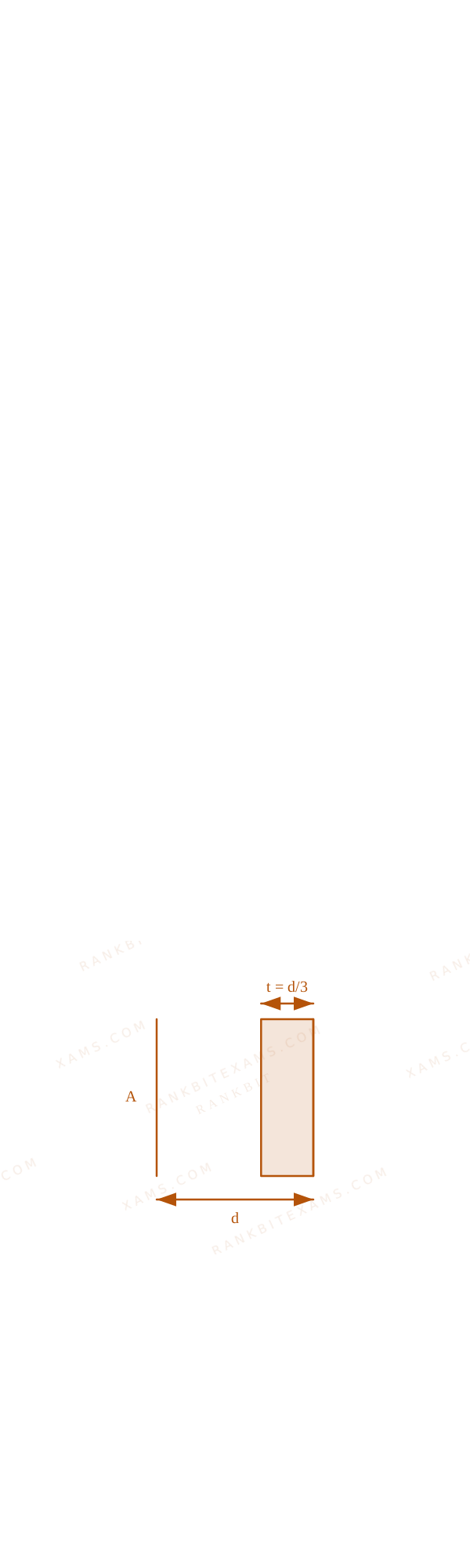
A parallel plate capacitor has capacitance C, when there is vacuum within the parallel plates. A sheet having thickness left(frac13right)^mathrmrd of the separation between the plates and relative permittivity K is introduced between the plates. The new capacitance of the system is :

Solution & Explanation

### Related Formula C = fracepsilon_0 Ad - t + fractK Alternatively, treat as two capacitors in series: C_eq = fracC_1 C_2C_1 + C_2 ### Core Logic Initial capacitance (vacuum): C = fracA epsilon_0d.
Capacitance with Dielectric diagram for Q34 - JEE Main 2026 Morning
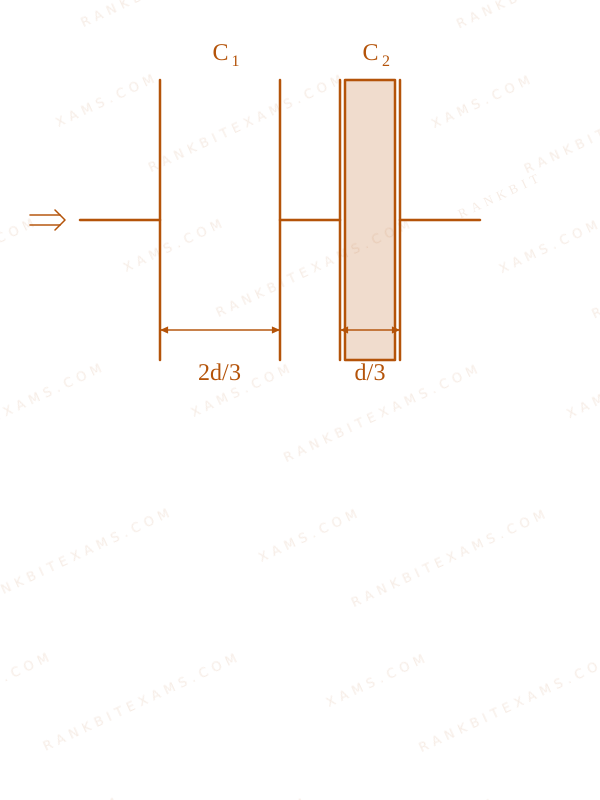
The system can be modelled as two capacitors in series: 1. A vacuum capacitor of thickness d - fracd3 = frac2d3 2. A dielectric capacitor of thickness fracd3 and dielectric constant K.
Capacitance with Dielectric diagram for Q34 - JEE Main 2026 Morning
### Step 1: Capacitors in Series The capacitances are: C_1 = fracepsilon_0 Aleft(frac2d3right) = frac32 left(fracepsilon_0 Adright) = frac32 C C_2 = fracK epsilon_0 Aleft(fracd3right) = 3K left(fracepsilon_0 Adright) = 3KC Now, equivalent capacitance in series: C_texteq = fracC_1 C_2C_1 + C_2 = fracleft(frac32 Cright) times (3KC)frac32 C + 3KC C_texteq = fracfrac92KC^2frac32C(1 + 2K) C_texteq = frac3KC2K + 1 ### Pattern Recognition Partial dielectric filling of thickness t: Use formula C_textnew = fracepsilon_0 Ad - t + t/K. Plugging t = d/3 directly gives fracepsilon_0 Ad - d/3 + d/3K = fracepsilon_0 Afrac2d3 + fracd3K = frac3K epsilon_0 A2Kd + d = frac3KC2K+1. ### Evaluation Rubric / Model Answer null ### Chapter Mix Class 12 Physics: Electrostatics
Capacitance with Dielectric diagram for Q34 - JEE Main 2026 Morning

More Electrostatics Previous-Year Questions — Page 5

Q1 jee_main_2025_07_april_evening Electrostatic Shielding
Given below are two statements: one is labelled as Assertion (A) and the other is labelled as Reason (R). Assertion (A): The outer body of an air craft is made of metal which protects persons sitting inside from lightning-strikes. [cite: 12] Reason (R): The electric field inside the cavity enclosed by a conductor is zero. [cite: 13] In the light of the above statements, chose the most appropriate answer from the options given below: [cite: 14]
  • A. Both (A) and (R) are correct and (R) is the correct explanation of (A) [cite: 15]
  • B. (A) is correct but (R) is not correct [cite: 16]
  • C. Both (A) and (R) are correct but (R) is not correct explanation of (A) [cite: 17]
  • D. (A) is not correct but (R) is correct [cite: 18]

Solution

### Core Logic According to electrostatic shielding, the electric field inside a cavity of a conductor is always zero, regardless of the size and shape of the cavity and regardless of any charges located outside or on the conductor's surface[cite: 660]. Therefore, when lightning strikes a metal aircraft, the entire charge stays on the outer metallic surface and flows down without producing an electric field inside, keeping passengers safe[cite: 12]. ### Step 1: Statement Evaluation * **Assertion (A):** Correct, passengers are protected from lightning because of the metallic body shield [cite: 12]. * **Reason (R):** Correct, the field inside a cavity of a conductor is zero [cite: 13]. * **Explanation:** Since the zero field property is precisely why passengers are protected, (R) correctly explains (A)[cite: 15]. ### Pattern Recognition Metallic shell / shield configuration always establishes E_textinside = 0[cite: 660]. This shielding mechanism directly underpins safety features in lightning scenarios for cars and airplanes. ### Evaluation Rubric / Model Answer null ### Chapter Mix Class 12 Physics: Electrostatics
Q10 jee_main_2025_07_april_evening Torque on a Dipole
A dipole with two electric charges of 2 µC magnitude each, with separation distance 0.5 µm, is placed between the plates of a capacitor such that its axis is parallel to an electric field established between the plates when a potential difference of 5 V is applied. Separation between the plates is 0.5 mm. If the dipole is rotated by 30^circ from the axis, it tends to realign in the direction due to a torque. The value of torque is : [cite: 58, 59, 60]
  • A. 5times10^-9~mathrmNm [cite: 60]
  • B. 2.5times10^-12~mathrmNm [cite: 61]
  • C. 5times10^-3~mathrmNm [cite: 62]
  • D. 2.5times10^-9~mathrmNm [cite: 62]

Solution

### Related Formula E = fracVd [cite: 736] tau = pEsintheta [cite: 737] p = q cdot a [cite: 738] ### Core Logic First, calculate the electric field magnitude E between the capacitor plates: [cite: 58, 736] E = frac50.5 times 10^-3 = 10^4\ textV/m [cite: 58, 59, 736] Next, evaluate the dipole moment p: [cite: 58, 738] p = (2 times 10^-6\ textC) times (0.5 times 10^-6\ textm) = 1 times 10^-12\ textCcdottextm [cite: 58, 740] Now find the torque when rotated by theta = 30^circ: [cite: 59, 737] tau = (1 times 10^-12) times 10^4 times sin 30^circ = 10^-8 times frac12 = 5 times 10^-9\ textNcdottextm [cite: 743] ### Pattern Recognition Always convert parameters to pristine standard SI units before applying electrostatic expressions (0.5\ mutextm = 5 times 10^-7\ textm and 0.5\ textmm = 5 times 10^-4\ textm) to secure zero conversion error[cite: 58, 59, 736, 738]. ### Evaluation Rubric / Model Answer null ### Chapter Mix Class 12 Physics: Electrostatics
Q21 jee_main_2025_07_april_evening Dielectrics and Capacitance
A parallel plate capacitor has charge 5times10^-6mathrm~C. A dielectric slab is inserted between the plates and almost fills the space between the plates. If the induced charge on one face of the slab is 4times10^-6mathrm~C then the dielectric constant of the slab is _______. [cite: 183, 184]
Numerical Answer. Answer: 5 to 5

Solution

### Related Formula Q_textind = Qleft(1 - frac1Kright) [cite: 813] ### Core Logic Substitute the values given for free surface charge Q = 5 times 10^-6\ textC and bound induced charge Q_textind = 4 times 10^-6\ textC into the equation: [cite: 183, 184, 814] 4 times 10^-6 = 5 times 10^-6 left(1 - frac1Kright) [cite: 814] frac45 = 1 - frac1K implies frac1K = 1 - frac45 = frac15 [cite: 815] K = 5 [cite: 815] ### Pattern Recognition The fraction of charge induced on the dielectric face scales structurally as fracK-1K[cite: 813, 815]. Observing a ratio of 4 parts out of 5 implies that the constant factor K must equal 5 directly[cite: 815]. ### Evaluation Rubric / Model Answer null ### Chapter Mix Class 12 Physics: Electrostatics
Q24 jee_main_2025_07_april_evening Electric Flux
The electric field in a region is given by vecmathrmE = (2hatmathrmi + 4hatmathrmj + 6hatmathrmk) times 10^3mathrmN / mathrmC . The flux of the field through a rectangular surface parallel to x-z plane is 6.0mathrmNm^2mathrmC^-1 . The area of the surface is __________ mathrmcm^2 . [cite: 195, 196]
Numerical Answer. Answer: 15 to 15

Solution

### Related Formula phi = vecE cdot vecA [cite: 827] ### Core Logic A surface aligned parallel to the xtext-z plane possesses an area vector pointing completely orthogonal to it along the y-axis direction, meaning vecA = Ahatj[cite: 196, 827]. Performing the dot product: [cite: 827] phi = left[(2hati + 4hatj + 6hatk) times 10^3right] cdot (Ahatj) = 4 times 10^3 A [cite: 195, 827] Given that the net flux magnitude is 6.0\ textNm^2textC^-1 [cite: 196]: 6 = 4 times 10^3 A implies A = frac64 times 10^3 = 1.5 times 10^-3\ textm^2 [cite: 828, 829] Converting square meters to square centimeters (1\ textm^2 = 10^4\ textcm^2): [cite: 196, 830] A = 1.5 times 10^-3 times 10^4 = 15\ textcm^2 [cite: 830] ### Pattern Recognition Always focus exclusively on the specific field component matched to the surface orientation normal[cite: 827]. For an xtext-z plane match, only the hatj coefficient creates flux[cite: 196, 827]. Do not miss the metric scale unit transition at the end (m^2 rightarrow cm^2)[cite: 196, 830]. ### Evaluation Rubric / Model Answer null ### Chapter Mix Class 12 Physics: Electrostatics
Q18 jee_main_2025_24_jan_evening Coulomb's Law
A small uncharged conducting sphere is placed in contact with an identical sphere but having 4 times 10^-8 C charge and then removed to a distance such that the force of repulsion between them is 9 times 10^-3 N. The distance between them is (Take frac14pivarepsilon_0 as 9 times 10^9 in SI units)
  • A. 2 cm
  • B. 3 cm
  • C. 4 cm
  • D. 1 cm

Solution

### Related Formula F = frack q_1 q_2r^2 ### Core Logic When two identical conducting spheres are brought into contact, the total initial charge splits equally between them: q_1 = q_2 = frac4 times 10^-8\ mathrmC + 02 = 2 times 10^-8\ mathrmC Given repulsion force, F = 9 times 10^-3\ mathrmN: 9 times 10^-3 = frac9 times 10^9 times (2 times 10^-8) times (2 times 10^-8)r^2 9 times 10^-3 = frac36 times 10^-7r^2 implies r^2 = frac36 times 10^-79 times 10^-3 = 4 times 10^-4 r = 2 times 10^-2\ mathrmm = 2\ mathrmcm
Charge redistribution schematic for two spheres Q18
### Pattern Recognition Identical spheres in contact distribute net charge equally due to symmetric capacitance sharing: q' = Q_texttotal / 2. ### Evaluation Rubric / Model Answer null ### Chapter Mix Class 12 Physics: Electrostatics

More Electrostatics Questions — jee_main_2026_21_jan_morning

Practice all Electrostatics previous-year questions →

Rankbit System
JEE Physics: Waves (+15.5%) | Electrostatics: Concentric Shells (-29.7%) | Modern Physics: Photoelectric Clones (+34.2%) | Mathematics: Definite Integrals (+18.1%) | Chemistry: Coordination Splitting (-11.4%) | JEE Physics: Waves (+15.5%) | Electrostatics: Concentric Shells (-29.7%) | Modern Physics: Photoelectric Clones (+34.2%) | Mathematics: Definite Integrals (+18.1%) | Chemistry: Coordination Splitting (-11.4%)
YOUR FIRST PREP STEP STARTS HERE

We Map Every Repeating Question in Competitive Exams.

Say goodbye to generic mock test fatigue. RankBit uses smart analysis to group past exam questions into their foundational Repeating Question Types. Find chapter weightage, track repeating questions, and score higher with targeted practice.

Select Your Target Exam

Choose an exam track below to find formulas per chapter and patterns.

Syncing Exam Intelligence

Mapping formulas and patterns across all tracks…

PATH A — FULL LENGTH PRACTICE

Full Mock Test Hub

Simulate real NTA exam conditions with fully tracked mocks. Time yourself against past papers.

Now Live Open
PATH B — TARGETED PRACTICE

Topic-wise Practice Hub

Practice past-year questions one chapter at a time. Pick an exam → subject → chapter and get every PYQ for that topic — pulled together from all past papers — with the chapter's key formulas alongside.

Loading Questions... Browse Topics
Latest from the Blog
View all →

Loading articles...