If x^2 + x + 1 = 0 , then the value of left(mathrmx+frac1mathrmxright)^4+left(mathrmx^2+frac1mathrmx^2right)^4+left(mathrmx^3+frac1mathrmx^3right)^4+ldots+left(mathrmx^25+frac1mathrmx^25right)^4 is :

Solution & Explanation

### Related Formula x^2 + x + 1 = 0 Rightarrow x = omega, omega^2 Properties of cube roots of unity: omega^3 = 1 and 1 + omega + omega^2 = 0. ### Core Logic Let alpha = omega. Then frac1x = frac1omega = omega^2. The series is sum_k=1^25 (omega^k + omega^2k)^4. Evaluate the term T_k = (omega^k + omega^2k)^4 based on the modulo of k with 3. ### Step 1: Cyclic Evaluation Case 1: k = 3m (multiples of 3) T_3m = (omega^3m + omega^6m)^4 = (1 + 1)^4 = 2^4 = 16 There are 8 such multiples up to 25 (3, 6, 9, dots, 24). Case 2: k neq 3m (non-multiples of 3) For k = 1, 2, 4, 5, dots omega^k + omega^2k will always be omega + omega^2 or omega^2 + omega. Since 1 + omega + omega^2 = 0, we have omega + omega^2 = -1. T_k neq 3m = (-1)^4 = 1 There are 25 - 8 = 17 such non-multiples up to 25. ### Step 2: Total Sum textSum = 17 times 1 + 8 times 16 = 17 + 128 = 145 ### Pattern Recognition Powers of x+1/x when x solves x^2 pm x + 1 = 0 perfectly orbit around periods of 3 or 6. Isolate the 3m resonant beats (which hit pure scalars like 1+1=2) versus the out-of-phase beats (which collapse to -1 or 1 via basic omega identities). ### Evaluation Rubric / Model Answer null ### Chapter Mix Class 11 Maths: Complex Numbers and Quadratic Equations

Reference Study Guides

More Complex Numbers and Quadratic Equations Previous-Year Questions — Page 3

Q55 jee_main_2025_04_april_evening Properties of Complex Numbers
Let the product of omega_1 = (8 + mathrmi) sin theta + (7 + 4 mathrmi) cos theta and omega_2 = (1 + 8 mathrmi) sin theta + (4 + 7 mathrmi) cos theta be alpha +mathrmibeta, mathrmi = sqrt-1. Let p and q be the maximum and the minimum values of alpha +beta respectively.
  • A. 140
  • B. 130
  • C. 160
  • D. 150

Solution

### Core Logic Let's expand the terms by grouping real and imaginary parts explicitly: omega_1 = (8sintheta + 7costheta) + i(sintheta + 4costheta) omega_2 = (sintheta + 4costheta) + i(8sintheta + 7costheta) Notice that if we let u = 8sintheta + 7costheta and v = sintheta + 4costheta, then: omega_1 = u + iv quad textand quad omega_2 = v + iu ### Step 1: Calculating the Product Multiplying omega_1 and \omega_2: omega_1omega_2 = (u + iv)(v + iu) = uv + iu^2 + iv^2 - uv = i(u^2 + v^2) Since the product is given as alpha + ibeta: alpha = 0 beta = u^2 + v^2 = (8sintheta + 7costheta)^2 + (sintheta + 4costheta)^2 ### Step 2: Simplifying the expression for alpha + beta Expanding the terms for beta: beta = (64sin^2theta + 49cos^2theta + 112sinthetacostheta) + (sin^2theta + 16cos^2theta + 8sinthetacostheta) alpha + beta = 0 + beta = 65sin^2theta + 65cos^2theta + 120sinthetacostheta Using the identity sin^2theta + cos^2theta = 1 and 2sinthetacostheta = sin 2theta: alpha + beta = 65 + 60sin 2theta ### Step 3: Max and Min Extrema Analysis Since -1 le sin 2theta le 1: textMaximum value p = 65 + 60(1) = 125 textMinimum value q = 65 + 60(-1) = 5 Sum of maximum and minimum bounds equals: p + q = 125 + 5 = 130 ### Pattern Recognition Observe the symmetric structure in complex variables: (u+iv) and (v+iu). Their product structurally completely cancels out the real component, saving you from a highly messy component expansion. ### Evaluation Rubric / Model Answer null ### Chapter Mix Class 11 Mathematics: Complex Numbers Class 11 Mathematics: Trigonometric Functions
Q71 jee_main_2025_04_april_evening Cube Roots of Unity
If alpha is a root of the equation x^2 + x + 1 = 0 and sum_k=1^nleft(alpha^k + frac1alpha^kright)^2 = 20, then n is equal to
Numerical Answer. Answer: 11 to 11

Solution

### Core Logic The equation x^2 + x + 1 = 0 has complex roots which are the non-real cube roots of unity. Thus, we can set alpha = omega (where omega^3 = 1 and 1 + omega + omega^2 = 0). Let's analyze the general term block T_k = left(omega^k + frac1omega^kright)^2: T_k = left(omega^k + omega^-kright)^2 = omega^2k + omega^-2k + 2 = omega^2k + omega^k + 2 Because omega^k is periodic with period 3, let's examine the values of T_k for different values of k: - If k is a multiple of 3 (k=3m): omega^2k = 1, omega^k = 1 implies T_k = 1 + 1 + 2 = 4. - If k is not a multiple of 3 (k=3m+1 or 3m+2): omega^2k + omega^k = -1 implies T_k = -1 + 2 = 1. ### Step 1: Evaluating periodic blocks Every block of three consecutive terms (k = 1, 2, 3) contributes exactly: textSum of a block = 1 + 1 + 4 = 6 We want the total summation to equal 20. Let's divide 20 by our block value 6: 20 = 3 times 6 + 2 This means the sum must consist of 3 full periodic blocks plus additional terms that add up to 2. ### Step 2: Determining the final term count n The number of terms in 3 full blocks is 3 times 3 = 9 terms, giving a sum of 18. To get the remaining value of 2, we look at the next terms: - Term 10 (k=10, not a multiple of 3) adds 1 implies textTotal = 18 + 1 = 19. - Term 11 (k=11, not a multiple of 3) adds 1 implies textTotal = 19 + 1 = 20. Hence, the series terminates exactly at n = 11. ### Pattern Recognition Whenever complex roots of unity or cyclic properties show up inside series sums, group terms into blocks based on the underlying period length (3 here) to convert large sums into simple modular arithmetic arithmetic calculations. ### Evaluation Rubric / Model Answer null ### Chapter Mix Class 11 Mathematics: Complex Numbers Class 11 Mathematics: Sequences and Series
Q73 jee_main_2025_04_april_morning Geometry of Complex Numbers
Let A = \z in mathbbC : |z - 2 - i| = 3\, B = \z in mathbbC : operatornameRe(z - iz) = 2\ and S = A cap B. Then sum_z in S |z|^2 is equal to
Numerical Answer. Answer: 22 to 22

Solution

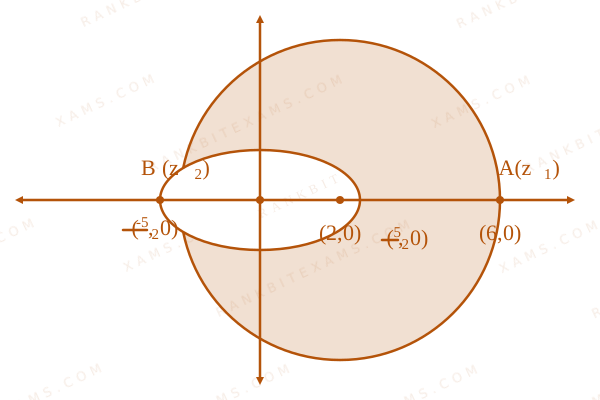
### Related Formula Magnitude squared representation: |z|^2 = x^2 + y^2 quad textfor z = x + iy ### Core Logic Convert complex sets into Cartesian forms by setting z = x + iy: Set A: |(x-2) + i(y-1)| = 3 implies (x-2)^2 + (y-1)^2 = 9 quad dots (1) Set B: z - iz = (x+iy) - i(x+iy) = (x+y) + i(y-x). operatornameRe(z - iz) = 2 implies x + y = 2 implies y = 2 - x quad dots (2) ### Step 1: Solve System Algebraically Substitute (2) into (1): (x - 2)^2 + (2 - x - 1)^2 = 9 implies (x - 2)^2 + (1 - x)^2 = 9 x^2 - 4x + 4 + 1 - 2x + x^2 = 9 implies 2x^2 - 6x - 4 = 0 implies x^2 - 3x - 2 = 0 Roots are x_1,2 = frac3 pm sqrt172. Correspondingly, y = 2 - x implies y_1,2 = frac1 mp sqrt172. ### Step 2: Evaluate Sum of Square Magnitudes Since S consists of the two intersection points z_1, z_2: sum_z in S |z|^2 = (x_1^2 + y_1^2) + (x_2^2 + y_2^2) = (x_1^2 + x_2^2) + (y_1^2 + y_2^2) Using identities from quadratic equation x^2 - 3x - 2 = 0 (x_1+x_2 = 3, x_1x_2 = -2): x_1^2 + x_2^2 = (3)^2 - 2(-2) = 13. Since y = 2-x, y^2 = 4 - 4x + x^2 implies y_1^2 + y_2^2 = 8 - 4(3) + 13 = 9. sum_z in S |z|^2 = 13 + 9 = 22 ### Pattern Recognition Avoid explicitly using radical root approximations. Summing symmetric expressions directly through standard Vieta coefficient sum shortcuts preserves clean fractions. ### Evaluation Rubric / Model Answer null ### Chapter Mix Class 11 Mathematics: Complex Numbers and Quadratic Equations
Q61 jee_main_2025_07_april_evening Locus of a Complex Number
If the locus of z in C, such that operatorname R e left(frac z - 12 z + mathrm iright) + operatorname R e left(frac bar z - 12 bar z - mathrm iright) = 2, is a circle of radius r and center (a, b) then frac15abr^2 is equal to:
  • A. 24
  • B. 12
  • C. 18
  • D. 16

Solution

### Related Formula For a complex number w, operatornameRe(w) = operatornameRe(barw). Hence: operatornameRe(w) + operatornameRe(barw) = 2operatornameRe(w) ### Core Logic Notice that fracbarz - 12barz - i is the exact complex conjugate of fracz - 12z + i. Thus, the given equation simplifies directly via complex identities to: 2operatornameReleft(fracz - 12z + iright) = 2 implies operatornameReleft(fracz - 12z + iright) = 1 ### Step 1: Substitute z = x + iy Let z = x + iy: frac(x - 1) + iy2x + i(2y + 1) To find the real part, multiply numerator and denominator by the conjugate of the denominator: operatornameReleft[ frac((x - 1) + iy)(2x - i(2y + 1))4x^2 + (2y + 1)^2 right] = 1 frac2x(x - 1) + y(2y + 1)4x^2 + (2y + 1)^2 = 1 ### Step 2: Expand and Arrange Circle Equation Expanding the expression: 2x^2 - 2x + 2y^2 + y = 4x^2 + 4y^2 + 4y + 1 2x^2 + 2y^2 + 2x + 3y + 1 = 0 Dividing full equation by 2: x^2 + y^2 + x + frac32y + frac12 = 0 ### Step 3: Extract Center and Radius textCenter (a, b) = left(-frac12, -frac34right) r^2 = g^2 + f^2 - c = left(frac12right)^2 + left(frac34right)^2 - frac12 = frac14 + frac916 - frac12 = frac516 Evaluating frac15abr^2: frac15 cdot left(-frac12right) cdot left(-frac34right)frac516 = fracfrac458frac516 = 18 ### Pattern Recognition Recognizing that operatornameRe(w) + operatornameRe(barw) = 2operatornameRe(w) avoids complex algebraic division on the second fractional expression completely. ### Evaluation Rubric / Model Answer null ### Chapter Mix Class 11 Mathematics: Complex Numbers Class 11 Mathematics: Circles
Q56 jee_main_2025_24_jan_morning Algebraic Properties of Complex Roots
If alpha and beta are the roots of the equation 2z^2 - 3z - 2i = 0 , where i = sqrt-1 , then 16 cdot mathrmReleft(fracalpha^19 + beta^19 + alpha^11 + beta^11alpha^15 + beta^15right) cdot operatornameImleft(fracalpha^19 + beta^19 + alpha^11 + beta^11alpha^15 + beta^15right) is equal to :
  • A. 398
  • B. 312
  • C. 409
  • D. 441

Solution

### Related Formula Since alpha and beta are roots of 2z^2 - 3z - 2i = 0, they satisfy the quadratic equation directly, meaning: 2alpha^2 - 3alpha - 2i = 0 implies 2left(alpha - fracialpharight) = 3 implies alpha - fracialpha = frac32 Similarly for beta: beta - fracibeta = frac32 ### Core Logic Square the baseline relation to transition to higher exponential powers: left(alpha - fracialpharight)^2 = left(frac32right)^2 implies alpha^2 - frac1alpha^2 - 2i = frac94 alpha^2 - frac1alpha^2 = frac94 + 2i Squaring once more to isolate the fourth powers: left(alpha^2 - frac1alpha^2right)^2 = left(frac94 + 2iright)^2 alpha^4 + frac1alpha^4 - 2 = frac8116 - 4 + 9i alpha^4 + frac1alpha^4 = frac4916 + 9i ### Step 1: Simplify the Target Expression Fraction Rearrange the given complex algebraic fraction by factoring out powers: fracalpha^19 + alpha^11 + beta^19 + beta^11alpha^15 + beta^15 = fracalpha^15left(alpha^4 + frac1alpha^4right) + beta^15left(beta^4 + frac1beta^4right)alpha^15 + beta^15 Since both alpha and beta satisfy the exact same symmetric relational identity: alpha^4 + frac1alpha^4 = beta^4 + frac1beta^4 = frac4916 + 9i Substitute this uniform value back into the algebraic expression: = frac(alpha^15 + beta^15)left(frac4916 + 9iright)alpha^15 + beta^15 = frac4916 + 9i ### Step 2: Extract Real and Imaginary Components From our simplified expression: mathrmRe = frac4916 operatornameIm = 9 Now, substitute these into the evaluation formula: textResult = 16 cdot left(frac4916right) cdot 9 = 49 cdot 9 = 441 ### Pattern Recognition Symmetric rational polynomials in roots alpha, beta that can be split into identical numeric multipliers for alpha^n and beta^n allow direct cancellation of the polynomial bases without evaluating the individual roots explicitly. ### Evaluation Rubric / Model Answer null ### Chapter Mix Class 11 Mathematics: Complex Numbers

More Complex Numbers and Quadratic Equations Questions — jee_main_2026_21_jan_morning

Practice all Complex Numbers and Quadratic Equations previous-year questions →

Rankbit System
JEE Physics: Waves (+15.5%) | Electrostatics: Concentric Shells (-29.7%) | Modern Physics: Photoelectric Clones (+34.2%) | Mathematics: Definite Integrals (+18.1%) | Chemistry: Coordination Splitting (-11.4%) | JEE Physics: Waves (+15.5%) | Electrostatics: Concentric Shells (-29.7%) | Modern Physics: Photoelectric Clones (+34.2%) | Mathematics: Definite Integrals (+18.1%) | Chemistry: Coordination Splitting (-11.4%)
YOUR FIRST PREP STEP STARTS HERE

We Map Every Repeating Question in Competitive Exams.

Say goodbye to generic mock test fatigue. RankBit uses smart analysis to group past exam questions into their foundational Repeating Question Types. Find chapter weightage, track repeating questions, and score higher with targeted practice.

Select Your Target Exam

Choose an exam track below to find formulas per chapter and patterns.

Syncing Exam Intelligence

Mapping formulas and patterns across all tracks…

PATH A — FULL LENGTH PRACTICE

Full Mock Test Hub

Simulate real NTA exam conditions with fully tracked mocks. Time yourself against past papers.

Now Live Open
PATH B — TARGETED PRACTICE

Topic-wise Practice Hub

Practice past-year questions one chapter at a time. Pick an exam → subject → chapter and get every PYQ for that topic — pulled together from all past papers — with the chapter's key formulas alongside.

Loading Questions... Browse Topics
Latest from the Blog
View all →

Loading articles...