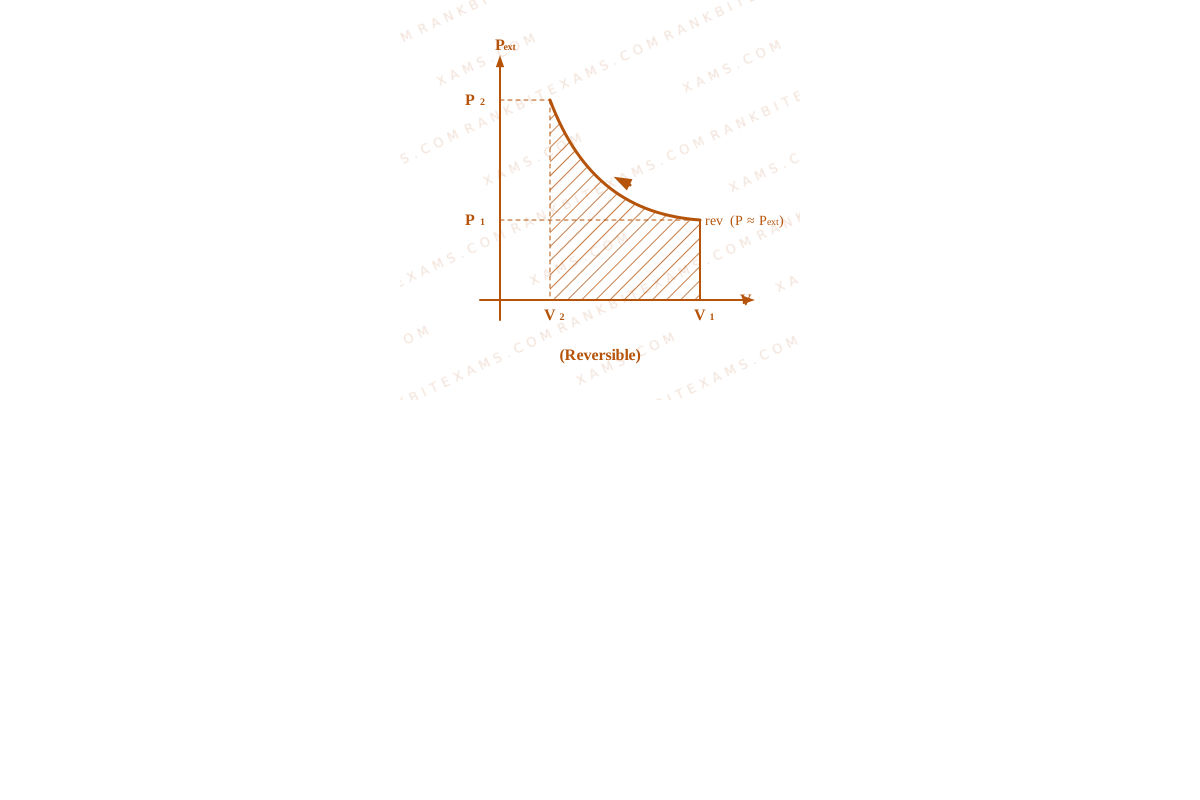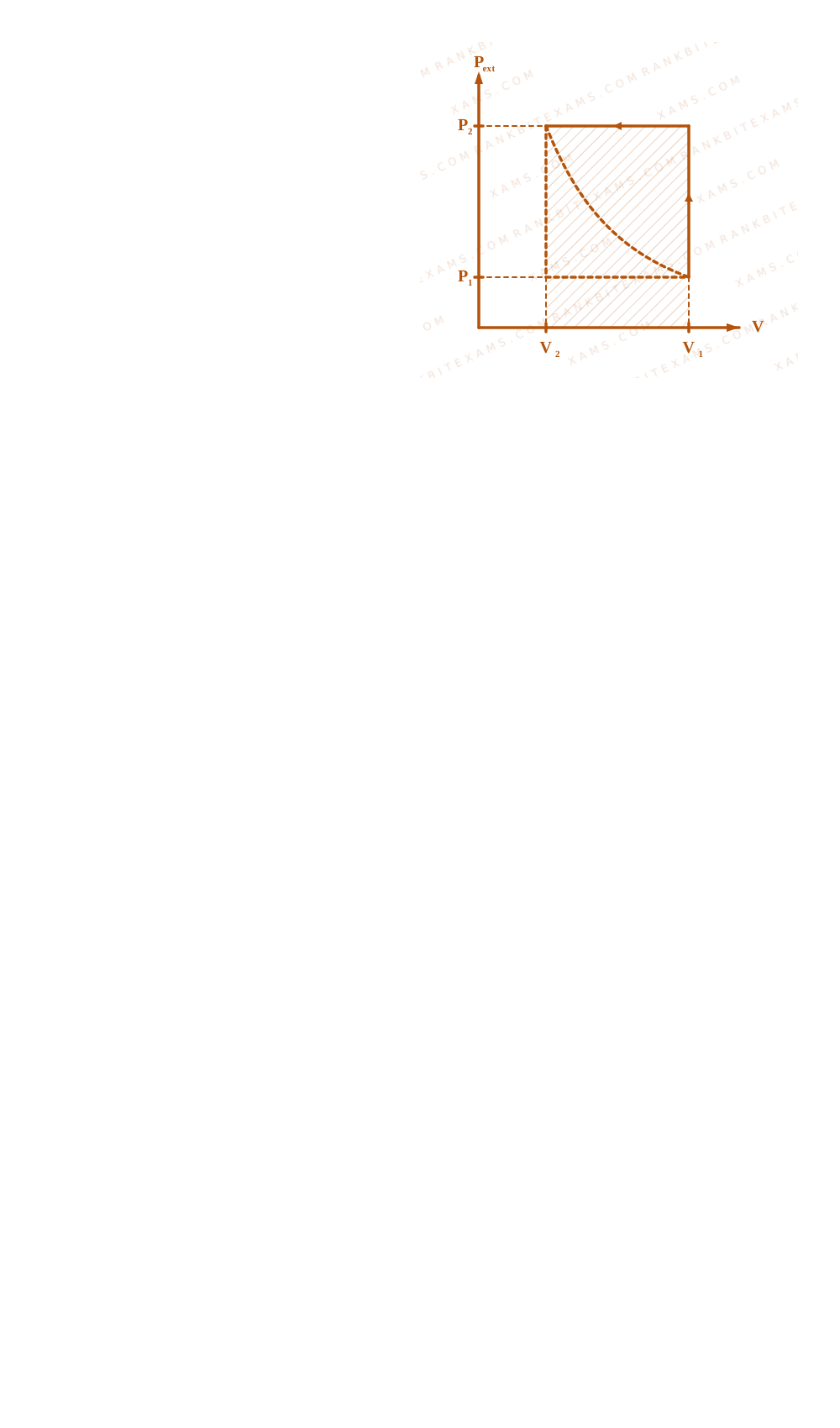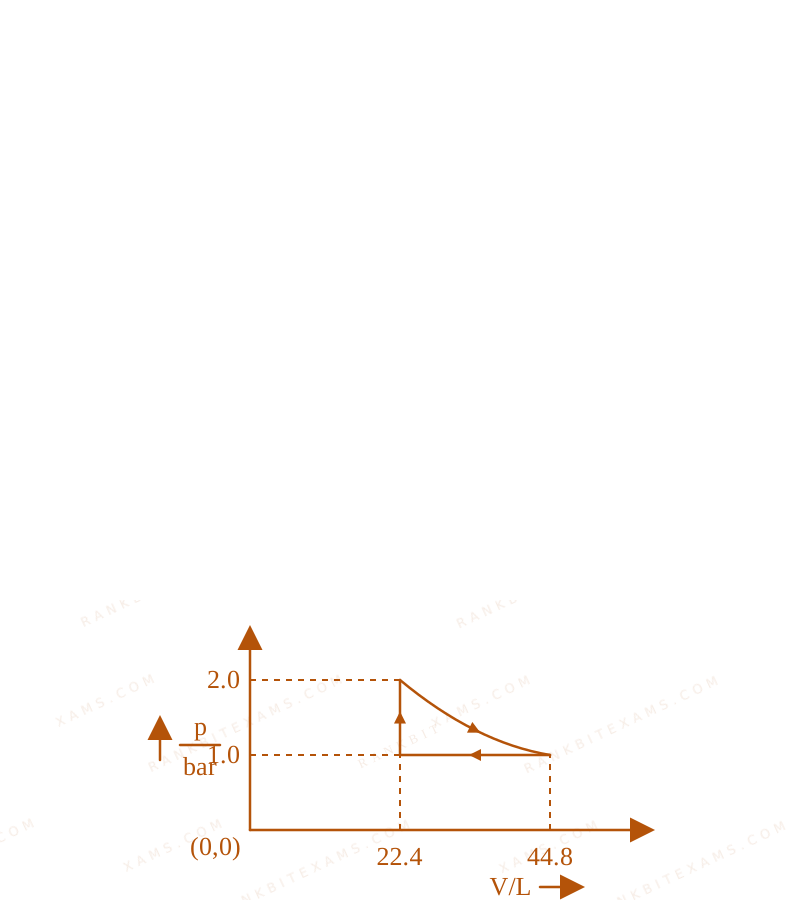
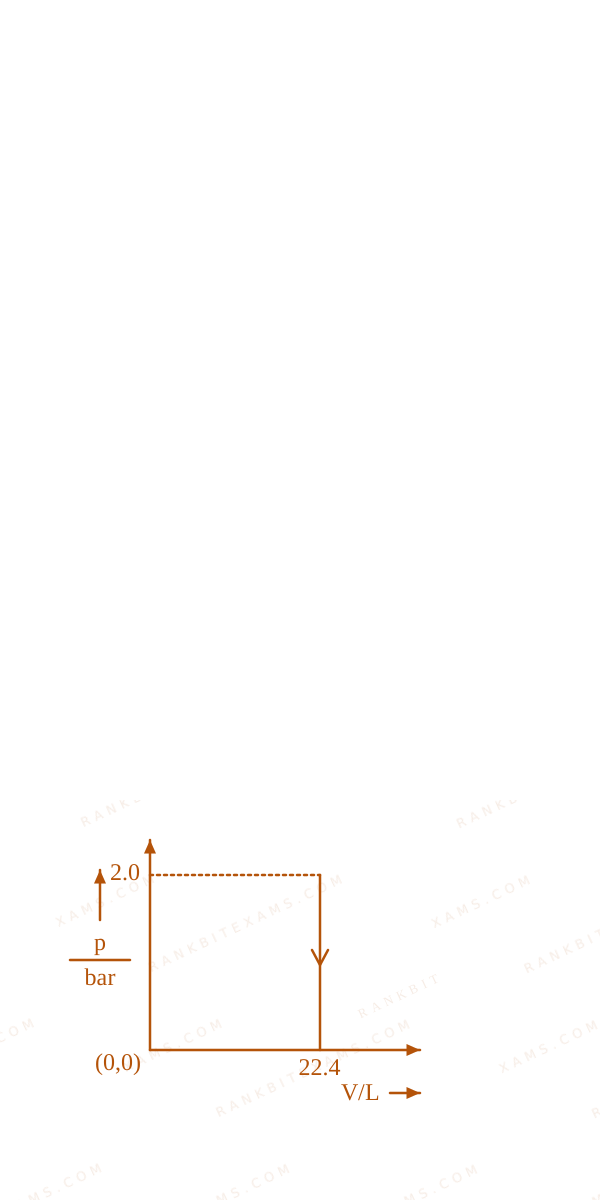
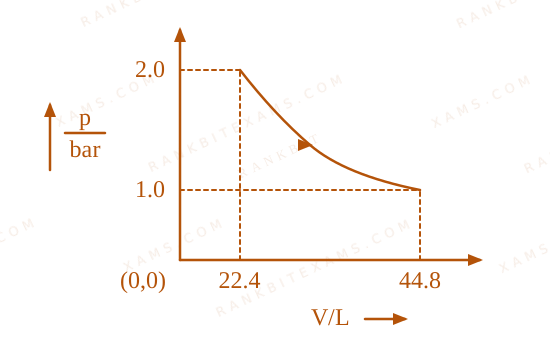
Which of the following graphs between pressure ‘P’ versus volume ‘V’ represent the maximum work done?

Solution & Explanation

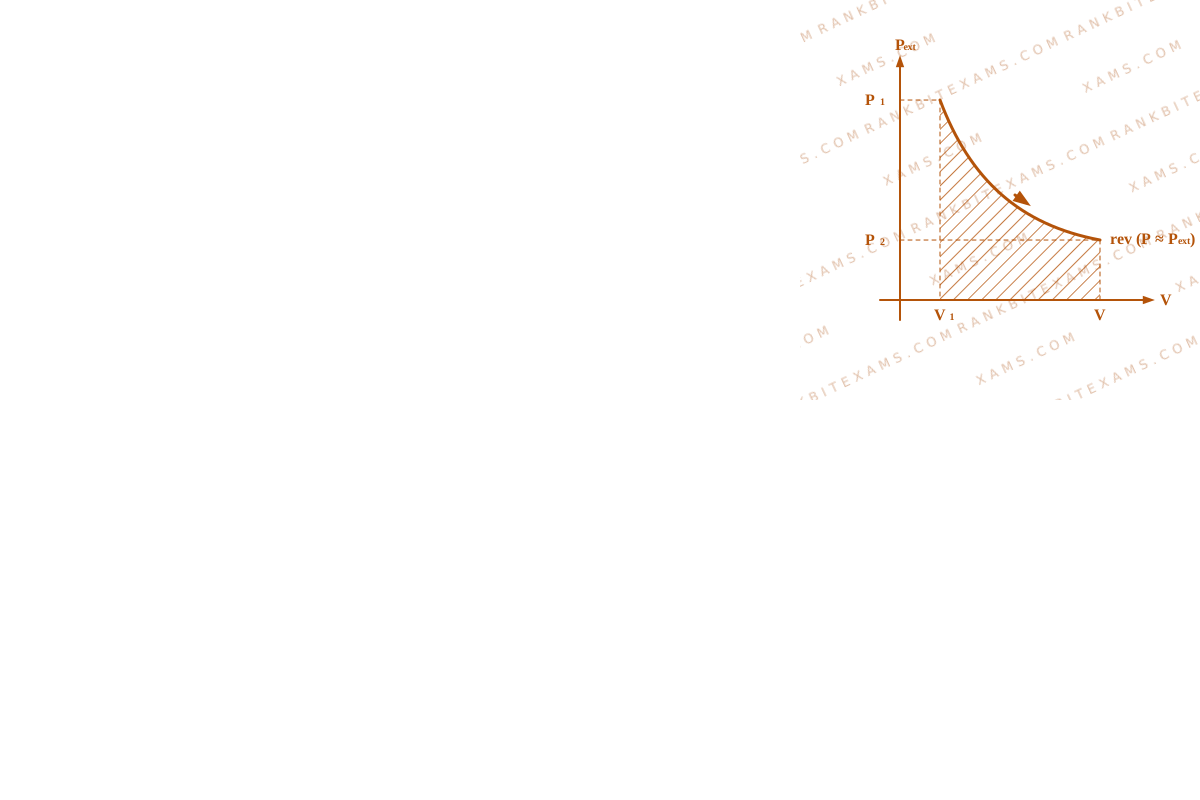
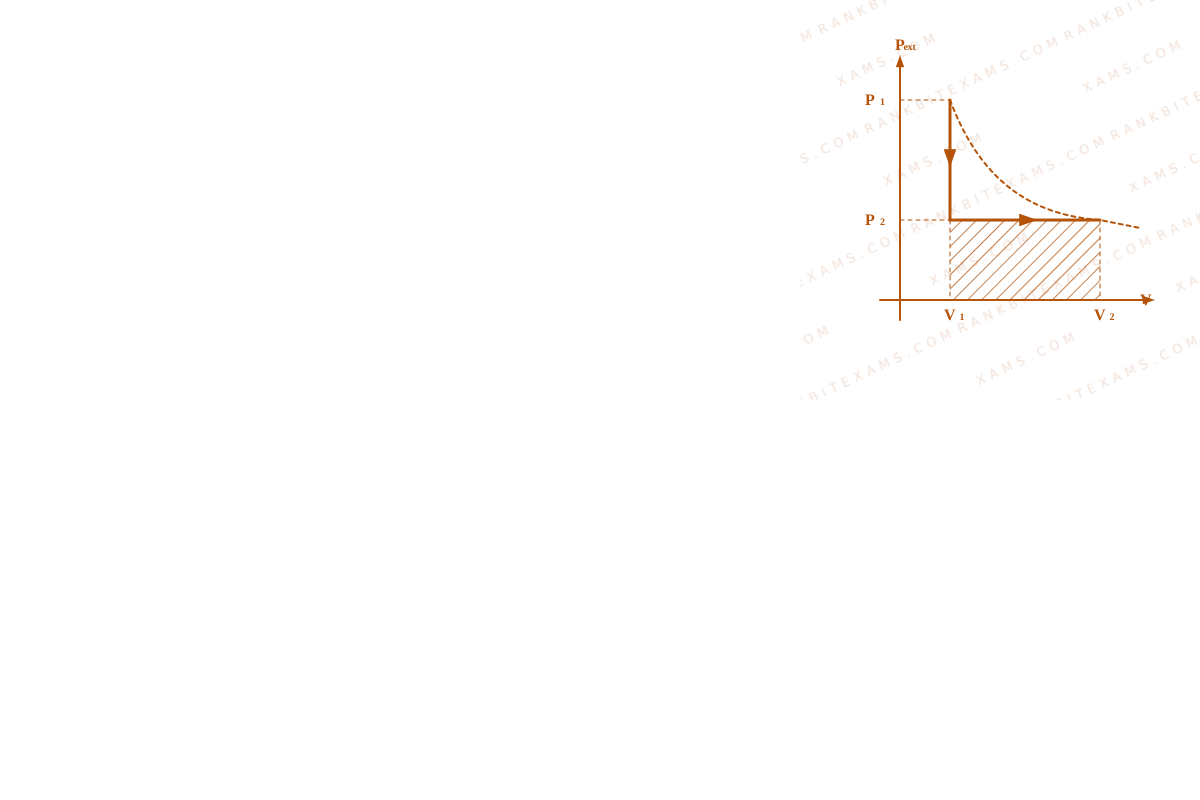
### Core Logic The magnitude of work done by or on a gas is given by the area under the P-V curve projected onto the volume axis. Graph 1: Cyclic process forming a triangle. Area is bounded, represents net work. Graph 2: Isochoric drop (vertical line at V=22.4L). Area = 0, so work done is zero. Graph 3: Expansion process forming a cycle. Area is enclosed in a convex shape. Graph 4: Direct expansion from V=22.4 to V=44.8 at pressure P=1 up to P=2 (a rectangle combined with a triangle). The total area under the upper curve from V=22.4 to V=44.8 covers the entire shaded region under the path down to the V-axis. Option (4) provides the largest total area under the curve extending down to the horizontal axis (maximum magnitude of work done). ### Evaluation Rubric / Model Answer null ### Chapter Mix Class 11 Chemistry: Thermodynamics
Reference Study Guides

More Thermodynamics Previous-Year Questions — Page 3

Q39 jee_main_2025_29_jan_evening Hess's Law of Constant Heat Summation
If C(textdiamond) ightarrow C(textgraphite) + Xtext kJ mol^-1 C(textdiamond) + O_2(g) ightarrow CO_2(g) + Ytext kJ mol^-1 C(textgraphite) + O_2(g) ightarrow CO_2(g) + Ztext kJ mol^-1 At constant temperature, then the correct relationship is:
  • A. X = Y + Z
  • B. -X = Y + Z
  • C. X = -Y + Z
  • D. X = Y - Z

Solution

### Core Logic Let's treat the given parameters as terms for exothermic heats evolved on the product side: 1) C(textdiamond) ightarrow C(textgraphite), Delta H = -X 2) C(textdiamond) + O_2(g) ightarrow CO_2(g), Delta H = -Y 3) C(textgraphite) + O_2(g) ightarrow CO_2(g), Delta H = -Z By subtracting Equation (3) from Equation (2): C(textdiamond) - C(textgraphite) ightarrow 0 implies C(textdiamond) ightarrow C(textgraphite) Delta H = (-Y) - (-Z) = Z - Y Matching this to Equation (1): -X = Z - Y implies X = Y - Z ### Pattern Recognition Hess's Law states that the enthalpy change of an overall reaction is equal to the sum of the enthalpy changes of its individual steps. ### Evaluation Rubric / Model Answer null ### Chapter Mix Class 11 Chemistry: Thermodynamics
Q34 jee_main_2025_28_jan_morning Phase Equilibrium and Le Chatelier's Principle
Ice and water are placed in a closed container at a pressure of 1 atm and temperature 273.15mathrmK . If pressure of the system is increased 2 times, keeping temperature constant, then identify correct observation from following:
  • A. textVolume of system increases.
  • B. textLiquid phase disappears completely.
  • C. textThe amount of ice decreases.
  • D. textThe solid phase (ice) disappears completely.

Solution

### Core Logic Water has a unique property where the density of the liquid phase is greater than the density of the solid phase (ice). Consequently, the molar volume of ice is larger than that of liquid water: V_m(textice) > V_m(textwater) According to Le Chatelier's Principle, increasing the pressure favors the phase that occupies a smaller volume to alleviate the applied stress. Thus, shifting the system forward converts ice into liquid water:
Phase shift diagram for Q34 - JEE Main 2025 Morning
If the pressure is increased considerably (such as doubling it to 2 atm) at 273.15mathrmK, the melting point decreases, causing the entire solid phase (ice) to disappear completely. ### Pattern Recognition Sees: Ice-water system under pressure change. Trap: Assuming that an increase in pressure always favors the solid phase. Water has an anomalous phase curve with a negative slope. ### Evaluation Rubric / Model Answer null ### Chapter Mix Class 11 Chemistry: Chemical Thermodynamics
Q50 jee_main_2025_28_jan_morning Bond Enthalpy Calculation
The formation enthalpies, Delta mathrmH_mathrmf^ominus for mathrmH_(mathrmg) and mathrmO_(mathrmg) are 220.0 and 250.0~mathrmkJ~mol^-1 , respectively, at 298.15mathrmK , and Delta mathrmH_mathrmf^- for mathrmH_2mathrmO_(mathrmg) is -242.0mathrmkJ\,mol^-1 at the same temperature. The average bond enthalpy of the O-H bond in water at 298.15mathrmK is \_\_\_\_\_\_\_\_\_\_\_\_\_\_\_\_\_\_\_\_\_\_\_\_\_\_\_\_\_\_\_\_\_\_\_\_\_\_\_\_\_\_\_\_\_\_\_\_\_\_\_ (nearest integer).
Numerical Answer. Answer: 466 to 466

Solution

### Related Formula Reaction enthalpy based on atomization processes: Delta_r H = sum Delta_f H(textproducts) - sum Delta_f H(textreactants) ### Step 1: Map the Dissociation Reaction Consider the dissociation of gas phase water molecules into constituent gaseous atoms: mathrmH_2mathrmO_mathrm(g) rightarrow 2mathrmH_mathrm(g) + mathrmO_mathrm(g) The total energy required corresponds to breaking exactly two mathrmO-mathrmH bonds: Delta_r H = 2 times textB.E.(mathrmO-mathrmH) ### Step 2: Calculate Delta_r H Using the enthalpies of formation: Delta_r H = [2 times Delta_f H(mathrmH_mathrm(g)) + Delta_f H(mathrmO_mathrm(g))] - Delta_f H(mathrmH_2mathrmO_mathrm(g)) Delta_r H = [2 times 220.0 + 250.0] - (-242.0) Delta_r H = [440.0 + 250.0] + 242.0 = 690.0 + 242.0 = 932.0\,mathrmkJ\,mol^-1 ### Step 3: Solve for Single Bond Enthalpy 2 times textB.E.(mathrmO-mathrmH) = 932.0 textB.E.(mathrmO-mathrmH) = frac932.02 = 466\,mathrmkJ\,mol^-1 ### Pattern Recognition Sees: Atomization state values used to evaluate single bond metrics. Shortcut: Remember textTotal Dissociation Energy = sum Delta_f H(textatoms) - Delta_f H(textmolecule). Halving the result gives the average bond enthalpy. ### Evaluation Rubric / Model Answer null ### Chapter Mix Class 11 Chemistry: Chemical Thermodynamics
Q35 jee_main_2025_03_april_morning Intensive and Extensive Properties
Which of the following properties will change when system containing solution 1 will become solution 2?
Solution state transition grid for Q35 - JEE Main 2025 Morning
The flowchart maps Solution 1 containing 10 mol solute in 10 L water transitioning to Solution 2 containing 1 mol solute in 1 L water.
  • A. Molar heat capacity
  • B. Density
  • C. Concentration
  • D. Gibbs free energy

Solution

### Core Logic Let us compute the concentration of both solutions: textConcentration of Solution 1 = frac10text mol10text L = 1text mol/L textConcentration of Solution 2 = frac1text mol1text L = 1text mol/L Since concentration is identical, both systems share matching compositions. Consequently, all **intensive properties** (independent of mass/size) like concentration, density, and molar heat capacity remain exactly equal. ### Step 1: Identifying the Variable Gibbs free energy (G) is an **extensive property** that scales directly with the amount of matter in the system. Because Solution 1 contains a larger total mass and volume than Solution 2, its overall Gibbs free energy value is different. ### Pattern Recognition Shortcut: Look for the only extensive property in the options. Density, concentration, and molar parameters are always intensive. Gibbs free energy (G) scales with total matter quantity. ### Evaluation Rubric / Model Answer null ### Chapter Mix Class 11 Chemistry: Chemical Thermodynamics
Q49 jee_main_2025_03_april_morning Bond Enthalpy and Enthalpy of Formation
Given: Delta Htextsub^ominus[C(textgraphite)] = 710text kJ mol^-1 DeltaC-HH^ominus = 414text kJ mol^-1 DeltaH-HH^ominus = 436text kJ mol^-1 DeltaC=CH^ominus = 611text kJ mol^-1 The Delta Hf^ominus for CH2=CH2 is ________ textkJ mol^-1 (nearest integer value)
Numerical Answer. Answer: 25 to 25

Solution

### Related Formula The enthalpy of formation reaction can be evaluated by balancing atomization and bond cleavage details: Delta H_f^circ = sum Delta Htextatomization (reactants) - sum Delta Htextbonds broken/formed (products) ### Core Logic The target formation reaction for ethylene (textC_2textH_4) from standard elemental states is: 2C(textgraphite) + 2H_2(g) ightarrow CH_2=CH_2(g) To construct this pathway: 1. Sublime 2 moles of solid graphite: 2 times Delta H_textsub^circ[C] 2. Dissociate 2 moles of gaseous textH-textH bonds: 2 times Delta_H-HH^circ 3. Form 1 mole of textC=textC double bonds: -1 times Delta_C=CH^circ 4. Form 4 moles of textC-textH single bonds: -4 times Delta_C-HH^circ ### Step 1: Arithmetic Calculation Delta H_f^circ = [2 times 710] + [2 times 436] - 611 - [4 times 414] Delta H_f^circ = 1420 + 872 - 611 - 1656 = 2292 - 2267 = 25text kJ mol^-1 ### Pattern Recognition Shortcut: Group energy components systematically. Reactant state atomization costs +2292text kJ. Exothermic structural bond formation releases -2267text kJ. Net difference yields a small endothermic value of +25text kJ/mol. ### Evaluation Rubric / Model Answer null ### Chapter Mix Class 11 Chemistry: Chemical Thermodynamics

More Thermodynamics Questions — jee_main_2026_21_jan_morning

Practice all Thermodynamics previous-year questions →

Rankbit System
JEE Physics: Waves (+15.5%) | Electrostatics: Concentric Shells (-29.7%) | Modern Physics: Photoelectric Clones (+34.2%) | Mathematics: Definite Integrals (+18.1%) | Chemistry: Coordination Splitting (-11.4%) | JEE Physics: Waves (+15.5%) | Electrostatics: Concentric Shells (-29.7%) | Modern Physics: Photoelectric Clones (+34.2%) | Mathematics: Definite Integrals (+18.1%) | Chemistry: Coordination Splitting (-11.4%)
YOUR FIRST PREP STEP STARTS HERE

We Map Every Repeating Question in Competitive Exams.

Say goodbye to generic mock test fatigue. RankBit uses smart analysis to group past exam questions into their foundational Repeating Question Types. Find chapter weightage, track repeating questions, and score higher with targeted practice.

Select Your Target Exam

Choose an exam track below to find formulas per chapter and patterns.

Syncing Exam Intelligence

Mapping formulas and patterns across all tracks…

PATH A — FULL LENGTH PRACTICE

Full Mock Test Hub

Simulate real NTA exam conditions with fully tracked mocks. Time yourself against past papers.

Now Live Open
PATH B — TARGETED PRACTICE

Topic-wise Practice Hub

Practice past-year questions one chapter at a time. Pick an exam → subject → chapter and get every PYQ for that topic — pulled together from all past papers — with the chapter's key formulas alongside.

Loading Questions... Browse Topics
Latest from the Blog
View all →

Loading articles...