Consider the following reactions:
NaCl + K₂Cr₂O₇ + H₂SO₄ arrow A + KHSO₄ + NaHSO₄ + H₂O$NaCl + K_{2}Cr_{2}O_{7} + H_{2}SO_{4} \rightarrow A + KHSO_{4} + NaHSO_{4} + H_{2}O$A + NaOH arrow B + NaCl + H₂O$A + NaOH \rightarrow B + NaCl + H_{2}O$B + H₂SO₄ + H₂O₂ arrow C + Na₂SO₄ + H₂O$B + H_{2}SO_{4} + H_{2}O_{2} \rightarrow C + Na_{2}SO_{4} + H_{2}O$
In the product 'C', 'X' is the number of O₂²⁻$O_{2}^{2-}$ units, 'Y' is the total number oxygen atoms present and 'Z' is the oxidation state of Cr. The value of X + Y + Z$X + Y + Z$ is ____.
Numerical Answer Type:
Enter a numerical valueAnswer: 13 to 13+4 marks
Solution & Explanation
Core Logic
The first reaction is the classical Chromyl Chloride Test:
4NaCl + K₂Cr₂O₇ + 6H₂SO₄ arrow 2CrO₂Cl₂ (A) + 2KHSO₄ + 4NaHSO₄ + 3H₂O$4\mathrm{NaCl} + \mathrm{K_2Cr_2O_7} + 6\mathrm{H_2SO_4} \rightarrow 2\mathrm{CrO_2Cl_2} (\text{A}) + 2\mathrm{KHSO_4} + 4\mathrm{NaHSO_4} + 3\mathrm{H_2O}$
Product A is Chromyl chloride (CrO₂Cl₂$\mathrm{CrO_2Cl_2}$), a red-orange gas.
When Chromyl chloride gas is passed into NaOH solution, it forms a yellow solution of sodium chromate (B):
CrO₂Cl₂ (A) + 4NaOH arrow Na₂CrO₄ (B) + 2NaCl + 2H₂O$\mathrm{CrO_2Cl_2} (\text{A}) + 4\mathrm{NaOH} \rightarrow \mathrm{Na_2CrO_4} (\text{B}) + 2\mathrm{NaCl} + 2\mathrm{H_2O}$
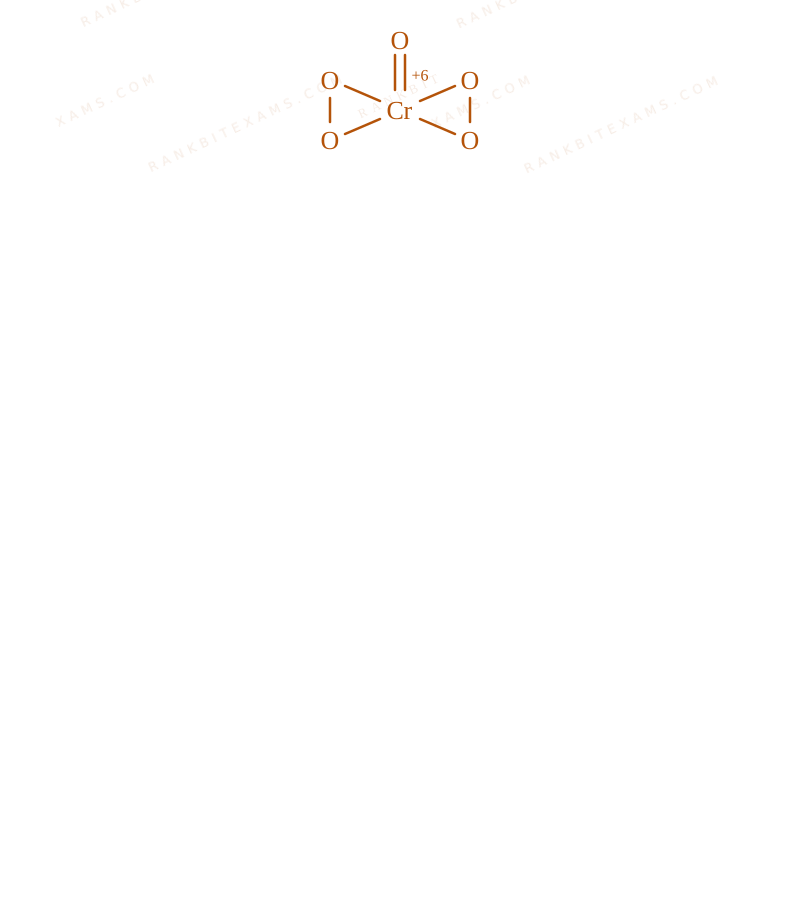
Acidifying the sodium chromate solution with H₂SO₄$H_2SO_4$ and adding H₂O₂$H_2O_2$ yields a deep blue solution of Chromium(VI) peroxide, CrO₅$CrO_5$ (C):
Na₂CrO₄ (B) + H₂SO₄ + 2H₂O₂ arrow CrO₅ (C) + Na₂SO₄ + 3H₂O$\mathrm{Na_2CrO_4} (\text{B}) + \mathrm{H_2SO_4} + 2\mathrm{H_2O_2} \rightarrow \mathrm{CrO_5} (\text{C}) + \mathrm{Na_2SO_4} + 3\mathrm{H_2O}$
Structure of CrO₅$CrO_5$:
Chromyl Chloride Test diagram for Q75 - JEE Main 2026 Morning
It has a butterfly structure.
Number of peroxy units (O₂²⁻$O_2^{2-}$), X = 2$X = 2$.
Total number of oxygen atoms, Y = 5$Y = 5$.
Oxidation state of Cr, Z = +6$Z = +6$.
Sum: X + Y + Z = 2 + 5 + 6 = 13$X + Y + Z = 2 + 5 + 6 = 13$.
Step 1: Final Calculation
X + Y + Z = 13$X + Y + Z = 13$
Pattern Recognition
Chromyl chloride testarrow$\rightarrow$CrO₂Cl₂$CrO_2Cl_2$ (red gas). Absorbed in NaOH arrow$\rightarrow$Na₂CrO₄$Na_2CrO_4$ (yellow). Tested with H₂O₂/H^+$H_2O_2/H^+$arrow$\rightarrow$CrO₅$CrO_5$ (butterfly structure, blue, two peroxy links, Cr in +6).
Chapter Mix
Class 12 Chemistry: d and f Block Elements
Class 11 Chemistry: Redox Reactions
An ion is diamagnetic if all its electrons are paired (i.e., zero unpaired electrons).
Let's write the electronic configuration for the elements in question.
Ions with an empty f-subshell (f⁰$f^0$, e.g., La³⁺, Ce⁴⁺$La^{3+}, Ce^{4+}$) or a completely filled f-subshell (f¹⁴$f^{14}$, e.g., Lu³⁺, Yb²⁺$Lu^{3+}, Yb^{2+}$) are invariably diamagnetic.
Chapter Mix
Class 12 Chemistry: The d- and f-Block Elements
Q76jee_main_2024_30_jan_morningTransition Elements
Let's determine the electronic configuration for each species by first writing the neutral atom's configuration, and then removing electrons starting from the outermost 4s$4s$ orbital.
A arrow$\rightarrow$ III
B arrow$\rightarrow$ II
C arrow$\rightarrow$ I
D arrow$\rightarrow$ IV
Chapter Mix
Class 12 Chemistry: The d- and f-Block Elements
Qjee_main_2024_31_jan_eveningProperties of Transition Metal Oxides
Choose the correct statements from the following
A. Mn₂O₇$Mn_2O_7$ is an oil at room temperature
B. V₂O₄$V_2O_4$ reacts with acid to give VO₂²⁺$VO_2^{2+}$
C. CrO$CrO$ is a basic oxide
D. V₂O₅$V_2O_5$ does not react with acid
Choose the correct answer from the options given below:
A.A, B and D only$\text{A, B and D only}$
B.A and C only$\text{A and C only}$
C.A, B and C only$\text{A, B and C only}$
D.B and C only$\text{B and C only}$
Solution
Core Logic
(A) Mn₂O₇$Mn_2O_7$ is a covalent oxide and exists as a green oil at room temperature. (Correct)
(B) V₂O₄$V_2O_4$ dissolves in acids to give VO²⁺$VO^{2+}$ (vanadyl) salts, not VO₂²⁺$VO_2^{2+}$. (Incorrect)
(C) CrO$CrO$ has chromium in the +2$+2$ oxidation state. Lower oxidation state metal oxides are typically basic in nature. (Correct)
(D) V₂O₅$V_2O_5$ is an amphoteric oxide; it reacts with both acids as well as bases. (Incorrect)
Step 1: Final Selection
Only statements A and C are correct, which corresponds to option (2).
Chapter Mix
Class 12 Chemistry: The d- and f-Block Elements
Q86jee_main_2024_31_jan_eveningChromyl Chloride Test
In the reaction of potassium dichromate, potassium chloride and sulfuric acid (conc.), the oxidation state of the chromium in the product is (+) ________
This reaction represents the Chromyl Chloride test used to detect the presence of chloride ions. When potassium dichromate is heated with a metal chloride in concentrated sulfuric acid, red vapors of chromyl chloride (CrO₂Cl₂$CrO_2Cl_2$) are evolved.
Step 1: Oxidation State Calculation
In chromyl chloride (CrO₂Cl₂$CrO_2Cl_2$):
Let the oxidation state of Chromium be x$x$.
Oxygen is typically -2$-2$ and Chlorine is -1$-1$.
x + 2(-2) + 2(-1) = 0$$x + 2(-2) + 2(-1) = 0$$
x - 4 - 2 = 0$x - 4 - 2 = 0$x = +6$x = +6$
Thus, the oxidation state of Chromium in the product is 6$6$.
Chapter Mix
Class 12 Chemistry: The d- and f-Block Elements
Class 11 Chemistry: Practical Chemistry
Q71jee_main_2024_31_jan_morningPotassium Dichromate and Permanganate
Identify correct statements from below:
A. The chromate ion is square planar.
B. Dichromates are generally prepared from chromates.
C. The green manganate ion is diamagnetic.
D. Dark green coloured K₂MnO₄$K_2MnO_4$ disproportionates in a neutral or acidic medium to give permanganate.
E. With increasing oxidation number of transition metal, ionic character of the oxides decreases.
Choose the correct answer from the options given below:
A.B, C, D only$\text{B, C, D only}$
B.A, D, E only$\text{A, D, E only}$
C.A, B, C only$\text{A, B, C only}$
D.B, D, E only$\text{B, D, E only}$
Solution
Step 1: Statement A Analysis
CrO₄²⁻$CrO_4^{2-}$ (chromate ion) is tetrahedral, not square planar. Statement A is incorrect.
Step 2: Statement B Analysis
2Na₂CrO₄ + 2H^+ arrow Na₂Cr₂O₇ + 2Na^+ + H₂O$2Na_2CrO_4 + 2H^+ \rightarrow Na_2Cr_2O_7 + 2Na^+ + H_2O$. Dichromates are indeed prepared from chromates. Statement B is correct.
Step 3: Statement C Analysis
The green manganate ion (MnO₄²⁻$MnO_4^{2-}$) has manganese in the +6 oxidation state (3d¹$3d^1$). Thus, it contains 1 unpaired electron and is paramagnetic, not diamagnetic. Statement C is incorrect.
Step 4: Statement D Analysis
Dark green coloured K₂MnO₄$K_2MnO_4$ undergoes disproportionation in neutral or acidic media to yield permanganate (MnO₄^-$MnO_4^-$) and manganese dioxide (MnO₂$MnO_2$). Statement D is correct.
Step 5: Statement E Analysis
Fajans' rule dictates that as the oxidation state increases, polarizing power increases, leading to a decrease in ionic character (increase in covalent character). Statement E is correct.
Final Conclusion
The correct statements are B, D, and E.
Chapter Mix
Class 12 Chemistry: The d- and f-Block Elements
More d and f Block Elements Questions — jee_main_2026_21_jan_morning
Practice past-year questions one chapter at a time. Pick an exam → subject → chapter and get every PYQ for that topic — pulled together from all past papers — with the chapter's key formulas alongside.