Consider the following reactions: NaCl + K_2Cr_2O_7 + H_2SO_4 rightarrow A + KHSO_4 + NaHSO_4 + H_2O A + NaOH rightarrow B + NaCl + H_2O B + H_2SO_4 + H_2O_2 rightarrow C + Na_2SO_4 + H_2O In the product 'C', 'X' is the number of O_2^2- units, 'Y' is the total number oxygen atoms present and 'Z' is the oxidation state of Cr. The value of X + Y + Z is ____.

Numerical Answer Type:
Enter a numerical value Answer: 13 to 13 +4 marks

Solution & Explanation

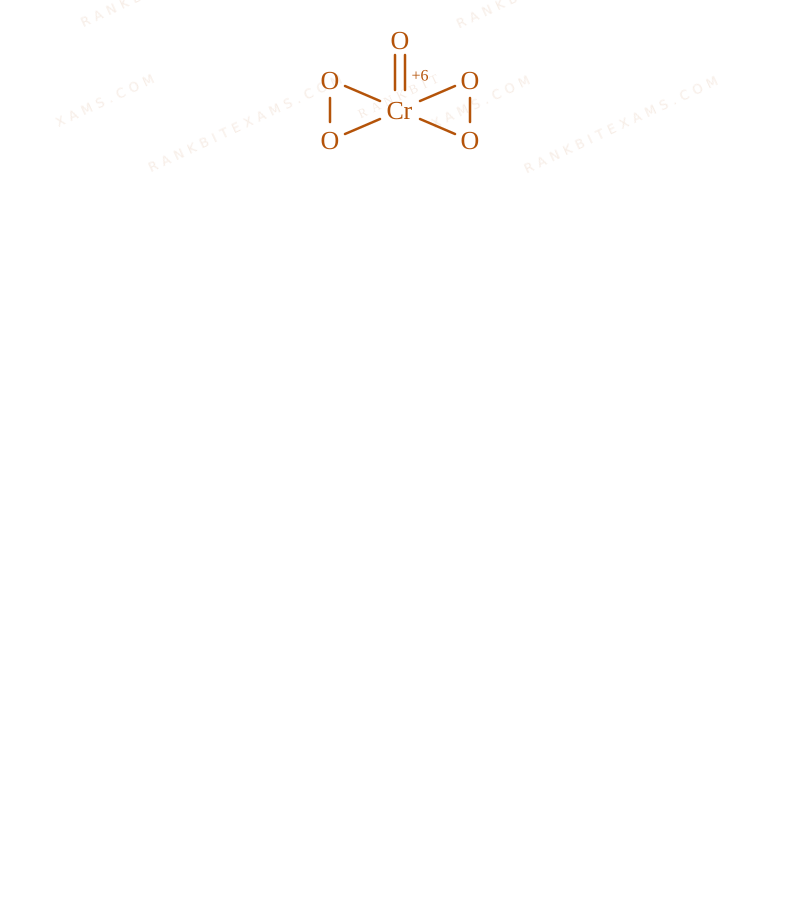
### Core Logic The first reaction is the classical **Chromyl Chloride Test**: 4mathrmNaCl + mathrmK_2Cr_2O_7 + 6mathrmH_2SO_4 rightarrow 2mathrmCrO_2Cl_2 (textA) + 2mathrmKHSO_4 + 4mathrmNaHSO_4 + 3mathrmH_2O Product A is Chromyl chloride (mathrmCrO_2Cl_2), a red-orange gas. When Chromyl chloride gas is passed into NaOH solution, it forms a yellow solution of sodium chromate (B): mathrmCrO_2Cl_2 (textA) + 4mathrmNaOH rightarrow mathrmNa_2CrO_4 (textB) + 2mathrmNaCl + 2mathrmH_2O Acidifying the sodium chromate solution with H_2SO_4 and adding H_2O_2 yields a deep blue solution of Chromium(VI) peroxide, CrO_5 (C): mathrmNa_2CrO_4 (textB) + mathrmH_2SO_4 + 2mathrmH_2O_2 rightarrow mathrmCrO_5 (textC) + mathrmNa_2SO_4 + 3mathrmH_2O Structure of CrO_5:
Chromyl Chloride Test diagram for Q75 - JEE Main 2026 Morning
- It has a butterfly structure. - Number of peroxy units (O_2^2-), X = 2. - Total number of oxygen atoms, Y = 5. - Oxidation state of Cr, Z = +6. Sum: X + Y + Z = 2 + 5 + 6 = 13. ### Step 1: Final Calculation X + Y + Z = 13 ### Pattern Recognition Chromyl chloride test rightarrow CrO_2Cl_2 (red gas). Absorbed in NaOH rightarrow Na_2CrO_4 (yellow). Tested with H_2O_2/H^+ rightarrow CrO_5 (butterfly structure, blue, two peroxy links, Cr in +6). ### Evaluation Rubric / Model Answer null ### Chapter Mix Class 12 Chemistry: d and f Block Elements Class 11 Chemistry: Redox Reactions

Reference Study Guides

More d and f Block Elements Previous-Year Questions — Page 2

Q39 jee_main_2025_07_april_morning Properties of Oxides
The first transition series metal 'M' has the highest enthalpy of atomisation in its series. One of its aquated ions (mathbfM^n+) exists in green colour. The nature of the oxide formed by the above M ion is:
  • A. textneutral
  • B. textacidic
  • C. textbasic
  • D. textamphoteric

Solution

### Core Logic 1. In the 3mathrmd transition series, **Vanadium (mathrmV)** has the highest enthalpy of atomisation (515 text kJ mol^-1). 2. One of its aquated ions, mathrmV^3+mathrm(aq) [specifically [mathrmV(H_2O)_6]^3+], has a characteristic **green colour**. 3. The corresponding oxide for this state is mathrmV_2mathrmO_3 (Vanadium(III) oxide). 4. Metal oxides in lower oxidation states (+2, +3) are typically **basic** in nature, while intermediate states like mathrmV_2mathrmO_4 are amphoteric, and high states like mathrmV_2mathrmO_5 are acidic. Therefore, mathrmV_2mathrmO_3 is purely a basic oxide. ### Pattern Recognition Vanadium (V) stands out with high atomisation enthalpy and characteristic oxidation states. Lower oxides of transition metals are always basic, higher oxidation state oxides are acidic. ### Evaluation Rubric / Model Answer null ### Chapter Mix Class 12 Chemistry: d- and f-Block Elements

Q36 jee_main_2025_08_april_evening Magnetic Properties
The correct decreasing order of spin-only magnetic moment values (BM) of textCu^+, \text{Cu}^{2+}, \text{Cr}^{2+}, and \text{Cr}^{3+}$ ions is:
  • A. textCu^+ > textCu^2+ > textCr^3+ > textCr^2+
  • B. textCu^2+ > textCu^+ > textCr^2+ > textCr^3+
  • C. textCr^2+ > textCr^3+ > textCu^2+ > textCu^+
  • D. textCr^3+ > textCr^2+ > textCu^+ > textCu^2+

Solution

### Related Formula Spin-only magnetic moment equation: mu = sqrtn(n+2) quad textBM where n is the exact count of unpaired d-shell electrons. ### Execution Let us compute the unpaired electron distribution for each transition metal ion: 1. **textCu^+**: Electronic configuration is [textAr]3d^10. All electrons are paired up. n = 0 implies mu = 0 text BM 2. **textCu^2+**: Electronic configuration is [textAr]3d^9. Has one unpaired hole. n = 1 implies mu = sqrt1(1+2) = sqrt3 approx 1.73 text BM 3. **textCr^3+**: Electronic configuration is [textAr]3d^3. Has three unpaired parallel spins. n = 3 implies mu = sqrt3(3+2) = sqrt15 approx 3.87 text BM 4. **textCr^2+**: Electronic configuration is [textAr]3d^4. Has four unpaired spins. n = 4 implies mu = sqrt4(4+2) = sqrt24 approx 4.90 text BM Arranging these values in decreasing structural order: mu(textCr^2+) > mu(textCr^3+) > mu(textCu^2+) > mu(textCu^+) ### Pattern Recognition The value of the spin-only magnetic moment scales monotonically with the number of unpaired electrons (n). More unpaired electrons directly translate to a higher magnetic moment, bypassing any tedious square-root calculations during testing. ### Evaluation Rubric / Model Answer null ### Chapter Mix Class 12 Chemistry: d- and f-Block Elements
Q44 jee_main_2025_28_jan_morning Oxidizing Properties of KMnO4 and K2Cr2O7
Which of the following oxidation reactions are carried out by both mathrmK_2mathrmCr_2mathrmO_7 and mathrmKMnO_4 in acidic medium? A. mathrmI^- rightarrow mathrmI_2 B. mathrmS^2- rightarrow mathrmS C. mathrmFe^2+ rightarrow mathrmFe^3+ D. mathrmI^- rightarrow mathrmIO_3^- E. mathrmS_2mathrmO_3^2- rightarrow mathrmSO_4^2- Choose the correct answer from the options given below:
  • A. textB, C and D only
  • B. textA, D and E only
  • C. textA, B and C only
  • D. textC, D and E only

Solution

### Core Logic In an acidic medium, both mathrmK_2mathrmCr_2mathrmO_7 and mathrmKMnO_4 act as strong oxidizing agents and carry out the following transformations: - **A:** Oxidize iodide to iodine: mathrmI^- rightarrow mathrmI_2 - **B:** Oxidize sulfide to elemental sulfur: mathrmS^2- rightarrow mathrmS - **C:** Oxidize ferrous ions to ferric ions: mathrmFe^2+ rightarrow mathrmFe^3+ For reactions D and E: - Iodide is oxidized to iodate (mathrmIO_3^-) by mathrmKMnO_4 primarily in a neutral or faintly alkaline medium, not acidic. - Thiosulfate (mathrmS_2mathrmO_3^2-) undergoes a disproportionation/precipitation reaction in acid rather than clean oxidation to sulfate by dichromate. Thus, statements A, B, and C are valid for both under acidic conditions. ### Pattern Recognition Sees: Shared oxidation products in an acidic environment. Shortcut: Remember that mathrmI^- rightarrow mathrmIO_3^- is the signature reaction for alkaline permanganate, allowing quick elimination of choices containing D. ### Evaluation Rubric / Model Answer null ### Chapter Mix Class 12 Chemistry: The d-and f-Block Elements
Q29 jee_main_2025_03_april_morning Magnetic Properties of Transition Metal Ions
The metal ions that have the calculated spin only magnetic moment value of 4.9 B.M. are: A. Cr^2+ B. Fe^2+ C. Fe^3+ D. Co^2+ E. Mn^3+ Choose the correct answer from the options given below:
  • A. A, C and E only
  • B. A, D and E only
  • C. B and E only
  • D. A, B and E only

Solution

### Related Formula The spin-only magnetic moment (mu) is given by: mu = sqrtn(n+2)text B.M. ### Core Logic Given mu = 4.9text B.M., we can solve for the number of unpaired electrons (n): 4.9 = sqrtn(n+2) implies 24.01 = n^2 + 2n implies n = 4 ### Step 1: Electron Configuration Audit Let us compute the number of unpaired electrons (n) for each ion: * **A.** _24textCr^2+: [textAr] 3d^4 implies n = 4 * B. _{26}\text{Fe}^{2+}: [\text{Ar}] 3d^{6} implies n = 4 * C. $_26textFe^3+: [textAr] 3d^5 implies n = 5 * D. _27textCo^2+: [textAr] 3d^7 implies n = 3 * E. _{25}\text{Mn}^{3+}: [\text{Ar}] 3d^{4} implies n = 4$ ### Step 2: Selection Thus, ions A, B, and E possess exactly 4 unpaired electrons and give a magnetic moment of 4.9\text{ B.M.} ### Pattern Recognition Shortcut: The value of the magnetic moment always starts with the integer equal to the number of unpaired electrons (4.x implies n = 4). Instantly filter configurations with d^4 or d^6$ profiles. ### Evaluation Rubric / Model Answer null ### Chapter Mix Class 12 Physics: d- and f-Block Elements
Q50 jee_main_2025_03_april_morning Potassium Dichromate - Preparation and Structure
Consider the following reactions: A+NaCl+H_2SO_4 ightarrow CrO_2Cl_2+textSide Products textCrO*2textCl*2(textVapour) + NaOH ightarrow B + NaCl + H_2O B+H^+ ightarrow C+H_2O The number of terminal 'O' present in the compound 'C' is
Numerical Answer. Answer: 6 to 6

Solution

### Core Logic Let us identify the sequential chemical components via the chromyl chloride test pathway: 1. Reactant **A** represents a dichromate salt like K_2Cr_2O_7. Heating it with metal chloride and concentrated acid generates deep red chromyl chloride vapors (CrO_2Cl_2). 2. Passing these vapors into sodium hydroxide dissolves them, producing yellow sodium chromate compound **B** (Na_2CrO_4). 3. Acidifying the chromate solution dimerizes it into orange sodium dichromate compound **C** (Na_2Cr_2O_7). ### Step 1: Structural Analysis of Dichromate The dichromate ion (Cr_2O_7^2-) consists of two tetrahedral chromium units sharing a bridging oxygen atom (textCr-textO-textCr). Each chromium atom retains 3 localized terminal oxygen units. Thus, the total count of terminal oxygen atoms in the structure is 2 times 3 = 6.
Dichromate structural topology breakdown diagram for Q50
### Pattern Recognition Shortcut: Chromyl chloride path loops directly from dichromate back to dichromate via chromate intermediate salts. Total oxygen atoms in textCr_2textO_7^2- is 7, out of which 1 is bridging, leaving exactly 6 terminal ones. ### Evaluation Rubric / Model Answer null ### Chapter Mix Class 12 Chemistry: d- and f-Block Elements

More d and f Block Elements Questions — jee_main_2026_21_jan_morning

Practice all d and f Block Elements previous-year questions →

Rankbit System
JEE Physics: Waves (+15.5%) | Electrostatics: Concentric Shells (-29.7%) | Modern Physics: Photoelectric Clones (+34.2%) | Mathematics: Definite Integrals (+18.1%) | Chemistry: Coordination Splitting (-11.4%) | JEE Physics: Waves (+15.5%) | Electrostatics: Concentric Shells (-29.7%) | Modern Physics: Photoelectric Clones (+34.2%) | Mathematics: Definite Integrals (+18.1%) | Chemistry: Coordination Splitting (-11.4%)
YOUR FIRST PREP STEP STARTS HERE

We Map Every Repeating Question in Competitive Exams.

Say goodbye to generic mock test fatigue. RankBit uses smart analysis to group past exam questions into their foundational Repeating Question Types. Find chapter weightage, track repeating questions, and score higher with targeted practice.

Select Your Target Exam

Choose an exam track below to find formulas per chapter and patterns.

Syncing Exam Intelligence

Mapping formulas and patterns across all tracks…

PATH A — FULL LENGTH PRACTICE

Full Mock Test Hub

Simulate real NTA exam conditions with fully tracked mocks. Time yourself against past papers.

Now Live Open
PATH B — TARGETED PRACTICE

Topic-wise Practice Hub

Practice past-year questions one chapter at a time. Pick an exam → subject → chapter and get every PYQ for that topic — pulled together from all past papers — with the chapter's key formulas alongside.

Loading Questions... Browse Topics
Latest from the Blog
View all →

Loading articles...