An organic compound (P) on treatment with aqueous ammonia under hot condition forms compound (Q) which on heating with Br_2 and KOH forms compound (R) having molecular formula C_9H_7N. Names of P, Q and R respectively are.

Solution & Explanation

### Core Logic The reaction of an amide with Br_2 and KOH is Hoffmann bromamide degradation. It steps down the carbon chain by one carbonyl carbon to form a primary amine. Let's analyze the options and molecular formula. The question says (R) has molecular formula C_9H_7N. Wait, looking at the standard solutions for this type of problem, aniline is C_6H_7N. The PDF says C_9H_7N which is likely a typo in the original paper for C_6H_7N, since option (1) gives Aniline (C_6H_7N). Let's assume the standard sequence: 1. mathrmPh-COOH xrightarrowmathrmNH_3, Delta mathrmPh-CO-NH_2 (Benzoic acid to Benzamide) 2. mathrmPh-CO-NH_2 xrightarrowmathrmBr_2/mathrmKOH mathrmPh-NH_2 (Benzamide to Aniline) Aniline is C_6H_5NH_2 = C_6H_7N. So P is Benzoic acid, Q is Benzamide, R is Aniline. ### Pattern Recognition Reaction sequence: Carboxylic\ Acid xrightarrowNH_3, Delta Amide xrightarrowBr_2/KOH Amine. The Br_2/KOH step is Hoffmann bromamide reaction. ### Evaluation Rubric / Model Answer null ### Chapter Mix Class 12 Chemistry: Amines Class 12 Chemistry: Aldehydes, Ketones and Carboxylic Acids
Reference Study Guides

More Amines Previous-Year Questions — Page 4

Q jee_main_2025_29_jan_morning Basic Character of Amines
Given below are some nitrogen containing compounds.
Nitrogen containing compounds profiles for Q46 - JEE Main 2025 Morning
Four amine candidates are indexed to find the optimal basic compound for reaction calculations.
Each of them is treated with HCl separately. 1.0 g of the most basic compound will consume ________ mg of HCl. (Given molar mass in g mol ^-1 C:12, H : 1, O : 16, Cl : 35.5)
Nitrogen containing compounds profiles for Q46 - JEE Main 2025 Morning
Four amine candidates are indexed to find the optimal basic compound for reaction calculations.
Numerical Answer. Answer: 341 to 341

Solution

### Related Formula textMoles = fractextMasstextMolar Mass textMass of HCl consumed = n_textamine cdot M_textHCl ### Core Logic Step 1: Identify the most basic amine Benzylamine (mathrmC_6mathrmH_5mathrmCH_2mathrmNH_2) is the most basic compound here because its nitrogen lone pair is localized and not involved in aromatic resonance. This stands in contrast to aniline or amides, which delocalize their lone pairs into the ring or carbonyl group . Step 2: Neutralization Stoichiometry mathrmC_6H_5CH_2NH_2 + mathrmHCl ightarrow mathrmC_6H_5CH_2NH_3^+ Cl^- Molar Mass of Benzylamine (mathrmC_7mathrmH_9mathrmN): M = (7 cdot 12) + (9 cdot 1) + 14 = 84 + 9 + 14 = 107 \, mathrmg/mol Moles of Benzylamine in 1.0text g : n = frac1.0107 simeq 0.009346 \, mathrmmol Since 1 mole of benzylamine reacts with 1 mole of mathrmHCl : textMoles of HCl consumed = 0.009346 \, mathrmmol textMass of HCl = 0.009346 cdot 36.5 = 0.3411 \, mathrmg = 341.1 \, mathrmmg ightarrow 341 ### Pattern Recognition Aliphatic localized clusters (like the -mathrmCH_2mathrmNH_2 segment in benzylamine) always show higher basicity than aromatic ring-conjugated arrays. ### Evaluation Rubric / Model Answer null ### Chapter Mix Class 12 Chemistry: Amines
Q70 jee_main_2024_01_february_morning Nomenclature of Amines
Given below are two statements: Statement (I) : Aminobenzene and aniline are same organic compounds. Statement (II) : Aminobenzene and aniline are different organic compounds. In the light of the above statements, choose the most appropriate answer from the options given below:
  • A. textBoth Statement I and Statement II are correct
  • B. textStatement I is correct but Statement II is incorrect
  • C. textStatement I is incorrect but Statement II is correct
  • D. textBoth Statement I and Statement II are incorrect

Solution

### Core Logic Aniline is the common name for the simplest aromatic amine, which consists of a phenyl group attached to an amino group (C_6H_5NH_2). According to IUPAC nomenclature, the amino group attached to a benzene ring can also be called aminobenzene. ### Step 1: Statement Validation Statement I: True. Aminobenzene is just the systematic IUPAC name for aniline. Statement II: False. They refer to the exact same molecule. ### Pattern Recognition Common names for simple aromatic compounds are often accepted as IUPAC names. Aniline = Benzenamine = Aminobenzene. ### Evaluation Rubric / Model Answer null ### Chapter Mix Class 12 Chemistry: Amines
Q80 jee_main_2024_01_february_morning Electrophilic Substitution
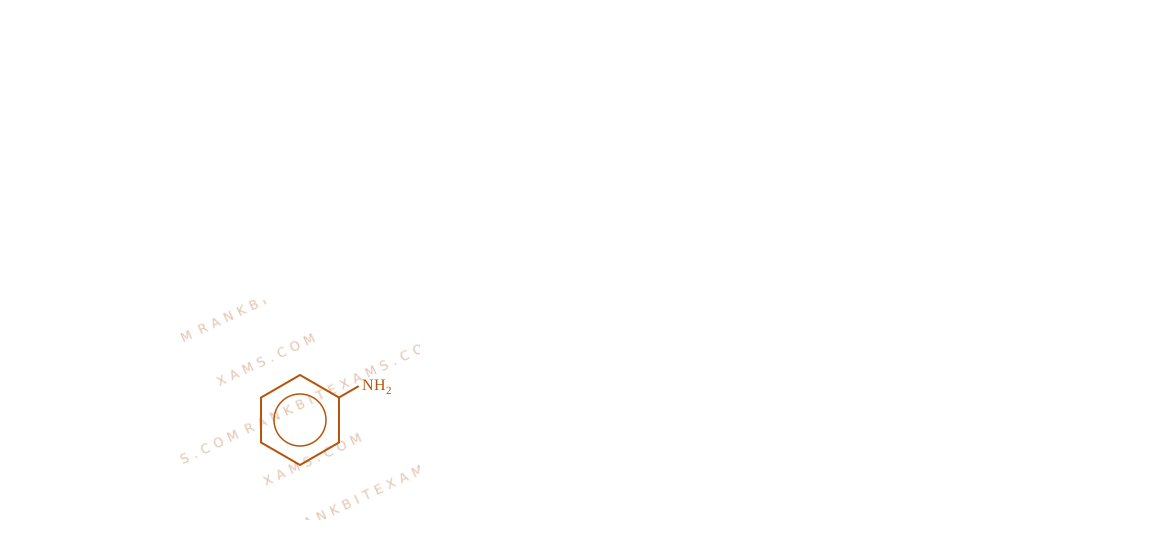
Given below are two statements: Statement (I): The NH_2 group in Aniline is ortho and para directing and a powerful activating group. Statement (II): Aniline does not undergo Friedel-Craft's reaction (alkylation and acylation). In the light of the above statements, choose the most appropriate answer from the options given below:
  • A. textBoth Statement I and Statement II are correct
  • B. textBoth Statement I and Statement II are incorrect
  • C. textStatement I is incorrect but Statement II is correct.
  • D. textStatement I is correct but Statement II is incorrect

Solution

### Core Logic Statement (I): The -NH_2 group has a lone pair of electrons on nitrogen, which undergoes resonance with the benzene ring (strong +M effect). This strongly activates the ring towards electrophilic substitution and directs incoming electrophiles to the ortho and para positions. Statement (II): Friedel-Crafts alkylation and acylation require a Lewis acid catalyst like anhydrous AlCl_3. Aniline is a Lewis base (due to the lone pair on N) and reacts with the Lewis acid AlCl_3 to form a stable salt/complex (C_6H_5overset+NH_2-AlCl_3^-). This removes the lone pair from resonance and converts the -NH_2 group into a strongly deactivating group, thereby halting the Friedel-Crafts reaction. ### Step 1: Evaluate Statements Statement I is correct. Statement II is correct. ### Pattern Recognition Aniline NEVER undergoes Friedel-Crafts because the base (NH_2) reacts with the catalyst (AlCl_3) before the reaction can proceed. ### Evaluation Rubric / Model Answer null ### Chapter Mix Class 12 Chemistry: Amines
Q68 jee_main_2024_29_jan_morning Electrophilic Substitution in Amines
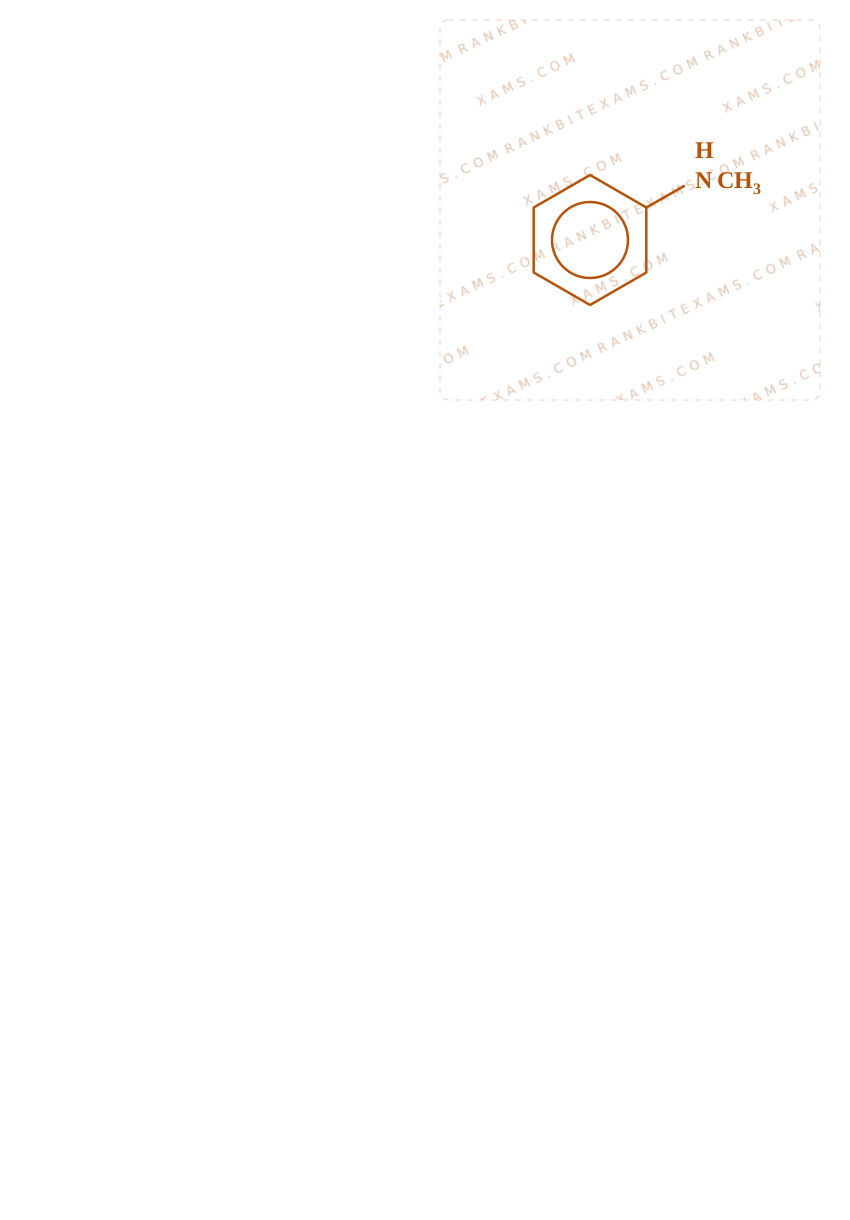
The arenium ion which is not involved in the bromination of Aniline is.
  • A. ""
  • B. ""
  • C. ""
  • D. ""

Solution

### Core Logic Aniline undergoes electrophilic aromatic substitution (like bromination). The -NH_2 group is a strongly activating group and directs incoming electrophiles to the ortho and para positions due to resonance electron donation (+M effect). ### Step 1: Identifying Sigma Complexes (Arenium Ions) When an electrophile (Br^+) attacks the ring, an intermediate arenium ion (sigma complex) is formed. - If attack occurs at the **ortho** or **para** position, the positive charge is delocalized onto the carbon atom bearing the -NH_2 group. The lone pair on nitrogen can then stabilize this positive charge via resonance, forming a highly stable resonance structure (an octet-complete intermediate). - If attack occurs at the **meta** position, the positive charge delocalizes only over the remaining ring carbons and never rests on the carbon bearing the -NH_2 group. Thus, it misses the extra stabilization provided by the nitrogen lone pair. Because the meta attack intermediate is less stable compared to ortho/para attack, and the -NH_2 is strictly o/p directing, the meta-arenium ion is NOT a primary intermediate involved in standard bromination pathways of neutral aniline. ### Step 2: Conclusion Option 3 displays the arenium ion resulting from a meta-attack (positive charge skips the -NH_2 substituted carbon).
Electrophilic Substitution in Amines diagram for Q68 - JEE Main 2024 Morning
Since -NH_2 is ortho/para directing, the meta-arenium ion will not be formed. ### Evaluation Rubric / Model Answer null ### Chapter Mix Class 12 Chemistry: Amines
Q68 jee_main_2024_30_january_evening Diazonium Salts
The products A and B formed in the following reaction scheme are respectively
Diazonium Salts diagram for Q68 - JEE Main 2024 Evening
The diagram shows a reaction pathway for synthesizing product A and B.
  • A.
  • B.
  • C.
  • D.

Solution

### Core Logic Step 1: Nitration of benzene using conc. HNO_3 and conc. H_2SO_4 gives nitrobenzene. Step 2: Reduction of nitrobenzene with Sn/HCl yields aniline. Step 3: Aniline reacts with NaNO_2/HCl at 0-5^circ C to form benzene diazonium chloride (Product A). Step 4: Benzene diazonium chloride undergoes a coupling reaction with phenol (typically in a mildly alkaline medium) to form p-hydroxyazobenzene, an orange dye (Product B).
Reaction pathway for products A and B diagram for Q68 - JEE Main 2024 Evening
The diagram shows a reaction pathway for synthesizing product A and B.
### Pattern Recognition Nitration rightarrow Reduction rightarrow Diazotization rightarrow Coupling (Azo Dye Test). ### Evaluation Rubric / Model Answer null ### Chapter Mix Class 12 Chemistry: Amines

More Amines Questions — jee_main_2026_21_jan_morning

Practice all Amines previous-year questions →

Rankbit System
JEE Physics: Waves (+15.5%) | Electrostatics: Concentric Shells (-29.7%) | Modern Physics: Photoelectric Clones (+34.2%) | Mathematics: Definite Integrals (+18.1%) | Chemistry: Coordination Splitting (-11.4%) | JEE Physics: Waves (+15.5%) | Electrostatics: Concentric Shells (-29.7%) | Modern Physics: Photoelectric Clones (+34.2%) | Mathematics: Definite Integrals (+18.1%) | Chemistry: Coordination Splitting (-11.4%)
YOUR FIRST PREP STEP STARTS HERE

We Map Every Repeating Question in Competitive Exams.

Say goodbye to generic mock test fatigue. RankBit uses smart analysis to group past exam questions into their foundational Repeating Question Types. Find chapter weightage, track repeating questions, and score higher with targeted practice.

Select Your Target Exam

Choose an exam track below to find formulas per chapter and patterns.

Syncing Exam Intelligence

Mapping formulas and patterns across all tracks…

PATH A — FULL LENGTH PRACTICE

Full Mock Test Hub

Simulate real NTA exam conditions with fully tracked mocks. Time yourself against past papers.

Now Live Open
PATH B — TARGETED PRACTICE

Topic-wise Practice Hub

Practice past-year questions one chapter at a time. Pick an exam → subject → chapter and get every PYQ for that topic — pulled together from all past papers — with the chapter's key formulas alongside.

Loading Questions... Browse Topics
Latest from the Blog
View all →

Loading articles...