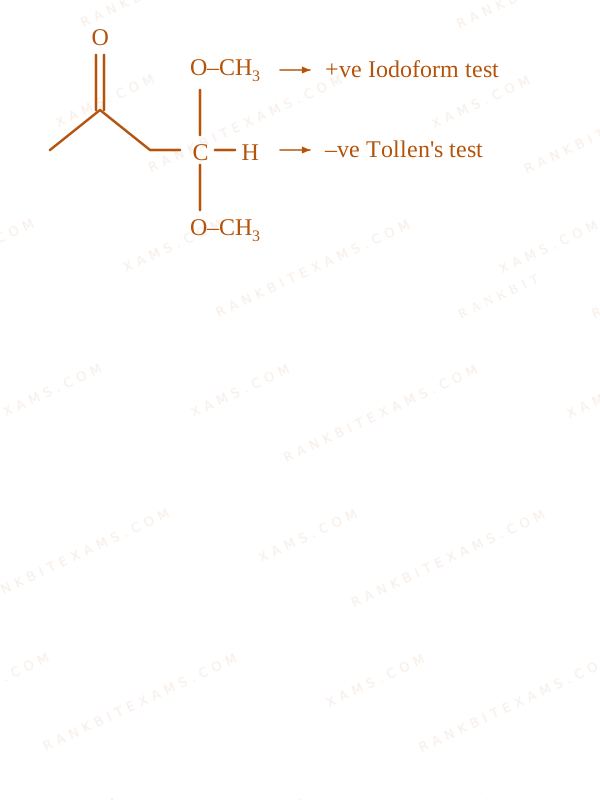
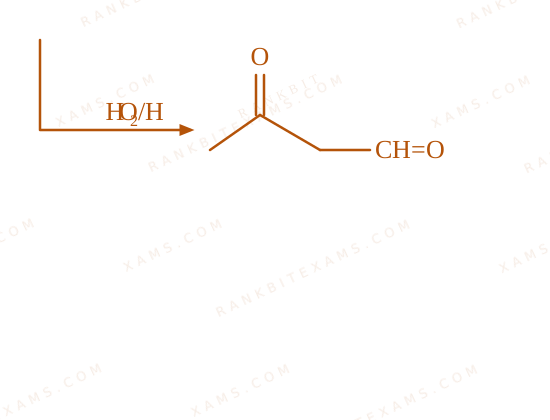
An organic compound “P” of molecular formula C_6H_12O_3 gives positive Iodoform test but negative Tollen’s test. When “P” is treated with dilute acid, it produces “Q”. “Q” gives positive Tollen’s test and also iodoform test. The structure of “P” is :

Solution & Explanation

### Core Logic Compound P (C_6H_12O_3) gives a positive iodoform test, indicating it has a methyl ketone group (CH_3CO-). It gives a negative Tollen's test, indicating no free aldehyde group. On acidic hydrolysis, P yields Q. Compound Q gives both positive iodoform test and Tollen's test, meaning Q contains both a methyl ketone and an aldehyde group. Looking at the options, if P is an acetal of an aldehyde, acidic hydrolysis will regenerate the aldehyde. Option 2 is mathrmCH_3-CO-CH_2-CH(OCH_3)_2 (an acetal of aldehyde). This compound 'P' has a CH_3CO- group (positive iodoform) and an acetal (protected aldehyde, negative Tollen's). On hydrolysis: mathrmCH_3-CO-CH_2-CH(OCH_3)_2 xrightarrowmathrmH_2O/H^+ mathrmCH_3-CO-CH_2-CHO + 2mathrmCH_3OH The product Q (mathrmCH_3-CO-CH_2-CHO) has a methyl ketone (positive iodoform test) and an aldehyde (positive Tollen's test).
Chemical Reactions of Aldehydes and Ketones diagram for Q61 - JEE Main 2026 Morning
### Pattern Recognition Whenever an aldehyde test becomes positive *after* hydrolysis, it points to a protected aldehyde, usually an acetal or hemiacetal. A compound with molecular formula C_n H_2n O_3 often represents a keto-acetal. ### Evaluation Rubric / Model Answer null ### Chapter Mix Class 12 Chemistry: Aldehydes, Ketones and Carboxylic Acids Class 12 Chemistry: Alcohols, Phenols and Ethers
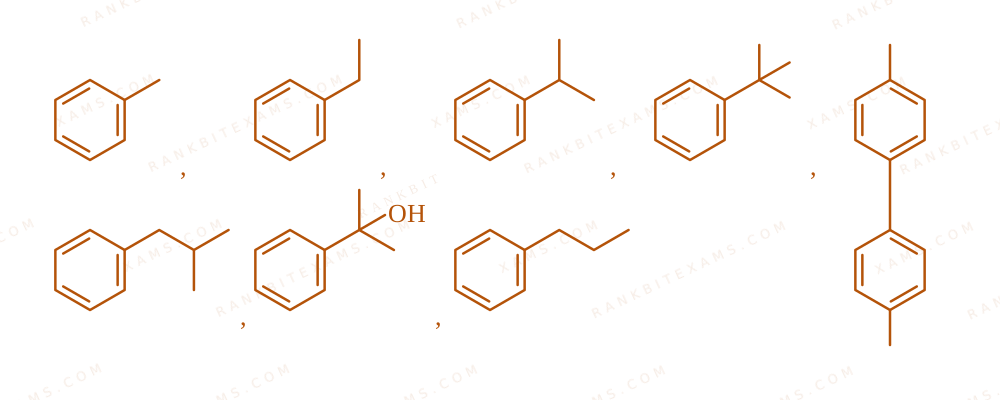
Chemical Reactions of Aldehydes and Ketones diagram for Q61 - JEE Main 2026 Morning

Reference Study Guides

More Aldehydes, Ketones and Carboxylic Acids Previous-Year Questions — Page 7
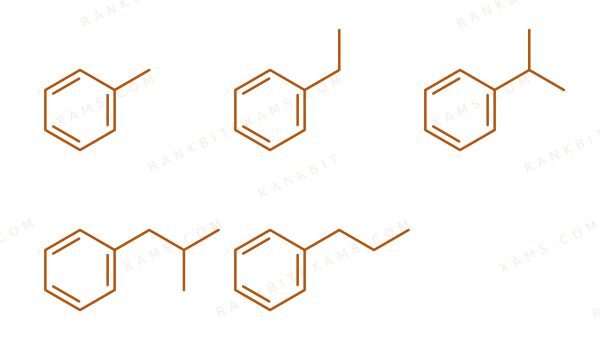
Q87 jee_main_2024_30_jan_morning Nucleophilic Addition Reactions
The compound formed by the reaction of ethanal with semicarbazide contains ________ number of nitrogen atoms.
Numerical Answer. Answer: 3 to 3

Solution

### Related Formula CH_3-CHO + H_2N-NH-CO-NH_2 rightarrow CH_3-CH=N-NH-CO-NH_2 + H_2O ### Core Logic Ethanal (CH_3CHO) reacts with semicarbazide (H_2N-NH-CO-NH_2) via nucleophilic addition followed by elimination of water to form a semicarbazone. ### Step 1: Product Analysis The product is Ethanal semicarbazone: CH_3-CH=N-NH-CO-NH_2. Counting the nitrogen atoms in this structure: 1. The imine nitrogen (=N-) 2. The amine nitrogen (-NH-) 3. The amide nitrogen (-NH_2) Total = 3 Nitrogen atoms. ### Evaluation Rubric / Model Answer null ### Chapter Mix Class 12 Chemistry: Aldehydes, Ketones and Carboxylic Acids
Q73 jee_main_2024_31_jan_evening Preparation of Aldehydes and Ketones
Identify the name reaction.
Preparation of Aldehydes and Ketones diagram for Q73 - JEE Main 2024 Evening
The image shows the conversion of benzene to benzaldehyde using CO, HCl, and Anhydrous AlCl3/CuCl.
  • A. text(1) Stephen reaction
  • B. text(2) Etard reaction
  • C. text(3) Gatterman-koch reaction
  • D. text(4) Rosenmund reduction

Solution

### Core Logic The reaction of benzene with carbon monoxide (CO) and hydrogen chloride (HCl) in the presence of anhydrous aluminium chloride (AlCl_3) and cuprous chloride (CuCl) to give benzaldehyde is known as the Gatterman-Koch reaction.
Preparation of Aldehydes and Ketones diagram for Q73 - JEE Main 2024 Evening
The image shows the conversion of benzene to benzaldehyde using CO, HCl, and Anhydrous AlCl3/CuCl.
### Pattern Recognition CO + HCl rightarrow Formyl chloride intermediate (in situ) with Lewis acid rightarrow formylation of benzene. This is definitively the Gatterman-Koch formylation. ### Evaluation Rubric / Model Answer null ### Chapter Mix Class 12 Chemistry: Aldehydes, Ketones and Carboxylic Acids
Q84 jee_main_2024_31_jan_morning Reactions with Grignard Reagent
The product of the following reaction is P.
Reactions with Grignard Reagent diagram for Q84 - JEE Main 2024 Morning
The image shows p-hydroxybenzaldehyde reacting with one equivalent of PhMgBr followed by aqueous ammonium chloride.
The number of hydroxyl groups present in the product P is
Numerical Answer. Answer: 0 to 0

Solution

### Core Logic The given reactant is p-hydroxybenzaldehyde, which contains both a phenolic -OH group (acidic) and an aldehyde group (electrophilic). When one equivalent of Grignard reagent (PhMgBr) is added, it behaves primarily as a strong base due to the presence of an acidic proton. Acid-base reactions are extremely fast compared to nucleophilic additions. The acidic phenolic -OH reacts with PhMgBr: PhMgBr + HO-C_6H_4-CHO rightarrow Ph-H (Benzene) + BrMg-O-C_6H_4-CHO Upon workup with aq. NH_4Cl, the phenoxide ion simply regenerates the starting p-hydroxybenzaldehyde. However, the question asks for the number of hydroxyl groups present in the formed product (Benzene).
Reactions with Grignard Reagent diagram for Q84 - JEE Main 2024 Morning
The image shows p-hydroxybenzaldehyde reacting with one equivalent of PhMgBr followed by aqueous ammonium chloride.
The distinct product formed in the reaction is Benzene. Benzene has 0 hydroxyl groups. ### Pattern Recognition Whenever a Grignard reagent encounters a molecule with an acidic hydrogen (alcohol, phenol, amine, alkyne), it will invariably act as a base first. If only 1 equivalent is used, nucleophilic addition to carbonyls will NOT happen. ### Evaluation Rubric / Model Answer null ### Chapter Mix Class 12 Chemistry: Aldehydes, Ketones and Carboxylic Acids Class 12 Chemistry: Alcohols, Phenols and Ethers

More Aldehydes, Ketones and Carboxylic Acids Questions — jee_main_2026_21_jan_morning

Practice all Aldehydes, Ketones and Carboxylic Acids previous-year questions →

Rankbit System
JEE Physics: Waves (+15.5%) | Electrostatics: Concentric Shells (-29.7%) | Modern Physics: Photoelectric Clones (+34.2%) | Mathematics: Definite Integrals (+18.1%) | Chemistry: Coordination Splitting (-11.4%) | JEE Physics: Waves (+15.5%) | Electrostatics: Concentric Shells (-29.7%) | Modern Physics: Photoelectric Clones (+34.2%) | Mathematics: Definite Integrals (+18.1%) | Chemistry: Coordination Splitting (-11.4%)
YOUR FIRST PREP STEP STARTS HERE

We Map Every Repeating Question in Competitive Exams.

Say goodbye to generic mock test fatigue. RankBit uses smart analysis to group past exam questions into their foundational Repeating Question Types. Find chapter weightage, track repeating questions, and score higher with targeted practice.

Select Your Target Exam

Choose an exam track below to find formulas per chapter and patterns.

Syncing Exam Intelligence

Mapping formulas and patterns across all tracks…

PATH A — FULL LENGTH PRACTICE

Full Mock Test Hub

Simulate real NTA exam conditions with fully tracked mocks. Time yourself against past papers.

Now Live Open
PATH B — TARGETED PRACTICE

Topic-wise Practice Hub

Practice past-year questions one chapter at a time. Pick an exam → subject → chapter and get every PYQ for that topic — pulled together from all past papers — with the chapter's key formulas alongside.

Loading Questions... Browse Topics
Latest from the Blog
View all →

Loading articles...