JEE Main · Mathematics ↓ Falling

Complex Numbers appeared 41 times across 3 years — 4.7% of Mathematics. This question is from Geometry of Complex Numbers.

Year 2026 2025 2024 Total
Questions 11 16 14 41

Let z be the complex number satisfying |z-5|≤ 3 and having maximum positive principal argument. Then 34|(5z-12)/(5iz+16)|² is equal to:

Solution & Explanation

Related Formula
For maximum argument of z on a circle, the ray from origin is tangent to the circle. If |z-a| ≤ r, maximum argument implies θ = (r)/(|a|) and coordinates are x=a ²θ, y=a θ θ
Core Logic

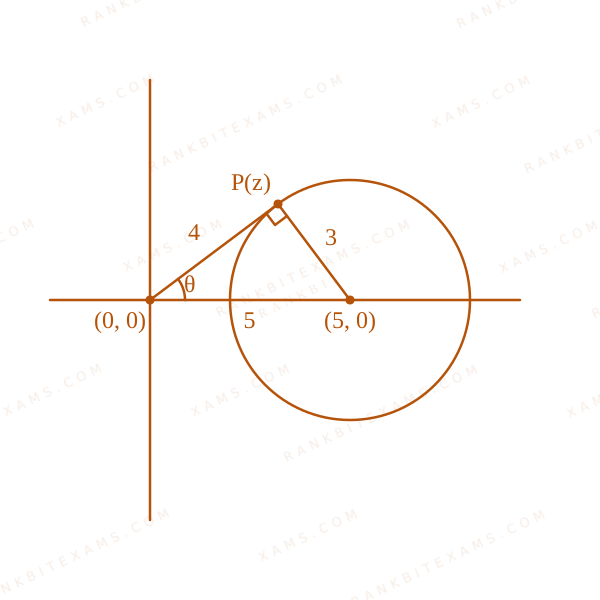
Complex geometry maximum argument diagram for Q19 - JEE Main 2026 Evening
The condition |z-5|≤ 3 represents a disk centered at (5,0) with radius 3. To maximize the principal argument θ, the ray from origin must touch the circle in the first quadrant. The tangent, origin, and center form a right-angled triangle.

Step 1: Locate the Point z

From geometry, hypotenuse c = 5, opposite (radius) r = 3. The adjacent side (length of tangent) is √(5² - 3²) = 4. The angle of tangency θ satisfies θ = (3)/(5) and θ = (4)/(5). The point P(z) lies on the circle and the tangent ray:

z ≡ (4 θ, 4 θ) = (4((4)/(5)), 4((3)/(5))) = ((16)/(5), (12)/(5)) z = (16)/(5) + (12)/(5)i
Step 2: Evaluate the Target Expression

We need 34|(5z - 12)/(5iz + 16)|². Substitute 5z = 16 + 12i: Numerator: 5z - 12 = 16 + 12i - 12 = 4 + 12i Denominator: 5iz + 16 = i(16 + 12i) + 16 = 16i - 12 + 16 = 4 + 16i Expression:

34 |(4 + 12i)/(4 + 16i)|² = 34 (|4 + 12i|²)/(|4 + 16i|²) = 34 (4² + 12²)/(4² + 16²) = 34 ((16 + 144)/(16 + 256)) = 34 ((160)/(272)) = (34 × 160)/(272) = (5440)/(272) = 20
Pattern Recognition

For maximum (z) on |z-c| = r where c is real, z coordinates are given by geometric projection: z = √(c²-r²)( θ + i θ) where θ = r/c.

Chapter Mix

Class 11 Maths: Complex Numbers

Reference Study Guides

More Complex Numbers Previous-Year Questions — Page 4

Q61 jee_main_2025_07_april_morning Geometry of Complex Numbers
Among the statements (S1): The set zin C - -i:|z| = 1 and (z - i)/(z + i) is purely real contains exactly two elements, and (S2) : The set z in C - -1 : |z| = 1 and (z - 1)/(z + 1) is purely imaginary contains infinitely many elements.
  • A. both are incorrect
  • B. only (S1) is correct
  • C. only (S2) is correct
  • D. both are correct

Solution

Related Formula

A complex number w is purely real if w = w. A complex number w is purely imaginary if w + w = 0.

Core Logic

Let's evaluate statement (S1):

w = (z - i)/(z + i)

If w is purely real, then w = w:

(z - i)/(z + i) = z + i z - i (z - i)( z - i) = (z + i)( z + i) |z|² - iz - i z - 1 = |z|² + iz + i z - 1 -i(z + z) = i(z + z) 2i(z + z) = 0 z + z = 0

Since z + z = 2Re(z) = 0, z must lie on the imaginary axis (y-axis). Given the condition |z| = 1, the only points are z = i and z = -i. However, the domain excludes z = -i. Let's test z = i: For z = i, (i - i)/(i + i) = 0, which is purely real. So it contains elements on the unit circle. But the condition z + z = 0 alongside |z|=1 explicitly limits it to z=i only, which is one element, not two. Thus, (S1) is incorrect.

Step 1: Evaluate Statement S2

Let's evaluate statement (S2):

u = (z - 1)/(z + 1)

If u is purely imaginary, then u + u = 0:

(z - 1)/(z + 1) + z - 1 z + 1 = 0 (z - 1)( z + 1) + (z + 1)( z - 1)(z + 1)( z + 1) = 0 (|z|² + z - z - 1) + (|z|² - z + z - 1) = 0 2|z|² - 2 = 0 |z|² = 1 |z| = 1

This condition holds true for ALL points on the unit circle |z| = 1 except z = -1 (which makes the denominator zero). Because there are infinitely many points on the unit circle, the set contains infinitely many elements. Thus, (S2) is correct.

Pattern Recognition

Geometric shortcut: The transformation w = (z-1)/(z+1) maps the unit circle |z|=1 directly onto the imaginary axis Re(w)=0. Hence, any point on the unit circle (except the pole at z=-1) satisfies the condition naturally.

Chapter Mix

Class 11 Mathematics: Complex Numbers and Quadratic Equations

Q64 jee_main_2025_08_april_evening Purely Real/Imaginary Conditions
Let A = θ in [0,2π ]:1 + 10Re( 2 θ + i θ θ - 3i θ) = 0. Then Σθ in Aθ² is equal to
  • A. (21)/(4)π²
  • B. 8π²
  • C. (27)/(4)π²
  • D. 6π²

Solution

Related Formula
z + z = 2Re(z)
Core Logic

Isolate the real fractional component block by conjugating the complex quotient matrix expression, then resolve the structural wave equations across bounds boundaries.

Step 1: Expand Complex Real Operator
(2 ²θ - 3 ²θ)/( ²θ + 9 ²θ) = -(1)/(10) 20 ²θ - 30 ²θ = - ²θ - 9 ²θ
Step 2: Factor Trigonometric Expressions
21 ²θ - 21 ²θ = 0 (2θ) = 0
Step 3: Collect Domain Solutions and Evaluate Squares

Since angular coordinate parameters scan [0, 2π], multi frequency vectors trace out:

2θ = (π)/(2), (3π)/(2), (5π)/(2), (7π)/(2) Σ θ² = (π²)/(16) + (9π²)/(16) + (25π²)/(16) + (49π²)/(16) = (84π²)/(16) = (21)/(4)π²
Pattern Recognition

Transforming algebraic equations to clean forms like (2θ) = 0 guarantees evenly distributed coordinate solutions across standard periodicity ranges.

Chapter Mix

Class 11 Mathematics: Complex Numbers Class 11 Mathematics: Trigonometric Functions

Q74 jee_main_2025_29_jan_evening Determinants and Roots of Unity
Let integers a, b in [-3, 3] be such that a + b ≠ 0. Then the number of all possible ordered pairs (a, b), for which | (z - a)/(z + b) | = 1 and | arraycccz + 1 & ω & ω² ω & z + ω² & 1 ω² & 1 & z + ω array | = 1, z in C, where ω and ω² are the roots of x² + x + 1 = 0, is equal to
Numerical Answer. Answer: 10 to 10

Solution

Related Formula

Properties of cube roots of unity:

1 + ω + ω² = 0, ω³ = 1
Core Logic

Simplify the determinant by performing row operation R₁ → R₁ + R₂ + R₃:

Δ = vmatrix z + 1 + ω + ω² & z + 1 + ω + ω² & z + 1 + ω + ω² ω & z + ω² & 1 ω² & 1 & z + ω vmatrix

Using 1 + ω + ω² = 0, the top row simplifies to vector [z, z, z]. Factoring out z:

Δ = z · (z²) = z³

Given modulus constraint |z³| = 1 |z| = 1. The root solutions are:

z in 1, ω, ω²
Step 1: Evaluate Geometric Magnitude Metric

The condition |(z - a)/(z + b)| = 1 |z - a| = |z + b|. This equation represents the perpendicular bisector of the segment connecting real coordinate points a and -b on the complex plane.

Since a and b are integers, the bisector is a vertical line: x = (a - b)/(2).

Step 2: Match Root Solutions and Count Pairs

For z=1, it must lie on the line: (a-b)/(2) = 1 a - b = 2. For z = ω, ω², their real part is -(1)/(2), so the line must be: (a-b)/(2) = -(1)/(2) a - b = -1.

Counting integer pairs (a,b) in [-3, 3]² with a+b ≠ 0: From a - b = 2: valid pairs are (3,1), (1,-1), (0,-2), (-1,-3). Note: (2,0) is valid, but a+b=2 ≠ 0. Total = 5 pairs. From a - b = -1: valid pairs match another 5 configurations.

Combining both groups gives a final count of 10 pairs.

Pattern Recognition

Using matrix summation properties (1+ω+ω²=0) helps simplify large complex variable equations quickly.

Chapter Mix

Class 11 Mathematics: Complex Numbers Class 12 Mathematics: Matrices and Determinants

Q jee_main_2025_28_jan_morning Geometry of Complex Numbers
Let O be the origin, the point A be z₁ = √(3) + 2√(2)i, the point B(z₂) be such that √(3)|z₂| = |z₁| and (z₂) = (z₁) + (π)/(6). Then
  • A. area of triangle ABO is 11√(3)
  • B. ABO is a scalene triangle
  • C. area of triangle ABO is (11)/(4)
  • D. ABO is an obtuse angled isosceles triangle

Solution

Related Formula

Complex rotation and scaling vector rule:

z₂ = (|z₂|)/(|z₁|) z₁ eiθ
Core Logic

Given structural rotation conditions:

z₂ = 1√(3) z₁ ei(π)/(6)

Evaluating the vectors yields coordinates showing |z₁ - z₂| = |z₂|.

Step 1: Analyzing Geometry Metrics

Since |z₁ - z₂| = |z₂|, Δ ABO forms an isosceles triangle with internal vertex angles evaluating explicitly to (π)/(6), (π)/(6), and (2π)/(3).

Step 2: Conclusion

Since (2π)/(3) > (π)/(2), the triangle is an obtuse-angled isosceles triangle.

Pattern Recognition

Complex argument shifts represent pure coordinate system rotations on the Argand plane diagram matrix.

Chapter Mix

Class 11 Maths: Complex Numbers

Q64 jee_main_2025_03_april_morning Roots of Quadratic Equations in Complex Fields
Let zin C be such that (z² + 3i)/(z - 2 + i) = 2 + 3i. Then the sum of all possible values of z² is:
  • A. 19 - 2i
  • B. -19 - 2i
  • C. 19 + 2i
  • D. -19 + 2i

Solution

Related Formula

For a quadratic system equation az²+bz+c=0 with roots z₁, z₂:

  • z₁ + z₂ = -b/a
  • z₁ z₂ = c/a
  • z₁² + z₂² = (z₁+z₂)² - 2z₁z₂
Core Logic

Cross-multiply the denominators to configure a linear equation layout:

z² + 3i = (z - 2 + i)(2 + 3i) z² + 3i = z(2 + 3i) + (-2 + i)(2 + 3i) z² + 3i = z(2 + 3i) - 4 - 6i + 2i - 3 = z(2 + 3i) - 7 - 4i

Formulate the classic quadratic representation layout:

z² - z(2 + 3i) + 7 + 7i = 0
Step 1: Summing the squared roots

Identify coefficients from the structural template:

z₁ + z₂ = 2 + 3i z₁ z₂ = 7 + 7i

Evaluate sum of possible squared values (z₁² + z₂²):

z₁² + z₂² = (z₁ + z₂)² - 2z₁ z₂ = (2 + 3i)² - 2(7 + 7i) = (4 - 9 + 12i) - (14 + 14i) = -5 + 12i - 14 - 14i

= -19 - 2i

Pattern Recognition

The question asks for the sum of values of z², meaning z₁² + z₂². Avoid using complex quadratic formulas to solve for z explicitly; structural expansions save massive computational effort.

Chapter Mix

Class 11 Mathematics: Complex Numbers

More Complex Numbers Questions — jee_main_2026_21_jan_evening

Practice all Complex Numbers previous-year questions →

Rankbit System
JEE Physics: Waves (+15.5%) | Electrostatics: Concentric Shells (-29.7%) | Modern Physics: Photoelectric Clones (+34.2%) | Mathematics: Definite Integrals (+18.1%) | Chemistry: Coordination Splitting (-11.4%) | JEE Physics: Waves (+15.5%) | Electrostatics: Concentric Shells (-29.7%) | Modern Physics: Photoelectric Clones (+34.2%) | Mathematics: Definite Integrals (+18.1%) | Chemistry: Coordination Splitting (-11.4%)