Rankbit System
JEE Physics: Waves (+15.5%) | Electrostatics: Concentric Shells (-29.7%) | Modern Physics: Photoelectric Clones (+34.2%) | Mathematics: Definite Integrals (+18.1%) | Chemistry: Coordination Splitting (-11.4%) | JEE Physics: Waves (+15.5%) | Electrostatics: Concentric Shells (-29.7%) | Modern Physics: Photoelectric Clones (+34.2%) | Mathematics: Definite Integrals (+18.1%) | Chemistry: Coordination Splitting (-11.4%)

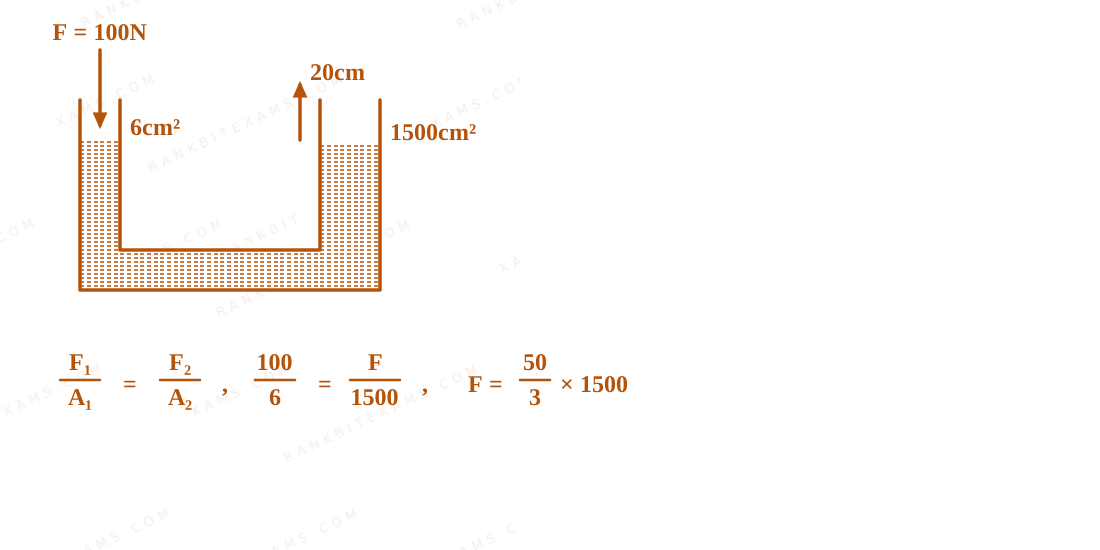
In a hydraulic lift, the surface area of the input piston is 6mathrmcm^2 and that of the output piston is 1500mathrmcm^2 . If 100mathrmN force is applied to the input piston to raise the output piston by 20mathrmcm , then the work done is ________ kJ. [cite: 1, 2]

Numerical Answer Type:
Enter a numerical value Answer: 5 to 5 +4 marks

Solution & Explanation

### Related Formula W = F_1 cdot s_1 = F_2 cdot s_2 ### Core Logic By conservation of liquid volume displacement during output piston elevation : A_1 cdot s_1 = A_2 cdot s_2 implies 6 cdot s_1 = 1500 cdot 20 implies s_1 = 5000text cm = 50text m Work performed on input boundary matches : W = F_1 cdot s_1 = 100text N cdot 50text m = 5000text J = 5text kJ Alternatively via output force profile calculation:
Hydraulic lift work diagram allocation
F_2 = F_1 fracA_2A_1 = 100 frac15006 = 25000text N W = F_2 cdot s_2 = 25000 cdot 0.2 = 5000text J = 5text kJ ### Chapter Mix Class 11 Physics: Mechanical Properties of Fluids

Reference Study Guides

More Mechanical Properties of Fluids Previous-Year Questions — Page 3

Q3 2025 Excess Pressure and Surface Tension
An air bubble of radius 0.1 cm lies at a depth of 20 cm below the free surface of a liquid of density 1000text kg/m^3 If the pressure inside the bubble is 2100 N/m² greater than the atmospheric pressure, then the surface tension of the liquid in SI unit is (use g=10text m/s^2)
  • A. 0.02
  • B. 0.1
  • C. 0.25
  • D. 0.04

Solution

### Related Formula The absolute pressure inside an air bubble submerged in a liquid is given by : P_textin = P_0 + ho gh + frac2TR where P_0 is atmospheric pressure, ho is the liquid density, g is gravity, h is depth, T is surface tension, and R is the radius. ### Core Logic We are given that the difference between the inside pressure and atmospheric pressure is 2100text N/m^2: P_textin - P_0 = ho gh + frac2TR = 2100 ### Step 1: Numerical Evaluation Substitute the given values into the relation : ho gh = 1000 times 10 times 0.20 = 2000text N/m^2 Now find the excess pressure from surface tension: frac2TR = 2100 - 2000 = 100text N/m^2 T = frac100 times R2 = 50 times (0.1 times 10^-2) = 0.05text N/m ### Pattern Recognition Total inside pressure accounts for both the hydrostatic pressure of the fluid column ( ho gh) and the spherical geometry boundary constraint pressure (frac2TR). ### Evaluation Rubric / Model Answer null ### Chapter Mix Class 11 Physics: Mechanical Properties of Fluids

Q7 2025 Surface Energy
The amount of work done to break a big water drop of radius 'R' into 27 small drops of equal radius is 10 J. The work done required to break the same big drop into 64 small drops of equal radius will be :-
  • A. 15 J
  • B. 10 J
  • C. 20 J
  • D. 5 J

Solution

### Related Formula The work done W in expanding surface area with surface tension S is given by: W = S cdot Delta A ### Core Logic By volume conservation during splitting : frac43pi R^3 = n left(frac43pi r^3 ight) implies r = fracRn^1/3 Total change in area gives work expression[cite: 636, 637]: W = S left(n cdot 4pi r^2 - 4pi R^2 ight) = 4pi R^2S left(n^1/3 - 1 ight) ### Step 1: Set up Proportions For n = 27 drops [cite: 53, 644]: W = 4pi R^2S (27^1/3 - 1) = 4pi R^2S (3 - 1) = 2(4pi R^2S) = 10text J 4pi R^2S = 5text J For n = 64 drops [cite: 53, 644]: W' = 4pi R^2S (64^1/3 - 1) = 4pi R^2S (4 - 1) = 3(4pi R^2S) W' = 3 times 5 = 15text J ### Pattern Recognition Work scales scaling-wise linearly with the key multiplier index (n^1/3 - 1). Taking ratios between targets directly avoids calculations of constants. ### Evaluation Rubric / Model Answer null ### Chapter Mix Class 11 Physics: Mechanical Properties of Fluids
Q18 2025 Archimedes Principle
A 400mathrmg solid cube having an edge of length 10mathrmcm floats in water. How much volume of the cube is outside the water? (Given: density of water = 1000mathrmkgmathrmm^-3 )
  • A. 1400mathrmcm^3
  • B. 4000mathrmcm^3
  • C. 400mathrmcm^3
  • D. 600~mathrmcm^3

Solution

### Related Formula By the law of flotation, the weight of a floating body must exactly balance the buoyant force exerted by the displaced fluid volume: M cdot g = rho_textfluid cdot V_textsubmerged cdot g ### Core Logic Given parameters: * Mass of the cube, M = 400 text g = 0.4 text kg * Total volume of the cube, V_texttotal = (10 text cm)^3 = 1000 text cm^3 = 10^-3 text m^3 * Density of water, rho_textwater = 1000 text kg/m^3 Equating weight to buoyant force to find the submerged volume V_d : 0.4 = 1000 times V_textsubmerged V_textsubmerged = frac0.41000 = 4 times 10^-4 text m^3 = 400 text cm^3 quad text Calculate the volume remaining outside the water surface : V_textoutside = V_texttotal - V_textsubmerged V_textoutside = 1000 text cm^3 - 400 text cm^3 = 600 text cm^3 quad text ### Pattern Recognition The fraction of a floating body's volume that is submerged equals the ratio of the body's density to the fluid's density: fracV_textsubmergedV_texttotal = fracrho_textbodyrho_textfluid. Here, the cube's effective density is 0.4 text g/cm^3, meaning 40\% is submerged and 60\% stays outside. ### Evaluation Rubric / Model Answer null ### Chapter Mix Class 11 Physics: Mechanical Properties of Fluids

More Mechanical Properties of Fluids Questions — jee_main_2025_29_jan_morning

Practice all Mechanical Properties of Fluids previous-year questions →

YOUR FIRST PREP STEP STARTS HERE

We Map Every Repeating Question in Competitive Exams.

Say goodbye to generic mock test fatigue. RankBit uses smart analysis to group past exam questions into their foundational Repeating Question Types. Find chapter weightage, track repeating questions, and score higher with targeted practice.

Select Your Target Exam

Choose an exam track below to find formulas per chapter and patterns.

Syncing Exam Intelligence

Mapping formulas and patterns across all tracks…

PATH A — FULL LENGTH PRACTICE

Full Mock Test Hub

Simulate real NTA exam conditions with fully tracked mocks. Time yourself against past papers.

Under Development
PATH B — TARGETED PRACTICE

Topic-wise Practice Hub

Practice past-year questions one chapter at a time. Pick an exam → subject → chapter and get every PYQ for that topic — pulled together from all past papers — with the chapter's key formulas alongside.

Loading Questions... Browse Topics
Latest from the Blog
View all →

Loading articles...