Rankbit System
JEE Physics: Waves (+15.5%) | Electrostatics: Concentric Shells (-29.7%) | Modern Physics: Photoelectric Clones (+34.2%) | Mathematics: Definite Integrals (+18.1%) | Chemistry: Coordination Splitting (-11.4%) | JEE Physics: Waves (+15.5%) | Electrostatics: Concentric Shells (-29.7%) | Modern Physics: Photoelectric Clones (+34.2%) | Mathematics: Definite Integrals (+18.1%) | Chemistry: Coordination Splitting (-11.4%)

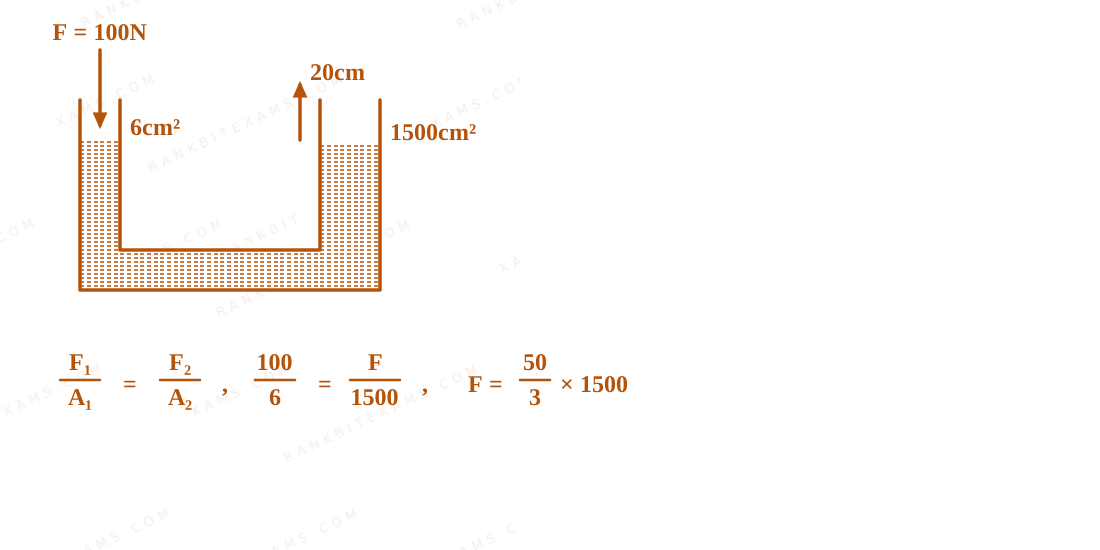
In a hydraulic lift, the surface area of the input piston is 6mathrmcm^2 and that of the output piston is 1500mathrmcm^2 . If 100mathrmN force is applied to the input piston to raise the output piston by 20mathrmcm , then the work done is ________ kJ. [cite: 1, 2]

Numerical Answer Type:
Enter a numerical value Answer: 5 to 5 +4 marks

Solution & Explanation

### Related Formula W = F_1 cdot s_1 = F_2 cdot s_2 ### Core Logic By conservation of liquid volume displacement during output piston elevation : A_1 cdot s_1 = A_2 cdot s_2 implies 6 cdot s_1 = 1500 cdot 20 implies s_1 = 5000text cm = 50text m Work performed on input boundary matches : W = F_1 cdot s_1 = 100text N cdot 50text m = 5000text J = 5text kJ Alternatively via output force profile calculation:
Hydraulic lift work diagram allocation
F_2 = F_1 fracA_2A_1 = 100 frac15006 = 25000text N W = F_2 cdot s_2 = 25000 cdot 0.2 = 5000text J = 5text kJ ### Chapter Mix Class 11 Physics: Mechanical Properties of Fluids

Reference Study Guides

More Mechanical Properties of Fluids Previous-Year Questions

Q4 2025 Surface Tension and Surface Energy
Two water drops each of radius r coalesce to form a bigger drop. If T is the surface tension, the surface energy released in this process is:
  • A. 4pi r^2 T left[2 - 2^frac23right]
  • B. 4pi r^2 T left[2 - 2^frac13right]
  • C. 4pi r^2 T left[1 + sqrt2right]
  • D. 4pi r^2 T left[sqrt2 - 1right]

Solution

### Related Formula 1. Surface Energy: U = T cdot A = T cdot (4pi R^2) 2. Conservation of Volume during coalescence of drops: 2 times left(frac43pi r^3right) = frac43pi R^3 ### Core Logic When two drops of radius r coalesce into a single larger drop of radius R, volume is conserved: R^3 = 2r^3 implies R = 2^1/3 r - Initial surface area of the two separate drops: A_i = 2 times 4pi r^2 = 8pi r^2 - Final surface area of the combined single drop: A_f = 4pi R^2 = 4pi (2^1/3 r)^2 = 4pi r^2 2^2/3 - Surface energy released: Delta E = U_i - U_f = T(A_i - A_f) Delta E = T left( 8pi r^2 - 4pi r^2 2^2/3 right) = 4pi r^2 T left[ 2 - 2^2/3 right] ### Pattern Recognition Sees: Coalescence of N identical drops. Trap: Forgetting to conserve volume first, or confusing initial and final surface areas. Shortcut: Energy released when N drops coalesce into one big drop is: Delta E = 4pi r^2 T left[ N - N^2/3 right] Here, substituting N = 2 directly gives 4pi r^2 T left[ 2 - 2^2/3 right]. ### Evaluation Rubric / Model Answer null ### Chapter Mix Class 11 Physics: Mechanical Properties of Fluids
Q21 2025 Hydrostatic Pressure
A vessel with square cross-section and height of 6mathrm~m is vertically partitioned. A small window of 100mathrm~cm^2 with hinged door is fitted at a depth of 3mathrm~m in the partition wall. One part of the vessel is filled completely with water and the other side is filled with the liquid having density 1.5times 10^3mathrm~kg/m^3. What force one needs to apply on the hinged door so that it does not get opened? (Acceleration due to gravity = 10mathrm~m/s^2)
Numerical Answer. Answer: 150 to 150

Solution

### Related Formula P = P_0 + rho g h F = Delta P cdot A ### Core Logic Let's analyze the pressure acting on the window at depth h = 3mathrm~m from both sides: - Water side (density rho_w = 1.0 times 10^3mathrm~kg/m^3): P_w = P_0 + rho_w g h - Denser liquid side (density rho_l = 1.5 times 10^3mathrm~kg/m^3): P_l = P_0 + rho_l g h The net pressure difference pushing on the window is: Delta P = P_l - P_w = (rho_l - rho_w) g h Delta P = (1.5 times 10^3 - 1.0 times 10^3) times 10 times 3 = 500 times 30 = 15000mathrm~N/m^2 The window has area A = 100mathrm~cm^2 = 100 times 10^-4mathrm~m^2 = 10^-2mathrm~m^2. To keep the door from opening, we must apply a force balancing the pressure difference: F = Delta P cdot A = 15000 times 10^-2 = 150mathrm~N ### Step 1: Final Conclusion The required force is 150\mathrm{~N}. ### Pattern Recognition For a vertical interface between two fluids, the net pressure difference is simply given by \Delta P = \Delta \rho \cdot g h. The ambient atmospheric pressure P_0$ cancels out since it acts on both sides of the window. ### Evaluation Rubric / Model Answer null ### Chapter Mix Class 11 Physics: Mechanical Properties of Fluids
Q 2025 Work Done by Gravity in Connecting Vessels
Two cylindrical vessels of equal cross sectional area of 2mathrm~m^2 contain water upto height 10mathrm~m and 6mathrm~m, respectively. If the vessels are connected at their bottom then the work done by the force of gravity is : (Density of water is 10^3mathrm~kg/m^3 and g=10mathrm~m/s^2)
  • A. 1 times 10^5mathrm~J
  • B. 4 times 10^4mathrm~J
  • C. 6 times 10^4mathrm~J
  • D. 8 times 10^4mathrm~J

Solution

### Related Formula The gravitational potential energy U of a liquid column of mass m and height h is evaluated relative to its bottom by placing its total mass at its center of mass (h/2): U = m g left(frach2right) = (rho A h) g left(frach2right) = frac12 rho A g h^2 Work done by the force of gravity (W) equals the negative change in potential energy: W = -Delta U = U_i - U_f ### Core Logic Since the vessels are identical and connected at the bottom, water flows from the higher column to the lower one until their final heights equalize at: h_f = frac10 + 62 = 8mathrm~m ### Step 1: Calculate Initial Potential Energy (U_i) Let the reference level U=0 be at the bottom: U_i = U_1 + U_2 = frac12 rho A g h_1^2 + frac12 rho A g h_2^2 U_i = frac12 rho A g left(10^2 + 6^2right) = frac12 rho A g (100 + 36) = 68 rho A g
Work Done by Gravity in Connecting Vessels
### Step 2: Calculate Final Potential Energy (U_f) Both vessels equalize to h_f = 8mathrm~m: U_f = 2 times left[ frac12 rho A g h_f^2 right] = rho A g (8^2) = 64 rho A g ### Step 3: Work Done by Gravity (W) W = U_i - U_f = 68 rho A g - 64 rho A g = 4 rho A g Substitute the given values ( ho = 10^3mathrm~kg/m^3, A = 2mathrm~m^2, g = 10mathrm~m/s^2): W = 4 times 10^3 times 2 times 10 = 8 times 10^4mathrm~J ### Pattern Recognition For leveling liquids between two identical connected columns, the shift in center of mass always simplifies. The loss in potential energy is given by \Delta U = \frac{1}{4} \rho A g (h_1 - h_2)^2. Applying this directly: Delta U = frac14 times 10^3 times 2 times 10 times (10 - 6)^2 = 5000 times 16 = 8 times 10^4mathrm~J$ ### Evaluation Rubric / Model Answer null ### Chapter Mix Class 11 Physics: Mechanical Properties of Fluids
Q12 2025 Viscosity and Terminal Velocity
A solid steel ball of diameter 3.6mathrm~mm acquired terminal velocity 2.45times10^-2mathrm~m/s while falling under gravity through an oil of density 925mathrm~kg~m^-3. Take density of steel as 7825mathrm~kg~m^-3 and g as 9.8mathrm~m/s^2. The viscosity of the oil in SI unit is :
  • A. 2.18
  • B. 2.38
  • C. 1.68
  • D. 1.99

Solution

### Related Formula Terminal velocity v_t of a spherical body falling through a viscous fluid is given by Stokes' Law: v_t = frac29 fracr^2 g (rho_textbody - rho_textfluid)eta Hence, the viscosity coefficient eta is: eta = frac29 fracr^2 g (rho_textbody - rho_textfluid)v_t ### Core Logic Given parameters: - Diameter d = 3.6mathrm~mm Rightarrow radius r = 1.8mathrm~mm = 1.8 times 10^-3mathrm~m - Terminal velocity v_t = 2.45 times 10^-2mathrm~m/s - Liquid density rho_textfluid = 925mathrm~kg/m^3 - Steel density rho_textbody = 7825mathrm~kg/m^3 - Acceleration due to gravity g = 9.8mathrm~m/s^2 ### Step 1: Substitute parameters into formula eta = frac29 times frac(1.8 times 10^-3)^2 times 9.8 times (7825 - 925)2.45 times 10^-2 eta = frac29 times frac3.24 times 10^-6 times 9.8 times 69002.45 times 10^-2 ### Step 2: Solve the numeric calculation eta = frac2 times 0.36 times 10^-6 times 9.8 times 69002.45 times 10^-2 eta = frac0.72 times 9.8 times 6900 times 10^-62.45 times 10^-2 eta = frac48700.8 times 10^-62.45 times 10^-2 = frac0.04870080.0245 approx 1.99mathrm~Pacdot s ### Pattern Recognition Be careful when converting diameter to radius (r = d/2$). Always ensure all numerical parameters are converted cleanly to SI base units (meters, kilograms, seconds) before applying Stokes' formula. ### Evaluation Rubric / Model Answer null ### Chapter Mix Class 11 Physics: Mechanical Properties of Fluids
Q22 2025 Excess Pressure in Soap Bubbles
The excess pressure inside a soap bubble A in air is half the excess pressure inside another soap bubble B in air. If the volume of the bubble A is n times the volume of the bubble B, then the value of n is ________.
Numerical Answer. Answer: 8 to 8

Solution

### Related Formula Excess pressure inside a soap bubble in air (which has two liquid-gas interfaces) is given by: Delta P = frac4TR Rightarrow R propto frac1Delta P The volume V of a spherical bubble of radius R is: V = frac43pi R^3 Rightarrow V propto R^3 propto left(frac1Delta Pright)^3 ### Core Logic Given state: Delta P_A = frac12 Delta P_B Rightarrow fracDelta P_BDelta P_A = 2 ### Step 1: Calculate the ratio of radii fracR_AR_B = fracDelta P_BDelta P_A = 2 ### Step 2: Calculate volume scaling parameter (n) V_A = n V_B Rightarrow n = fracV_AV_B = left(fracR_AR_Bright)^3 = (2)^3 = 8 ### Pattern Recognition Volume scale factors depend on the cube of linear scale factors (V propto R^3). Since radius is inversely proportional to excess pressure, a halving of excess pressure leads to doubling of radius, scaling volume by 2^3 = 8. ### Evaluation Rubric / Model Answer null ### Chapter Mix Class 11 Physics: Mechanical Properties of Fluids

More Mechanical Properties of Fluids Questions — jee_main_2025_29_jan_morning

Practice all Mechanical Properties of Fluids previous-year questions →

YOUR FIRST PREP STEP STARTS HERE

We Map Every Repeating Question in Competitive Exams.

Say goodbye to generic mock test fatigue. RankBit uses smart analysis to group past exam questions into their foundational Repeating Question Types. Find chapter weightage, track repeating questions, and score higher with targeted practice.

Select Your Target Exam

Choose an exam track below to find formulas per chapter and patterns.

Syncing Exam Intelligence

Mapping formulas and patterns across all tracks…

PATH A — FULL LENGTH PRACTICE

Full Mock Test Hub

Simulate real NTA exam conditions with fully tracked mocks. Time yourself against past papers.

Under Development
PATH B — TARGETED PRACTICE

Topic-wise Practice Hub

Practice past-year questions one chapter at a time. Pick an exam → subject → chapter and get every PYQ for that topic — pulled together from all past papers — with the chapter's key formulas alongside.
Loading Questions... Browse Topics
Latest from the Blog
View all →

Loading articles...